WORLD
WORLD
Akongo
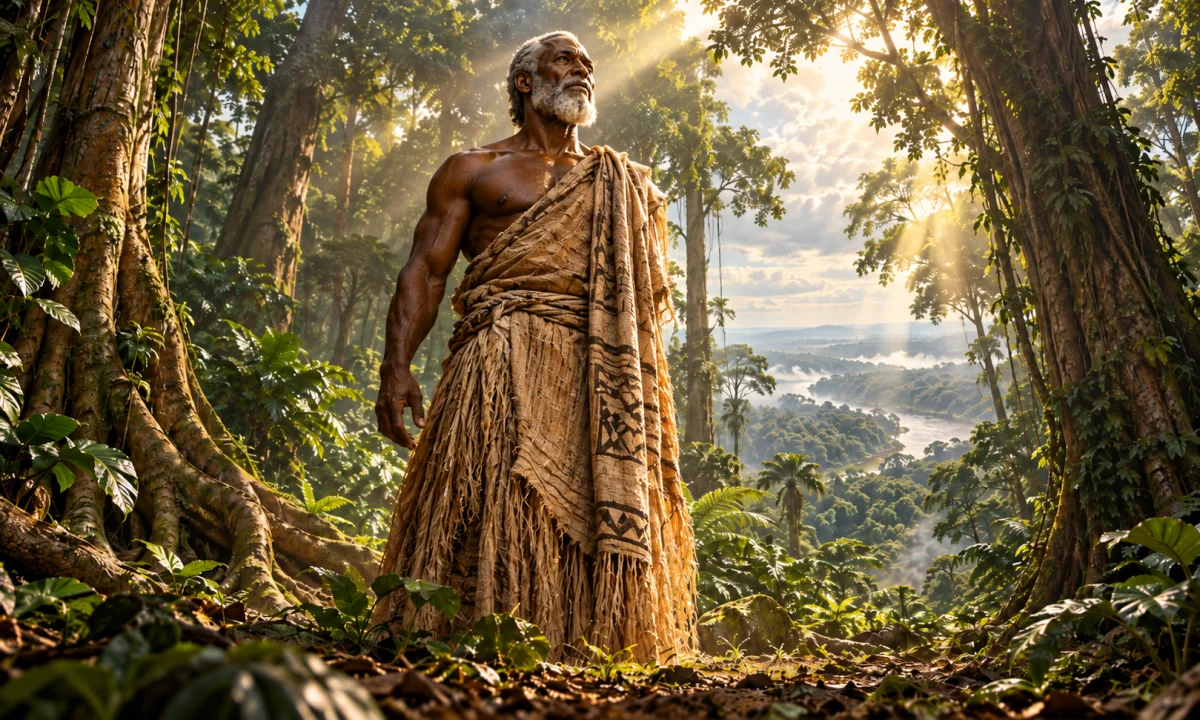
Akongo is a name associated with a supreme creator or high god in traditions reported from parts of the Congo Basin in Central Africa. The name is most often connected with the Ngombe, although some summaries associate it more broadly with neighbouring Bantu-speaking peoples. Because these traditions were transmitted orally and recorded by outsiders in different periods and languages, the identity, spelling and mythology of Akongo are not completely uniform. Akongo should therefore be understood through particular regional traditions rather than as a single, universally defined African deity.
Origins and cultural setting
The Ngombe live chiefly in the northern and northwestern parts of the Democratic Republic of the Congo, in a region shaped by the Congo River and its tributaries. Their cultural world includes farming, fishing, hunting, village life and extensive knowledge of the forest environment. Like many societies in Central Africa, the Ngombe have traditionally understood the visible world as connected with an invisible realm inhabited by powerful beings, ancestors and spirits.
Akongo belongs to the category often called a high god or creator deity. In descriptions of Central African religions, such a being is frequently regarded as the source of the world and of human life, while daily religious attention may be directed more often towards ancestors, local spirits or specialised powers. This distinction is important. A supreme creator is not necessarily worshipped in the same manner as a village spirit or an ancestral presence, and the existence of a high god does not imply a rigid pantheon with a fixed hierarchy.
Information about Akongo comes mainly from oral tradition and from ethnographic reports rather than from a single sacred scripture. Oral traditions can preserve stable themes while allowing differences in wording, emphasis and narrative detail. Early European accounts also translated indigenous concepts into terms such as “god,” “creator” or “spirit,” which may not correspond exactly to the original categories. As a result, brief reference works sometimes present a simplified version of beliefs that were more varied in their original cultural setting.
Name and identity
The spelling Akongo is the form most commonly encountered in English-language discussions of Central African mythology. Other spellings may occur in older publications or in records influenced by local pronunciation and colonial-era orthographies. A spelling variant does not automatically indicate a different deity, but names must be assessed in relation to the people, language and source in which they appear.
There is no secure basis for treating every figure called Akongo in African mythology databases as identical. Some sources use the name specifically for a creator among the Ngombe; others extend it to nearby communities or describe it in general terms as a Bantu high god. These wider identifications may reflect genuine regional connections, but they may also result from the tendency of older comparative works to group distinct traditions together.
The meaning of the name is likewise not securely established in a form that can be applied across all contexts. It is safer to retain the traditional name than to assign it a speculative translation. Akongo is sometimes described simply as the supreme being, creator or father of life, but such titles are interpretive descriptions rather than proof of a single original meaning.
Akongo as creator
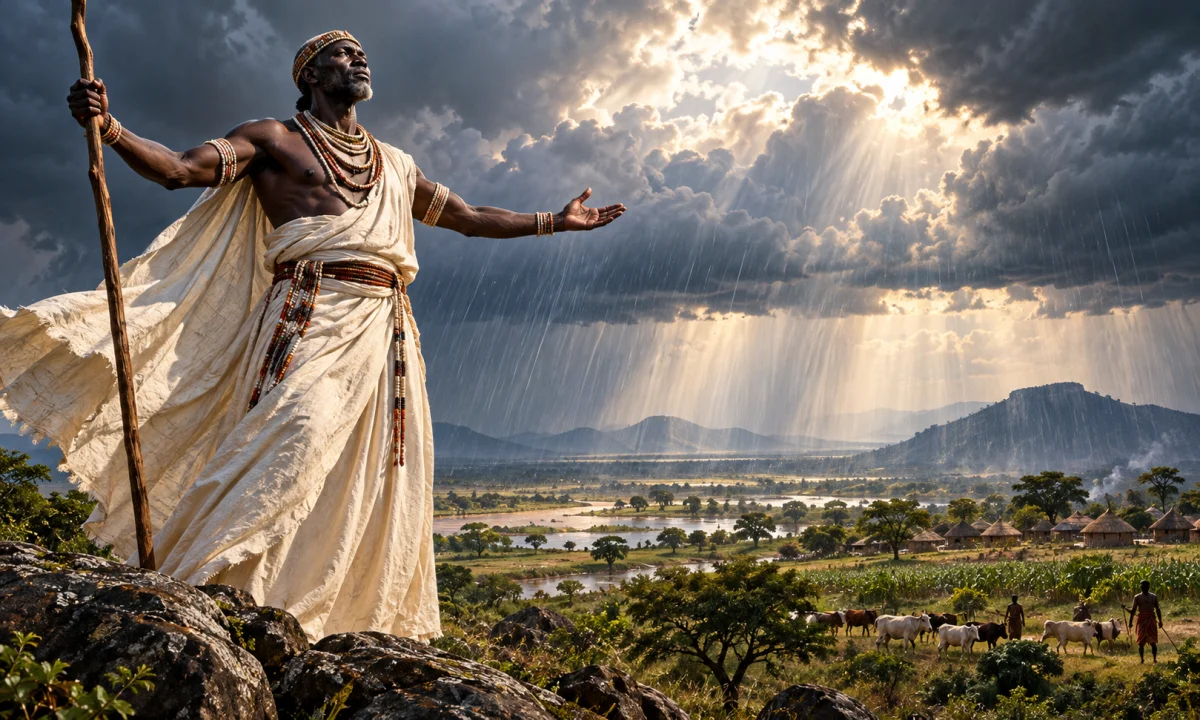
In the traditions most commonly associated with Akongo, the deity is the origin of the ordered world and of human beings. Akongo’s creative role places the figure above ordinary spirits and makes Akongo responsible for the fundamental conditions of existence: the separation or arrangement of the world, the creation of living beings and the establishment of the relationship between humanity and the divine realm.
Accounts of creation involving Akongo are not preserved in one standard narrative. Some retellings state that Akongo created the first people and other living things. Others concentrate less on the mechanics of creation than on the fact that life ultimately depends on the supreme being. Details such as the material from which human beings were formed, the sequence of creation or the names of the first people should not be treated as universal features of Akongo’s mythology.
A recurring theme in reports about high gods of the Congo Basin is withdrawal. The creator is said to have been close to human beings in an earlier age but to have moved away from the world because of human misconduct, disorder or disturbance. Akongo is often presented in this pattern: after creating humanity, the deity becomes remote from ordinary human life. This distance helps explain why a supreme creator may be acknowledged as powerful and original without receiving the same everyday attention given to ancestors and local spiritual forces.
The withdrawal motif should not be reduced to a single moral lesson. It can express several ideas at once: the separation between the sacred and the human worlds, the difficulty of communicating directly with the creator, and the perceived disorder of present human existence. In some versions, human behaviour is responsible for the separation; in others, the narrative simply describes a transition from a primordial age of closeness to the current world.
Attributes and powers
Akongo is generally described as a creator, a source of life and a supreme spiritual authority. The figure is not usually represented with the detailed physical appearance associated with a human-shaped god in classical Mediterranean mythology. Descriptions tend to focus on function and status rather than on clothing, weapons, family relationships or a fixed visual form.
As a high god, Akongo may be associated with the sky or with a realm above the ordinary world. This association is common in accounts of Central African creator beings, but it does not necessarily mean that Akongo is simply a sky god in the narrow sense. The sky can signify remoteness, power, immortality and the divine origin of rain and life. Where a source places Akongo in the heavens, the statement should be read within that broader symbolic context.
Some popular summaries attribute control over rain, fertility, moral order or human destiny to Akongo. These associations are plausible for a creator deity, but they are not equally well documented in every account. There is a difference between a general theological inference and a specific traditional attribute. Akongo’s securely repeated characteristics are the role of supreme creator and the relationship between creation and divine withdrawal; more elaborate lists of powers require caution.
Nor should Akongo automatically be described as a “god of” one particular natural object or human activity. A creator may stand above specialised functions rather than governing a single domain. The evidence does not support presenting Akongo as a war god, love god, trickster or ruler of the dead unless a particular regional tradition clearly uses that role.
Stories and recurring themes
Creation and separation
The central narrative pattern connected with Akongo is the creation of humanity followed by separation. In a primordial period, the creator is close enough to the first people for a direct relationship to exist. Human beings then fail to maintain the proper relationship through disobedience, conflict, noise or another form of disorder, depending on the version. Akongo retreats to a distant divine realm, leaving people to live in a world where direct access to the creator is no longer normal.
This narrative belongs to a broad family of “withdrawn creator” traditions found in many parts of Africa, but similarities do not prove that all such stories share one origin. Comparable themes can arise because communities use stories of divine distance to explain mortality, suffering, ritual mediation or the apparent silence of the supreme being. Akongo’s story must remain connected to the Ngombe and neighbouring Central African contexts in which it was recorded.
Human responsibility
When human behaviour causes or contributes to Akongo’s withdrawal, the story gives creation a moral dimension. Human beings are not merely passive inhabitants of a world made by the deity; they are participants in a relationship that can be damaged. Disobedience and social disorder become explanations for the distance between the human community and the creator.
It would be misleading, however, to turn the story into a fully developed doctrine of “original sin.” That Christian theological term carries meanings that do not automatically belong to Ngombe religious thought. The traditional narrative is better understood as an account of broken primordial closeness and the consequences of human conduct. Its emphasis may be social and relational rather than focused on inherited guilt.
Relationships with other spiritual beings
Available descriptions do not provide a consistent, detailed family tree for Akongo. The deity is sometimes called the father or source of other spiritual beings in broad summaries, but the exact status of such beings varies between accounts. It is therefore preferable to speak of Akongo’s supremacy or creative priority rather than inventing a fixed divine genealogy.
Akongo’s remoteness also helps clarify the importance of other forms of religious practice. Ancestors can remain connected to living descendants through memory, lineage and ritual, while local spirits may be associated with forests, rivers, animals, places or particular dangers. These beings are not simply “lesser gods” in every traditional system. They belong to different relationships and spheres of religious experience.
In a society where the supreme creator is distant, ritual specialists, elders and family authorities may have an important role in maintaining proper relations with the unseen world. Yet the available general accounts do not justify assigning one standard priesthood, temple system or set of sacrifices specifically to Akongo. Practices would have depended on community, period and local religious tradition.
Cultural significance
Akongo represents a way of thinking about origins, order and the distance between humanity and the sacred. The creator’s remoteness does not make the deity irrelevant. Instead, it places Akongo at the deepest level of explanation: the world exists because of the creator, even though everyday religious life may be organised around more immediate spiritual relationships.
The figure also illustrates why the category “African mythology” can be misleading when used as though it described one unified religion. Africa contains thousands of peoples, languages and historical traditions. A creator name recorded in one part of the Congo Basin should not be turned into a continent-wide equivalent of a single universal god. Similar ideas—such as a supreme creator, a sky realm or divine withdrawal—appear in different cultures, but their meanings depend on local histories and social structures.
Akongo’s mythology is particularly vulnerable to simplification because it is often represented in short lists of African gods. Such lists may place Akongo beside figures from West, East or southern Africa without explaining that these beings belong to unrelated traditions. A respectful account distinguishes the documented Ngombe connection from broader comparisons and marks uncertainty where the evidence is limited.
Distinguishing Akongo from similar names
Akongo should not automatically be identified with Nzambi, a name associated with the supreme creator in Kongo religious traditions, or with Nyambe, a creator figure known from parts of south-central Africa. These beings may share the broad category of high god, but they belong to different cultural and linguistic settings. Nor should Akongo be merged with Bumba, the creator figure of the Kuba-related Bushongo tradition, whose creation narratives have their own characters and structure.
Names that resemble Akongo in spelling may also refer to people, places or other spiritual figures in different African languages. A similar-looking word is not sufficient evidence of identity or common origin. Proper comparison requires attention to the community that uses the name, the language involved and the source’s description of the figure.
Sources and modern reception
Because Akongo’s tradition was transmitted orally, there is no single canonical text that fixes every detail. Ethnographic records, linguistic observations and later reference works preserve fragments and interpretations, but each must be read in its historical context. Older records may use outdated names for communities, classify local religious concepts through European categories or combine information gathered from neighbouring peoples.
Akongo has not become a major figure in globally distributed popular culture in the way that Anansi, various Egyptian deities or figures from Greek and Norse mythology have. The name appears mainly in encyclopedic lists, comparative mythology, educational material and occasional discussions of African creator traditions. Modern retellings may give Akongo a detailed appearance, personality or set of powers that is not clearly supported by traditional evidence. Such creative expansions belong to modern interpretation rather than to the documented core of the tradition.
The most careful understanding of Akongo keeps both aspects in view: the deity’s importance as a creator and high god in traditions associated especially with the Ngombe, and the limits of the surviving record. Akongo is not a character with one universally fixed biography, but a culturally situated name whose meaning depends on the community, language and account in which it appears.