WORLD
WORLD
Aeolus
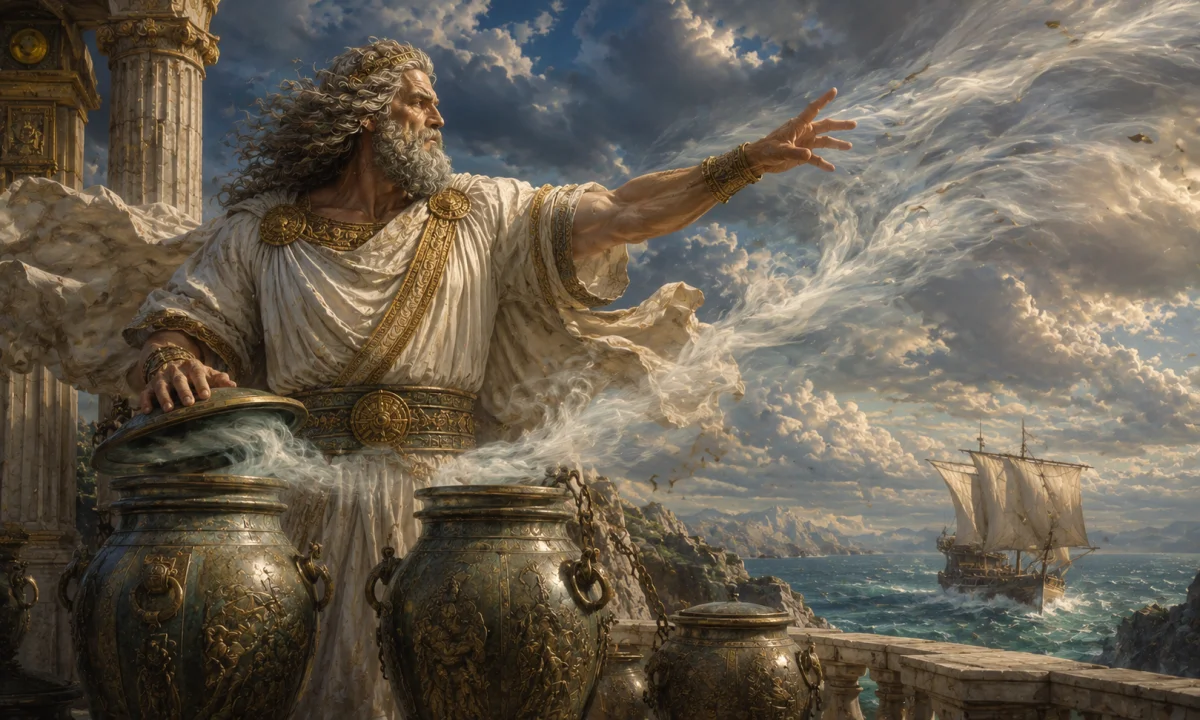
Aeolus is a name associated with the winds in Greek mythology, but it does not belong to only one figure. In the Odyssey, Aeolus is a powerful ruler who keeps the winds under control on the floating island of Aeolia. Later Greek and Roman writers increasingly present him as the divine master or guardian of the winds. Other mythological figures named Aeolus include a son of Hellen and an ancestor of several heroic peoples. These figures are related by name and tradition, but they should not automatically be treated as the same being.
Origins and cultural setting
Wind was a major force in the religious imagination of ancient Greece. Sailors depended on favourable winds, farmers watched seasonal changes in the air, and sudden storms could transform a voyage or destroy a harvest. Greek mythology therefore gave the winds personal names, genealogies and recognizable personalities. The principal directional winds were the Anemoi: Boreas from the north, Notus from the south, Eurus from the east or southeast, and Zephyrus from the west. Other winds also appear in ancient sources.
Aeolus occupies a different position from these named winds. He is generally not one of the Anemoi themselves. Instead, in the most influential early account, he is the ruler or keeper who can release, restrain or contain them. This role reflects an important distinction in Greek thought between a natural force and the figure who governs it. Aeolus is associated with wind because he controls the winds, not necessarily because he is identical with the moving air.
The earliest substantial surviving narrative about him appears in Book 10 of Homer's Odyssey. Homer describes Aeolus as the son of Hippotes and as a figure who is “dear to the immortal gods.” The poem does not clearly call him one of the Olympian gods. He appears instead as a privileged ruler with extraordinary authority over the winds and a close relationship with the divine order.
The name Aeolus and the problem of identity
The Greek name is Aiolos (Αἴολος), rendered in Latin and English as Aeolus. Its meaning and historical development are not entirely certain. It is often connected with a Greek adjective meaning something like “quick-moving,” “changeable” or “variegated,” qualities that suit shifting winds. The exact etymology, however, should not be treated as completely established.
Ancient myth preserves several figures named Aeolus. The most important distinctions are these:
- Aeolus, son of Hippotes: the ruler of the winds in the Odyssey, later transformed in many retellings into a wind god or divine keeper.
- Aeolus, son of Hellen: a legendary ancestor of the Aeolians and one of the sons of Hellen, the mythical ancestor of the Greek people.
- Aeolus, son of Poseidon and Arne: a figure appearing in later mythographic traditions, sometimes linked with the foundation of settlements and with the previous Aeolus through complicated genealogies.
These versions overlap in later genealogical writing, and ancient authors did not always organize them consistently. The Aeolus who receives Odysseus is usually distinguished from the son of Hellen, although later traditions may connect the wind-keeper to the Aeolian people or place both figures within related family trees.
Aeolus in the Odyssey
Odysseus reaches Aeolia after leaving the land of the Cyclopes. The island is described as floating, surrounded by a bronze wall and sheer cliffs. The image places Aeolia outside ordinary geography and gives it the character of a sealed, otherworldly domain. Aeolus lives there with his wife and their twelve children, six sons and six daughters. The sons and daughters are married to one another, forming a closed household under Aeolus's authority.
The unusual family arrangement is part of the poem's depiction of Aeolus as a ruler whose household is orderly, enclosed and separate from the wider human world. It should not be read as evidence for a general Greek marriage custom. Rather, it marks Aeolia as a strange and exceptional place within the voyage narrative.
Aeolus welcomes Odysseus and his companions for a month. When Odysseus finally asks for help continuing his journey to Ithaca, Aeolus gathers the dangerous winds and confines them in a bag made from the hide of an ox. He leaves only the west wind, Zephyrus, free to blow the ships towards home. The gift is not simply a container of “wind” in the singular; it represents the controlled release of several competing atmospheric forces.
For nine days the voyage goes well. Ithaca comes within sight, but Odysseus, exhausted, falls asleep. His crew, believing that the bag contains valuable treasure, opens it. The winds rush out, driving the ships back towards Aeolia. Odysseus returns to Aeolus and asks for assistance once more.
This time Aeolus refuses. He concludes that a person pursued by such misfortune must be hated by the gods and says that he cannot help someone whom the divine powers appear to oppose. The refusal is significant: Aeolus has the power to manage the winds, but he does not claim unlimited power over fate. His control is conditional, and he interprets Odysseus's disaster within the broader logic of divine favour and punishment.
The episode explores several recurring themes in the Odyssey: the danger of suspicion among companions, the consequences of failing to respect a gift, the narrow distance between success and disaster, and the limits of human control. Odysseus is nearly home, yet a single act by his crew destroys the voyage. Aeolus's island becomes a place where order has been established, but where that order can be broken through curiosity and mistrust.
Aeolia and the geography of the winds
The location of Homer's Aeolia is uncertain. Later writers and commentators associated it with islands in the western Mediterranean, especially the Lipari Islands north of Sicily. The island of Lipara was known in antiquity for volcanic activity, and its unusual landscape may have encouraged associations with divine or subterranean forces. Some ancient traditions connected the region with Hephaestus and the forge of the gods as well as with Aeolus.
There is no secure evidence that Homer's floating Aeolia was intended to be identical with a specific historical island. The poem's geography combines recognizable maritime routes with extraordinary places such as the land of the Cyclopes and the realm of Circe. Attempts to map every location precisely are therefore speculative. The association with the Lipari Islands is historically influential, but it remains an interpretation rather than a proven identification.
The idea of a floating island also emphasizes Aeolus's separation from ordinary political geography. He is not merely a local king on a known coast. His domain is a controlled environment in which the winds are treated almost like living or captive beings.
Attributes and powers
Aeolus's defining power is command over the winds. In the Homeric narrative he can gather them, restrain them and release a selected wind for a particular purpose. He is therefore a guardian of atmospheric order. His authority resembles that of a custodian or master of forces rather than that of a warrior god.
Unlike many Greek gods, Aeolus has no consistently fixed physical appearance in the surviving tradition. He is normally imagined as a human ruler or divine-looking king rather than as a creature with a standard monstrous form. Artists and later storytellers may give him a cloak, a sceptre, a crown or a vessel containing the winds, but these are conventional visual choices rather than details securely established by the earliest myth.
The famous bag of winds is also primarily a literary object. It symbolizes containment: unpredictable forces are made portable and temporarily subject to human plans. The episode does not establish a universal Greek belief that winds were always stored in bags. It is part of Homer's imaginative storytelling, later expanded by artistic and literary tradition.
Aeolus is often represented as impartial or conditional rather than simply benevolent. He helps Odysseus generously at first, but he withdraws his aid after the gift is misused and after he interprets the hero's continuing misfortune as divinely determined. His behaviour reflects the importance of hospitality in Greek epic while also showing that hospitality has limits.
The Anemoi and other wind beings
Aeolus should be distinguished from the individual wind gods known as the Anemoi. Boreas is the north wind, associated with cold weather and violent force. Zephyrus is the west wind, often represented as gentler and linked with spring or favourable sailing. Notus is the south wind, commonly associated with storms and late-summer weather. Eurus is an eastern or southeastern wind whose direction and character vary somewhat between sources.
In the Odyssey, Zephyrus is the wind left free to carry Odysseus towards Ithaca, while the other winds are confined. Aeolus is therefore not simply another name for Zephyrus or for all winds collectively. He stands above the winds in the narrative's hierarchy.
Greek authors sometimes personified winds in different ways, and the boundaries between god, spirit, natural power and poetic metaphor were not rigid. Local religious practice could give a wind particular importance, while poets could use the same wind as a character in a story. This variety helps explain why later writers sometimes describe Aeolus as a god, even though Homer's presentation is more ambiguous.
Later Greek and Roman developments
Over time, Aeolus became more clearly identified as the divine ruler of the winds. In later Greek mythography, his genealogy and status were reorganized, sometimes linking him with divine ancestry or with the legendary Aeolian peoples. Such accounts do not form one uniform canonical version. They show how ancient writers attempted to reconcile figures and traditions that had developed in different places and periods.
Roman literature gave Aeolus an important role in Virgil's Aeneid. At the beginning of the poem, Juno asks Aeolus to release the winds against the fleet of Aeneas. Aeolus opens the mountain or cavern where the winds are held, and the storm scatters the Trojan ships. In return, Juno offers him Deiopea, a beautiful nymph, as a bride.
Virgil's version is closely related to the Homeric episode but is not identical to it. Aeolus is presented as a powerful ruler of the winds, and the winds are enclosed in a cavern rather than described only through Homer's distinctive bag. The Roman poem also makes him an instrument in the conflict between Juno and Aeneas. This shift places Aeolus within a specifically Roman epic framework and gives him a more overtly divine and cosmic role.
Later authors, commentators and artists often blended Homer's island, Virgil's cavern and other ideas about subterranean or maritime wind powers. The result is the familiar image of Aeolus as an old king or god standing beside a cave or vessel from which the winds emerge. That image is traditional in a broad sense, but it draws from several layers of literature rather than from one complete ancient biography.
The other Aeolus figures
Aeolus, son of Hellen
In Greek genealogical myth, Hellen is the ancestor whose name is connected with the Hellenes, or Greeks. His son Aeolus is commonly described as the ancestor of the Aeolians, one of the major Greek-speaking groups of the ancient world. This Aeolus belongs to a different type of myth: he is an eponymous ancestor, meaning that his name explains the identity of a people.
Traditions vary concerning his descendants. Some accounts make him the father of Cretheus, Sisyphus, Athamas, Salmoneus, Perieres and Canace, while other genealogies differ in their arrangement or include additional figures. These relationships are part of complex mythographic family trees and should not be confused with the household of the wind-keeper in the Odyssey.
Aeolus, son of Poseidon
A third Aeolus is described in some later traditions as the son of Poseidon and Arne. He is associated with Melanippe, also called Arne in certain accounts, and with the foundation or naming of settlements in southern Italy. This tradition belongs to the extensive cycle of myths concerning migrations, colonization and the origins of Greek communities in the western Mediterranean.
The existence of several figures with the same name illustrates how Greek myth was assembled from local legends, poetic genealogies and attempts to explain ethnic names. A shared name does not prove that all these Aeoli were originally one character. In many cases, later authors connected separate traditions because their names or associations seemed to invite a relationship.
Religious and symbolic significance
Aeolus reflects the ancient Mediterranean experience of dependence on the sea and the weather. A sailor could prepare a ship, choose a route and read the sky, yet remain vulnerable to forces beyond human control. In the Homeric story, the winds are not random background scenery. They have been organized by a ruler, but they can still produce catastrophe when released at the wrong moment.
His story also gives mythic form to the idea that knowledge and power require restraint. Odysseus's crew does not understand the object they have been entrusted with, and their suspicion leads them to open it. The disaster is caused not by a lack of power but by a failure of trust and discipline. Aeolus's role as keeper makes him a figure of boundaries: some forces may be managed, but they must not be treated carelessly.
There is limited evidence for a single, widespread cult of Aeolus comparable to the cults of Zeus, Athena or Apollo. His importance is primarily literary and mythological in the surviving record. This does not mean that winds lacked religious significance. The Anemoi received local honours in some places, and wind powers could be incorporated into temples, rituals and civic symbolism. Aeolus himself, however, is best understood as a mythic ruler whose profile was shaped especially by epic poetry.
Reception in art and popular culture
Aeolus continued to appear in medieval, Renaissance and early modern representations of the winds. Artists often portrayed him as a bearded man emerging from or guarding a cave, while small winged figures or puffing faces represented the winds under his command. These images frequently combine classical literary descriptions with broader artistic conventions for depicting weather.
In modern popular culture, Aeolus may appear in fantasy novels, films, games and children's adaptations as a literal wind god, a magical king or the owner of a bag containing storms. Such portrayals usually simplify the ancient material by treating the Homeric wind-keeper, the Roman ruler of a cavern and the various genealogical Aeoli as one character. That simplification can be useful for storytelling, but it is not a complete representation of the ancient traditions.
The most enduring image remains the keeper of the winds: a powerful figure who can release a favourable breeze, imprison destructive air and decide whether a traveller deserves further assistance. In the oldest surviving narrative, however, Aeolus is more ambiguous than a straightforward weather deity. He is a privileged ruler at the boundary between human and divine worlds, and his authority is exercised within the larger limits imposed by fate, the gods and the fragile conduct of mortals.