WORLD

Aurai
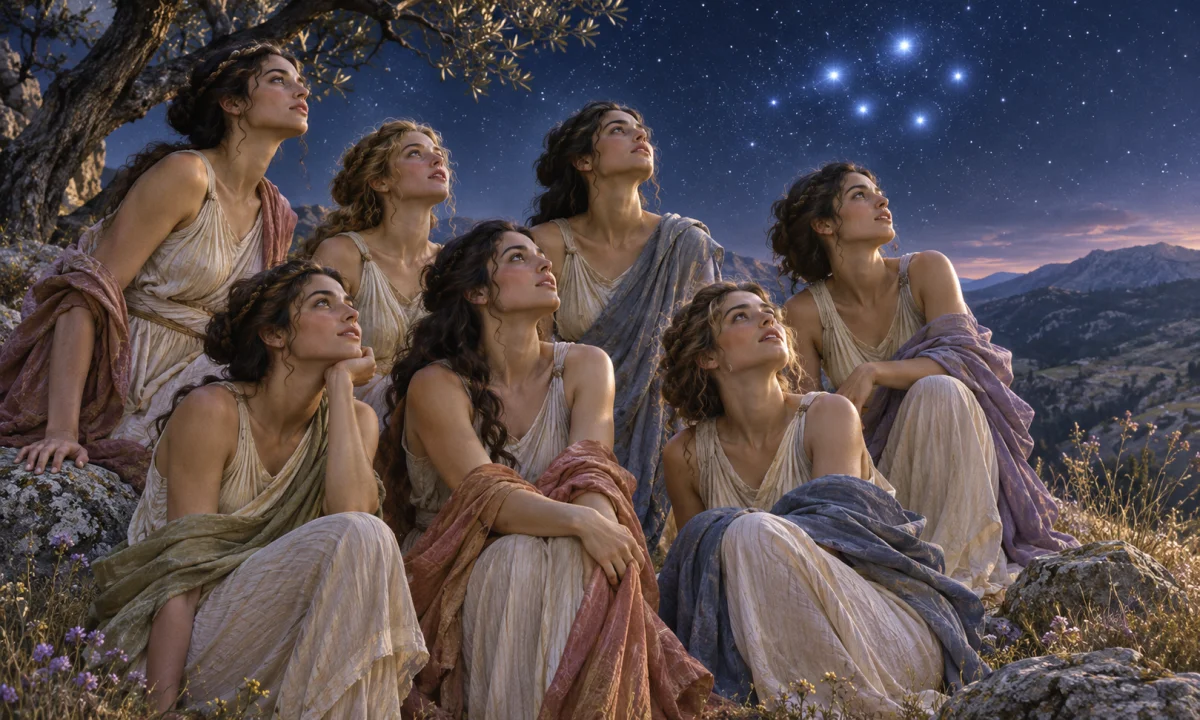
Aurai (singular Aura; Greek Αὔραι and Αὔρα) are the personified breezes of Greek mythology. They belong to the broad family of minor nature divinities associated with the movement and qualities of the natural world. Unlike the better-known Anemoi, who represent the directional winds, the Aurai are generally understood as light airs, refreshing breezes or currents of atmosphere. Their identity is not completely fixed across ancient sources, and the name can refer either to a collective group of breeze spirits or, in later literary mythology, to an individual nymph named Aura.
Origins and cultural setting
Greek religious imagination often treated natural forces as both physical realities and divine presences. Rivers, springs, mountains, forests, winds and particular places could possess a supernatural personality without belonging to a single, rigidly organized pantheon. The Aurai fit this pattern. They are not major Olympian gods with a standardized cult, genealogy and mythology, but minor female nature beings whose presence is suggested by the Greek understanding of air and wind.
The Greek noun aura means a breeze, breath of air or moving current. It could describe a pleasant wind, particularly one experienced as cool or refreshing, but it was also capable of poetic and religious personification. The plural Aurai therefore means, in a straightforward sense, “breezes.” Translators may render the beings as breeze nymphs, air spirits or personified breezes, although none of these English terms captures every use of the Greek word.
Greek religion had several overlapping groups of beings connected with air and wind. The Anemoi were the named winds, especially Boreas from the north, Notus from the south, Eurus from the east and Zephyrus from the west. The Harpies were storm-associated female beings in certain traditions, while the Nephelai were cloud nymphs. The Aurai occupied a less sharply defined place. They were associated with the air in motion, but they were not normally arranged as a directional wind system or given a fixed set of individual names.
Ancient sources and uncertain classification
Evidence for the Aurai is scattered through Greek poetry and later mythographic writing rather than concentrated in one foundational narrative. Ancient authors could use the word as a poetic personification of breezes without intending to describe a fully independent race of supernatural beings. In other contexts, an Aura appears as an individual female figure with her own story.
This variation is important. The collective Aurai should not automatically be treated as a clearly defined sisterhood with a universally accepted genealogy. Some traditions connect breeze nymphs with the vast family of nature spirits descended from Oceanus and Tethys, just as many rivers, springs and other water-related beings were placed within an Oceanid framework. Other literary passages do not provide a genealogy at all. The surviving evidence does not establish one uncontested origin for every being called an Aura or Aurae.
The word also appears in different literary and religious contexts. A poet might address the breezes as living presences that carry fragrance, cool the air or move through a sacred landscape. A later mythographer might turn the name Aura into the proper name of a single nymph. These uses are related through language and symbolism, but they are not necessarily descriptions of one identical character.
Name and identity
Aura is the singular form, while Aurai is the plural. The Greek word is related to the idea of air in motion rather than to a specific wind direction. It should not be confused with the modern English word “aura,” which usually means an atmosphere surrounding a person or place, a distinctive quality, or, in some contexts, a sensory warning before a seizure or migraine. The modern word ultimately has a classical connection, but its common meanings are not a direct description of the ancient Aurai.
The name can also create confusion because Aura is used for more than one figure in classical literature. In some contexts it is a poetic personification of a breeze. In the Dionysiaca of Nonnus, a late Greek epic, Aura is an individual huntress and nymph whose story is significantly more elaborate than the brief references to the collective Aurai. Treating every ancient use of “Aura” as a reference to that heroine obscures the difference between a general natural force and a particular mythological character.
Attributes and natural symbolism
The Aurai are associated with the gentle movement of air rather than with the destructive force of storms. Their imagined presence belongs to open landscapes, woodland clearings, meadows, hillsides and coastal places where a light wind can be felt. As with many Greek nature spirits, their existence is often conveyed through effects rather than through detailed physical descriptions: leaves stir, garments move, heat is relieved, scents travel and the atmosphere becomes fresh.
Ancient art and literature do not provide a single standard appearance for the Aurai. When represented in visual or poetic imagination, they may be understood as young female spirits, comparable in form to other nymphs. Flowing clothing, loosened hair and garments lifted by the wind are natural symbolic features, but they should not be treated as mandatory attributes established by a canonical Greek tradition.
The breezes could be beneficial, especially when they cooled the body or made travel and outdoor life more pleasant. They could also be unsettling because air is invisible, changeable and difficult to control. A breeze may arrive unexpectedly, carry a scent or sound from a distant place, or alter the conditions of a ritual or journey. The Aurai therefore belong to the same imaginative world as other personifications of forces that are helpful but not entirely predictable.
Their symbolism includes movement, freshness, breath and transition. Air connects places without being confined to any one of them. It passes through forests, over water and across cultivated land. In poetic language, this makes the Aurai suitable images for fleeting sensations and for the boundary between the visible world and the unseen environment surrounding it.
The collective Aurai and other wind beings
The Aurai are sometimes described as nymphs, but this classification should be used with care. “Nymph” is a useful modern category for many minor female nature divinities, yet ancient Greek writers did not always apply the term in a uniform technical way. The Aurai share important characteristics with nymphs: they are feminine, connected with nature and generally less powerful than the great gods. Nevertheless, the sources do not always present them as members of a single formal nymph class.
They are also distinct from the Anemoi. The Anemoi are usually conceived as male wind gods with specific directional identities and, in later art, recognizable attributes. Zephyrus, for example, is the west wind, while Boreas is the north wind. The Aurai do not normally represent north, south, east or west. They evoke breezes as a category, particularly light or gentle currents of air.
They should likewise be distinguished from the Nephelai, the cloud nymphs. Clouds and breezes naturally appear together in weather imagery, but the two groups represent different aspects of the atmosphere. Nor should the Aurai be merged with the Hesperides, Naiads, Dryads or Nereids merely because all are feminine nature spirits. Greek mythology contains many overlapping classes of minor divinity, but each name carries its own traditional associations.
Aura in the story of the Dionysiaca
The most developed ancient narrative involving an individual Aura occurs in Nonnus’ Dionysiaca, a long Greek poem probably composed in late antiquity. This Aura is not simply a generic breeze. She is presented as a swift, independent and strongly virginal huntress, connected with the wilderness and with the circle of Artemis.
In Nonnus’ account, Aura is the daughter of Lelantus and Periboea. This genealogy belongs to the poem’s particular version and should not be projected backward as the universal origin of all Aurai. Aura’s identity as the daughter of Lelantus is especially appropriate to her character: Lelantus is associated with concealment and movement, while Aura herself is difficult to catch and proud of her physical hardiness.
Aura’s confidence brings her into conflict with Artemis. She compares her own body and endurance with those of the goddess, arguing that Artemis’ appearance is too delicate to represent true athletic strength. The insult is not merely a casual boast. It challenges Artemis in the areas most closely associated with her divine identity: virginity, hunting, physical independence and mastery of the wild.
Artemis is angered by the comparison. In the poem’s elaborate sequence of divine revenge, Nemesis becomes involved, and Aura is made to suffer the kind of desire that she had previously rejected. Dionysus becomes enamoured of her, while Aura herself is not presented as freely choosing an ordinary romantic relationship. The episode reflects a recurring pattern in ancient myth in which a powerful god pursues a resistant female figure, often with tragic consequences. It should not be read as a simple love story or as evidence that all Aurai were companions of Dionysus.
Dionysus eventually takes Aura while she is vulnerable and unable to consent. She later discovers that she is pregnant with twins. The narrative becomes increasingly violent: Aura, driven into madness and despair, gives birth to the children and kills one of them. The surviving child is associated with Iacchus, a figure linked in different traditions with Dionysus and with the ritual world of Eleusis. The precise relationship between Iacchus and Dionysus varies in ancient religious and literary traditions, so Nonnus’ treatment should not be treated as a universal account of Iacchus’ identity.
At the end of Aura’s story, she is overcome by grief and madness and enters the river Sangarius. Nonnus connects her fate with transformation into a natural feature, generally understood as a spring or watery manifestation. Details of her final transformation and its interpretation depend on how the poem’s mythic language is read. The episode nevertheless returns Aura to the natural world: the huntress who embodied swift movement and untamed wilderness becomes part of the landscape rather than receiving a place among the ruling gods.
Relationship to Artemis and Dionysus
Aura’s connections with Artemis and Dionysus belong specifically to the literary narrative preserved by Nonnus. Artemis represents disciplined virginity, hunting and the ordered mastery of nature. Aura resembles the goddess in these respects but is more defiant and less protected by divine status. Her challenge to Artemis exposes the tension between a mortal or semi-divine wilderness figure and an Olympian goddess who governs the same sphere at a higher level.
Dionysus enters the story as a god of desire, intoxication, transformation and overwhelming natural energy. The contrast between Aura’s austere independence and Dionysus’ pursuit creates the poem’s central conflict. Her association with a breeze does not mean that she is a regular member of the Dionysian retinue, and the myth does not establish the Aurai as a standard group of companions or lovers of Dionysus.
The story also helps explain why the individual Aura should not be casually merged with the collective breeze spirits. Her genealogy, hunting identity, conflict with Artemis, pregnancy and tragic transformation are features of one late literary narrative. They are not attributes consistently assigned to every ancient reference to an Aura or to all Aurai.
Religious and literary significance
The Aurai illustrate the flexibility of Greek divine categories. A breeze could be described physically, invoked poetically or personified as a female spirit. This does not necessarily indicate a separate temple cult or a standardized theology. Greek religious life included major public gods, local divinities, ancestral powers, personified abstractions and spirits of particular natural places. The Aurai belong mainly to the poetic and mythological side of this spectrum, although the absence of extensive surviving evidence does not prove that no local observances ever existed.
Their relative obscurity is also significant. Greek mythology is not limited to the most famous gods and heroes. Many minor beings remain visible only through a name, an epithet or a brief image in poetry. The Aurai represent the ancient tendency to recognize divine presence in ordinary environmental experience: the breath of air on the skin, the motion of leaves and the invisible force that joins distant parts of the landscape.
In later classical reception, aura continued to be useful as a poetic image for a breeze or breath of air. Writers and artists could draw on the classical personification without preserving a fixed mythology for the Aurai. Modern fantasy, games and popular fiction may use “Aura” as a personal name or as a term for an invisible energy, but such uses generally belong to later invention rather than to a continuous ancient tradition. The historically grounded meaning remains that of the breeze personification, alongside the separate late literary figure Aura in the Dionysiaca.