WORLD
WORLD
Apollo
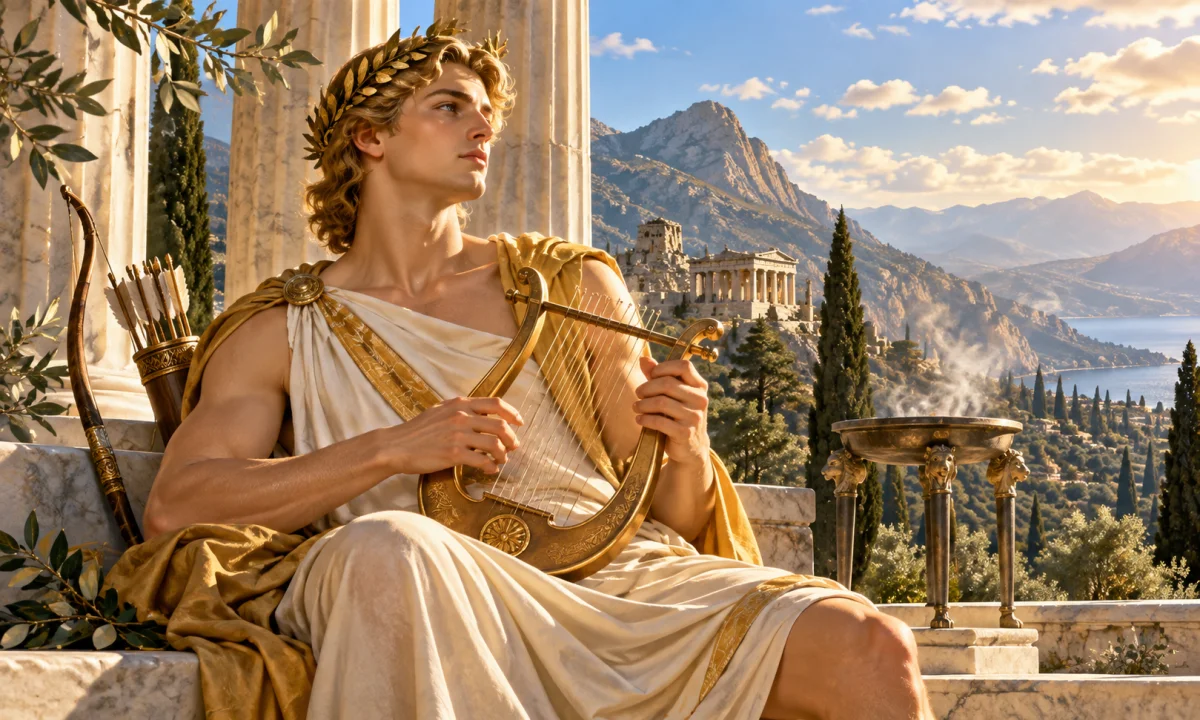
Apollo is one of the most important gods of ancient Greek religion and mythology. He is associated with prophecy, healing, music, poetry, archery, protection from disease, and the ordered movement of life and ritual. In later tradition he became strongly identified with the sun, although the earliest Greek evidence does not make him simply a sun god. Apollo was worshipped throughout the Greek-speaking world and beyond, with major sanctuaries at Delphi, Delos, and Claros. His Roman name was also Apollo, an unusual case in which a Greek god retained his name in Roman religion.
Origins and cultural setting
Apollo belonged to the generation of Olympian gods descended from Zeus and Leto. Ancient Greek religious tradition usually describes him as the twin brother of Artemis, goddess of the hunt and associated with wild places, childbirth, and later the moon. Their birth was traditionally placed on the island of Delos, which became one of Apollo’s most important sacred centres.
The historical origins of Apollo are not fully certain. His name and earliest character do not have a single universally accepted explanation, and scholars have proposed different relationships between Apollo and older Aegean, Anatolian, or Indo-European religious traditions. Apollo appears in the Linear B tablets from the Mycenaean period in a form that may refer to him, although the identification and interpretation of the relevant evidence remain debated. The surviving written descriptions of his myths come mainly from later Greek literary works, including epic poetry, hymns, tragedy, and historical or philosophical writing.
Apollo was not defined by one exclusive function. Greek religion often allowed a god to possess several connected powers, and Apollo’s many roles reflect a broad concern with health, ritual purity, knowledge, harmony, boundaries, and the control of dangerous forces. He could protect a community from plague, but he could also send plague as punishment. He could heal illness, yet his arrows were imagined as a source of sudden death. He represented beauty and order, but myths also show him acting with violence, jealousy, or severe retribution.
Name and identity
The meaning and origin of the name Apollo remain uncertain. Ancient writers sometimes connected it with Greek words or concepts, but these explanations do not establish the original meaning of the name. Modern interpretations have linked Apollo with ideas such as purification, destruction, assembly, or regional religious traditions, but no single explanation is accepted by all scholars.
In Greek, the god could be called Apollon, while Latin uses Apollo. He also had many cult titles, or epithets, that emphasized particular aspects of his power. Apollon Pythios referred to the god of Delphi after his victory over the serpent Python. Apollon Delios identified him with Delos, and Apollon Lykeios was associated with the sanctuary and cult of the Lyceum at Athens and elsewhere. Apollon Smintheus, especially important in the Troad, was connected with mice or disease-bearing rodents, though the precise meaning of the title is debated. Apollon Paian, or Paean, expressed his role as a healer and deliverer from affliction.
These titles do not necessarily describe separate gods. They are local or functional forms of the same divine figure. Apollo’s worship varied from place to place, and one community might emphasize prophecy while another focused on healing, protection, music, or the safeguarding of young people.
Appearance and attributes
Greek artists commonly represented Apollo as a youthful, beardless man with long hair and a harmonious, athletic body. His youthful appearance expressed his enduring vitality rather than a claim that he was literally a child. He might wear a wreath of laurel, carry a bow and quiver, or hold a lyre or kithara. In sculpture and vase painting he is often calm and composed, although other images show him as an active archer or a victorious god.
- The lyre or kithara: These instruments represent music, poetry, and the disciplined ordering of sound. Apollo was leader of the Muses in later tradition and a patron of skilled performance.
- The bow and arrows: His arrows could bring sudden death or disease, while his skill with the bow marked him as a powerful protector and hunter-like figure.
- The laurel: Laurel was sacred to Apollo, especially because of the myth of Daphne. Laurel branches and wreaths were also connected with victory, purification, and the Pythian Games.
- The tripod: The sacred tripod of Delphi symbolized the god’s oracle and the prophetic authority of his sanctuary.
- The raven and swan: These birds appear in some traditions associated with Apollo, though their importance varies according to region and source.
In later art and popular imagination, Apollo is often shown driving the chariot of the sun. This image has roots in the gradual association between Apollo and solar powers, but in earlier Greek religion the sun was more directly personified by Helios. The identification of Apollo with the sun became increasingly prominent in Hellenistic and Roman periods and was influential in later European art and literature.
Delphi and the Pythian oracle
Apollo’s sanctuary at Delphi was the most famous centre of his worship. Delphi stood on the slopes of Mount Parnassus in central Greece and was regarded by many Greeks as a sacred meeting point of the Greek world. The sanctuary contained the oracle through which Apollo communicated, traditionally through the Pythia, a woman who served as his prophetic priestess.
According to the best-known foundation myth, Delphi had once belonged to the earth goddess Gaia and was guarded by a serpent or dragon called Python. Apollo killed Python and claimed the sanctuary. The story explains the name Pythian, a title used for Apollo and for the games held at Delphi. In some accounts, Apollo had to undergo ritual purification after the killing, showing that even a god’s act of violence could create religious pollution requiring expiation.
The Pythia delivered responses to questions from individuals, cities, and rulers. Ancient accounts describe her speaking in an inspired or altered state, while priests and interpreters helped formulate the oracle’s response. The exact procedure probably varied over time, and later literary descriptions may dramatize it. The oracle’s answers were often expressed in ambiguous language, allowing different interpretations and sometimes becoming meaningful only after events had occurred.
Delphi was not merely a place where people asked private questions. Greek communities consulted Apollo about colonization, warfare, legislation, religious practice, and the management of crises. The sanctuary helped create a shared religious culture across politically independent city-states, though its influence should not be imagined as absolute or uniform.
Delos, birth and sacred geography
Delos was traditionally the birthplace of Apollo and Artemis. The myth explains that Leto, pregnant by Zeus, was pursued or obstructed by Hera and struggled to find a place willing to receive her. In one widespread version, the floating island of Delos accepted her after being promised honour from Apollo. Leto gave birth there, and the island became a major centre of Apollo’s worship.
The Delian tradition appears in the Homeric Hymn to Apollo, a poem probably composed in the archaic period, although its exact date and history of composition are uncertain. The hymn includes both Delian and Delphic material and presents Apollo as a god whose authority extends across the Greek world. Delos later became an important religious and commercial centre, although its sanctity was shaped by changing political circumstances and local practices.
Major myths
Birth and the killing of Python
The story of Apollo’s birth establishes his connection with Delos, while the killing of Python establishes his authority at Delphi. Python is sometimes called male and sometimes described more generally as a monstrous serpent. The god’s victory is not simply a heroic combat scene: it explains the possession of a sanctuary and the foundation of rites, games, and prophetic practice. The myth also preserves the idea that divine power may need to be integrated into an existing sacred landscape rather than appearing without conflict.
Niobe
Niobe, queen of Thebes, boasted that she was superior to Leto because she had many children, while Leto had only Apollo and Artemis. In the most familiar form of the myth, Apollo and Artemis killed Niobe’s children with their arrows. The number of Niobe’s children varies between sources, as do details of the attack and the fate of the survivors. Niobe was transformed into stone, from which tears continued to flow.
The story emphasizes the danger of insulting a god or diminishing a divine parent. It also presents Apollo and Artemis as a closely united pair whose arrows can punish human arrogance. The myth is deliberately severe, and ancient audiences did not necessarily treat Niobe as wholly innocent; the focus is on the consequences of challenging divine hierarchy.
Coronis and Asclepius
Coronis was a mortal woman loved by Apollo and the mother of Asclepius, the great healer of Greek mythology. In one version, Apollo learned through a bird or a prophetic sign that Coronis had been unfaithful. He killed her, or ordered her death, but rescued the unborn Asclepius from her body as it was placed on the funeral pyre. The centaur Chiron then raised Asclepius and taught him medicine.
Asclepius eventually gained such skill that he could restore the dead. Zeus struck him with a thunderbolt because this threatened the boundary between mortals and gods. Apollo, angered by the death of his son, killed the Cyclopes who had made Zeus’s weapon, and Zeus punished Apollo by making him serve a mortal for a period. The details vary, but the myth links Apollo with both healing and the destructive consequences of challenging cosmic order.
Admetus and service to a mortal
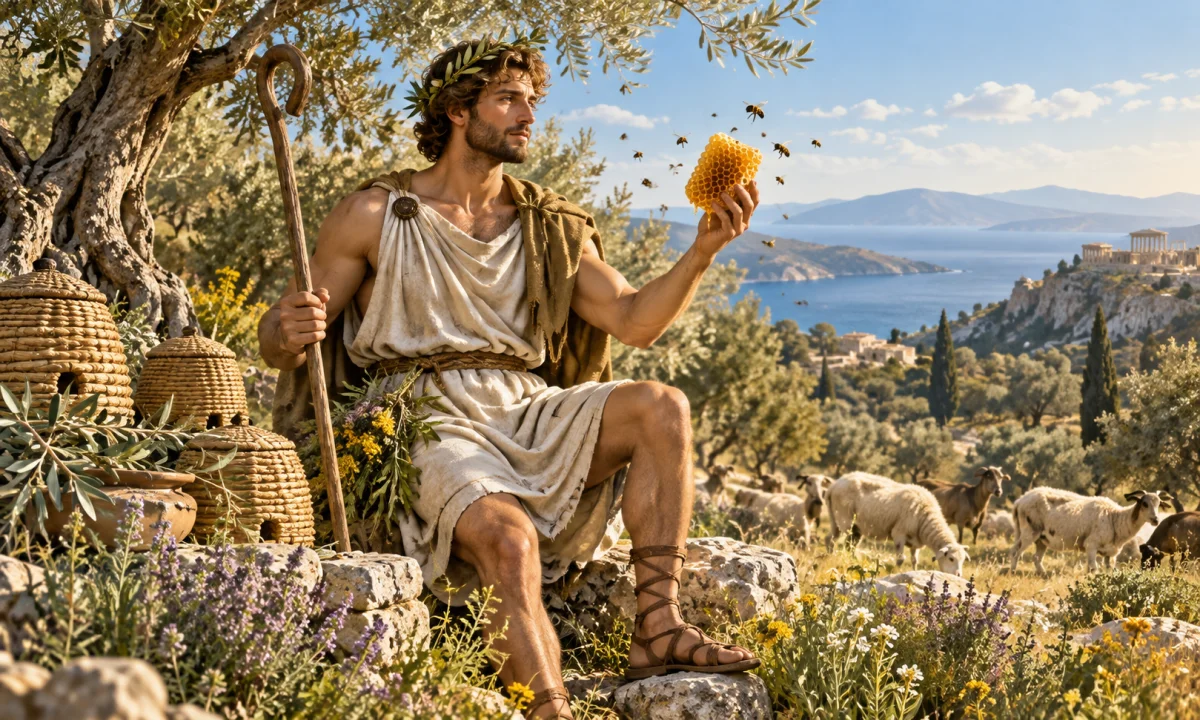
One tradition says that Apollo served King Admetus of Pherae after Zeus punished him for killing the Cyclopes. Apollo became a herdsman and helped Admetus win the hand of Alcestis. In later stories, Admetus was allowed to live beyond his appointed time if another person died in his place. Alcestis accepted the exchange, and Heracles eventually brought her back from death in one version of the tale.
This story presents Apollo in an unusually humble role. Rather than ruling from Olympus, he tends animals and assists a mortal household. His service can be interpreted as ritual compensation for violence, but the myth also shows how divine favour may operate through personal loyalty and hospitality.
Daphne
Daphne was a nymph who rejected marriage and devoted herself to a life of freedom, often under the protection of Artemis. After Apollo became infatuated with her, she fled from him and prayed for escape. She was transformed into a laurel tree, or in some versions was changed by her father, the river god Peneus.
Apollo then made the laurel sacred to himself and used its leaves in ritual and athletic contexts. The tale has been interpreted in different ways: as an origin myth for the sacred laurel, as a story about desire and refusal, or as a narrative that exposes the danger of divine pursuit. Modern retellings sometimes romanticize Apollo’s pursuit, but the traditional story also clearly involves Daphne’s loss of bodily autonomy and her transformation as a means of escape.
Musical contests
Apollo appears in several myths involving musical competition. He competed with the satyr Marsyas, who played the pipes. After Apollo won, he punished Marsyas by flaying him. The brutality of the result contrasts with the ideal of civilized music and may express the Greek opposition between disciplined harmony and uncontrolled or excessive performance.
In another famous story, Apollo competed with Pan, who played the syrinx. The judge Midas preferred Pan’s music and was given the ears of a donkey. Versions differ in their details, and the association between Apollo and musical order should not be reduced to a simple opposition between “good” and “bad” music. These myths explore skill, judgement, pride, and the social power of artistic standards.
Apollo’s religious roles
Prophecy and purification
Apollo was one of the principal Greek gods of prophecy. His prophetic power operated through sanctuaries, priests, signs, dreams, and inspired speech. He was also associated with purification after bloodshed or ritual pollution. The Greek concept of purity was not identical to modern ideas of cleanliness; it concerned the proper condition required for approaching the gods, performing ceremonies, or participating in communal life.
Healing and disease
Apollo was called upon to prevent or end plague and illness, but he could also be imagined as the sender of disease. At the beginning of the Iliad, for example, Apollo sends a plague against the Greek army after his priest is dishonoured. His arrows carry the invisible force of sudden sickness. This dual role reflects a common religious pattern: the deity who controls a danger may also be the deity most capable of removing it.
Music, poetry and education
Apollo’s connection with music extended beyond entertainment. Music, poetry, dance, and measured speech were important parts of Greek education and public ritual. Apollo’s lyre represented harmony, proportion, and mastery of technique. His association with the Muses made him a patron of artistic creation, although the Muses themselves remained distinct goddesses with their own identities and functions.
Youth, boundaries and civic order
In several communities Apollo was connected with the transition from childhood to adulthood and with the protection of young men. Festivals and initiation practices dedicated to him could mark changes in social status. He was also associated with colonies, roads, boundaries, and the establishment of ordered communities. These functions relate to his wider role as a god who brings structure to uncertain or dangerous spaces.
Apollo and Artemis
Apollo and Artemis were often worshipped as twins, but they were not simply male and female versions of the same god. Artemis was associated with the wilderness, hunting, childbirth, and the protection of girls and young animals. Apollo had stronger associations with prophecy, music, healing, civic order, and male initiation. Their shared use of the bow and their ability to send death from a distance created a close symbolic relationship, while their distinct cults preserved different religious emphases.
Distinctions from similar figures
Apollo should not be confused with Helios, the ancient personification of the sun. Apollo became solar in later Greek and Roman interpretation, but Helios was an independent god with his own genealogy, cult, and mythic role. Nor should Apollo be merged with Asclepius, who was his son and a separate god of medicine, or with Orpheus, the legendary musician and poet who was a mortal or semi-divine hero rather than an Olympian deity.
Some later traditions also connected Apollo with the Roman god Sol, with Egyptian religious figures, or with philosophical ideas of cosmic reason. Such comparisons belong to later syncretism and interpretation, not to the basic identity of the archaic Greek god. The meaning of Apollo changed across centuries, but those changes did not erase the distinct local traditions through which he was worshipped.
Later reception
Apollo remained important during the Hellenistic and Roman periods, when Greek religious ideas spread widely and gods were increasingly interpreted through comparison with other divine traditions. Roman writers adopted Apollo as a major god, and Roman emperors sometimes promoted his worship as a symbol of order, victory, healing, or cultural refinement. His prophetic sanctuary at Delphi continued to attract attention even after political and religious circumstances changed.
In Renaissance and later European art, Apollo became a favourite figure for representing ideal beauty, poetry, music, rational order, and the sun. Modern literature, theatre, games, films, and young-adult fiction frequently portray him as a charismatic immortal, a patron of artists, or a powerful but flawed character. These adaptations may draw on traditional names and myths while changing relationships, personalities, or moral themes. They belong to modern popular culture rather than serving as evidence for ancient Greek religious practice.