WORLD

Zara-mama
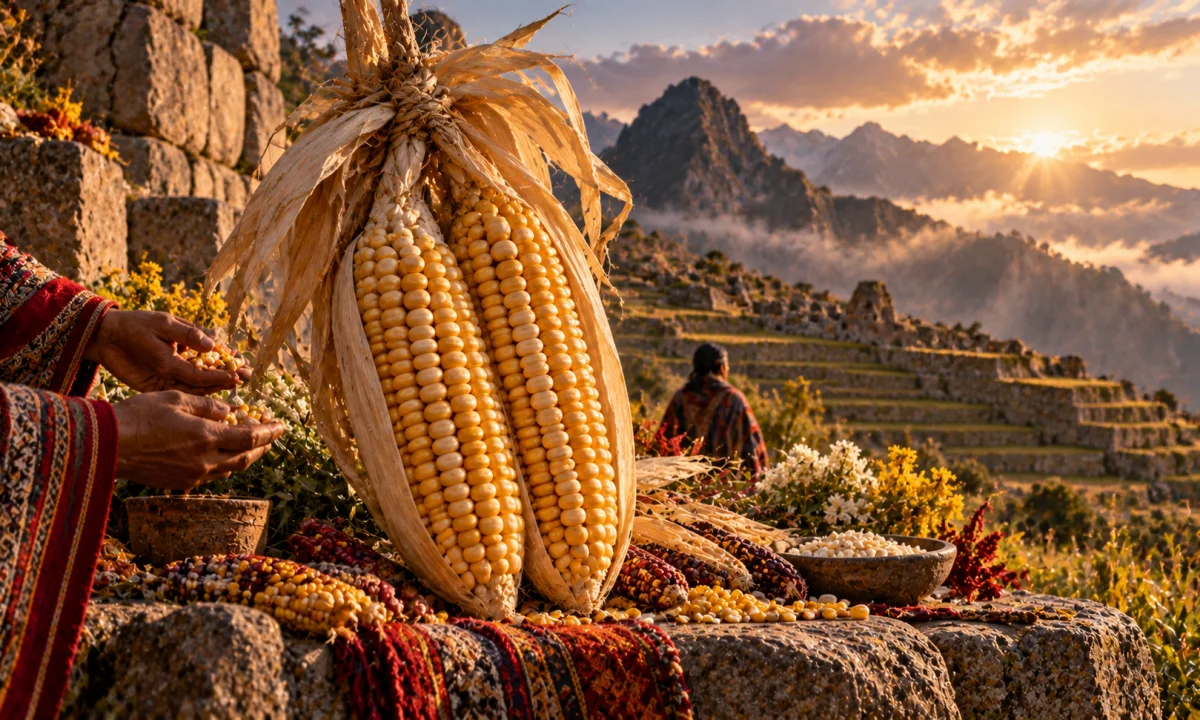
Zara-mama is a name used for a maize or corn mother in accounts of Inca and broader Andean religious tradition. The figure is also written Zaramama, Sara Mama or Mama Sara. The variations reflect differences in colonial spelling, modern transliteration and regional usage. In standardized Quechua, sara commonly means “maize” or “corn,” while mama means “mother.” Zara-mama therefore means something close to “Mother Maize.”
The name does not refer to a single figure described in one surviving Inca scripture. Knowledge of Inca religion comes mainly from colonial-era chronicles, missionary writings, Quechua-language records, archaeology, later ethnography and living Andean traditions. These sources do not always agree about whether Zara-mama was a major goddess, a local sacred power, a personification of the crop or a ritual object representing maize. It is safest to understand her as a traditional corn-mother figure whose identity and importance vary between sources.
Maize in the Andean religious world
Maize was one of the most important cultivated plants in the Andes. It was used as food, stored as a valuable agricultural product, exchanged through systems of labour and tribute, and made into chicha, a fermented drink used in feasting and ceremonial life. Certain varieties were also reserved for ritual purposes. Because the crop depended on fertility, rainfall, soil, seasonal timing and human labour, it belonged to a religious world in which agriculture was understood as a relationship between people, land and sacred powers.
Inca religion did not separate practical farming from ritual responsibility in the modern sense. Fields, springs, mountains, stones, ancestors and agricultural products could all possess sacred significance. The Inca state maintained rituals intended to secure the well-being of crops and the wider empire, while local communities retained their own huacas, or sacred places and beings. A corn mother could consequently be understood at several levels: as the life within the plant, as the fertility of the field, as the protection of the harvest and as a personified expression of the crop’s value.
Maize was especially associated with political and ceremonial power. The Inca administration collected and redistributed grain, and state storehouses held large quantities of maize alongside other provisions. Chicha made from maize played an important role in public ceremonies, reciprocal obligations and offerings. The sacred status of maize was therefore connected not only with subsistence but also with hospitality, authority, celebration and relations between communities.
The name and its spelling
The form Zara-mama is not the only way the name appears. Other forms include Zaramama, Zara Mama, Sara Mama and Mama Sara. Spanish colonial writers did not use a single standardized system for recording Quechua words. They represented sounds according to Spanish spelling conventions, and later writers sometimes altered those spellings further. A written z in an older form may correspond to the s found in modern Quechua spelling.
For that reason, Zara-mama should not automatically be treated as a separate goddess from every figure called Sara Mama. In many contexts, the names are variant forms of the same corn-mother concept. At the same time, regional traditions can give related names different meanings, so it is unwise to assume that every use of Zaramama, Sara Mama or Mama Sara refers to precisely the same local being.
The name should also not be interpreted as the personal name “Zara” followed by an unrelated word for mother. Its meaning is connected with maize. The spelling zara belongs largely to older or non-standardized representations, whereas sara is the form more commonly encountered in modern Quechua contexts.
Identity and classification
Zara-mama is often described in modern summaries as an Inca goddess of corn. That description conveys her central association, but it can give a misleading impression of a fully documented divine personality with a fixed mythology. The evidence is more limited. Some references present her as a maize deity; others treat the name as a personification of the crop or as part of a ritual agricultural tradition. There is no securely preserved canonical story that establishes her genealogy, appearance and powers in the manner of a literary mythological character.
It is also important to distinguish the religious world of the Inca state from the wider Andean traditions that existed before, alongside and after it. The Inca Empire incorporated many peoples and local cults. A figure associated with maize could have been known under different names in different valleys, and an imperial religious system could acknowledge or reorganize local sacred practices without erasing them. Calling Zara-mama “Inca” identifies the cultural setting in which the figure is commonly discussed, but it does not prove that every Andean community understood her in the same way.
Terms such as “goddess,” “spirit” and “deity” are useful in English but do not always map exactly onto Andean categories. A sacred crop or being could be active, relational and ritually important without belonging to a rigid hierarchy of gods. Zara-mama may therefore be better understood as a personified agricultural power than as a goddess with a clearly defined divine biography.
Attributes and symbolic meaning
Zara-mama’s principal attribute is maize itself. She represents the plant’s power to grow, mature and nourish human communities. Her symbolism includes fertility, abundance, continuity and the return of life after planting. As “mother maize,” she expresses the idea that the crop gives nourishment in a manner comparable to a parent caring for children.
The association also carries obligations. Maize does not simply appear as a gift detached from human action. It requires seed selection, preparation of the ground, planting, weeding, irrigation or rain, protection from pests and careful harvesting. Religious respect for the crop could therefore reinforce ideals of reciprocity and responsibility. People depended on maize, but they were also expected to treat the land, agricultural powers and one another properly.
Some accounts associate corn-mother traditions with special ears of maize, unusual plants or small representations made from maize leaves, stalks or ears. These practices should not be turned into a single universal image of Zara-mama. The available descriptions are uneven, and an object used in one community may not have been known elsewhere. Nor is there a securely established ancient portrait showing what Zara-mama looked like in human form.
Where maize was represented in a human or doll-like form, the object could function as more than an image. It might embody the vitality of the crop, protect the seed or participate in a household or agricultural rite. Such representations are best interpreted within their particular ritual context rather than automatically labelled statues of an Inca goddess.
Relationships with other sacred figures
Zara-mama is sometimes listed alongside female figures whose names contain mama, but shared terminology does not establish a family relationship. In Andean religious language, mama can indicate motherhood, generative power, abundance or the importance of a particular natural or cultural domain.
She is not the same figure as Pachamama. Pachamama is widely associated with the earth, land, fertility and the broader environment, although her meaning varies across Andean regions and historical periods. Zara-mama has the narrower focus of maize. A community might honour both powers, with the earth providing the field and the corn mother embodying the crop that grows within it, but this does not make them identical.
She is also distinct from Mama Ocllo, the culture heroine and female ancestor who appears in Inca origin traditions. Mama Ocllo is connected with the foundation of royal society and the transmission of social or cultural practices, whereas Zara-mama represents maize and agricultural fertility. Likewise, she should not be confused with Mama Quilla, the moon-associated figure, or with Mama Coca, whose name is linked with the coca plant.
The agricultural cycle could bring Zara-mama into practical association with other sacred powers. Sunlight, rain, mountain waters, fertile earth and human labour were all necessary for a successful harvest. The thunder and weather deity often called Illapa is therefore relevant to agricultural ritual, but surviving evidence does not justify assigning him a universal spouse or fixed romantic relationship with Zara-mama. Modern retellings sometimes construct tidy divine families that are not securely supported by the historical record.
Stories and ritual context
No single, widely attested narrative about Zara-mama survives in the way that stories of certain culture heroes or dynastic ancestors do. This absence does not mean that maize had no myths. It means that the available evidence does not preserve one authoritative version under this particular name. Oral traditions may have attached stories to planting, harvest, famine, the origin of cultivated plants or the conduct expected of farmers, but many such accounts were recorded late, changed through transmission or were identified by outsiders using broad labels.
Colonial observers often described Indigenous religious practices through Christian categories. Missionaries could call a sacred being a “devil,” an “idol” or a “false god,” while Spanish chroniclers might arrange diverse local powers into a pantheon resembling European ideas about classical gods. Their records remain valuable, but they must be read critically. They may preserve Quechua names and ritual details while misunderstanding the relationships between beings or presenting local practices as evidence of a single organized religion.
Archaeology provides evidence for the importance of maize through storage facilities, agricultural terraces, serving vessels, brewing equipment and ceremonial contexts. Such evidence can show that maize held economic and ritual significance, but it rarely proves that a particular object represented Zara-mama. A corn-shaped object, a female figurine or a ceremonial vessel cannot be assigned to her with confidence unless its context and associated evidence support that identification.
Ritual offerings connected with farming could include food, drink and other valued materials. Chicha was especially important in ceremonial life, and maize could be offered, shared or used in acts of hospitality and reciprocity. These practices do not necessarily constitute worship directed at Zara-mama as an independent personality. They demonstrate the wider sacred status of maize and the relationships surrounding its cultivation.
Cultural significance
The corn-mother concept expresses an important Andean understanding of dependence and reciprocity. Food is not merely a commodity; it comes from a living landscape shaped by ancestral knowledge, seasonal cycles, collective labour and sacred relationships. By giving maize a maternal identity, the tradition emphasizes nourishment, vulnerability and continuity between generations.
The figure also reflects the contrast between abundance and danger. A successful maize harvest could support feasts, state obligations and survival through difficult seasons. Crop failure, drought, frost or disease threatened both households and political systems. A maize mother consequently symbolizes hope, but not guaranteed abundance. Respect for her or for the sacred life of the crop belongs to a larger effort to maintain balance with the forces on which agriculture depends.
It is useful to avoid describing Zara-mama as a simple “fertility goddess” without qualification. That phrase can reduce a complex agricultural tradition to a generic theme shared by many religions. Her significance is more specifically tied to maize as a cultivated plant, food, ritual substance, economic resource and bearer of community memory.
Traditional identity and modern portrayals
Modern books, websites and fantasy-oriented treatments often present Zara-mama as a clearly defined Inca goddess with a standard appearance, a list of powers and a fixed place in a divine family. Such presentations can make the figure easy to recognize, but they may combine details from different Andean traditions or fill gaps in the evidence with imaginative invention. A name appearing in a modern catalogue of mythology is not, by itself, proof of a uniform ancient cult.
Contemporary Andean communities continue to maintain agricultural ceremonies, offerings and celebrations connected with land, crops, ancestors and seasonal change. These living practices should not automatically be labelled unchanged survivals from the Inca Empire. Traditions develop through time and have been shaped by Indigenous continuity, colonial Christianity, local history and modern political and cultural movements. They nevertheless demonstrate that maize remains deeply significant in Andean cultural life.
Zara-mama is therefore best approached as a variable corn-mother tradition associated with Quechua and Inca cultural contexts. Her name points to maize, her symbolism concerns nourishment and agricultural fertility, and her meaning is inseparable from the reciprocal relationships that sustain Andean farming. The uncertain spelling, uneven documentation and regional variation are not minor details: they are essential to understanding why Zara-mama appears differently in different accounts.