WORLD
WORLD
Xochiquetzal
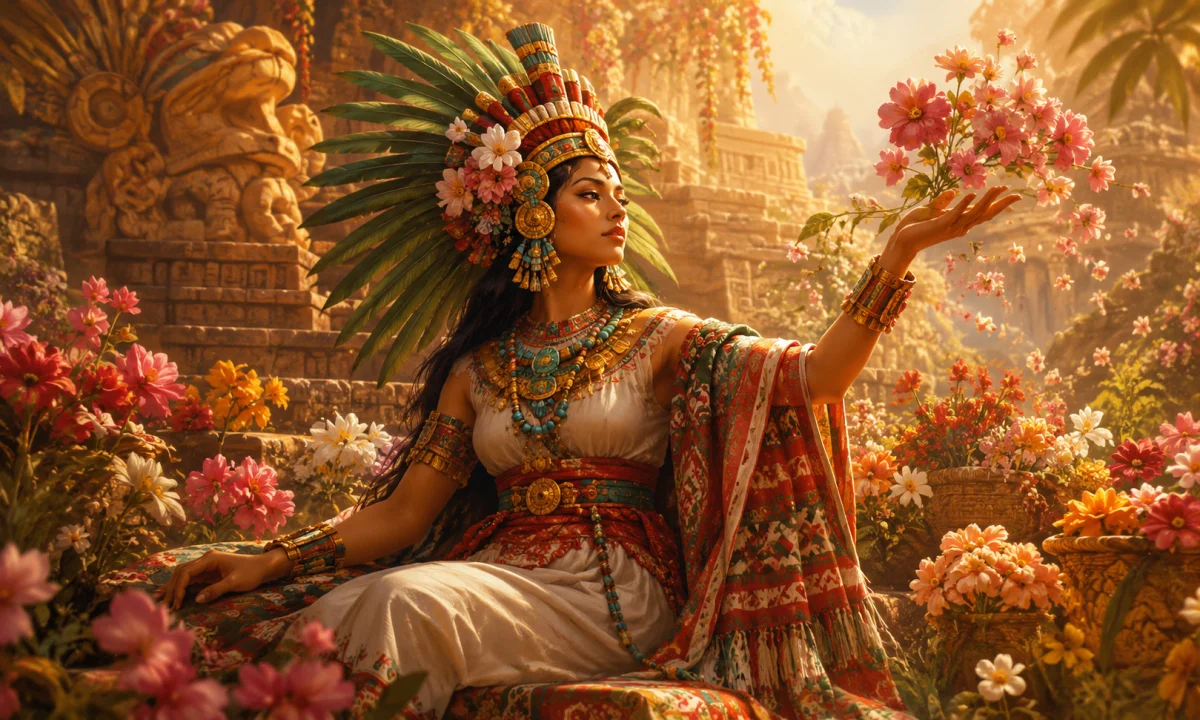
Xochiquetzal is a major goddess in Aztec religion and a broader figure in central Mexican mythology. Her name is usually understood as meaning “Precious Flower” or “Flower Feather,” combining Nahuatl words associated with flowers, beauty, and richness. She was linked with love, beauty, sexuality, pregnancy, childbirth, weaving, female craftsmanship, youth, and the pleasure and abundance associated with fertility. In surviving Nahua tradition, she appears as a powerful and sometimes ambivalent deity rather than a simple “goddess of love” in the modern sense.
Origins and cultural setting
Xochiquetzal belongs to the religious world of the Nahua peoples of central Mexico, especially the Mexica, commonly called the Aztecs in English. Knowledge of her comes from a mixture of pre-Columbian visual tradition, colonial-era Nahuatl and Spanish accounts, and later scholarly interpretation. Because the surviving sources were recorded after the Spanish conquest, details about her cult and mythology are sometimes incomplete or filtered through colonial perspectives.
She was worshipped within a religious system in which gods were not isolated personalities but part of a dense sacred landscape of forces, domains, and ritual obligations. Xochiquetzal’s sphere overlaps with several other deities, which is typical of Mesoamerican religion. She is associated with fertility and beauty, but also with the skilled arts of women, household production, and the social power connected to adornment, cloth, and luxury goods.
Modern presentations sometimes treat her as a single, fixed “goddess of love,” but the traditional picture is broader. She is also connected with springtime, flowers, and sensual abundance, and in some contexts with the dangerous force of desire as well as its pleasures. Like many Mesoamerican divinities, she can be read as both beneficent and potentially destabilizing.
Name and identity
The name Xochiquetzal is normally analyzed from Nahuatl as xōchitl (“flower”) plus quetzalli (“precious feather,” “quetzal feather,” or something finely valued and beautiful). The combination suggests not only floral beauty but also rarity, luxury, and preciousness. Because Nahuatl imagery often layers physical beauty with prestige and sacred value, the name conveys more than a simple botanical image.
Different spellings appear in English-language writing, including Xochiquetzal, Xochiquetzal, and occasional variant transliterations. Xochiquetzal is the most common scholarly and popular form. The figure should not be confused with later or unrelated beings whose names merely resemble hers. She is a distinct deity within central Mexican religion.
Her identity is sometimes described in relationship to other fertility and female deities, especially Toci, Tlazolteotl, and Chalchiuhtlicue, but these are not the same being. The religious categories of the preconquest Nahua world were fluid enough that overlaps and shared functions are normal, and some colonial sources may reflect that fluidity without always sorting it neatly.
Attributes and symbolism
Xochiquetzal is most often associated with beauty, flowers, fertility, weaving, and youthful female adornment. In art and ritual language, flowers are not merely decorative; they signal preciousness, transience, pleasure, and sacred vitality. For that reason, Xochiquetzal can symbolize the height of life’s bloom as well as its fragility.
She is also tied to weaving and the arts of women. In Mesoamerican societies, cloth production was economically important and symbolically charged. Weaving was not simply domestic labor; it was a skilled and culturally significant craft associated with femininity, social order, and status. Xochiquetzal’s patronage of weaving reflects this wider world of textile production and female artistry.
Some traditions connect her with sexual attraction, courtship, and the pleasures of intimacy. These associations should be understood in a ritual and cosmological frame rather than a modern romantic one. In Nahua thought, sexuality could be linked to generative power, social continuity, and the abundance of life, but it could also require regulation and ritual awareness.
She is sometimes described as a patron of young women, midwives, and those involved in birth and female fertility, though specific roles vary by source. Her domain can include pregnancy and childbirth, but these themes are not always separated cleanly from broader fertility symbolism. In many cases, Xochiquetzal appears as part of a network of divine powers governing the life cycle and the reproductive capacities of women.
Appearance in art and iconography
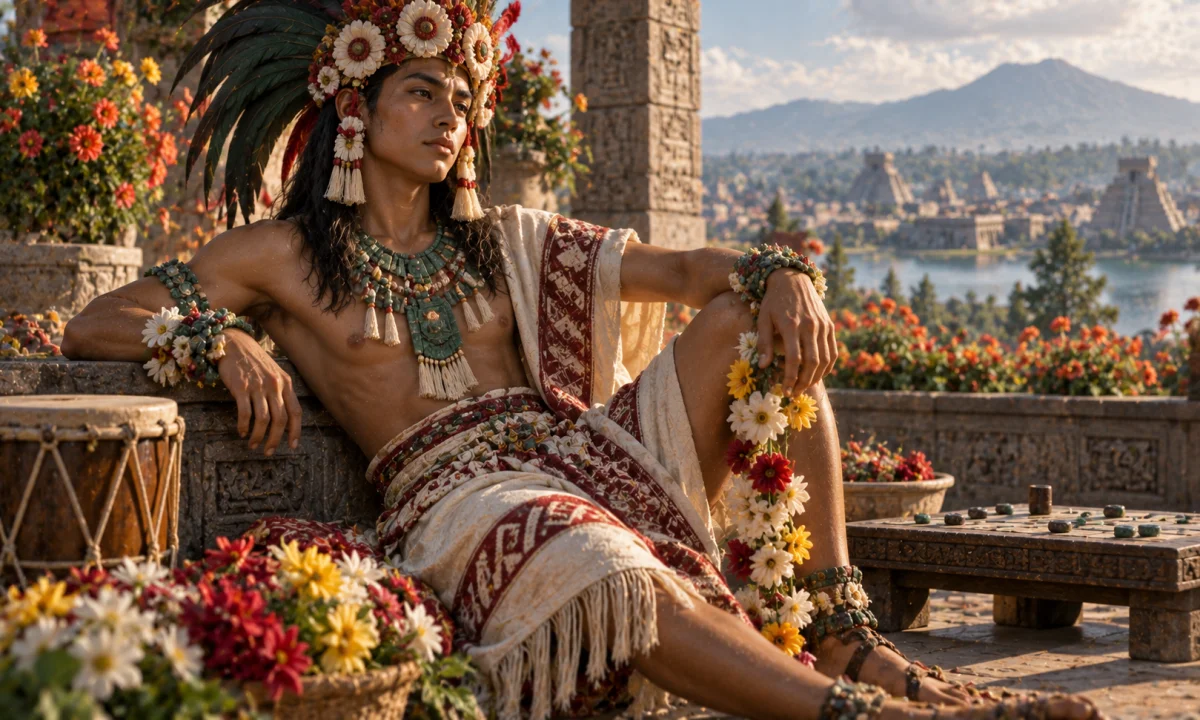
In surviving depictions, Xochiquetzal is often shown with elaborate garments, bright ornamentation, and floral imagery. She may wear a distinctive headdress or carry symbols of luxury and fertility. As with many Aztec deities, iconographic identification can be difficult because similar regalia and emblematic motifs recur across different gods and goddesses.
Feathers, flowers, textiles, and jewelry all reinforce her associations with beauty and preciousness. These images also place her within the elite visual language of the Mexica world, where ornament was deeply meaningful and connected to sacred power. A deity of beauty was not frivolous; beauty itself could be a form of divine potency.
Because many pre-Hispanic images were destroyed or altered after the conquest, interpretations of Xochiquetzal’s iconography often depend on later codices, colonial descriptions, and comparative analysis. As a result, some details are still debated by scholars. The broad outlines of her presentation are clearer than every specific attribute.
Roles in religion and daily life
Xochiquetzal’s significance likely extended beyond mythic narrative into ritual and everyday life. Deities in Nahua religion were often honored through seasonal festivals, offerings, and ceremonial performances that linked cosmic cycles to human labor and social order. Xochiquetzal’s associations with flowers, fertility, and textile production suggest a connection to both seasonal renewal and domestic prosperity.
Her presence in the religious imagination would have mattered to women engaged in weaving and other forms of craft, though it would be misleading to imagine her as a narrowly “female-only” deity. Nahua religion was communal and hierarchical, and divine powers were relevant to the whole social body. Still, her strongest symbolic ties are with female-coded activities and with the generative forces that sustain households and lineages.
She also appears in the context of controlled desire and ritualized beauty. The Aztec world did not separate aesthetics from sacred power in the way modern categories often do. Flowers, perfumes, fine cloth, and ornament could all be signs of divine presence. Xochiquetzal embodies that intertwining of the lovely, the valuable, and the fertile.
Myths and stories
Surviving myths about Xochiquetzal are fragmentary and sometimes inconsistent. The colonial record preserves only pieces of larger traditions, and the goddess’s stories may have varied by place and period. Because of this, it is best to speak carefully about her mythology rather than claiming a single fixed cycle of tales.
One recurring pattern places her among the divine beings associated with the beginning of human life, sexuality, or fertility. In some accounts she is connected with young women, attractiveness, and the dangers or desires of erotic life. These stories often do not function as entertainment in the modern sense; they express cosmological and moral ideas about power, desire, and social conduct.
Another theme links Xochiquetzal with loss and displacement. Some traditions portray her as a goddess who has been separated from an earlier, more ideal state or who experiences descent into suffering and constraint. This pattern fits a broader Mesoamerican tendency to represent divine powers as vulnerable to conflict, theft, captivity, or transformation. Such stories can express the tension between abundance and scarcity, beauty and violence, or pleasure and loss.
She is sometimes connected to the realm of Tláloc, the rain god, and to the fertile, life-giving forces of the earth and water. In Mesoamerican religion, fertility deities are often relational rather than isolated, linked through marriage, accompaniment, or ritual association. Xochiquetzal’s connections to these powers reinforce her role as a figure of abundance and generative life.
Relationships with other deities
Xochiquetzal is frequently discussed alongside deities such as Tlazolteotl, Toci, and Chalchiuhtlicue, but these relationships are complex and should not be simplified. Some of these figures overlap in function, while others reflect different regional traditions or distinct aspects of female sacred power. Scholarly interpretation sometimes differs on how to map these relationships.
She is also associated in some accounts with Tonacatecuhtli and Tonacacihuatl, the primordial couple linked with sustenance and creation. These associations place Xochiquetzal within a cosmological framework in which fertility is not merely biological but tied to nourishment, cosmic order, and human survival.
In later tradition, especially in syncretic or popular retellings, Xochiquetzal is sometimes paired with romantic or aesthetic themes that are not necessarily central in the oldest sources. Such depictions can be creative, but they should not be mistaken for a direct summary of preconquest belief.
Festivals, offerings, and ritual importance
The Aztec ritual calendar included festivals for different divine powers, and Xochiquetzal had her place within that calendar. Exact details are not always securely preserved, but her worship was likely marked by offerings of flowers, food, incense, and possibly textile-related or beauty-related ceremonial display. Flowers themselves were a particularly important sacred offering in central Mexican religion.
Because of the scarcity and ambiguity of the sources, caution is needed when describing exact rites. Colonial chroniclers sometimes interpreted ceremonies through Christian assumptions, while indigenous traditions were changing under colonial pressure. Even so, the surviving material makes clear that Xochiquetzal was not a marginal figure. She belonged to a major cluster of deities associated with life, pleasure, and the social arts.
Ritual attention to Xochiquetzal likely reinforced idealized forms of femininity, fertility, and skilled production, but it may also have acknowledged the unpredictability of desire and the fragility of beauty. In Nahua thought, divine powers were often both desired and feared because they were intensely alive and powerful.
Interpretation and cultural significance
Scholars often interpret Xochiquetzal as a deity who brings together several values that were central in Nahua culture: beauty, fecundity, craftsmanship, and status. Flowers and feathers were among the most valued natural images in Mesoamerican symbolic language, so her name alone signals a rich network of meanings.
She also helps illuminate the cultural importance of women’s labor. Weaving was a crucial part of household and tribute economy, and its elevation in divine form shows that craft was not secondary to sacred life. Xochiquetzal’s patronage of textile production suggests that fertility in the Aztec world included the ability to make, sustain, and adorn social life.
Her erotic and aesthetic associations should not be flattened into modern stereotypes. In the Nahua context, beauty was a form of force, and sensuality was tied to both generation and impermanence. Xochiquetzal therefore stands at the intersection of desire and discipline, abundance and loss, pleasure and responsibility.
She also reflects the broader Mesoamerican understanding that the universe is animated by relational powers rather than abstract principles. A goddess of flowers is also a goddess of time, season, social value, and embodied life. That layered symbolism is one reason Xochiquetzal remains significant in studies of Aztec religion.
Distinction from similar figures
Xochiquetzal is sometimes confused with other female deities because Mesoamerican religions use overlapping imagery and related domains. The most common confusion is with Tlazolteotl, who is also associated with sexuality and fertility but has a different religious profile, including sin, confession, and purification in some traditions. Xochiquetzal is not simply another name for Tlazolteotl.
She may also be confused with Chalchiuhtlicue, a water goddess linked to rivers, lakes, and birth. While both can be associated with fertility and life-giving power, Chalchiuhtlicue’s core identity is watery, whereas Xochiquetzal’s is floral, ornamental, and connected to weaving and beauty.
Toci is another related figure, often linked with the motherly and earth-centered aspects of female divinity. Again, overlap does not mean identity. Nahua religious categories can be difficult to separate with modern precision, and different communities may have emphasized different aspects of each deity.
It is also important not to import the attributes of later folk saints, modern goddess spirituality, or New Age reinterpretations into the ancient tradition. Those are separate developments, even when they borrow her name or imagery.
Later reception and modern popular culture
Xochiquetzal appears in modern books, games, art, and online writing as one of the best-known Aztec goddesses, often emphasized as a goddess of beauty, flowers, and love. These retellings can help keep interest in Mesoamerican mythology alive, but they frequently simplify her into a more familiar romantic archetype.
In modern popular culture, her image may be used for aesthetic themes, fantasy character design, or spiritual eclecticism. Such uses are understandable, but they usually draw selectively from the tradition and may ignore her deeper connections to weaving, social order, and the complexity of Nahua sacred thought.
Contemporary indigenous and scholarly efforts increasingly emphasize the need to treat Aztec deities within their own historical and cultural contexts. That means recognizing Xochiquetzal as part of a living legacy of Nahua language, symbolism, and ritual memory, rather than as a generic “goddess of flowers” detached from the world that created her.
Key themes associated with Xochiquetzal
- Flowers, beauty, and preciousness
- Weaving, textile production, and female craftsmanship
- Fertility, pregnancy, childbirth, and generative power
- Sexuality, desire, and sensual abundance
- Youth, adornment, and luxury
- Seasonal renewal and the fragility of life
Why Xochiquetzal matters in Aztec mythology
Xochiquetzal matters because she reveals how richly the Nahua world linked aesthetics, labor, and fertility. She is not only a figure of beauty but also a divine expression of valued human activities: making cloth, celebrating life, and honoring the forces that allow communities to flourish. Her mythology, though fragmentary, shows that flowers in Aztec religion were never merely decorative. They were signs of sacred vitality, social refinement, and the preciousness of existence.