WORLD
WORLD
Xmulzencab
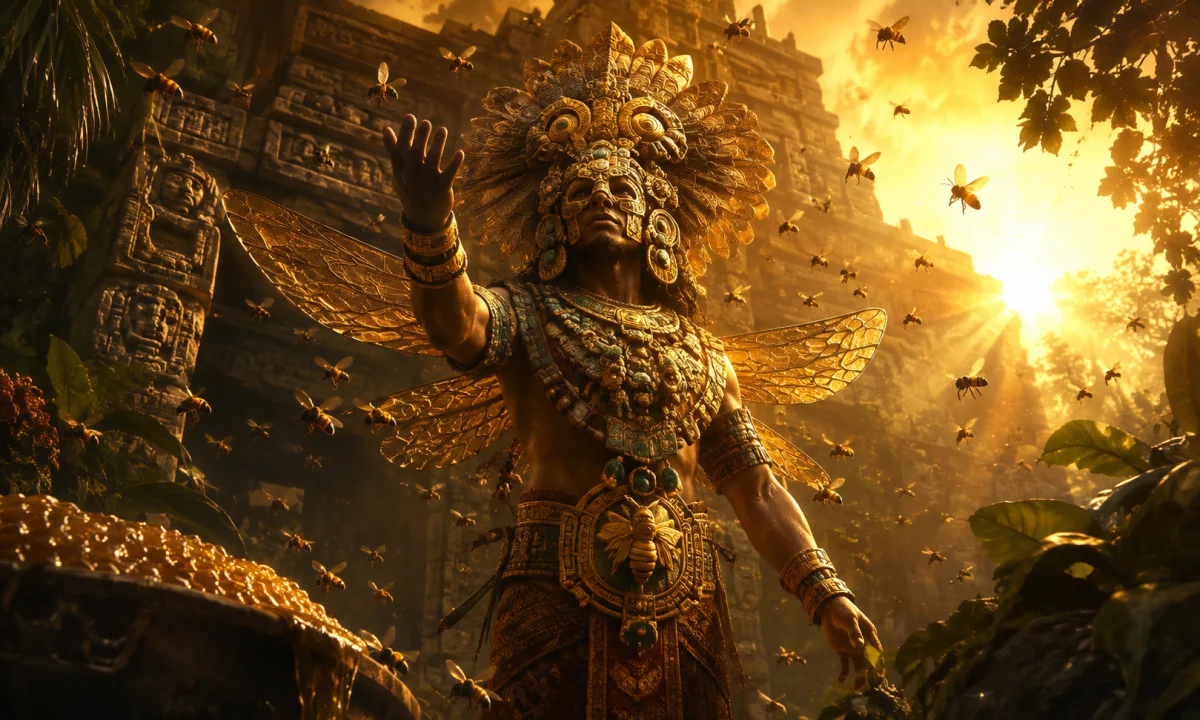
Xmulzencab is a little-known name associated with Aztec mythology, though the identity behind the term is not fully secure. In surviving modern references, Xmulzencab is usually treated as a mythic or divine being from the broader Mesoamerican religious world, but there is not enough clear surviving evidence to describe the figure with confidence in the way one could describe major Aztec gods such as Huitzilopochtli, Tlaloc, or Quetzalcoatl. Because of that, any account of Xmulzencab has to be cautious: the name appears obscure, its spelling varies, and the surviving tradition is uncertain.
The Aztec religious system was part of a wide Mesoamerican landscape of shared symbols, deities, ritual practices, and local traditions. Names and stories often changed from one region to another, and many figures known in later records may reflect the mixing of Nahua, Maya, and colonial-era interpretations. Xmulzencab belongs in that complex setting. Rather than representing a securely defined deity with a single fixed profile, the name is best understood as a tradition-laden but poorly documented figure whose exact place in Aztec belief remains disputed.
Origins and cultural setting
Aztec religion developed in central Mexico before the Spanish conquest and drew on older Mesoamerican ideas about the cosmos, sacrifice, rain, fertility, warfare, kingship, and the cycles of time. Gods and supernatural beings were not always isolated personalities in the modern sense. They could function as powers, titles, local patrons, or aspects of larger sacred forces. In that environment, a name such as Xmulzencab may have referred to a local divine being, a regional spirit, a variant name recorded imperfectly by later writers, or a term preserved through oral tradition rather than through extensive written documentation.
The difficulty is that the surviving sources for many lesser-known Mesoamerican names are fragmentary. Colonial-era scribes, missionaries, and later collectors often wrote indigenous names according to Spanish spelling habits, and the same name could appear in different forms. Some words were misunderstood, abbreviated, or translated inconsistently. When a figure is as obscure as Xmulzencab, scholars and readers alike must be careful not to assume certainty where the evidence does not support it.
In practical terms, that means Xmulzencab should not be treated as a universally attested major Aztec deity. If the name belongs to a genuine traditional figure, it likely circulated in a local or specialized context rather than in the best-known pan-Aztec religious canon. It is also possible that later references have blurred distinctions between different cultural traditions in Mesoamerica. For that reason, any discussion of Xmulzencab must remain open to the possibility that the name is rare, regionally specific, or affected by transcription problems.
Name, spelling, and identity
The form Xmulzencab itself is unusual in English-language discussions of Aztec religion. The initial X is not surprising in Mesoamerican names, since many indigenous languages recorded in colonial spelling use x for sounds unlike the modern English sh or h. However, the overall shape of the name does not make its cultural attribution straightforward. It may reflect a Nahua spelling tradition, but it may also have been adapted or misread in transmission.
Because of that uncertainty, it is important not to overstate the figure’s identity. Xmulzencab is not securely identified in the way some major deities are. There is no widely accepted standard profile describing a fixed domain, family, iconography, or mythological cycle for this name in the available material commonly associated with Aztec mythology. If the name is discussed in a modern context, it is often because of interest in obscure deities, local traditions, or incomplete lists of Mesoamerican supernatural beings.
When a name is uncertain, several possibilities must remain in view:
- the figure may have been a local deity or spirit with limited surviving documentation;
- the name may preserve a variant spelling of a better-known being from another Mesoamerican tradition;
- the term may reflect later confusion between different cultural records;
- or the name may survive only as a fragmentary reference without enough context for secure identification.
That uncertainty is not a weakness in scholarship; it is part of the historical record. Mesoamerican religion was diverse, and the colonial destruction of temples, manuscripts, and ritual knowledge means that many names cannot now be explained with certainty.
Possible roles and symbolic associations
Because the surviving evidence is unclear, the attributes of Xmulzencab cannot be stated definitively. No stable traditional description of appearance, costume, animal form, or sacred implements can be given with confidence. Unlike gods whose roles are clearly documented through codices, ritual calendars, or colonial chronicles, Xmulzencab does not have a widely established set of symbols in the commonly available record.
Even so, a name preserved in an Aztec or broader Mesoamerican context may have carried one or more of the following kinds of significance:
- a protective or local divine function;
- an association with a particular landscape feature, settlement, or lineage;
- a connection to fertility, rain, agriculture, or the underworld;
- a role in ritual language, mythic genealogy, or calendrical symbolism;
- or a more abstract sacred presence rather than a highly personified god.
Those possibilities are interpretive rather than certain. They reflect how Mesoamerican religions often operated: sacred figures could be tied to natural powers, communal identity, and cycles of life and death. If Xmulzencab belonged to this world, the figure may have been understood less as an isolated character and more as part of a living network of divine forces.
Stories and surviving tradition
No widely known myth cycle securely centered on Xmulzencab is preserved in standard accounts of Aztec mythology. That does not necessarily mean the figure never had stories attached to it; rather, those stories have not survived clearly enough, or they may exist in materials that are difficult to identify or interpret. In Aztec and other Mesoamerican traditions, oral transmission was essential, and the loss of priestly knowledge after the conquest affected the survival of narratives unevenly.
For major gods, we can often discuss specific episodes, such as creation acts, descent into the underworld, or ritual contests. For Xmulzencab, no comparable narrative core is securely established. Any attempt to assign a detailed mythology would risk inventing details that the historical record does not support. The most accurate statement is that the figure’s narrative tradition, if one existed in a recoverable form, is now poorly documented.
That said, obscure divine names in Mesoamerican settings often appear in relation to local rites, seasonal ceremonies, or place-based legends rather than in formal cosmogonic stories. Xmulzencab may have functioned in such a setting. If so, the name could have carried significance in ritual speech, community memory, or devotional practice even without a large body of surviving myth.
Relation to Aztec religion and wider Mesoamerican belief
Aztec religion was not a closed or uniform system. It included imperial state cults, local patron deities, household rites, and older regional practices absorbed into the expanding Mexica sphere. A lesser-known name like Xmulzencab fits more comfortably into that plural world than into a rigid pantheon model. Mesoamerican religions often overlapped through shared imagery and concepts: water, maize, mountains, caves, suns, winds, and the movement between life and death.
Scholars studying obscure names must also consider the effects of cultural translation. Spanish chroniclers sometimes attempted to classify indigenous gods according to European categories such as “god,” “demon,” or “idol,” which can distort the original meaning. A figure like Xmulzencab may have been more nuanced than any one of those labels suggests. It may have been sacred, dangerous, protective, ancestral, or place-bound in ways not neatly captured by later translations.
In Mesoamerican thought, divine power was often relational. A sacred being could be linked to a specific community, agricultural cycle, or ritual obligation. If Xmulzencab belonged to that pattern, then the figure’s meaning would have depended on context rather than on a universal mythology. That helps explain why obscure names are so hard to classify from surviving records alone.
Distinction from similar or potentially confused figures
Because the name is rare and the documentation uncertain, Xmulzencab is especially vulnerable to confusion with other Mesoamerican beings. The most responsible approach is to distinguish it carefully from figures that are better known or similarly named.
First, Xmulzencab should not be assumed to be one of the major, widely attested Aztec gods unless a specific source makes that identification clear. The name does not have the strong documentary presence of Tlaloc, Tezcatlipoca, Quetzalcoatl, Xipe Totec, or Coatlicue.
Second, it should not automatically be merged with figures from the Maya region simply because some Mesoamerican divine names share overlapping sounds or endings. Mesoamerican traditions influenced one another, but they were not identical. A name that resembles a Maya term may still belong to a different linguistic and religious setting.
Third, modern lists of “Aztec gods” often mix names from different sources, periods, and languages. Some are genuine deities; others are local spirits, colonial inventions, or misread spellings. Xmulzencab may fall somewhere within that problematic range. Without stronger evidence, it is better to preserve uncertainty than to force the name into a false certainty.
Meaning and interpretation
Even with limited data, an obscure figure such as Xmulzencab can still be meaningful for understanding how Mesoamerican religion has been remembered. The name reminds us that the sacred world of the Aztecs was larger and more diverse than the small set of famous deities often repeated in textbooks. It also shows how much of that world has been damaged by historical loss.
In scholarly terms, uncertainty itself is informative. When a name survives without a clear role, it may indicate one of several things: local devotional importance, incomplete colonial documentation, regional variation, or later cataloguing errors. A responsible interpretation does not pretend to know more than the sources allow. Instead, it recognizes that some divine names remain partially visible, like traces of a larger religious landscape.
If Xmulzencab was indeed a sacred being in the Aztec or broader Nahua world, the figure may have represented a specific kind of power that mattered to a community but never became widely standardized. That would not make the figure less real to those who revered it. Many indigenous religious traditions included local sacred figures whose importance was intense and practical, even if they were never written down in detail.
Modern references and popular culture
Xmulzencab does not appear to have a strong presence in mainstream modern popular culture. It is not a commonly adapted figure in film, television, video games, or commercial mythology projects in the way that some better-known Mesoamerican deities have become. Where the name does appear today, it is usually in discussions of obscure mythological names, online compilations, or lists of lesser-known gods.
Because of the name’s obscurity, modern references should be read carefully. Online and popular accounts sometimes repeat uncertain identifications without checking whether the figure is securely attested. In the case of Xmulzencab, the best approach is to treat modern mentions as secondary and to distinguish them from the older traditional record, which is limited and not fully clear.
Any contemporary use of the name should therefore be understood as part of modern interest in Mesoamerican mythology rather than as strong evidence for a well-documented ancient cult. When popular culture does engage with obscure indigenous names, it often simplifies them. For a figure as uncertain as Xmulzencab, that risk is especially high.
Why the name matters
Names like Xmulzencab matter because they preserve traces of religious worlds that were not fully written down and were often violently disrupted. Even when the details are uncertain, the survival of a name can point to a once-living tradition of worship, storytelling, or local sacred knowledge. For the study of Aztec mythology, such names are reminders that the historical record is incomplete and that absence of evidence is not the same as evidence of absence.
At the same time, careful handling is essential. It is tempting to fill gaps with imagination, but doing so can flatten real cultural differences and create false certainty. Xmulzencab should therefore be approached as an uncertain Mesoamerican name associated with Aztec mythology, not as a fully reconstructed deity. That careful distinction respects both the limitations of the evidence and the depth of the tradition from which the name may have come.