WORLD
WORLD
Urpay Huachac
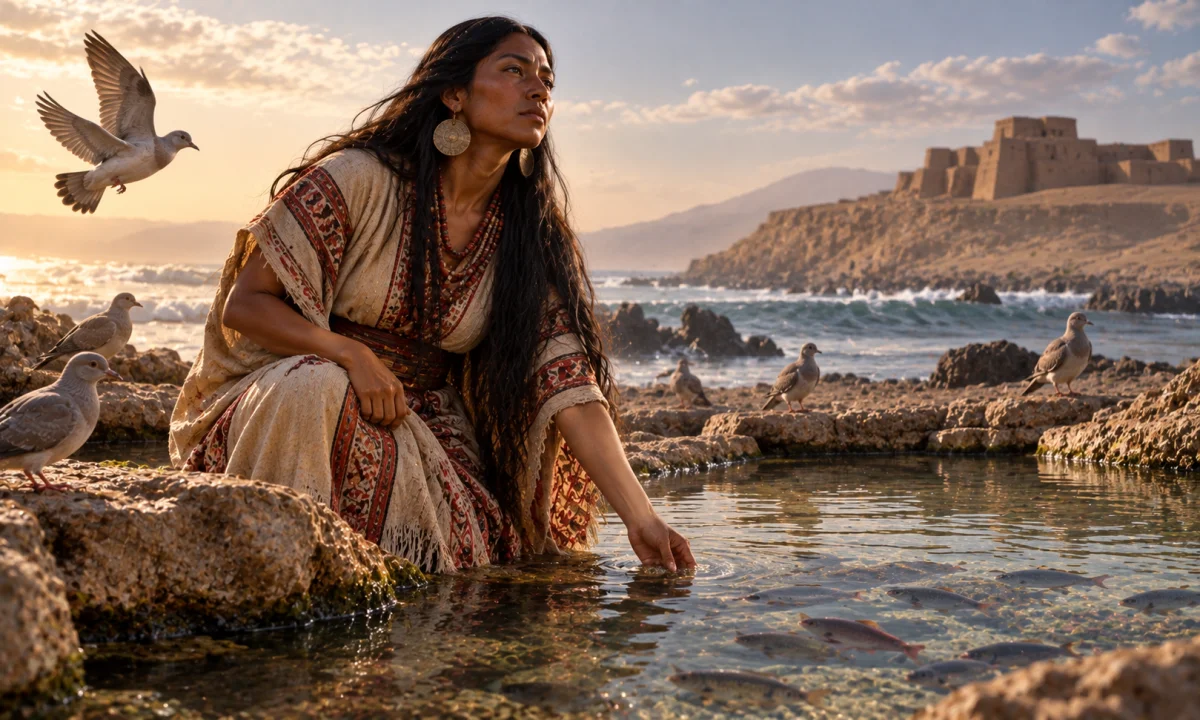
Urpay Huachac—also written Urpayhuachac, Urpay Huachac, or with other colonial spelling variations—is a female sacred being recorded in the mythology of the central Andes. She is best known from the Huarochirí Manuscript, a Quechua account of local religious traditions written down during the Spanish colonial period. In that tradition, she is associated with Pachacamac, with fish and the sea, and with the generation or care of aquatic life.
Although Urpay Huachac is often described as an Inca goddess, that label requires some qualification. The traditions concerning her come principally from the Huarochirí region of the central Peruvian Andes and the nearby Pacific coast, rather than from a clearly documented, empire-wide Inca religious system. The Inca state incorporated many regional sacred beings and places into its political and religious world, but local traditions did not necessarily originate with the Inca court. Urpay Huachac is therefore more precisely understood as a central Andean huaca whose story was preserved in a colonial record and later grouped under the broad heading of Inca mythology.
Origins in Andean religious tradition
The most important surviving account of Urpay Huachac appears in the Huarochirí Manuscript, a collection of myths, ritual traditions, genealogies and accounts of sacred places associated with communities in the Huarochirí area. The work was recorded in Quechua in the early colonial period, probably in the context of efforts to document and suppress indigenous religious practices. It is not an Inca theological handbook, and it does not present a single, systematic pantheon. Instead, it preserves stories connected with particular communities, huacas and ritual landscapes.
In Andean religion, a huaca could be a sacred person, ancestor, mountain, spring, rock, shrine or other powerful presence. The category does not correspond exactly to the modern European idea of a god or goddess. A huaca could be active in the landscape, connected to a community, and involved in the origin of animals, plants, places and social groups. Urpay Huachac belongs to this wider world of sacred beings rather than to a neatly organized mythology with fixed divine ranks.
Her connection with Pachacamac is particularly significant. Pachacamac was a major coastal sacred power whose sanctuary stood south of present-day Lima. He was associated with creation, earthquakes, prophecy and the power of the coastal landscape. His cult was important before the expansion of the Inca Empire, although the Inca later recognized and incorporated Pachacamac into their religious sphere. Urpay Huachac is described in the Huarochirí tradition as his wife, but the exact nature of their relationship and their place within wider Andean theology vary according to the passage and interpretation.
The name Urpay Huachac
The name is recorded through colonial spelling, and its form is not completely uniform. Modern publications may write it as Urpay Huachac, Urpayhuachac, or use related spellings such as Urpayhuachaq. These differences reflect the attempts of Spanish-language writers and later editors to represent Quechua sounds with changing orthographic conventions.
The name is commonly connected with Quechua words relating to a dove or pigeon and to giving birth, producing or bringing forth. It is therefore sometimes translated in a form such as “she who gives birth to doves.” Such translations should be treated cautiously. Colonial Quechua spelling was inconsistent, dialects differed, and the meaning of a sacred name cannot always be reconstructed with certainty from its written form alone. The name may point toward fertility, birds or generation, but it does not by itself establish that Urpay Huachac was primarily a bird goddess.
Some modern descriptions call her a goddess of fish, the sea or marine fertility. These descriptions arise chiefly from the story associated with her fish rather than from a long, independent body of information about her worship. The evidence supports a strong connection with aquatic life, but it does not justify assigning her every feature commonly associated with a universal “sea goddess.”
Urpay Huachac and the origin of fish
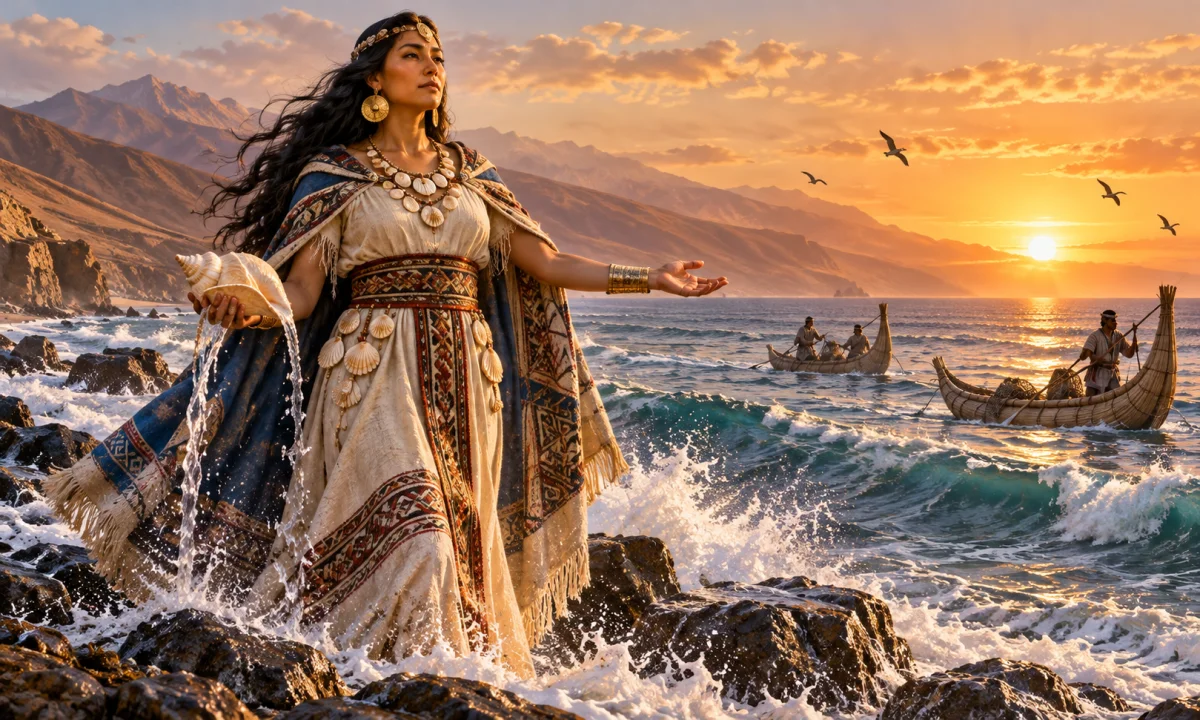
The best-known episode involving Urpay Huachac concerns fish kept in a pond or enclosed body of water. In the narrative, she possesses or cares for fish, which are presented as unusual and sacred rather than as ordinary domestic animals. A conflict involving the culture hero or creator-like being Cuniraya Huiracocha leads to the release of these fish into the sea.
The details differ in translation and interpretation, but the central event is consistent: Cuniraya acts against Urpay Huachac’s fish, and they enter the ocean. The story explains how fish came to inhabit the sea in abundance. It is therefore an etiological myth—a story explaining the origin or distribution of a natural feature. Urpay Huachac’s importance in this episode lies not only in her relationship to fish but also in the fact that her sacred, contained life becomes part of the wider marine world.
This movement from a pond or enclosed place into the ocean can be read in several ways. It may explain the transition from a local sacred resource to the immense abundance of the Pacific. It may also express the instability of relations among powerful huacas: sacred beings can create, protect, steal, release or transform living things. The story does not present nature as separate from divine or human action. Fish populations, the sea and the powers associated with them belong to a connected sacred landscape.
Some summaries state that Urpay Huachac was the mother of all fish. That wording conveys her mythic importance, but the surviving narrative is more specific and should not automatically be expanded into a complete doctrine of marine creation. The account clearly associates her with fish and their dispersal; whether she was universally regarded as the literal mother of every fish is less certain.
Relationship with Pachacamac
Urpay Huachac is most often identified as the wife of Pachacamac. This relationship places her within a coastal religious setting shaped by the movement of water, marine resources, fertility and sacred power. It also links her to one of the most important pre-Inca and Inca-period sanctuaries on the central Peruvian coast.
The word “wife” should not necessarily be understood through the model of a fixed family pantheon. Andean myths frequently describe relationships between huacas in ways that connect communities, places and powers. A divine marriage can indicate alliance, shared territory, ritual association or a relationship between complementary forces. In Urpay Huachac’s case, her connection with Pachacamac helps situate her among the sacred beings of the coastal world, but surviving evidence does not provide a full account of their household, cult or offspring.
Urpay Huachac is also mentioned in narratives involving Cuniraya Huiracocha. Cuniraya is a complex and disruptive figure who appears in several episodes of the Huarochirí traditions. He can be associated with creation and culture, but he is also a trickster-like presence whose actions produce conflict, transformations and changes in the world. His treatment of Urpay Huachac’s fish fits this broader pattern: an act of anger or disorder becomes part of an explanation for the natural world.
Attributes and symbolism
Unlike some better-known figures in Andean mythology, Urpay Huachac does not have a securely established physical appearance. There is no reliable ancient portrait that defines her body, clothing, ornaments or animal form. Images produced in modern books, games or illustrations are therefore interpretations rather than authenticated depictions of an ancient goddess.
Her principal attributes are relational:
- Fish and aquatic life: She is connected with fish kept in a sacred pond and with their release into the sea.
- The Pacific coastal environment: Her story belongs to a region where ocean resources, rivers, irrigation and changing ecological zones were central to human life.
- Generation and fertility: The interpretation of her name may refer to giving birth or bringing forth, although the exact linguistic meaning remains uncertain.
- Sacred containment and dispersal: The fish move from a bounded, exceptional place into the open ocean, creating a mythic account of abundance.
- Female sacred authority: Her role is not limited to being someone’s wife. She possesses a distinctive power and a mythically important relationship with living creatures.
The fish episode may also reflect the importance of water management in the Andes. Highland and coastal societies depended on springs, canals, wetlands, rivers and marine ecosystems, even though these environments were sharply different. Myths about the movement of animals and water can preserve cultural ideas about how ecological abundance is produced and controlled. It would be too speculative to claim that the story is simply an allegory of irrigation or fishing, but its imagery is rooted in a society attentive to the sacred power of water and food resources.
Variants and limits of the evidence
Information about Urpay Huachac is limited compared with the material available for figures such as Viracocha, Inti, Pachamama or Pachacamac. Much of what is said about her derives from a small number of passages in a colonial manuscript, and those passages survive through modern editions and translations. Translators may differ in how they render personal names, kinship terms, verbs and descriptions of sacred beings.
The manuscript itself also reflects a particular historical moment. Its traditions were recorded after the Spanish invasion, when indigenous communities were responding to political violence, Christian evangelization and the destruction or transformation of local shrines. The record is invaluable, but it should not be treated as a direct transcript of an unchanged pre-Columbian religion. Nor should every figure mentioned in it be assumed to have had the same meaning throughout the Andes.
For these reasons, several claims often repeated about Urpay Huachac remain uncertain. It is not securely established that she was worshipped everywhere as a major Inca goddess, that she ruled all oceans, or that she possessed a standard bird-headed or fish-tailed form. Such features may come from modern artistic reconstruction, generalized descriptions of Andean mythology or the blending of separate traditions.
Distinction from other Andean figures
Urpay Huachac should not be automatically identified with Pachamama. Pachamama is a broad Andean earth and fertility power whose traditions vary greatly by region and period. Both figures can be associated with fertility and the natural world, but Urpay Huachac’s surviving story is specifically tied to fish, the sea and the Huarochirí tradition.
She is also distinct from Mama Cocha, a water-related figure known in later descriptions of Andean religion. Mama Cocha is often characterized as a mother or power of waters, lakes and the sea, but the evidence for her identity, cult and relationship to other beings differs from the evidence concerning Urpay Huachac. Similar aquatic associations do not prove that the two names refer to the same being.
Urpay Huachac should likewise not be confused with Urpi, a Quechua term associated with a dove or pigeon and used in various cultural and poetic contexts. The resemblance between the words may be relevant to the interpretation of her name, but it does not establish a separate dove goddess or a direct equivalence between Urpay Huachac and every figure called Urpi.
Cultural significance
Urpay Huachac illustrates the regional and layered character of Andean mythology. Her story does not present a distant supernatural ruler detached from the environment. Instead, it connects a sacred woman, a powerful male huaca, a trickster-like being, fish, a pond and the ocean in one chain of events. The natural world is populated by histories, relationships and obligations.
Her importance also lies in the way a relatively brief episode can preserve a local explanation for marine abundance. The release of fish into the sea transforms a limited sacred possession into a resource of the broader world. In this sense, Urpay Huachac is associated with origins, fertility and ecological transformation, although these interpretations should remain grounded in the surviving story rather than expanded into an unsupported universal mythology.
Modern accounts sometimes present her as a fully defined “Inca fish goddess” with a fixed appearance, a broad portfolio and a place in a standardized pantheon. That presentation is convenient for popular storytelling, but the historical evidence is narrower. Urpay Huachac is most securely understood as a sacred female being of the Huarochirí tradition, connected to Pachacamac and to the mythic dispersal of fish into the sea.