WORLD
WORLD
Urcaguary
Urcaguary is a little-known figure associated with Inca mythology and the hidden wealth of the earth. In modern descriptions, Urcaguary is usually presented as a subterranean guardian of gold, silver, precious stones and other mineral treasures. The being is often given a serpentine form, although accounts differ considerably in its appearance, name and exact nature.
Unlike major Inca deities such as Inti, the Sun, or Viracocha, Urcaguary does not appear as a central figure in the best-known early colonial accounts of Inca religion. Information about Urcaguary is comparatively limited and is repeated mainly in later summaries of Andean mythology. For that reason, claims about the figure should be treated cautiously. Urcaguary belongs to the wider body of traditions connected with sacred mountains, caves, mines, serpents and the concealed riches of the Andean landscape, but the surviving evidence does not establish a single, universally accepted myth.
Origins and cultural setting
The Inca Empire developed within a much older Andean religious world. Before and during Inca rule, communities across the Andes treated mountains, springs, caves, stones, fields and unusual natural features as places of spiritual significance. Such sacred places were often known as huacas, a broad Quechua term for beings, objects or locations possessing sacred power. A huaca could be connected with ancestors, local origins, fertility, protection, political authority or the forces of the landscape.
Mineral wealth was not simply an economic resource. Gold and silver had ceremonial, political and religious importance, particularly in relation to the sun, temples, rulers and elite display. Mines and deep places could therefore be understood as powerful locations requiring respect. Offerings, ritual observances and restrictions surrounded many kinds of sacred sites, although the specific customs varied between communities and regions.
Within this setting, a being associated with underground treasure is culturally intelligible even when the surviving documentation is incomplete. Urcaguary can be understood as a personification or guardian of the earth's concealed wealth: a power that protects what lies below the surface and punishes careless or greedy intrusion. That interpretation reflects broader Andean ideas about reciprocity between humans, the land and supernatural forces, but it does not prove that every community understood Urcaguary in the same way.
The name and the question of identity
The spelling Urcaguary is common in English-language references, but Urkaguary and other forms also occur. The variation reflects the difficulty of representing Quechua and other Andean languages through Spanish and later European spelling conventions. The original linguistic form is not securely established in the material commonly available about the figure.
The meaning of the name is also uncertain. Some interpretations associate the first part with Andean words connected with mountains or high places, but a confident translation should not be presented as fact without a clear linguistic source. The name may have been altered, simplified or reinterpreted as it passed through different languages and retellings.
Urcaguary is sometimes called an Inca god. That label is convenient but may be too definite. The limited evidence does not show that Urcaguary occupied a position comparable to the empire-wide cults of major Inca gods. It may be more accurate to describe Urcaguary as a legendary or mythological guardian associated with the subterranean world and mineral riches, whose name became attached to Inca mythology in later accounts.
Appearance and attributes
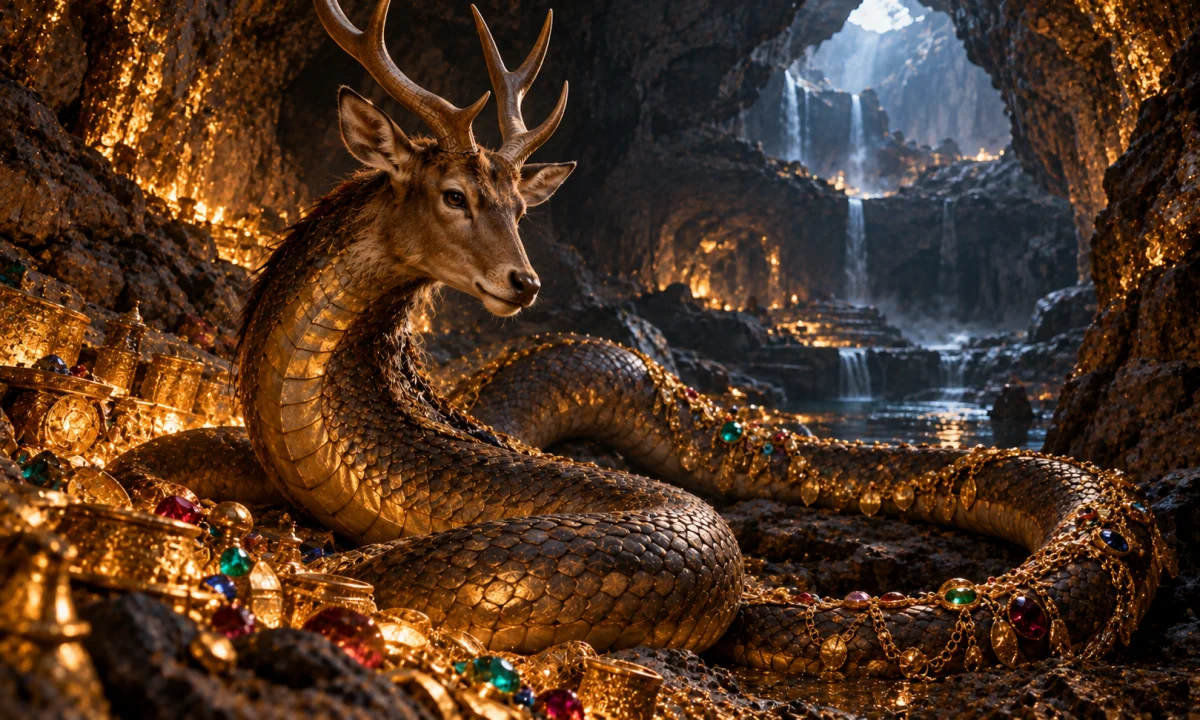
Descriptions of Urcaguary commonly emphasize a serpent-like body. The creature is often said to dwell beneath the ground, in caves or in places where precious metals and stones are hidden. Some modern accounts describe a long tail decorated with gold chains, jewels or other treasures. Other depictions give the being a partly human form or combine serpentine features with traits that are not consistent from one account to another.
There is no securely documented canonical image of Urcaguary comparable to the well-established iconography of certain major Andean deities. Illustrations found in modern books and online collections therefore frequently reflect artistic interpretation rather than an ancient image preserved in a known temple, manuscript or archaeological tradition. A picture of a horned, human-faced or otherwise elaborate treasure serpent should not automatically be treated as evidence for a fixed traditional appearance.
The association with precious metals is especially prominent in modern descriptions. Gold, silver and gemstones may appear on the body of the being, within its lair or as objects under its protection. These details express the idea that wealth is guarded below the earth by a power older and stronger than human ownership. The treasure is not necessarily presented as a reward waiting for anyone who can find it. In many folkloric interpretations, approaching it without permission is dangerous.
Urcaguary as a guardian of hidden wealth
The central role attributed to Urcaguary is guardianship. The being is generally described as protecting underground riches rather than creating them or distributing them freely. This makes Urcaguary different from a straightforward deity of prosperity. Its power is defensive and territorial: it watches over places concealed from ordinary people and keeps the boundary between the human world and the depths of the earth.
This role can be read in several ways. At a practical level, it reflects the danger and uncertainty of mining in mountainous terrain. At a religious level, it expresses the belief that natural wealth belongs within a network of obligations involving the land, ancestors, communities and sacred powers. At a moral level, the guardian warns against uncontrolled greed. The treasure hidden beneath the earth may be valuable, but it is also dangerous because it is connected with forces that humans do not control.
Such themes are widespread in Andean folklore, where mountains and subterranean places can be entrances to other realms. A cave may be a place of origin, a sanctuary, a burial location or a passage into a supernatural domain. A mine may likewise be treated as more than a workplace. It can be a dangerous opening into a living, sacred landscape, requiring offerings and respectful conduct.
Stories and narrative traditions
No single ancient Urcaguary story is securely preserved as a standard episode of Inca mythology. Modern accounts often describe the being's function and appearance but do not transmit a long, clearly attested narrative involving named companions, enemies or descendants. Stories that portray Urcaguary guarding a specific hoard, attacking treasure seekers or inhabiting a particular mountain may belong to later folklore, local tradition or modern elaboration rather than to a single empire-wide myth.
This lack of a fixed narrative is significant. Mythological figures are not always preserved through complete stories. Some survive as names, attributes, ritual associations or brief references in later compilations. In Urcaguary's case, the available tradition seems to have concentrated on the image of a subterranean treasure guardian. The absence of a well-attested story should not be filled with invented adventures or presented as though a canonical cycle existed.
Accounts may also vary because Andean religious traditions were highly regional. The Inca state incorporated many communities with their own sacred places, languages and local beings. Imperial religion did not erase every local tradition, and a figure connected with a mine, cave or mountain could have had significance in one area without being known throughout the Andes. A name recorded in a later source may consequently represent a local or transformed tradition rather than a universal Inca belief.
Relationship to serpents in Andean religion
Urcaguary's serpentine form invites comparison with Amaru, a powerful serpent or dragon-like being found in Andean religious and folkloric traditions. Amaru is associated in different contexts with water, the underworld, fertility, transformation and the forces linking different levels of the cosmos. Its meanings vary by region and period, and it should not automatically be identified with Urcaguary.
The two figures may resemble one another because serpents have a natural place in stories about the earth, caves, rivers and hidden realms. A snake moves close to the ground and can disappear into cracks or holes, making it a compelling symbol of subterranean power. Yet resemblance does not establish identity. Urcaguary is specifically associated in modern descriptions with mineral treasure and its protection, whereas Amaru has a broader and better-attested range of meanings in Andean cosmological interpretation.
Urcaguary should also not be confused with Supay. Supay is a complex Andean figure whose meanings changed substantially through colonial Christian interpretation. In some contexts, the name became associated with the devil, while earlier or local traditions could involve a powerful spirit of the dead or the underworld. Supay is not simply a treasure serpent, and the two figures belong to different strands of Andean religious representation.
Religious significance and interpretation
The most useful interpretation of Urcaguary is not as a simple equivalent of a European dragon guarding a hoard. The figure belongs to a landscape in which mountains, mines and underground spaces could possess agency and sacred force. Treasure was part of a relationship with the earth, not merely an object detached from its place of origin.
Urcaguary can therefore symbolize the limits of human possession. Gold and gemstones may be extracted, exchanged or used in ritual, but their existence remains dependent on the earth and on powers associated with it. A guardian of such wealth represents the idea that access must be controlled. The danger lies not only in the creature itself but also in violating the obligations attached to a sacred place.
It is important, however, to distinguish interpretation from documented ancient belief. Scholars and cultural historians may use Urcaguary to discuss themes of subterranean guardianship, Andean symbolism and the religious meaning of mining. Those themes are plausible within the broader Andean setting, but they should not be turned into claims about a fully documented cult or a single official Inca doctrine.
Sources, transmission and uncertainty
Knowledge of Inca religion comes from several kinds of evidence, including colonial-era chronicles, missionary writings, Quechua-language material, archaeology, art history, oral traditions and later ethnographic work. Each type of evidence has limitations. Colonial writers often misunderstood or reinterpreted Indigenous beliefs through European Christian categories. Oral traditions can preserve ancient themes while also changing over time. Later reference works may combine figures from different areas or repeat earlier summaries without providing a clear chain of transmission.
Urcaguary is particularly vulnerable to this problem because the figure is not prominent in the commonly cited early accounts of the Inca pantheon. Statements that describe Urcaguary as an official empire-wide god, assign a precise temple or festival to the being, or provide a detailed genealogy should therefore be treated with caution unless supported by strong evidence. The popular image is best regarded as a later, limited and variable tradition connected with Andean ideas about underground wealth.
This uncertainty does not make Urcaguary meaningless. It shows how mythological identities can survive unevenly. A figure may remain in circulation through short descriptions, local memories, artistic reconstructions and modern retellings even when the original context has not been preserved in detail. Responsible discussion keeps the attractive imagery while making clear what is known, what is inferred and what remains uncertain.
Modern representation
Urcaguary occasionally appears in modern lists of Inca gods, encyclopedias of mythical creatures, fantasy art and fictional settings involving ancient South America. Contemporary artists commonly emphasize a gigantic serpent covered in gold, a guardian beneath a mountain or a hybrid creature surrounding a treasure chamber. These images draw on the traditional association with subterranean riches but should be understood as modern interpretations rather than recovered ancient iconography.
Modern popular culture also tends to give Urcaguary a more clearly defined personality and mythology than the surviving evidence supports. Fiction may portray the being as a monster, a benevolent protector, an enemy of explorers or a supernatural source of wealth. Such uses are legitimate creative adaptations, but they are separate from the limited historical and folkloric record.
In cultural and historical contexts, Urcaguary is most accurately presented as a disputed and sparsely documented Andean figure associated chiefly with hidden mineral wealth, serpentine imagery and the sacred power of the earth. Its significance lies less in a large body of surviving stories than in the way the figure reflects enduring concerns about mountains, mines, treasure, danger and the boundaries between human society and the unseen world below it.