WORLD
WORLD
Supay
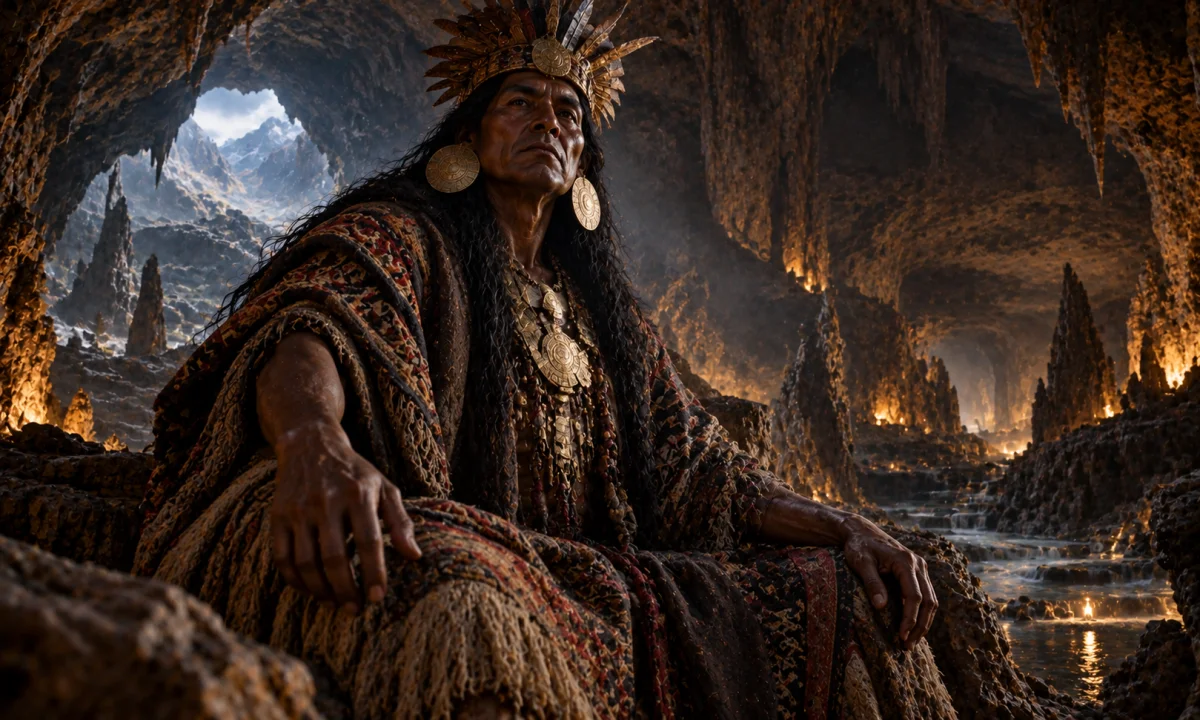
Supay is a name from the Quechua-speaking Andes that Spanish missionaries and later writers commonly translated as “devil,” “demon,” or “evil spirit.” It is often presented as an Inca god of death or the underworld, but that description is more certain in modern summaries than in the surviving evidence. Supay’s identity changed significantly as Indigenous religious ideas were recorded through Christian categories, and as local Andean traditions continued to develop after the Spanish conquest.
Origins and cultural setting
The word supay belongs to the religious vocabulary of the Andes, especially the Quechua-speaking regions of present-day Peru, Bolivia, Ecuador, and parts of Argentina and Chile. “Inca mythology” is a useful broad label, but it can be misleading if it suggests that Supay was a clearly defined god worshipped in a uniform way throughout the Inca Empire. The Inca state incorporated many local peoples and sacred traditions, and religious practices varied from one community to another.
Much of what is known about Andean religion comes from sources written after the Spanish invasion. Missionaries, colonial administrators, Indigenous authors writing in Spanish or Quechua, and later ethnographers all recorded religious terms and stories. These sources are valuable, but they do not provide a simple, untouched account of pre-conquest belief. Christian writers often classified unfamiliar beings as devils, idols, or demons. As a result, Supay may represent several related ideas rather than a single ancient deity with one fixed mythology.
Before and after the conquest, Andean communities maintained relationships with mountains, springs, caves, ancestors, the dead, animals, and the forces believed to animate places. Sacred beings were not always divided into the modern categories of “god,” “spirit,” and “demon.” A powerful being could be dangerous, generous, protective, or demanding according to the relationship established with it. This religious context is important when interpreting Supay.
The name Supay and its changing meaning
Early colonial Quechua vocabularies and religious writings use forms of supay in connection with spirits, the dead, and the Christian Devil. Spanish missionaries frequently used the word as a translation for “demon” or “devil,” while Quechua speakers could use it in a wider range of contexts. Spellings vary because colonial writers represented Quechua sounds according to Spanish conventions. Forms such as Supay, Zupay, and Supai can therefore appear in different records.
The term can also occur in compounds. Supay wasi, for example, has been used for “devil’s house” or “hell” in Christianized Quechua vocabulary. Such expressions show how the word was incorporated into a new religious framework. They do not, by themselves, prove that pre-Hispanic Andean people imagined a place identical to the Christian Hell or a ruler identical to Satan.
The meaning of Supay is consequently disputed. In some interpretations, Supay was an Indigenous spirit or power associated with the dead and with the hidden, dangerous aspects of the landscape. In others, the name mainly reflects the colonial use of Quechua vocabulary to describe the Devil. Both lines of interpretation must be considered, and neither should be treated as a complete explanation for every regional tradition.
Identity and classification
Modern reference works sometimes describe Supay as the Inca god of death, the ruler of the underworld, or a lord of darkness. These descriptions capture certain later portrayals, but the surviving evidence does not establish a single standardized Inca theology in which Supay held exactly these offices. There is no securely preserved pre-conquest epic devoted to Supay comparable to the major literary myth cycles of some other cultures.
A cautious description is that Supay is a Quechua Andean supernatural figure or category of spirit whose meaning became associated with death, the dead, dangerous places, subterranean powers, and the Christian Devil. Depending on the region and period, Supay may be treated as an individual being, a class of spirits, or a name applied to an adversarial supernatural force.
This uncertainty does not make Supay unimportant. It reveals how religious concepts can survive under colonial pressure by changing names, associations, and public forms. A word once connected with local spirit traditions could be used by missionaries to speak about Christian evil, while communities continued to attach it to older ideas about the dead, mountains, mines, and unseen powers.
Associations with death and the underworld
Supay is often connected with death and the realm of the dead. These associations have encouraged comparisons with an underworld ruler, but Andean ideas about death do not necessarily match the European image of a single infernal kingdom governed by a devil. Indigenous beliefs about the dead could involve ancestors, burial places, continuing obligations, and relationships between the living and the deceased.
In some accounts, Supay is described as a being dwelling below the earth or in a hidden realm. This imagery fits broader Andean ideas in which caves, mines, springs, and mountains may serve as entrances to powerful sacred spaces. The world beneath the surface was not simply a place of punishment. It could also be a source of fertility, minerals, water, ancestry, and transformation.
For this reason, Supay’s underworld associations can be ambivalent. The being may be feared as a bringer of illness, death, or misfortune, yet approached with offerings or respect. A spirit that controls access to wealth or protection cannot be understood only as an embodiment of moral evil. In many Andean religious settings, relationships with dangerous powers are managed through reciprocity, ritual attention, and avoidance rather than through a simple division between good and evil.
Supay, mines, and subterranean wealth
Later Andean traditions frequently associate Supay with mines and the underground world. Miners may regard the depths as inhabited by powerful beings who control mineral wealth and can punish disrespect. This association reflects the importance of mines as dangerous, sacred, and economically significant places. It should not automatically be projected back into every period of Inca religion.
In Bolivia, the figure most famously connected with miners is often called the Tío, or “Uncle.” The Tío is a modern Andean mine spirit whose imagery combines Indigenous ideas about subterranean powers with Catholic concepts of the Devil. Miners may offer coca, alcohol, cigarettes, or other gifts in rituals addressed to the Tío. The figure can be feared and respected as the owner or guardian of the mine.
The Tío is sometimes identified with Supay or described as a later form of the same underground power. That relationship varies by region and by interpretation. It is more accurate to say that the Tío and Supay belong to overlapping religious histories than to insist that they are always identical. The Tío is a distinct modern mine tradition, while Supay is an older and broader Quechua term with multiple colonial and regional meanings.
Appearance and powers
There is no universally agreed ancient description of Supay’s appearance. Popular illustrations often portray the figure as a horned, dark-skinned devil with claws, a tail, and a pitchfork. These features come chiefly from European and Christian demon imagery, as well as from later Andean festival costumes. They should not be presented as securely documented characteristics of a pre-Hispanic Inca being.
In later representations, Supay may appear as an imposing male spirit, a masked devil, or the master of a subterranean realm. The figure can possess supernatural strength, control hidden riches, cause illness or death, and punish those who violate sacred places. In some accounts, however, the same power can protect workers, grant prosperity, or mediate access to mineral wealth.
These contradictory qualities are not necessarily an inconsistency. Andean sacred beings are often understood through reciprocal relationships. A mountain, ancestor, or mine spirit may provide benefits while also demanding respect. Offerings and ritual obligations acknowledge that human survival depends on forces that cannot be completely controlled. Supay’s dangerous generosity fits this wider pattern better than the image of a purely malicious tempter.
Colonial Christianization
The Spanish conquest transformed the public language of Andean religion. Missionaries sought to suppress Indigenous ceremonies and redirect devotion toward Christianity. They needed Quechua words for concepts such as God, angel, saint, sin, demon, and Hell. Supay was consequently used in Christian teaching as a word for the Devil or for demonic beings.
This process had two effects. It gave Supay a strongly negative meaning in many written sources, and it encouraged later readers to assume that the figure had always been an Andean equivalent of Satan. At the same time, local traditions did not disappear. Indigenous religious practices could continue in concealed, adapted, or openly syncretic forms, linking Christian symbols with older ideas about sacred landscapes and reciprocal exchange.
The colonial use of the word also complicates attempts to reconstruct an original Inca belief. A missionary text may accurately record how Quechua speakers used a term in a Christian context, but it may not preserve the term’s earlier religious meaning. Conversely, later folklore may preserve genuine Indigenous patterns while also incorporating centuries of Catholic imagery. Supay must therefore be studied as a figure with a changing historical identity.
Supay in Andean festivals and dance
Supay is especially relevant to Andean masked dances and festivals in which devils, angels, miners, and other figures act out struggles between sacred and dangerous powers. The Bolivian Diablada is the best-known example. Its costumed devils appear in a Catholic-inflected drama associated with the Virgin of Socavón and with the mining culture of Oruro.
Names and roles in the Diablada vary. The principal devil may be called Lucifer, Supay, or another title depending on the version and local tradition. Female devil figures may be known by names such as China Supay. These festival characters are not straightforward survivals of an ancient Inca pantheon. They are products of a long process involving Indigenous ritual forms, Catholic religious theatre, mining communities, colonial history, and national cultural identity.
Festival devils can be frightening, comic, energetic, and visually magnificent at the same time. Their masks often have horns, fangs, bulging eyes, snakes, lizards, or other exaggerated features. Such imagery reflects Christian demonology and local artistic traditions rather than providing a literal portrait of an ancient Supay. The dance setting gives the figure a social and ceremonial role that differs from the role of a mine spirit or a word used for the Devil in a colonial vocabulary.
Relationships with other Andean beings
Supay is sometimes confused with several other Andean supernatural figures. The most important distinction is between Supay and Pachamama. Pachamama is broadly associated with the earth, fertility, nourishment, and the well-being of communities, although her meaning also varies across the Andes. She is not simply a female counterpart to Supay, and neither figure should be reduced to a Christian good-versus-evil pair.
Supay is also not identical to the apu. An apu is a sacred mountain or mountain spirit, and the term can refer to powerful beings connected with particular peaks. Some local traditions may connect subterranean powers, mountains, and Supay, but that does not make every apu a Supay. Nor is Supay automatically the same as every spirit of the dead or every being said to inhabit a cave or mine.
Another potentially confusing term is saqra, often translated in modern discussions as a devil, trickster, or mischievous spirit. Saqra figures are prominent in some Andean dances and may resemble Supay in costume or behavior. The terms can overlap in Christianized popular usage, but they are not interchangeable everywhere. Meanings depend on language, community, ritual setting, and historical period.
Cultural significance
Supay illustrates the difficulty of separating “mythology” from living religious history. The figure cannot be understood solely through a list of powers or a single story. Supay’s significance lies partly in the meeting of different systems of thought: pre-conquest Andean relationships with the dead and the landscape, Inca political religion, Catholic missionary language, mining traditions, and modern festival culture.
The figure also reflects the moral complexity of sacred power. In European Christian writing, the Devil is fundamentally opposed to God and represents sin. In Andean contexts associated with Supay, danger and usefulness may exist together. A subterranean power can threaten miners while also being approached as the source or guardian of wealth. Respect, exchange, and ritual caution may be more important than the question of whether the being is simply “good” or “evil.”
For Indigenous and Andean-descended communities, these traditions are not merely remnants of the Inca past. They may form part of contemporary celebrations, local religious practice, artistic expression, and debates about cultural identity. Treating Supay only as a mythological devil can erase the historical experiences through which the figure acquired its present meanings.
Supay in modern popular culture
Modern books, games, videos, and fantasy fiction often present Supay as a clearly defined demon, death god, or lord of the underworld. Such portrayals may draw on genuine Andean vocabulary, but they usually combine it with generic fantasy, European demonology, or invented mythology. A horned ruler with a fixed genealogy and a standardized set of powers belongs to modern adaptation unless a specific regional tradition supports those details.
Contemporary depictions can still be culturally meaningful when they acknowledge the figure’s layered history. The most responsible portrayals distinguish between colonial descriptions of Supay as the Devil, regional traditions involving mines and the dead, and the imaginative conventions of popular entertainment. Supay is not one unchanging Inca character but a name whose religious significance has been repeatedly reinterpreted across the Andes.