WORLD
WORLD
Umvelinqangi
Umvelinqangi is a supreme or creator figure in some Zulu religious traditions of southern Africa. The name is commonly associated with the “First One” or “First Origin,” and Umvelinqangi is often described as a heavenly power connected with creation, thunder, lightning, rain and the ordering of the world. Accounts differ, however. Zulu religious ideas were transmitted principally through oral tradition, and early written descriptions were produced by outsiders who did not always use Zulu concepts consistently. As a result, Umvelinqangi may appear in different sources as a creator deity, a sky god, a thunder being or a name closely associated with the highest divine power.
Origins and cultural setting
Umvelinqangi belongs to the religious traditions of the Zulu people, whose historic homeland lies mainly in present-day KwaZulu-Natal in South Africa. Zulu religion developed within a wider Nguni cultural environment and shares certain themes with neighbouring southern African traditions, although individual names and teachings should not automatically be treated as interchangeable.
Traditional Zulu religion recognises a relationship between the visible world, the natural forces that affect it and the realm of the ancestors. The living may honour deceased family members, often called amadlozi, who remain involved in the welfare of their descendants. Illness, misfortune, fertility, family conflict and other difficulties may be interpreted through relationships among people, ancestors and spiritual powers. Within this religious framework, a high creator or heavenly being can be understood as the source of existence, while ancestors have a more immediate role in family and community life.
There is no single Zulu scripture that provides a universally fixed account of Umvelinqangi. Knowledge of the figure comes from oral histories, religious practice, personal names, praise traditions and descriptions recorded by missionaries, colonial officials, linguists and later scholars. These records are valuable but must be read carefully. They may reflect the vocabulary of Christian theology, the assumptions of European observers or attempts to translate complex Zulu ideas into categories such as “god,” “spirit” or “devil.” Different informants and communities may also preserve different emphases.
The name and its meaning
The name is written in several ways, including Umvelinqangi and uMvelinqangi. The initial u- is part of the grammatical form used in isiZulu, and spelling may vary depending on whether a writer follows ordinary Zulu orthography, an older transcription system or an English-language reference work.
Umvelinqangi is often explained as meaning something like “the First One,” “the First to Appear” or “the First Origin.” Such translations are useful approximations rather than exact definitions. Zulu names can carry grammatical and philosophical meanings that are not fully conveyed by a short English gloss. The name presents the being as prior to ordinary creation or as the original source from which other things proceed.
The word should not be treated as a simple equivalent of the English word “God” in every context. Some descriptions use it for a distinct supreme being, while others place it within a group of names or concepts referring to the highest divine power. The meaning can therefore depend on the community, the period in which an account was recorded and the translator’s interpretation.
Identity and classification
Umvelinqangi is most often classified as a creator and sky deity. In accounts that distinguish him clearly from other beings, he stands above the world and is associated with the origin and maintenance of life. The sky is an important setting for his power because storms, lightning and rain are visible forces that influence crops, animals, travel and human safety.
Some descriptions call Umvelinqangi a god of thunder or lightning. This does not necessarily mean that thunder and lightning are merely his physical weapons in the manner of a character in a modern fantasy story. Rather, storms may be understood as signs of a powerful sacred presence. The attribution of storms to a divine being reflects the religious significance of weather and the dependence of communities on seasonal rain.
Other accounts give more emphasis to Umvelinqangi as an abstract or remote creator. In these interpretations, he is not primarily a character who appears in human form and participates in a long sequence of adventures. He is the originating power behind existence, while other spiritual beings, natural forces and ancestors occupy more immediate places in religious life.
Attributes and powers
Descriptions of Umvelinqangi commonly associate the figure with several broad powers:
- Creation: Umvelinqangi may be presented as the source of the world, life and the order of nature.
- The heavens: His realm is often placed above the earth, linking him with the sky and celestial power.
- Thunder and lightning: Storm phenomena can be interpreted as manifestations of divine strength or signs of displeasure.
- Rain and fertility: As a heavenly power, he may be connected indirectly with the rain on which agriculture, grazing and human survival depend.
- Supreme authority: In accounts that distinguish him from other spiritual beings, he occupies the highest level of the divine order.
These attributes should not be imagined as a rigid theological catalogue shared by every Zulu community. Oral traditions often preserve themes rather than a single standard profile. One narrator may stress creation, another thunder, and another the distance of the heavenly power from ordinary human affairs.
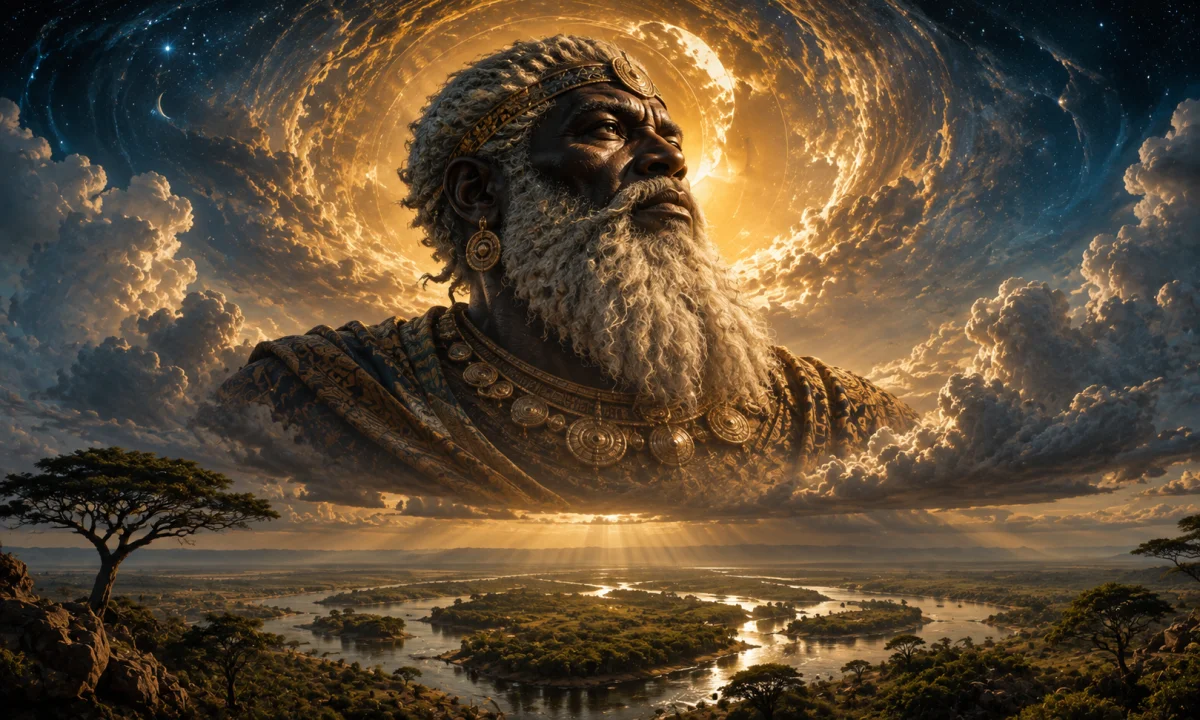
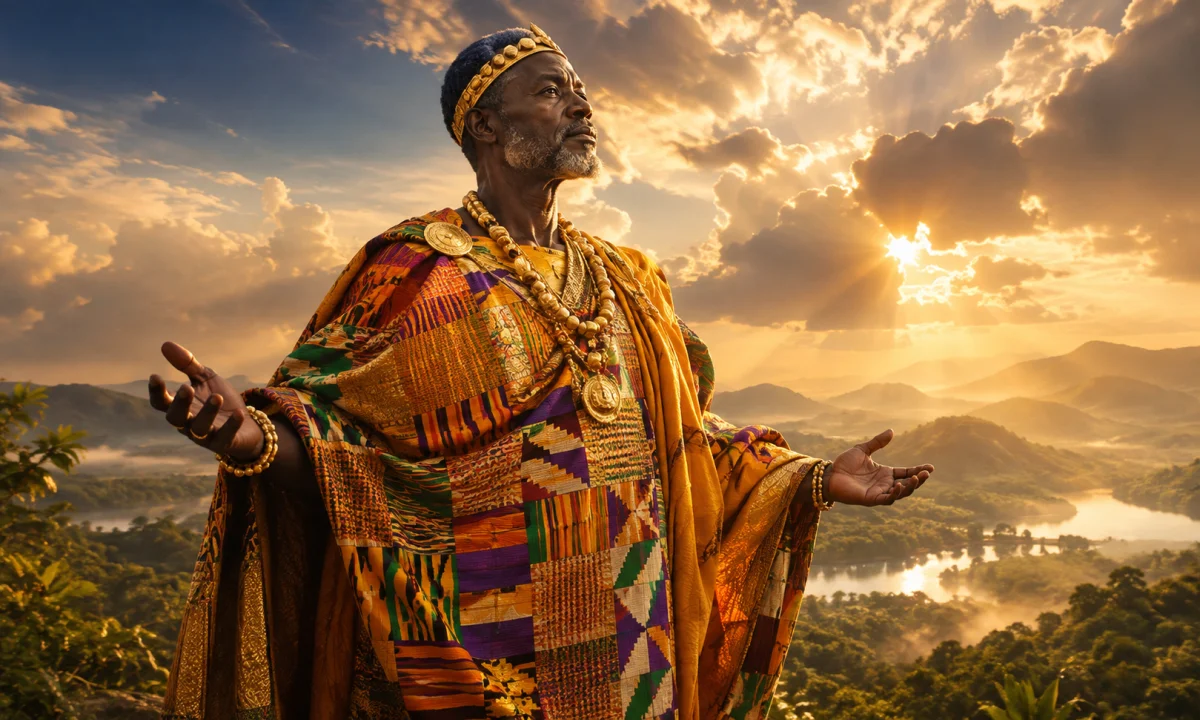
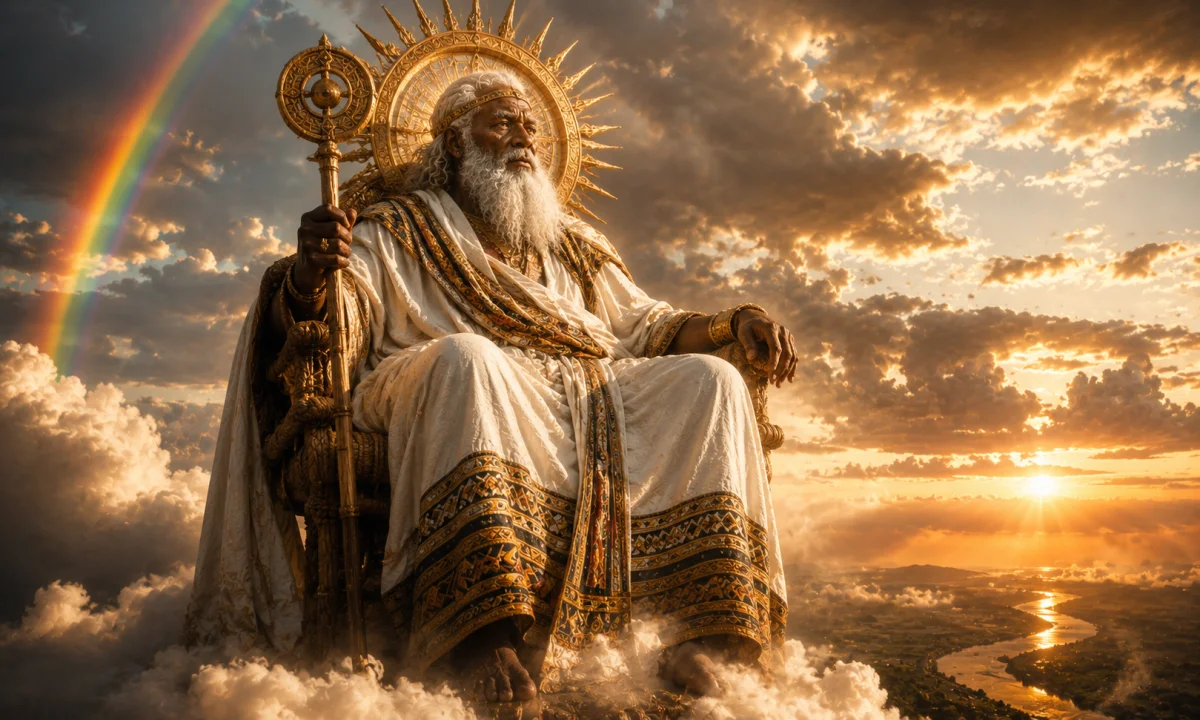
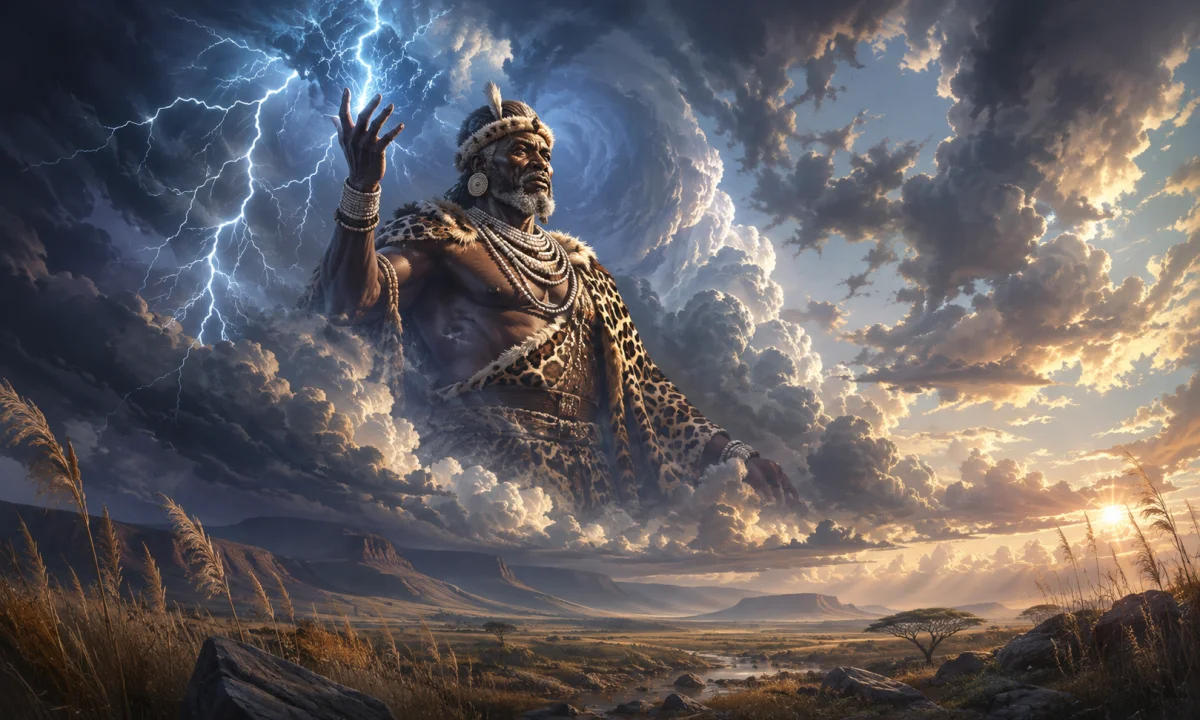
There is also no reliable basis for assigning Umvelinqangi a single universally accepted human appearance. Representations showing him as a bearded man, a warrior, a king or a personified storm god are usually artistic interpretations rather than features established throughout Zulu tradition. The figure’s importance often lies in power, origin and cosmic position rather than in a fixed bodily form.
Umvelinqangi and the ancestors
A distinction between Umvelinqangi and the ancestors is important. The amadlozi are deceased members of a family or lineage who may continue to influence the living. They can be approached through family ritual, consultation and offerings, and they are closely connected with ancestry, kinship and the moral obligations of the household. Umvelinqangi, by contrast, is associated with the original or highest divine power and is not simply an ancestral spirit.
This distinction does not mean that the two spheres are unrelated. A religious worldview can place a supreme creator at the top of existence while treating ancestors as active intermediaries or guardians within the human community. Some accounts suggest that the high deity is too remote for everyday contact, whereas ancestors are encountered through practical family concerns. Other accounts allow more direct recognition of the creator. The balance between these ideas varies in both description and practice.
Missionary writers sometimes compared the highest Zulu deity with the Christian God and described ancestor rites as a separate or lower form of religion. Such comparisons can obscure the way traditional Zulu religion connects family, land, morality, life, death and the sacred. The relationship between Umvelinqangi and the ancestors is better understood within Zulu concepts than through a simple opposition between “God” and “spirits.”
Umvelinqangi and Unkulunkulu
Umvelinqangi is frequently confused with Unkulunkulu, another major name in discussions of Zulu religion. The two figures are not automatically identical. In many accounts, Unkulunkulu is described as an ancestral first human, an origin figure or the progenitor of humanity. Stories may say that Unkulunkulu emerged from a reed or from a bed of reeds and brought human beings, animals or social knowledge into the world. This reed-origin tradition is associated primarily with Unkulunkulu, not with a universally established story about Umvelinqangi.
Other accounts and older written sources use the two names in overlapping ways. Some translators treated Unkulunkulu as the supreme creator, while others distinguished him from a higher heavenly being called Umvelinqangi. The overlap may result from regional variation, changes in usage, translation choices or attempts by informants and observers to fit different religious ideas into a single framework.
For that reason, it is safest to state that Umvelinqangi and Unkulunkulu are distinct in some traditions but conflated or closely related in others. A description of Unkulunkulu’s reed emergence should not automatically be presented as an episode in Umvelinqangi’s mythology. Likewise, calling Umvelinqangi simply “the same god as Unkulunkulu” erases an important area of uncertainty.
Thunder, lightning and dangerous power
Thunderstorms have a strong symbolic presence in many African religious traditions, but the specific meaning of lightning differs from culture to culture. In Zulu contexts, lightning can be associated with supernatural agency and with forces that require caution. A storm is not merely a weather event in a religious interpretation; it may signal that unseen powers are active in the world.
Some accounts connect lightning with the anger or judgement of a high deity. Others discuss lightning in relation to particular ritual specialists, witches, ancestors or dangerous beings. These explanations should not be collapsed into one doctrine. The presence of thunder and lightning in descriptions of Umvelinqangi indicates a connection with heavenly power, but it does not prove that every lightning strike was traditionally understood in exactly the same way.
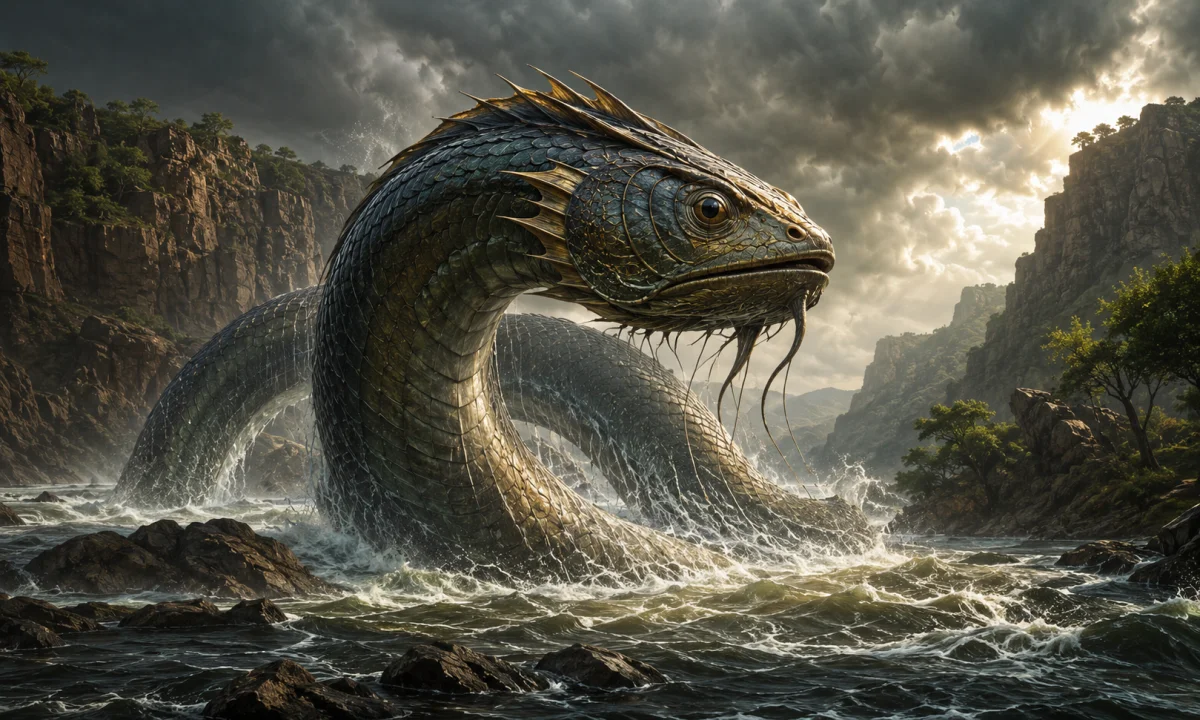
Umvelinqangi should also be distinguished from Inkanyamba, a storm-associated being found in Zulu and related regional traditions. Inkanyamba is often described in modern accounts as a great serpent or dragon-like creature associated with whirlwinds, storms or particular bodies of water. Although both figures may be linked with weather, they are not simply different names for one being. Inkanyamba belongs to a different set of stories and local associations, and representations of it as a serpent should not be used as a standard image of Umvelinqangi.
Stories and the absence of a fixed mythology
Compared with the mythologies of ancient Greece or Scandinavia, the surviving material about Umvelinqangi does not form a large, standardised cycle of written stories. The figure is more often encountered in statements about creation, divine authority, weather and the structure of the spiritual world than in a sequence of detailed adventures.
This absence of a fixed narrative should not be mistaken for a lack of mythology. Oral religious traditions do not need a canonical book or a single official story cycle. Teachings may be carried through praise names, ritual language, origin accounts, family memory and explanations of natural events. Narratives can also change according to the setting in which they are told. A story intended to explain human origins may emphasise Unkulunkulu, while a religious account of heavenly power may invoke Umvelinqangi.
Because the surviving records are uneven, it is difficult to identify a universally accepted list of relationships, enemies, offspring or heroic episodes involving Umvelinqangi. Claims that give the figure a detailed family tree or a complete set of exploits should be treated cautiously unless they can be tied to a specific tradition. Many such details come from modern retellings, generalised mythology websites or comparisons with unrelated thunder gods.
Religious significance
Umvelinqangi expresses the idea that the world has a first and highest source. The name’s emphasis on priority or firstness gives the figure a philosophical dimension: existence is not portrayed as an accidental collection of unrelated things but as something grounded in an originating power. The association with the sky places that origin beyond ordinary human society while keeping it connected to visible and life-giving natural processes.
The figure also illustrates the way religious traditions can combine cosmic distance with local spiritual relationships. A creator may be remote, while ancestors remain involved in everyday family affairs. Rain, thunder and lightning connect the remote heavens with the immediate needs and dangers of life on earth. This arrangement does not require a strict separation between “nature” and “religion”; weather, morality, ancestry and divine power can be interpreted as parts of one connected order.
Umvelinqangi is therefore significant not only as a name for a deity but also as evidence of the complexity of Zulu religious thought. The figure cannot be fully understood by reducing him to a generic “African sky god.” His identity is shaped by isiZulu language, Nguni history, oral transmission, relationships with ancestors and the problems created when foreign observers translated local religious concepts into their own categories.
Later representations
In contemporary books, classroom materials and online discussions, Umvelinqangi is often presented as a clearly defined African thunder god or as the Zulu equivalent of a supreme creator. These descriptions can make the subject easier to recognise, but they may also simplify genuine variation. Some modern illustrations give him the appearance of a storm warrior or an imposing sky king. Such images are creative reconstructions, not evidence of a traditional canonical appearance.
Modern cultural and religious discussions may revive or reinterpret older Zulu concepts as part of wider interest in Indigenous African spirituality. These interpretations can be meaningful within their own settings, but they should be distinguished from historical descriptions and from the diversity of present-day Zulu religious identity. Umvelinqangi is not a character with one universally standardised design, biography or set of powers comparable to a figure from a modern fictional franchise.