WORLD
WORLD
Ueuecoyotl
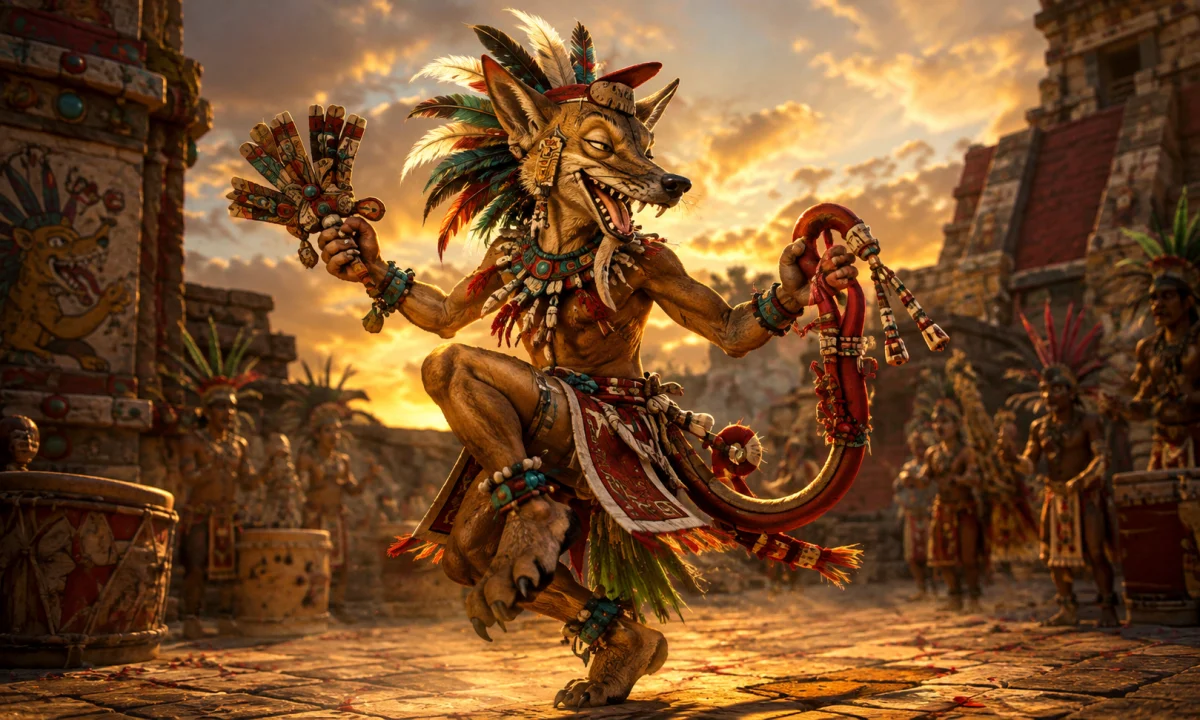
Ueuecoyotl, more commonly written Huehuecoyotl, is a figure of Nahua religious tradition often described as an old coyote associated with music, dancing, pleasure, and trickery. The name comes from Nahuatl huehue, meaning “old” or “ancient,” and coyotl, meaning “coyote.” He belongs to the religious world of central Mexico before and during the Spanish conquest, although the surviving evidence does not provide one complete, uncontested biography. Different colonial records and modern interpretations emphasize different aspects of his character.
Name and identity
Huehuecoyotl is the spelling most often used in modern English, while Ueuecoyotl reflects an older or alternate way of representing the same Nahuatl name. Nahuatl spelling was not standardized in the sixteenth century, and colonial writers recorded indigenous words according to different orthographic conventions. The two forms therefore generally refer to the same figure rather than to separate deities.
The literal meaning, “Old Coyote,” is significant. In Nahua thought, age could suggest experience, authority, or a connection with an earlier and less orderly condition of the world. At the same time, the coyote was a familiar animal known for adaptability, opportunism, nocturnal activity, and behavior that could appear both clever and disruptive. The name combines venerable age with the unpredictable character of a wild animal.
Huehuecoyotl is commonly classified as a trickster deity, but that label should be used carefully. “Trickster” is a comparative term applied by modern scholars to figures who cross boundaries, exploit confusion, challenge rules, or use wit rather than force. Nahua sources do not necessarily present Huehuecoyotl as a single, neatly defined equivalent of trickster figures from other cultures. He is better understood as a complex divine personality connected with artistic performance, pleasure, sexuality, deception, and social inversion.
Cultural setting
Huehuecoyotl belongs to the broader religious tradition of the Nahua-speaking peoples of central Mexico. The Mexica, often called the Aztecs, were one important Nahua society, but they were not the only people who recognized related religious concepts or deities. Religious practices differed among cities and communities, and a deity’s role could change according to local tradition.
Music, dance, song, costume, and public celebration had serious religious importance in Nahua society. They were not merely forms of entertainment separate from worship. Festivals included drumming, singing, processions, ritual dancing, impersonation of divine beings, and offerings. Performers could occupy special social and ceremonial roles, while songs preserved historical memory, praised rulers, addressed gods, or expressed reflections on death and impermanence.
Within this setting, Huehuecoyotl’s association with dancing and music does not make him a minor “party god” in the modern sense. Artistic performance could create a temporary world in which ordinary distinctions were rearranged. A dancer might represent a deity; a masked performer might take on an animal identity; a festival could permit forms of behavior that would normally be restricted. Huehuecoyotl’s reputation for revelry and rule-breaking reflects this ritual and social context.
Surviving evidence and its limitations
Knowledge of Huehuecoyotl comes mainly from colonial-period records and pictorial manuscripts produced after the Spanish invasion, often by Indigenous artists and informants working within a new colonial environment. Important classes of evidence include Nahuatl-language descriptions, illustrated manuscripts, calendrical material, and accounts of ceremonies and deities. These sources preserve valuable Indigenous information, but they do not form a single, consistent scripture or mythology.
Colonial descriptions were shaped by several factors. European friars often organized Nahua religion according to categories familiar from Christian theology, such as “gods,” “idols,” “devils,” and “sins.” Indigenous artists and scribes, meanwhile, worked with established visual conventions that do not always correspond directly to European descriptions. A manuscript image may identify a figure through costume, color, gesture, or emblem, while a written account may stress moral behavior or ritual function.
For this reason, statements about Huehuecoyotl should not be treated as though they come from one ancient narrative. No complete pre-conquest epic centered on him survives in a form that allows every detail of his character to be securely reconstructed. Some modern summaries combine information from different manuscripts, later interpretations, and general ideas about the coyote as a trickster. Those combinations can be suggestive, but they should not be mistaken for a single traditional story.
Attributes and associations
Music, song, and dance
Huehuecoyotl is particularly associated with music, dance, and festive performance. These connections place him among the divine powers linked with the arts and with the emotional energy of communal celebration. His presence in this sphere suggests movement, rhythm, improvisation, and the ability of performance to alter ordinary social relationships.
Dance in Nahua ritual could be disciplined and highly organized, involving groups of performers, prescribed movements, instruments, and festival schedules. Huehuecoyotl’s association with dance should therefore not be reduced to uncontrolled amusement. At the same time, his coyote identity gives the association an unruly dimension: he represents the performer who can imitate, disguise, mock, seduce, and move between different roles.
Music and dance also had an ambiguous moral reputation. They were essential to ceremony, yet colonial observers sometimes condemned particular forms of singing, drinking, erotic behavior, or festival conduct. The surviving descriptions may consequently present Huehuecoyotl through a mixture of Indigenous religious meaning and European moral judgment.
Trickery and boundary crossing
As an old coyote, Huehuecoyotl is linked with cleverness, deception, and the capacity to turn situations to his advantage. His trickster quality is not simply villainous. A trickster may expose hypocrisy, overturn an apparently fixed hierarchy, or reveal that social rules are less stable than they seem. Such a figure can be entertaining and dangerous at the same time.
Huehuecoyotl’s behavior is often interpreted through the coyote’s position between categories. The animal is wild but familiar, solitary but adaptable, and associated with both the margins and the settlements of human society. This makes the coyote a suitable emblem for a deity who crosses boundaries between order and disorder, seriousness and laughter, restraint and appetite, or respectable identity and disguise.
Sexuality and pleasure
Modern accounts frequently connect Huehuecoyotl with sexual freedom, erotic behavior, and sensual pleasure. There is a genuine basis for linking him with forms of pleasure and transgression, but the surviving evidence does not justify assigning every erotic or sexual story from Nahua mythology to him. Nor should he be described as a simple patron of unrestricted sexuality without qualification.
Nahua religious thought recognized powerful deities and ritual forces associated with fertility, desire, beauty, childbirth, and sexual activity. Huehuecoyotl’s particular character is more closely related to the social and moral ambiguity of pleasure: the enjoyment of music, feasting, dancing, drinking, flirtation, disguise, and behavior that can challenge accepted boundaries. His role is therefore best understood as part of a wider religious concern with appetite, self-control, and the risks of excess.
Appearance in visual tradition
Images identified as Huehuecoyotl commonly emphasize his animal nature, especially through a coyote head or coyote-like features. In some depictions he appears in a lively or dancing posture, reinforcing his connection with performance and movement. Manuscript art does not function like a modern portrait system, however. A figure’s identity may be communicated through a combination of body position, costume, color, headdress, and accompanying signs.
Visual details can vary among manuscripts, and not every coyote-headed or animal-associated figure should automatically be labeled Huehuecoyotl. Some images may represent another deity, a ritual impersonator, or a symbolic form rather than a separate divine person. Identifications therefore depend on the manuscript context and on comparison with written descriptions.
The coyote head is more than an illustration of the deity’s name. Animal forms in Mesoamerican religious art could indicate transformation, association, impersonation, or a particular power. A divine figure with animal features might not be imagined as a human being wearing a decorative mask. The image could express a genuine overlap between human, animal, and supernatural identities.
Stories, relationships, and variants
Huehuecoyotl is not preserved through one famous cycle of myths comparable to the best-known stories about Quetzalcoatl, Huitzilopochtli, or the creation of the Fifth Sun. His identity emerges more from descriptions of divine attributes, ritual associations, and manuscript imagery than from a large body of surviving narrative.
Some modern retellings describe him as a seducer, prankster, shapeshifter, or companion of other major deities. These descriptions often reflect reasonable interpretations of his associations, but the specific relationships are not equally secure. Claims that he was consistently a lover, spouse, child, rival, or servant of a particular deity should be treated cautiously unless they can be tied to a clearly identified traditional account.
Huehuecoyotl is sometimes connected in modern writing with Tezcatlipoca, partly because both figures can be associated with deception, uncertainty, and disruptive power. This does not mean that they are the same deity. Tezcatlipoca is a major creator, ruler, warrior, and cosmic power with a much broader and more extensively documented religious profile. Shared trickster-like qualities do not establish identity or a fixed family relationship.
He is also sometimes associated with Xochiquetzal, a goddess linked with beauty, sexuality, flowers, weaving, and fertility. Such comparisons arise from overlapping themes of sensuality and pleasure, but Huehuecoyotl should not automatically be presented as her consort. Nahua traditions contain many figures connected with erotic or festive themes, and thematic similarity is not proof of a personal relationship.
Religious meaning
Huehuecoyotl can be interpreted as a divine expression of the unstable relationship between social order and human desire. Festivals establish rules, but they can also create permitted moments of reversal and excess. Music can reinforce community, yet it can also stir emotion and encourage people to abandon their ordinary roles. A coyote can survive through intelligence and flexibility, but the same qualities can make him untrustworthy.
This combination helps explain why Huehuecoyotl is more complicated than a god of happiness or entertainment. Pleasure in Nahua religious life was powerful, and powerful things required management. Excessive drinking, sexual conduct, vanity, deception, and disorder could threaten individuals and communities. At the same time, ritual celebration, artistic skill, and controlled inversion were necessary parts of religious and civic life. Huehuecoyotl occupies the tension between those positions.
The adjective “old” also gives the name a distinctive force. He is not merely a young animal spirit or a generic coyote. The old coyote may represent accumulated cunning, an ability to outlast others, and knowledge gained through long experience. His age can make him seem venerable, but it can also intensify the sense that he has seen through social pretenses and knows how easily rules can be manipulated.
Distinction from other coyote figures
Coyotes appear in the stories and symbolism of many Indigenous peoples of North America and Mesoamerica. The presence of a coyote trickster in one tradition does not demonstrate a direct connection with every other coyote figure. Similar animal symbolism can arise independently from the animal’s widespread geographic range and recognizable behavior.
Huehuecoyotl should therefore not be merged with the coyote creator or trickster figures of Pueblo, Great Basin, Plains, or other Native American traditions. Those beings belong to distinct cultural systems, languages, ceremonial contexts, and bodies of story. They may share broad themes such as cleverness or boundary crossing, but they are not interchangeable.
He should also be distinguished from Itzpapalotl, the “Obsidian Butterfly,” from Xolotl, the dog- or canine-associated companion of Quetzalcoatl, and from Ahuiizotl, a dangerous water creature. Their animal features and supernatural qualities differ, even when modern illustrations or simplified lists place them together as “animal gods.” Xolotl in particular is sometimes confused with Huehuecoyotl because both may be represented with canine characteristics, but their names, myths, and religious functions are not the same.
Colonial and modern reception
During the colonial period, Spanish writers often interpreted Nahua festivals and sexual customs through Christian moral categories. A deity associated with dancing, pleasure, and deception could consequently be described in strongly negative terms. These accounts remain important historical evidence, but their judgments should not be treated as neutral descriptions of how Nahua worshippers understood the figure.
In modern scholarship and popular writing, Huehuecoyotl is often presented as an appealing example of the Mesoamerican trickster: ancient, playful, shape-changing, sexually ambiguous, and resistant to authority. Some of these themes are consistent with his name and documented associations, while others are expanded through comparative mythology or contemporary creative interpretation.
Modern fantasy novels, games, role-playing settings, artwork, and online mythology lists may use Huehuecoyotl as a coyote spirit, a comic deity, a shapeshifter, or a patron of musicians. Such portrayals can introduce the name to new audiences, but they are adaptations rather than direct evidence of pre-conquest belief. In particular, modern depictions that give him a fixed set of powers, a detailed genealogy, or a romantic relationship with another deity may be inventions or reconstructions rather than securely documented tradition.