WORLD

Huehuecoyotl
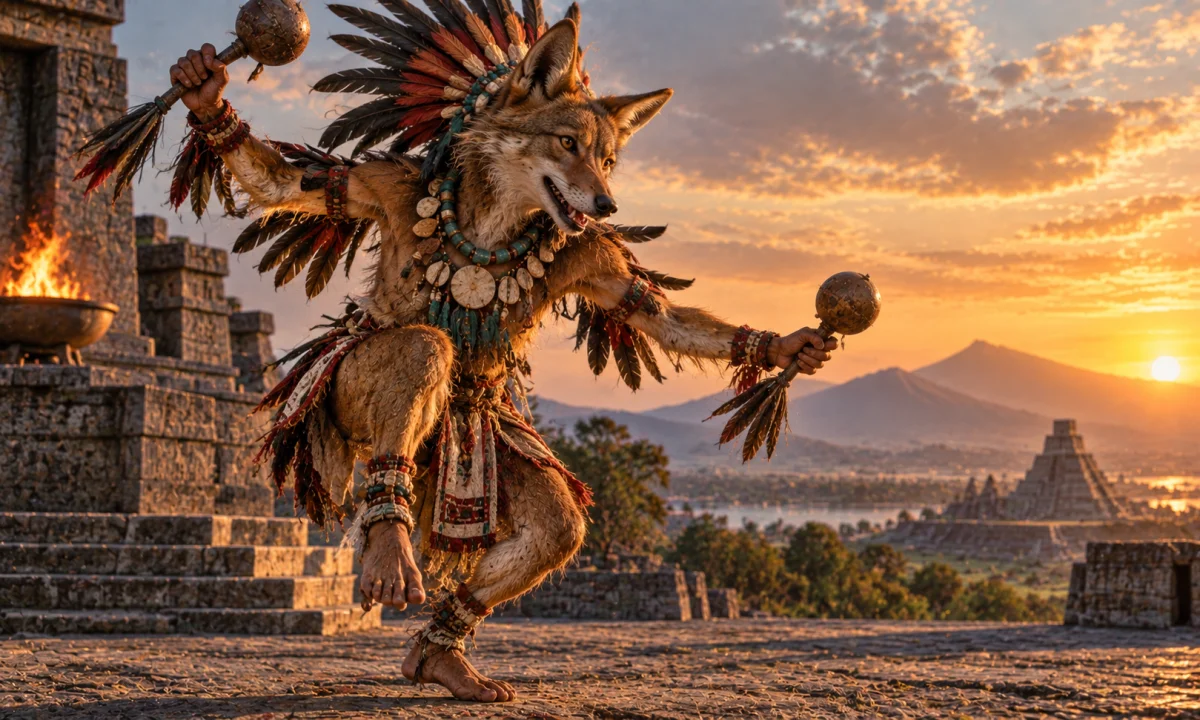
Huehuecoyotl, usually translated as “Old Coyote” or “Ancient Coyote,” is a figure associated with the religious traditions of central Mexico, especially the Nahua world often described through the broad label “Aztec.” He is connected with music, dance, festivity, erotic energy and the disruptive intelligence of the trickster. His image combines a coyote’s head or body with human posture and ritual costume. Unlike major gods such as Huitzilopochtli, Tlaloc or Quetzalcoatl, Huehuecoyotl is not known from one large, continuous cycle of myths. His identity is reconstructed from pictorial manuscripts, colonial descriptions and comparisons with related Nahua religious concepts, so some details commonly repeated about him remain uncertain.
Name and identity
The name Huehuecoyotl comes from Classical Nahuatl. Huehue means “old,” “ancient” or “elder,” while coyotl means “coyote.” The name can therefore suggest an old or venerable coyote rather than simply a large animal. Modern publications use several spellings, including Huehuecoyotl, Huehuecóyotl and Huēhuecōyōtl. The variation reflects different conventions for marking Nahuatl vowel length and stress.
“Aztec mythology” is a convenient modern term, but it can hide the diversity of the region. The Mexica of Tenochtitlan belonged to a wider Nahua-speaking cultural world that included many communities, local traditions and overlapping religious practices. A deity’s name, image or ritual association could therefore have different emphases in different places. Huehuecoyotl should not automatically be treated as a universally standardized god with exactly the same character across all Nahua communities.
He is often classified as a trickster figure, although that label is partly an analytical term created by modern scholars. A trickster may cross boundaries, mock authority, change roles and expose the instability of social rules. Huehuecoyotl’s coyote nature fits this pattern, but he was not merely a comic character. Music, dance, sexuality and public celebration were powerful religious activities, and the disorder associated with them could be both dangerous and sacred.
Historical and religious setting
Huehuecoyotl is best understood within the ritual culture of central Mexico before and during the early colonial period. Nahua religion did not sharply separate “mythology,” “religion,” performance and social life in the way modern categories often do. Songs, dances, costumes, painted books, festivals and calendrical ceremonies all helped communicate relationships between humans, animals, gods and cosmic forces.
The most important evidence for Huehuecoyotl comes from central Mexican pictorial manuscripts and from early colonial efforts to record Indigenous religion. Manuscripts such as the Codex Borgia and Codex Borbonicus preserve images of deities and calendrical beings, though their exact interpretation is not always certain. These books were created in a period of cultural transition, and the surviving manuscripts do not function like modern biographies. They provide ritual signs, costumes, symbols and sequences of images rather than a single written explanation of every figure.
Descriptions gathered by Spanish missionaries and Indigenous informants are also valuable, particularly the material associated with Bernardino de Sahagún and the Florentine Codex. However, colonial records must be read carefully. They were produced through translation, Christian comparison, changing political conditions and European attempts to organize Nahua beliefs according to unfamiliar categories. A name appearing in one manuscript or colonial account does not necessarily prove that every community understood the figure in the same way.
Appearance and iconography
Huehuecoyotl is commonly shown with coyote features, especially a coyote head, ears, muzzle or tail, combined with a human body. In some representations the figure appears to dance or adopt an energetic, asymmetrical pose. Such movement is important: the image does not present a quiet animal deity but a performer whose body communicates rhythm, vitality and deliberate disruption.
His costume may include ornaments, feathers, painted designs and elements associated with ritual performance. Particular details vary between manuscripts, and not every coyote-like figure can be identified with certainty as Huehuecoyotl. Painted books use a visual language in which animals, colors, gestures, headdresses and objects can all carry meaning. Identification therefore depends on the full image and its calendrical or ritual context, not only on the presence of a coyote head.
Musical instruments and dancing are among the associations most often linked with him. The figure may be discussed alongside drums, rattles, song and communal celebration, although individual representations do not always show every one of these objects. The coyote’s restless movement and vocal nature also make it an appropriate emblem for sound, performance and behavior that slips beyond ordinary restraint.
Music, dance and festivity
Huehuecoyotl’s strongest traditional associations are with music and dance. In Nahua society, music was not simply entertainment. Songs could preserve history, praise rulers, invoke sacred powers or accompany ceremonies. Dancing likewise formed part of public religious life and could express devotion, social identity and cosmic order.
At the same time, music and dance could create a temporary world in which ordinary status and behavior were loosened. Performers adopted costumes, imitated animals, used stylized movements and entered a ritual state different from everyday life. Huehuecoyotl represents this capacity for transformation. He belongs to the festive sphere, but the festival is not necessarily harmless: it can involve intoxication, sexual joking, mockery, competition and the temporary inversion of social expectations.
Some modern descriptions call him a god of pleasure or sexual indulgence. This reflects genuine associations between coyote imagery, erotic behavior and social transgression, but the evidence does not establish one simple, universally accepted doctrine about him. He should not be reduced to a “god of sex,” and claims that he had a fixed set of lovers or introduced particular sexual practices to humanity are often repeated without a clearly secure early source.
The coyote as a sacred and ambiguous animal
The coyote held an important place in the symbolic world of Mesoamerica. It was a familiar predator, scavenger and opportunistic animal, capable of surviving near human settlements while remaining wild. Its howl, intelligence and unpredictable behavior encouraged associations with night, wilderness, hunger, sexuality and cunning.
In central Mexican thought, animal forms did not necessarily indicate that a deity was simply an animal worshipped in isolation. A divine being could reveal itself through an animal, possess animal attributes or express a broader force through the animal’s habits. Huehuecoyotl’s coyote identity therefore points toward adaptability and boundary crossing. He belongs neither wholly to the human social order nor entirely to the untamed landscape.
The word coyote itself entered English through Spanish from Nahuatl, although English uses the word for the living animal rather than for Huehuecoyotl. The modern animal name should not be confused with the religious figure. Likewise, the presence of coyotes in Indigenous stories throughout North America does not mean that all coyote beings are versions of Huehuecoyotl. Similar animal symbolism can arise in different cultures without proving a direct historical relationship.
Stories and relationships
There is no single, securely preserved narrative about Huehuecoyotl comparable to the well-known stories of Quetzalcoatl, the creation of the Fifth Sun or the birth of Huitzilopochtli. Surviving evidence presents him more often as an iconographic and ritual figure than as the central character in a long myth. This absence is significant: it is better to acknowledge the limited evidence than to construct a complete biography from later summaries.
Some modern accounts connect Huehuecoyotl with Tezcatlipoca, presenting both as powerful tricksters or describing contests between them. The comparison is understandable because Tezcatlipoca is also associated with unpredictability, transformation and the testing of human beings. Nevertheless, a shared trickster quality does not establish that Huehuecoyotl was a subordinate, sibling, servant or regular opponent of Tezcatlipoca. Relationships between the two figures are not consistently documented across the surviving sources.
He is also sometimes grouped with deities connected to flowers, song and performance, especially Xochipilli and Macuilxochitl. These figures have overlapping associations, but they are not interchangeable. Xochipilli is strongly associated with flowers, beauty, music, dance and altered states, while Macuilxochitl has his own connections with music, games, pleasure and calendrical symbolism. Huehuecoyotl’s distinctive contribution is the coyote form and the particular combination of age, cleverness, festivity and transgression.
Calendrical and ritual associations
Nahua religious thought included several interlocking calendars. The tonalpohualli, a 260-day divinatory cycle, organized days through combinations of numbers and signs. Deities and supernatural beings could serve as patrons or influences within this system. Huehuecoyotl appears in calendrical and divinatory contexts, but the exact role assigned to him varies according to the manuscript and the interpretation of its imagery.
It is therefore risky to state that he was simply “the god of” one particular day sign or that every person born under a certain sign belonged to him. Calendrical images may represent lords of time, omens, patrons, ritual powers or symbolic combinations rather than exclusive ownership. Interpretations also differ because the surviving manuscripts are not all from the same place or period.
The calendar placed human conduct within a larger sacred pattern. A figure such as Huehuecoyotl could embody the opportunities and dangers of pleasure, cleverness and social freedom. His presence in ritual or calendrical imagery may have warned that skill and enjoyment can bring success, but can also produce excess, conflict or loss of control.
Gender, sexuality and social boundaries
Huehuecoyotl is frequently described in modern writing as sexually ambiguous, bisexual or connected with same-sex desire. These interpretations arise from the broader association of coyote figures with erotic license and from Nahua traditions in which performers, ritual roles and festive behavior could challenge ordinary gender expectations. Some colonial descriptions also record Indigenous categories of gender and sexuality, but those accounts are filtered through European moral vocabulary and do not map neatly onto modern identities.
The evidence does not support treating Huehuecoyotl as a straightforward equivalent of a modern LGBTQ identity, nor does it justify assuming that every mention of him concerned sexuality. His symbolism is broader: it includes bodily pleasure, performance, disguise, social inversion and the instability of fixed categories. Sexual themes may be part of that field of meaning without exhausting it.
This distinction matters because popular retellings often turn a complex religious figure into a simple emblem of either unrestricted sexuality or modern sexual identity. Such interpretations can be meaningful as contemporary readings, but they should be identified as interpretations rather than presented as undisputed statements about ancient Nahua belief.
Interpretation and cultural significance
Huehuecoyotl can be understood as a figure of licensed disorder. Festivals sometimes permit actions that would be unacceptable in ordinary circumstances, yet this permission is structured by ritual. The dancer does not merely break rules; the dancer enters a recognized setting in which rules are tested, inverted or made visible. Huehuecoyotl’s old coyote persona captures this tension between freedom and danger.
His age is also meaningful. “Old Coyote” suggests experience, cunning and long familiarity with human weakness. An elderly or ancient figure need not be solemn in the European sense. In this case, age may intensify the character’s authority as a worldly, knowing and difficult-to-deceive presence. The old coyote understands social conventions well enough to manipulate them.
The figure also illustrates how Nahua religious categories could overlap. Music was connected with flowers and poetry, bodily pleasure could accompany sacred festivals, and animal imagery could express human social behavior. Rather than separating sacred seriousness from comedy or sensuality, the tradition could treat laughter, dancing, disguise and excess as forces that needed ritual recognition.
Distinction from other coyote figures
Huehuecoyotl should not be confused with every deity, hero or spirit represented as a coyote. Coyotes appear in a variety of Mesoamerican stories and images, and the animal could function as an emblem of hunting, warfare, fertility, wilderness or deception. A coyote image alone is not enough to establish the identity Huehuecoyotl.
He is also distinct from Tezcatlipoca, despite their occasional comparison as unpredictable or disruptive powers. He should not be merged with Xolotl, the canine companion and transformative aspect associated with Quetzalcoatl, or with the many dog and canine beings connected with death and the underworld. These figures belong to different symbolic and mythic complexes. Similar animal features do not make them versions of one another.
Later reception
Huehuecoyotl has become more visible in modern books, websites, games and fantasy art because contemporary audiences are drawn to trickster gods, animal-headed beings and deities associated with music or sexual ambiguity. In these settings he may be portrayed as a playful shapeshifter, a patron of performers or a rebellious supernatural character. Such portrayals can draw inspiration from traditional themes, but they are modern adaptations rather than direct records of pre-Hispanic worship.
Modern interest is most responsible when it preserves the uncertainty of the evidence. Huehuecoyotl was not simply a cartoon trickster or a generic “Aztec coyote god.” He belongs to a complex religious world in which song, dance, animal identity, erotic energy and social inversion could all carry sacred significance. The surviving record reveals a vivid but partial figure, and that partiality is part of the historical reality of Huehuecoyotl.