WORLD
WORLD
Tzitzimitl
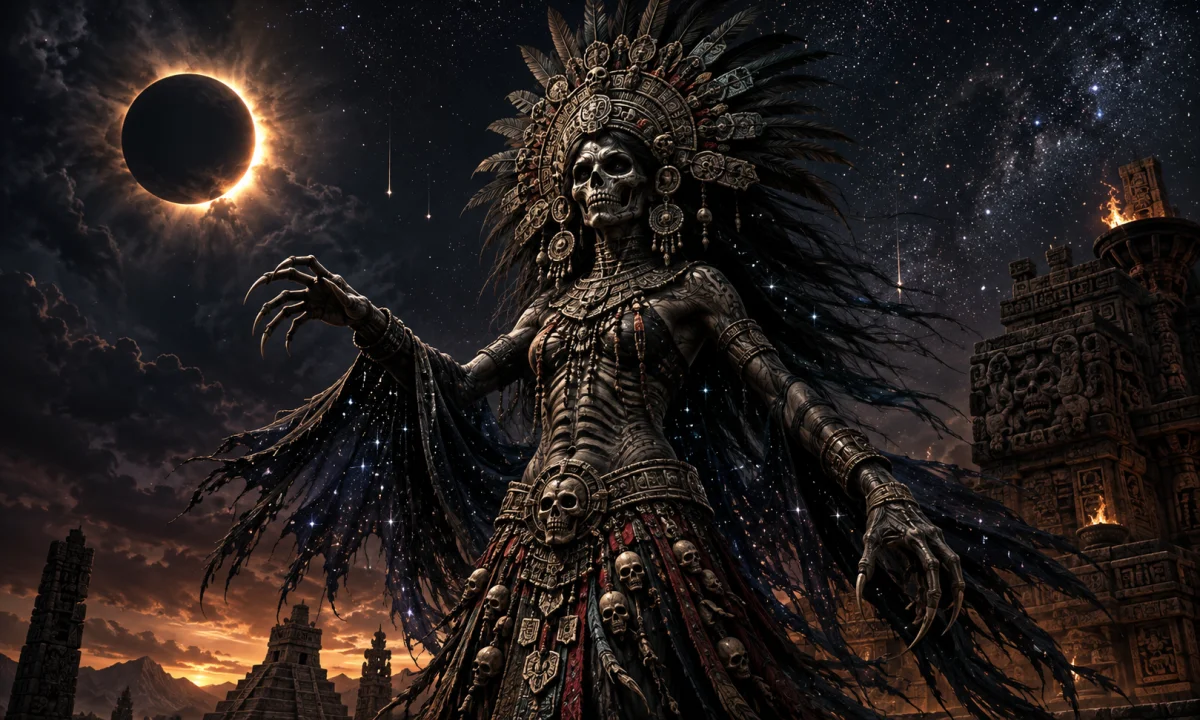
Tzitzimitl is the singular form of tzitzimime, a Nahuatl term for dangerous supernatural beings associated with the stars, darkness and cosmic disorder in central Mexican religious traditions. They are most often discussed within Mexica, commonly called Aztec, mythology, although the surviving evidence reflects a wider Mesoamerican cultural world and does not present one perfectly uniform doctrine. In European-language sources, tzitzimime are sometimes called “star demons” or “devils,” but these translations can be misleading. They were not simply equivalent to the Christian Devil. Rather, they belonged to a sacred cosmos in which celestial forces could be protective, destructive, or both depending on circumstances.
Name and identity
The word tzitzimitl is generally treated as singular, while tzitzimime is the plural. Nahuatl terms were recorded in several spelling systems after the Spanish conquest, so variants may appear in older publications. The precise meaning and etymology of the word remain debated, and no single translation fully captures its religious significance.
Colonial dictionaries and descriptions often present the tzitzimime as terrifying beings who lived among the stars or descended from the heavens. Some accounts describe them as female, while others use the term more broadly for hostile or ominous celestial powers. This variation may reflect differences between local traditions, the purposes of individual informants, and the way Spanish-speaking writers interpreted Nahuatl religious concepts.
The category should therefore not be understood as the name of one individual goddess or monster. Tzitzimitl is primarily a class or designation, although particular divine figures could be identified with, associated with, or described as tzitzimime. The singular form can also give the impression that the tradition centres on a single named being, which is not generally supported by the surviving evidence.
Religious setting in central Mexico
Mexica religion understood the universe as vulnerable to repeated destruction and renewal. The present world was believed to be the fifth age, or Fifth Sun, and its continuation depended on the movement of the sun, the proper performance of ritual, and the maintenance of relationships between humans and divine powers. The heavens were not a distant, peaceful realm separate from earthly life. Stars, planets, eclipses and other celestial events could signal danger and affect the fate of communities.
Within this setting, the tzitzimime represented one form of celestial threat. They were especially feared when the normal order of the sky appeared to fail. Darkness during an eclipse, the disappearance or weakening of the sun, and the transition between cosmic periods could all evoke the possibility that hostile beings might enter the human world.
The fear was not necessarily based on a permanent opposition between good and evil. Mesoamerican religious traditions often treated divine powers as capable of sustaining life while also bringing illness, warfare, famine or death. A being connected with the stars could possess immense sacred power without fitting neatly into the categories of benevolent deity and evil demon used in later European theology.
The New Fire ceremony and the end of an age
The clearest historical context for the tzitzimime is the Mexica ceremony known as the New Fire ceremony, performed at the end of a 52-year calendar cycle. This cycle, called a xiuhmolpilli, occurred when the 260-day ritual calendar and the 365-day solar calendar returned to the same combination. The completion of the cycle was a moment of profound uncertainty because people did not know whether the sun would rise again.
During the ceremony, household fires were extinguished throughout the region. Priests gathered at a sacred place, traditionally identified in colonial accounts with the Hill of the Star, and watched the sky. If the expected celestial sign appeared, a new fire was kindled and carried to temples and households. The renewed flame symbolized the continuation of the current world and the restoration of cosmic order.
The feared alternative was that the sun might fail to rise and that destructive forces would descend. Tzitzimime were among the beings associated with this catastrophe. Some accounts say they would come down from the sky to devour humanity if the cycle ended without the renewal of the sun. The ceremony therefore involved more than marking a date: it confronted the possibility of universal destruction and ritually secured another period of existence.
Modern descriptions sometimes portray the New Fire ceremony as if the tzitzimime were the sole cause of the danger. The sources are more complex. The ceremony concerned the continuation of the sun, the danger of cosmic instability and the fate of the world as a whole. Tzitzimime belong to this wider network of fears rather than functioning as a single villain in a simple myth.
Appearance and visual symbolism
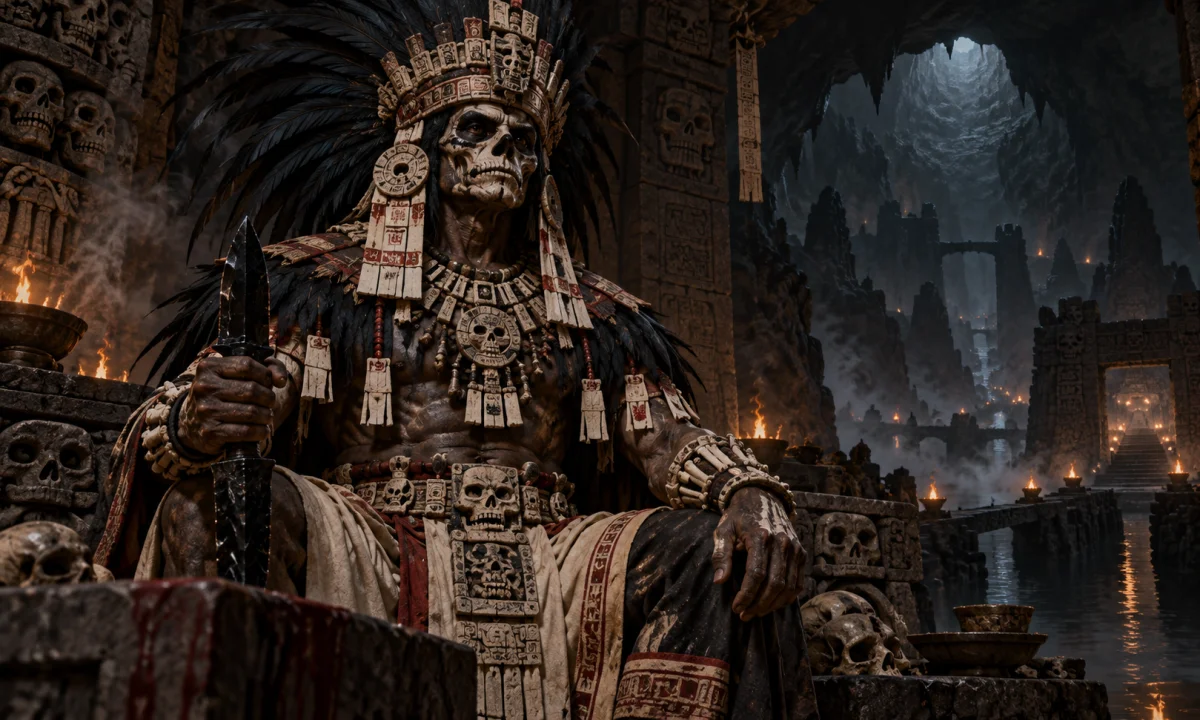
Written descriptions of the tzitzimime are inconsistent, and no surviving image can be identified with complete certainty as a universal representation of the entire class. They are often imagined as skeletal or corpse-like female beings, sometimes with claws, fangs, exposed bones or other frightening features. Such imagery reflects their association with death and cosmic danger, but it should not be treated as a fixed rule for every tzitzimitl.
Images of threatening female supernatural beings in central Mexican manuscripts and sculpture may show powerful goddesses, dead women, star beings or other categories that later writers grouped together. The visual language of bones and skeletal bodies was not limited to one mythological group. It could express death, sacrifice, the underworld, transformation and the destructive side of sacred power.
The stars themselves were central to the symbolic identity of the tzitzimime. Their presence in the night sky could be interpreted as the visible manifestation of powerful beings. When darkness spread during an eclipse or at the expected end of a calendar cycle, the celestial order seemed temporarily exposed as fragile. The tzitzimime embodied the danger hidden behind the ordinary appearance of the heavens.
Itzpapalotl and other associated figures
Itzpapalotl, whose name is commonly translated as “Obsidian Butterfly,” is frequently associated with the tzitzimime. She is a powerful and dangerous female deity connected in different sources with fire, the earth, sacrifice, warfare, hunting and the stars. Some accounts explicitly describe her as a tzitzimitl or place her among such beings, while other presentations treat her as a distinct goddess who shares important characteristics with them.
Itzpapalotl should not automatically be treated as the personal name of “the” Tzitzimitl. The relationship between the goddess and the broader category varies according to the source and interpretation. Her identity is more specific and more extensive than the general designation tzitzimitl, and reducing her to a generic star demon removes much of her religious complexity.
Other female deities have also been connected with the tzitzimime in modern discussions. These associations may arise from shared links with stars, fire, death, warfare or dangerous female power. However, similarity does not establish identity. Figures such as Citlalicue, a celestial mother figure in some traditions, and other star-related beings should not be merged with the tzitzimime without evidence from a particular source.
Eclipses, women and the danger of transformation
Colonial accounts record fears surrounding eclipses, especially solar eclipses. Because the sun appeared to be attacked, weakened or temporarily hidden, an eclipse could be interpreted as a sign that dangerous celestial forces were active. Some traditions held that pregnant women and unborn children were particularly vulnerable at such times. Protective actions reported in later sources include the use of obsidian blades or other objects, though the details and meanings vary.
These reports should be approached carefully. They were written down after the conquest, often by Spanish friars or colonial researchers working through Indigenous informants and translators. The records are valuable, but they do not provide a neutral transcript of pre-conquest belief. They may combine different regional practices, interpret Indigenous ideas through Christian categories, or preserve only fragments of traditions that had already changed.
The concern about pregnancy during an eclipse also belongs to a wider Mesoamerican pattern in which celestial events could affect bodily development, birth and social order. It does not mean that all Mexica communities followed the same practice or that every tradition described pregnant women in the same way. The evidence supports the existence of eclipse-related fears, but not a single standardized ritual system.
Tzitzimime and the dead
The frightening appearance of some tzitzimime has led to frequent comparisons with ghosts and the dead. Their associations with bones, night and danger certainly overlap with ideas about death, but they were not simply human spirits. They were celestial or divine powers whose danger concerned the stability of the world itself.
They are also distinct from the cihuateteo, the spirits of women who died during childbirth. Cihuateteo were believed in some traditions to appear at crossroads and could frighten or harm the living, particularly children. Because both groups may be represented as dangerous female figures and both can be linked with death, they are sometimes confused. Their origins, religious roles and mythological contexts are different.
They should likewise be distinguished from mictecacihuatl, the female ruler associated with the realm of the dead in Mexica tradition. Mictecacihuatl has a specific underworld role, whereas the tzitzimime are primarily connected with the heavens, stars and the threat of cosmic collapse. Shared skeletal imagery does not make them interchangeable.
Sources and historical uncertainty
Knowledge of the tzitzimime comes mainly from sources recorded in the sixteenth century, after the Spanish invasion of central Mexico. Important evidence includes Nahuatl-language accounts, colonial ethnographic descriptions and Indigenous pictorial manuscripts. These materials preserve valuable information about Mexica religion, but they do not constitute one complete pre-conquest mythological handbook.
Some descriptions were produced by missionaries who sought to classify Indigenous gods according to Christian concepts. In that setting, terms such as “devil,” “demon” or “evil spirit” could be applied to beings that did not occupy the same moral category as Christian demons. Other records were shaped by the interests of Spanish administrators, Indigenous artists, translators and local informants. The surviving picture is therefore both rich and incomplete.
The word “Aztec” also requires some care. It is a widely used modern label for the Nahuatl-speaking peoples of central Mexico, especially the Mexica-led empire. The traditions associated with the tzitzimime were not necessarily confined to the capital of Tenochtitlan, and related ideas may have existed among other communities in forms that cannot be reconstructed with certainty. It is safer to speak of Mexica and central Mexican religious traditions than to assume one identical belief throughout Mesoamerica.
Meaning and cultural significance
The tzitzimime express the precariousness of existence in a universe that required continual renewal. The sun did not simply shine because nature operated automatically; its movement was part of a sacred order that could fail. Rituals, offerings and calendar observances helped maintain the relationship between human society and the powers governing the cosmos.
They also reveal how celestial observation and religious imagination worked together. Stars and eclipses were real phenomena, but their meaning was interpreted through stories about creation, sacrifice, danger and renewal. The night sky could be both a source of knowledge and a realm of threat. Tzitzimime personified the fear that the apparent order of the heavens might break open.
Their often female representation is significant, but it should not be reduced to a simple idea that women or femininity were viewed as evil. Female divine figures in Mexica religion could be creators, mothers, warriors, earth powers, healers or destroyers. The tzitzimime belong to a group of powerful beings whose danger reflects their extraordinary sacred force, not merely a moral judgment about gender.
Later reception and modern usage
In modern writing, the tzitzimime often appear as “Aztec star demons,” skeletal women or monsters who descend during an eclipse or at the end of the world. This imagery draws on genuine features of the surviving traditions, but popular retellings usually simplify the differences between the plural class, individual goddesses and other dangerous female beings.
They have also been adapted in contemporary fantasy, horror, games, novels, visual art and other media. Such works may use the name for an army of monsters, a single villain or a general symbol of apocalyptic darkness. These adaptations are modern interpretations rather than direct evidence for Mexica religion. The historical tradition is better understood through its connections with celestial power, the New Fire ceremony, eclipses and the continuing vulnerability of the cosmic order.