WORLD
WORLD
Tunupa
Tunupa is a sacred and highly variable figure of the central Andes, associated especially with the highlands of present-day Bolivia and southern Peru. He is often described as a wandering creator, prophet, culture hero or powerful deity, and is sometimes identified with Viracocha. That identification is not universally accepted. The surviving accounts were written after the Spanish conquest, and they preserve traditions from several Andean communities rather than a single, fixed system of “Inca mythology”.
Tunupa is therefore best understood as a figure whose identity changed according to region, language and religious context. In some accounts he resembles a benevolent civiliser who teaches people and brings order to the world. In others he is linked with lightning, fire, water, volcanic power and violent transformations of the landscape. His name also appears in different forms, including Tonapa, Thunupa and Tunupa. These variants may reflect differences in pronunciation, transcription and local tradition.
Cultural setting and surviving traditions
The Andes did not have one unified mythology. Religious traditions varied among Quechua-, Aymara- and other-speaking communities, while the Inca state incorporated local sacred places and beings into a larger imperial system. A deity honoured in one valley could be associated with another figure, given a new title or interpreted through Inca ideas elsewhere.
Tunupa is especially important in traditions connected with the high plateau, or Altiplano, around Lake Titicaca and the present-day departments of La Paz, Oruro and Potosí in Bolivia. The figure also appears in material concerning southern Peru. Some traditions may predate Inca rule, while others were reshaped during the Inca period or under colonial Christian influence. It is not possible to assign every story to a precise historical period.
No pre-conquest Andean book sets out a complete mythology of Tunupa. Knowledge of the figure comes mainly from colonial texts, Indigenous accounts recorded in colonial settings, place names, ritual practices and later oral traditions. Important written evidence includes accounts by Spanish chroniclers and Indigenous or Indigenous-informed writers such as Juan de Santa Cruz Pachacuti Yamqui Salcamayhua. These records are valuable, but they are not neutral transcripts of ancient belief. Their authors worked within Christian colonial society and sometimes interpreted Andean beings through biblical, European or Inca political categories.
The term “Inca mythology” can consequently be misleading if it suggests that Tunupa was a uniform, empire-wide god with a single official legend. Tunupa is certainly relevant to the religious world encountered and incorporated by the Inca state, but the figure is often more closely connected with broader Aymara and highland Andean traditions than with a clearly defined imperial cult.
Name and identity
The spelling Tunupa is now common in English-language writing, but historical sources use several forms. Tonapa is particularly frequent in colonial documents. The relationship between these names is not always certain: they may be variant spellings of one figure, or they may reflect related but locally distinct traditions.
Some writers connect the name with words relating to thunder, lightning or fire, although the etymology is debated. A secure translation should therefore be avoided. The resemblance between Tunupa and terms for thunder in some Andean languages has encouraged interpretations of the figure as a storm or lightning deity, but linguistic similarities alone do not establish a single original meaning.
Tunupa has often been described as a creator, but this title requires qualification. In some colonial accounts, he participates in the ordering or renewal of the world; in others, he teaches human beings, judges their behaviour or transforms the landscape. He is not always presented as the sole creator of everything. In several traditions, the high god Viracocha occupies that role, while Tunupa is either an aspect, messenger, predecessor or alternative name.
Appearance and character
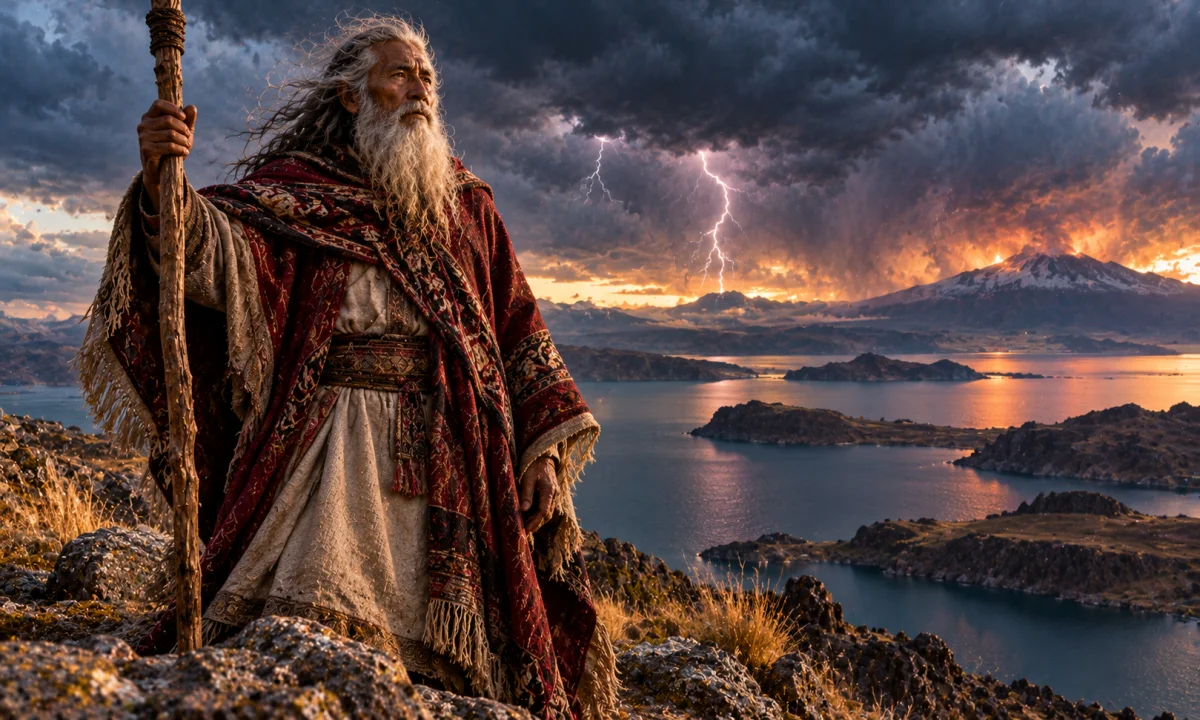
Stories about Tunupa commonly present him as a travelling holy man or powerful stranger. He may be depicted as an old man, a bearded visitor or a poorly dressed wanderer who carries a staff. He travels through communities, speaks to their inhabitants and demonstrates supernatural powers. These details have sometimes led modern writers to compare him with Christian missionaries or with the European image of a biblical prophet.
Such comparisons must be treated carefully. The colonial descriptions may have been influenced by Christian expectations, and the original traditions may not have imagined Tunupa in exactly the same way. A staff, a journey and a preaching role can also function as conventional signs of authority in many kinds of religious narrative. There is no firm evidence that Tunupa was simply an Andean version of Jesus, Saint Thomas or another Christian figure.
His character is equally variable. He can be compassionate toward the poor and hostile toward arrogant or immoral people. In some stories he is rejected, mocked or attacked by local communities. In others, he punishes social disorder through drought, flood, fire or transformation into stone. His moral role is not limited to kindness: he represents the power to establish order and to destroy what has become corrupt.
Wandering teacher and culture hero
One major group of traditions portrays Tunupa as a travelling culture hero. He visits settlements, teaches rules of conduct and condemns abuses such as drunkenness, sexual violence, greed or the mistreatment of strangers. He may also teach practical or sacred knowledge. The exact content of his teaching varies between accounts, and surviving sources do not provide a single curriculum attributed to him.
This wandering role places Tunupa within a broad Andean pattern of sacred visitors who move across an unsettled landscape and leave behind named places, shrines or social institutions. The journey links separate communities into a shared sacred geography. Mountains, springs, lakes and roads become evidence of the visitor’s passage, while unusual rocks and landforms may be explained as people or animals transformed by divine power.
In some narratives, Tunupa’s reception reveals the moral condition of a community. Those who offer hospitality are rewarded, while those who insult or refuse him are punished. The story thus gives religious meaning to the obligations of hospitality and reciprocity, values that were central to many Andean societies. Tunupa’s stranger status is significant: people cannot recognise his power from his appearance alone, and their treatment of him becomes a test.
Relationship with Viracocha
Tunupa is frequently linked with Viracocha, one of the best-known creator figures in accounts of Inca religion. The relationship is not consistent. Some colonial traditions make Tunupa another name for Viracocha or describe a figure called Tunupa Viracocha. Others distinguish them, presenting Tunupa as a travelling prophet while Viracocha remains a more remote creator. In still other interpretations, Tunupa may represent an older local deity whose attributes were absorbed into stories about Viracocha.
Viracocha itself is not a simple, universally fixed figure. Colonial writers recorded different versions of his origins, actions and relationships, and modern scholars continue to debate how Inca and local traditions were combined in those accounts. The association between the two figures is consequently important, but it should not be turned into an unquestioned equivalence.
Some popular accounts say that Tunupa was Viracocha’s son, companion or predecessor. These family relationships are not stable across the evidence and should not be treated as part of a universally accepted genealogy. Andean religious systems often allowed sacred beings to overlap in function or identity without requiring the rigid family structures familiar from classical Greek or Roman mythology.
Water, fire and the transformation of the land
Tunupa is strongly connected with opposing natural forces. He may be associated with fire, lightning and volcanic heat, but also with rain, lakes, rivers and the fertilising power of water. These associations reflect the environment of the Altiplano, where access to water is vital and where mountains, storms, salt flats and volcanoes dominate the landscape.
Several traditions connect Tunupa with Lake Titicaca or with journeys across its surrounding region. The stories differ in detail, but water often marks a moment of crisis, disappearance or transformation. A sacred traveller may be carried across the lake, enter the water, escape by boat or be swallowed by a flood. Such episodes should not be reduced to one standard myth, since different communities preserve different versions.
In some accounts, Tunupa’s suffering or tears help explain the presence of a lake or other body of water. Elsewhere, his anger or supernatural power produces floods and changes the shape of the land. These stories express a characteristic Andean understanding of landscape: mountains, lakes and springs are not passive scenery but active sacred powers with histories and relationships.
Tunupa and the volcano
The name Tunupa is also associated with Volcán Tunupa, a striking mountain on the northern edge of the Salar de Uyuni in Bolivia. The volcano and the surrounding salt flat are central to modern regional storytelling and Indigenous understandings of place. Some contemporary legends describe Tunupa as a woman or mother whose grief, anger or bodily transformation explains the salt flat and nearby mountains.
These stories are sometimes presented as if they were a single ancient Inca myth, but the evidence does not support such a simple claim. The gender and character of Tunupa vary between traditions, and the modern legends connected with the volcano should not automatically be treated as direct survivals of a pre-Columbian narrative. They may preserve older sacred ideas while also reflecting later local elaboration, Spanish influence, tourism and modern cultural revival.
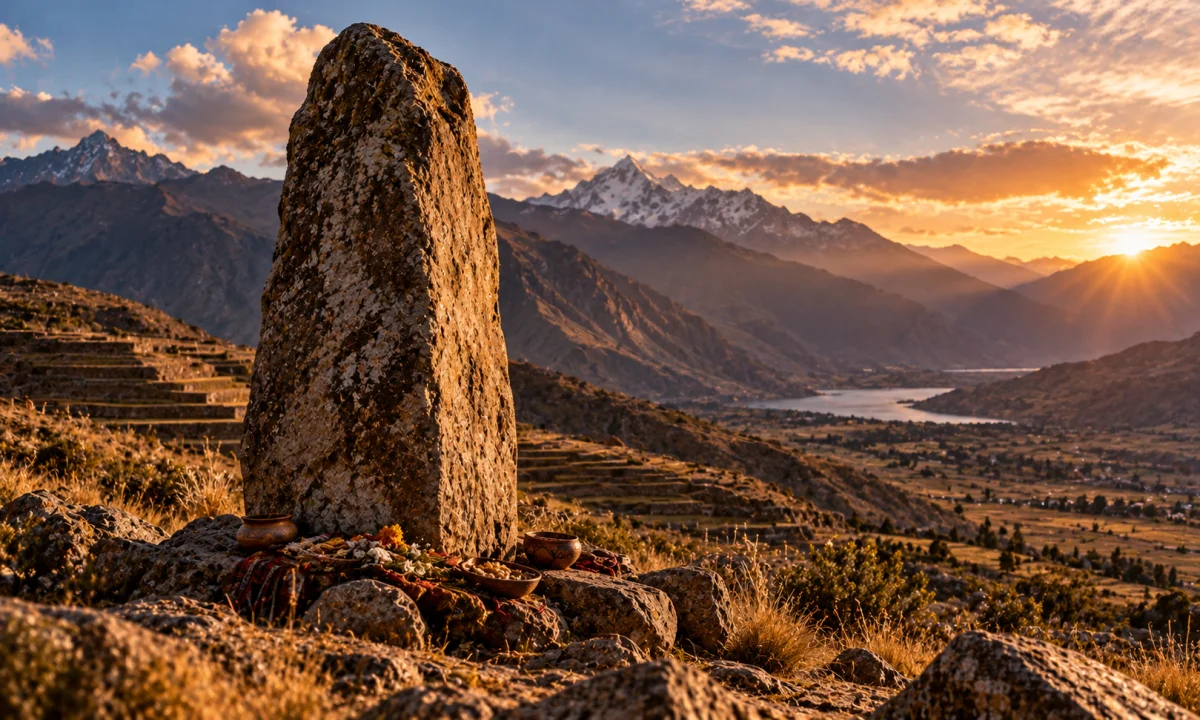
The volcano nevertheless demonstrates why Tunupa cannot be understood only as a character in a written story. In Andean religion, a named mountain may be a living sacred presence, a place of offerings and a participant in the moral and ecological life of a community. The relationship between the name Tunupa and the mountain is therefore part of a wider sacred geography, even where the details of the associated legend remain uncertain.
Miracles, punishment and sacred geography
Colonial accounts attribute various miracles to Tunupa. He may cause springs to appear, cross difficult terrain, control storms, change rocks or punish those who reject his message. Some people are turned into stone, animals or other landscape features. These transformations resemble stories associated with other Andean creator and culture-hero figures, making it difficult to determine which episodes originally belonged specifically to Tunupa.
Stories of punishment often explain the existence of ruins, unusual rocks or abandoned settlements. A community that behaves badly may be destroyed, petrified or overwhelmed by water. The narrative gives a moral interpretation to visible features of the landscape and reinforces the idea that sacred power remains present in places associated with catastrophe.
At the same time, Tunupa’s destructive aspects do not make him an “evil” being in a simple sense. Floods, storms, volcanic eruptions and transformations can be dangerous, but they may also clear away disorder and prepare the world for renewal. Andean religious thought commonly treats power as ambivalent: a mountain, storm or ancestor may protect a community while also demanding respect and proper ritual behaviour.
Christian interpretations and colonial change
Spanish missionaries and chroniclers often attempted to classify Andean beings as gods, demons, idols or distorted memories of biblical events. A wandering Tunupa who teaches morality could be interpreted as a pagan prophet, a demonic imitation of a Christian saint or evidence of supposed pre-Christian knowledge of Christianity. These interpretations tell us as much about colonial religious assumptions as they do about Tunupa’s earlier identity.
Some later writers connected Tunupa with the legend that the apostle Saint Thomas travelled in South America. This association is part of colonial and postcolonial interpretation, not established evidence that Tunupa was originally Saint Thomas. The supposed apostolic journey helped Europeans fit unfamiliar Andean traditions into a Christian historical framework.
Christianisation did not simply erase the figure. In many Andean communities, older sacred places and beings continued to be respected, sometimes under Christian names or alongside Christian practices. The resulting religious life was neither a wholly unchanged pre-conquest religion nor a complete replacement by Christianity. Tunupa belongs to this complex history of adaptation, translation and survival.
Distinguishing Tunupa from similar figures
Viracocha: Tunupa and Viracocha are sometimes identified, but they should not automatically be treated as the same being. Viracocha is generally described in colonial accounts as a creator or world-ordering figure, whereas Tunupa is particularly associated with wandering, teaching, punishment and the highland landscape. Some traditions combine these roles; others keep them separate.
Illapa: Illapa is a Quechua-associated thunder or storm deity often linked with lightning, rain and warfare. Because Tunupa is also connected in some interpretations with thunder, fire or storms, the two may be compared. They are not, however, securely identical. Illapa belongs to a different set of names and traditions, and the overlap may reflect shared Andean ideas about atmospheric power rather than one god under two names.
Supay: Supay is another figure frequently misunderstood in modern summaries. Colonial writers often translated or interpreted Supay through the Christian concept of the devil, while Indigenous usage could involve an underground being, a powerful spirit or a being connected with the dead. Supay is not simply another name for Tunupa.
Pachamama: Pachamama refers to an earth or world-mother presence deeply important in Andean religious life. Some modern retellings place Tunupa within a family of mountains and earth beings, but these relationships vary by region and should not be presented as a fixed pan-Andean genealogy.
Interpretation and significance
Tunupa’s importance lies partly in his resistance to a single classification. He may be a deity, culture hero, prophet, mountain presence or name attached to a group of related sacred traditions. This flexibility is not necessarily a sign of confusion in Andean religion. Sacred beings could be understood through several overlapping relationships: a local mountain might also be an ancestor, a deity might appear as a human traveller, and a creator figure might be identified with a regional power.
The figure also expresses the importance of movement and encounter. Tunupa arrives from elsewhere, crosses difficult terrain and enters communities whose people must decide how to treat a vulnerable-looking stranger. His journey connects human morality with the natural environment. Hospitality, reciprocity and respect for sacred powers become matters with consequences for rain, fertility, survival and the stability of the world.
For modern Indigenous communities and cultural institutions, Tunupa can represent the persistence of Andean memory and the sacred character of the highland landscape. Contemporary accounts may combine oral tradition, archaeology, colonial texts, local identity and environmental awareness. They should be approached as living interpretations rather than as museum pieces or perfectly preserved transcripts of an ancient Inca creed.