WORLD
WORLD
Tloquenahuaque
Tloquenahuaque is a name or epithet found in Nahua religious language and commonly associated with a supreme, all-encompassing divine power. It belongs to the religious world of central Mexico, especially the traditions recorded among Nahua-speaking peoples during and after the Spanish conquest. The name is often translated as “Lord of the Near and the Nigh,” “He Who Is Near and Beside,” or “the One who is close to all things.” Its exact identity, however, is not completely settled. Some interpretations identify Tloquenahuaque with the dual creator known as Ometeotl, while others treat the name as a title applied to more than one high deity or as a poetic description of the sacred power that sustains the universe.
Cultural setting
The religious traditions usually called Aztec mythology developed among several related Nahua-speaking communities. The Mexica of Tenochtitlan were the most powerful of these communities at the time of the Spanish invasion, but their religion was part of a wider Mesoamerican cultural environment. Nahua religious thought included many gods, sacred forces, ancestral powers, celestial bodies, natural phenomena and patron beings connected with particular communities or occupations.
These traditions did not always classify divine beings in the same way as modern Western religions. A figure could be a god, an aspect of a greater power, a sacred name, a manifestation or an epithet used in ritual and poetry. The Nahuatl word teotl, often translated as “god,” can also refer to a sacred or powerful presence. For that reason, describing Tloquenahuaque simply as an “Aztec god” can conceal the uncertainty surrounding the name and its religious function.
The surviving evidence was recorded mainly in the colonial period. Spanish missionaries, Indigenous scholars and bilingual writers documented Nahuatl prayers, songs, myths, histories and ritual knowledge. The most important materials include the Nahuatl texts associated with Bernardino de Sahagún, poetic manuscripts and other colonial compilations. These sources preserve valuable Indigenous concepts, but they were written after the conquest, under Christian influence and through processes of translation, selection and interpretation. They do not provide a single, standardized theology.
The name and its spelling
The name appears in several forms, including Tloque Nahuaque, Tloque Nahuaque with long-vowel markings in scholarly transcription, and forms such as Tloquenahuaque or Tloque-Nahuaque. Differences arise because colonial Spanish writers did not consistently record Nahuatl pronunciation or word division. Modern scholars may also use different orthographic systems.
The first element is generally connected with the idea of being near, beside or in the vicinity of something. The second element is associated with what is nearby, surrounding or accompanying. The combined expression is therefore commonly understood as referring to a power that is “near and beside” everything. English translations vary because the phrase is poetic and its grammar does not map neatly onto a single English expression.
“Lord of the Near and the Nigh” is the best-known traditional-style translation, but it should not be treated as a universally agreed literal definition. “The One Who Is Near and Beside” emphasizes presence rather than lordship, while “He Who Is Close to All Things” conveys the broader theological idea. These translations describe the name’s religious associations, not necessarily a complete biography or fixed personal identity.
Identity and relationship to Ometeotl
Tloquenahuaque is frequently connected with Ometeotl, the dual or twofold creator associated with Ometecuhtli and Omecihuatl. In many modern presentations of Nahua religion, Ometeotl is described as the supreme cosmic principle, with Tloquenahuaque presented as one of its names. This interpretation became especially influential through twentieth-century studies of Nahua philosophy and poetry.
According to this reading, Ometeotl embodies complementary duality: male and female, generative and receptive, celestial and earthly, or active and passive. Ometeotl is said to dwell in Omeyocan, the “Place of Duality,” above the visible heavens. Tloquenahuaque then expresses the same power as the presence that is close to all beings and things. Other associated names in this interpretive framework include Ipalnemoani, “He by Whom We Live,” and Moyocoyani, often translated as “the Self-Creator” or “the One Who Creates Himself.”
This identification is influential but not beyond dispute. The colonial sources do not present a single, consistent account in which Ometeotl, Tloquenahuaque and every related divine name are clearly defined as parts of one systematic theology. Some scholars argue that Ometeotl was a genuine high-level concept in Nahua thought. Others caution that the idea of a single supreme creator may have been shaped by Christian expectations or by modern efforts to reconstruct a coherent philosophical system from poetic and religious passages.
It is therefore more accurate to say that Tloquenahuaque was associated in some sources and interpretations with a supreme or foundational sacred power than to claim that every Nahua community worshipped a deity of this name in exactly the same way. The name may function as an epithet, a theological title or a poetic designation rather than as the name of an independent deity with a separate mythology.
Attributes and religious meaning
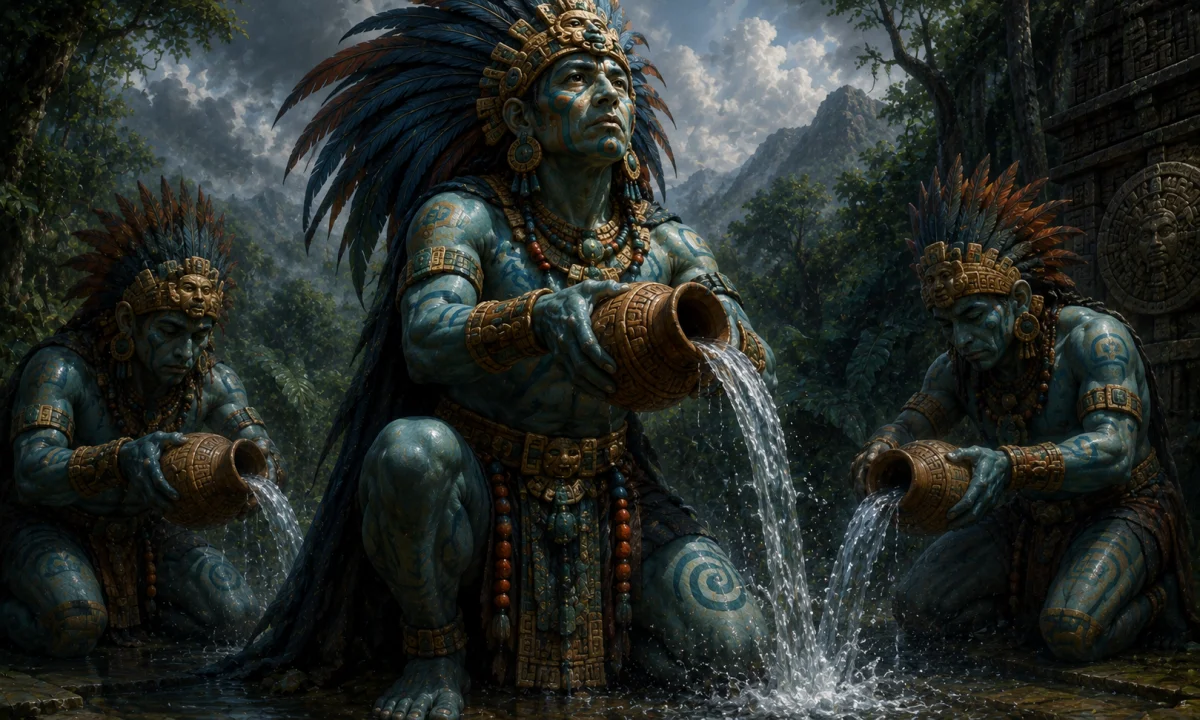
Tloquenahuaque is not known for a distinctive physical form. Unlike deities such as Tlaloc, whose imagery includes recognizable eyes, fangs and rain-related features, or Huitzilopochtli, who has a more developed mythic and ritual profile, Tloquenahuaque does not have a securely identified standard costume, sculpture or emblem. No particular surviving image can confidently be labelled as Tloquenahuaque.
The figure’s principal attribute is omnipresence or intimate proximity. The name suggests a sacred power that is not remote from the world. It is near the living, near the earth, near the heavens and near the processes through which life is maintained. This is reflected in related expressions that describe the divine as the source by whom human beings live or as the power present in all places.
The name can also imply a reality beyond ordinary sight. Nahua religious poetry often uses paradox, metaphor and shifting divine titles. The sacred may be both hidden and present, difficult to know yet active in every part of existence. Tloquenahuaque therefore fits a pattern of religious language in which a deity is not described only through appearance or dramatic action, but through a statement about the relationship between the sacred and the world.
Some modern writers call Tloquenahuaque the creator of the universe. Creation is certainly part of the wider theological interpretation associated with the name and with Ometeotl. Yet the surviving sources do not offer one universally accepted creation narrative centred specifically on Tloquenahuaque. The name is better understood as connected with cosmic generation, sustaining power and the ordering of existence than as the protagonist of a single canonical creation story.
Sources and surviving traditions
The name and related titles occur within the religious and poetic language preserved in colonial-era Nahuatl materials. Prayers and ritual speeches recorded in the traditions associated with Sahagún use elevated names for divine powers, including expressions concerning the one who is near and beside. Nahuatl poetry also invokes remote, hidden or all-encompassing sacred forces in language that can be difficult to classify according to modern categories such as “god,” “philosophical principle” or “creator.”
These texts must be read carefully. Some were collected by Christian missionaries who were attempting to understand Indigenous religion, while others were produced by Indigenous authors working within a colonial literary environment. A passage may preserve pre-conquest religious ideas, reinterpret them through Christian concepts, or combine several layers of tradition. The existence of a name in a colonial manuscript does not by itself prove that it had the same meaning or importance before the conquest.
There is also no clear evidence of a large, independent temple cult devoted specifically to Tloquenahuaque. The major state cults of central Mexico centred on deities such as Huitzilopochtli, Tlaloc, Tezcatlipoca and Quetzalcoatl, though these figures themselves had complex and overlapping identities. Tloquenahuaque appears more often in learned, poetic or theological contexts than in descriptions of a separate public priesthood and festival cycle.
Stories and relationships
Tloquenahuaque has no extensive cycle of myths comparable to the stories of the Five Suns, the birth and struggles of Huitzilopochtli, the deeds of Quetzalcoatl or the transformations of Tezcatlipoca. Its importance lies less in narrative episodes than in the meanings attached to the name.
Where the name is linked with Ometeotl, it belongs to a conception of primordial duality and cosmic generation. Ometeotl is described in some reconstructions as the source of the gods and of the ordered universe, while Tloquenahuaque emphasizes the same sacred power’s nearness to the created world. These relationships are interpretive rather than a universally fixed genealogy preserved in every source.
Tloquenahuaque should also not be treated as simply another name for every major creator or culture hero in Mesoamerican tradition. Quetzalcoatl, for example, is a complex deity associated with wind, learning, priesthood, rulership and creation traditions, and is also linked with the feathered serpent. Tezcatlipoca is associated with night, rulership, conflict, destiny, sorcery and the smoking mirror. Neither figure can be reduced to Tloquenahuaque merely because both may have cosmic or creator-related roles in different narratives.
Distinctions from similar figures
Ometeotl
Ometeotl is the figure most often identified with Tloquenahuaque in modern summaries. The connection is reasonable within one important scholarly interpretation, but the names are not automatically interchangeable in every source. Ometeotl highlights duality and generative complementarity; Tloquenahuaque highlights nearness and presence. They may represent related aspects of a high sacred reality, or they may reflect different strands of Nahua religious vocabulary.
Tezcatlipoca
Some confusion arises because Tezcatlipoca can also appear in sources as a powerful, invisible or omnipresent deity. He is called by several titles and has broad cosmic influence. Nevertheless, Tezcatlipoca has a distinct mythic and ritual profile, including associations with the night, the north, jaguars, rulership, fate and the smoking mirror. Tloquenahuaque should not be identified with Tezcatlipoca simply because both can be described as powerful or unseen.
Ipalnemoani and Moyocoyani
Ipalnemoani and Moyocoyani are other names frequently grouped with Tloquenahuaque in discussions of a supreme Nahua deity. Ipalnemoani refers to the one by whom life exists, while Moyocoyani is commonly understood as the self-originating or self-creating one. These expressions belong to a related field of theological and poetic language, but their exact relationship is debated. They should be presented as associated titles or concepts, not automatically as a confirmed list of alternate names.
Cultural significance
The importance of Tloquenahuaque lies in the possibility that Nahua religious thought included ways of speaking about a sacred reality that was more encompassing than any single anthropomorphic deity. The name points toward a divine presence that is close to the world rather than isolated from it. It also shows why Nahua religion cannot be represented accurately as either a simple collection of unrelated gods or a straightforward form of monotheism.
Nahua communities maintained many local and specialized cults, each with its own rituals, myths and forms of devotion. At the same time, religious poetry could speak of unity, origin, duality and the power behind life. Tloquenahuaque belongs to this meeting point between particular divine figures and broader reflections on existence. The term is especially valuable for understanding how language, ritual and philosophy interacted in Nahua traditions.
Later reception
In modern books, websites and popular spiritual writing, Tloquenahuaque is sometimes presented as an undisputed “supreme Aztec god,” an all-powerful creator or a direct equivalent of the Christian God. Such descriptions simplify a complicated body of evidence. They may reflect one scholarly reconstruction, a modern religious interpretation or a desire to create a single central deity for an otherwise diverse tradition.
There is no widely established modern popular-culture image of Tloquenahuaque comparable to the representations of Quetzalcoatl, Huitzilopochtli or Tezcatlipoca. When the name appears in contemporary fantasy, games or esoteric writing, its portrayal is usually an adaptation rather than a continuation of a clearly documented ancient cult. Traditional Nahua concepts should therefore be distinguished from later attempts to turn Tloquenahuaque into a standardized character with fixed powers, appearance and mythology.