WORLD
WORLD
Tiwanaku
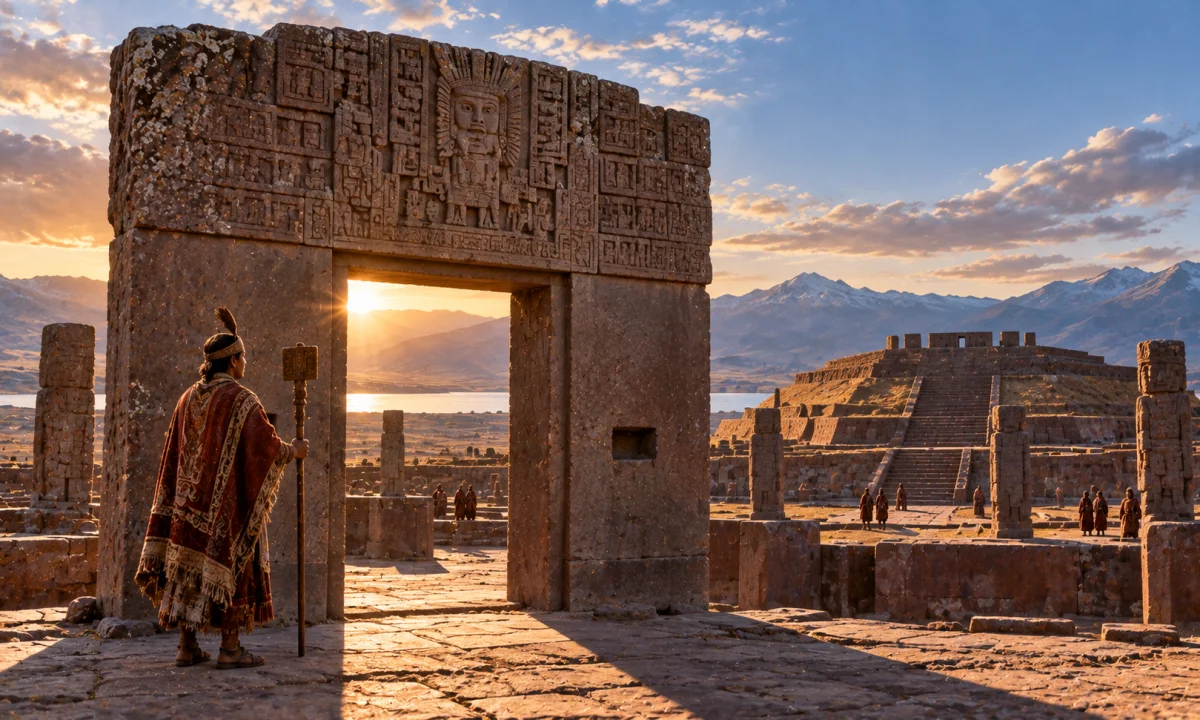
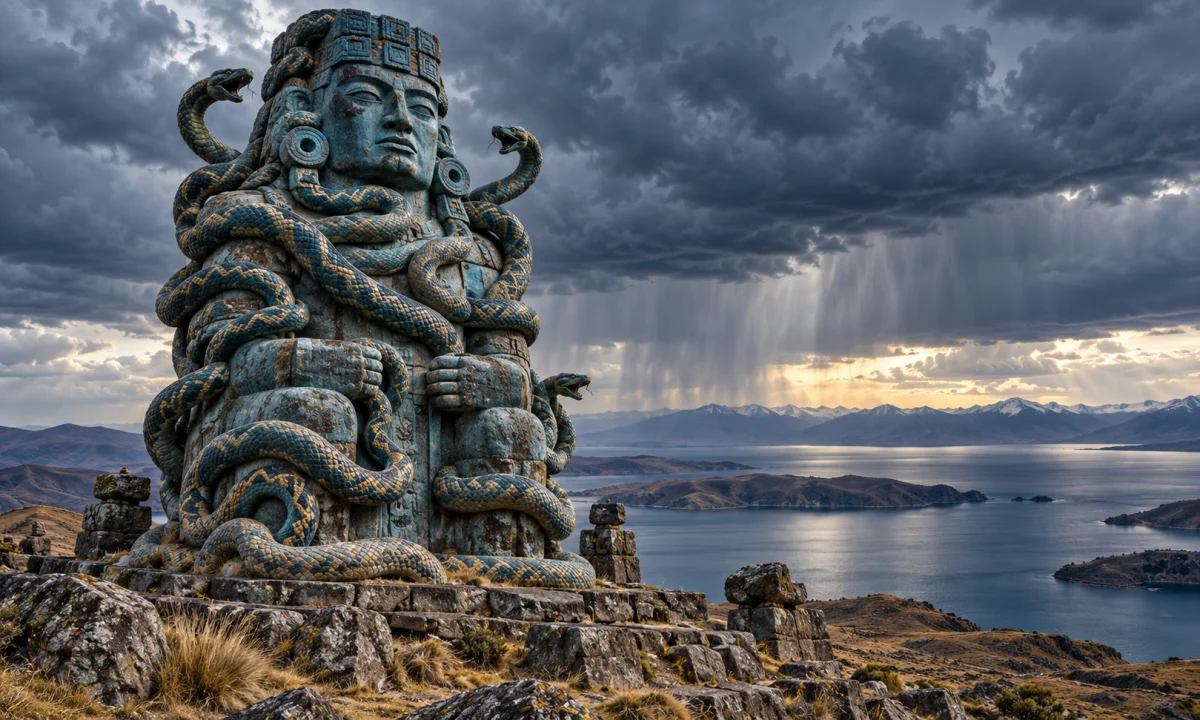
Tiwanaku is an ancient ceremonial and political centre in the southern Andes, near the southern shore of Lake Titicaca in present-day Bolivia. It is often placed under Inca mythology because later Inca traditions connected the region with creation stories and with the creator figure Viracocha. Tiwanaku itself, however, was not an Inca god, spirit or legendary hero. It was the centre of a powerful pre-Inca civilisation whose religious ideas and monuments strongly influenced later interpretations of the sacred landscape.
What Tiwanaku was
Tiwanaku was the capital or principal ceremonial centre of a civilisation that developed in the Lake Titicaca basin and spread across parts of modern Bolivia, southern Peru, northern Chile and north-western Argentina. Its greatest period of influence is usually placed between approximately the fifth and tenth centuries CE, although occupation in the area began much earlier and continued after the civilisation’s political centre declined.
The name is written in several ways, including Tiwanaku, Tiahuanaco and Tiahuanacu. Tiwanaku is commonly used in modern Bolivian and Aymara contexts, while Tiahuanaco became widespread through Spanish colonial spelling. The original meaning and linguistic history of the name remain uncertain. Proposed explanations have connected it with Aymara expressions, but no single etymology is universally accepted.
The site stood at a high altitude in a region shaped by Lake Titicaca, seasonal farming and difficult mountain environments. Its builders developed raised fields, irrigation systems, roads and long-distance exchange networks. Llamas played an important role in transport, while maize, potatoes, quinoa and other crops supported communities adapted to the high Andes.
Tiwanaku and the Inca tradition
The Inca Empire arose centuries after Tiwanaku’s political power had faded. The Inca incorporated the Lake Titicaca region into their empire during the fifteenth century, but they inherited a landscape already filled with ancient sanctuaries, monuments and local traditions. Inca accounts treated Tiwanaku as a place of exceptional antiquity and sacred importance.
Several colonial-era accounts describe Viracocha, the Inca creator figure, as travelling through or creating beings at places associated with Lake Titicaca and Tiwanaku. These accounts were recorded after the Spanish conquest and differ in their details. They should not be treated as direct records of Tiwanaku religion. They reveal how Inca and Indigenous informants understood the ancient site within later creation narratives, rather than providing a complete account of the beliefs held by Tiwanaku’s original inhabitants.
The association between Tiwanaku and Inca mythology is therefore historical and interpretive. Tiwanaku influenced the sacred geography that the Inca encountered, while Inca traditions supplied some of the stories through which later observers tried to explain the ruins. There is no reliable evidence that the Tiwanaku people worshipped Viracocha under that name, or that their religious system was simply an early form of Inca religion.
The ceremonial landscape
The monumental centre of Tiwanaku contains platforms, courtyards, temples, carved stones and carefully fitted masonry. Important structures include the Akapana, a stepped platform or pyramid; the Kalasasaya, a large enclosed ceremonial complex; the Semi-subterranean Temple; and Pumapunku, a monumental architectural complex famous for its precisely cut stone blocks.
The site’s layout appears to have been connected with ritual movement, public ceremonies and the organisation of political authority. Some spaces may have been accessible to large gatherings, while others were more restricted. The architecture also demonstrates an understanding of astronomical alignments, although the exact purposes of individual alignments remain debated and should not automatically be interpreted as a complete calendar or observatory.
Tiwanaku’s religious life was probably inseparable from its political structure. Monumental construction required labour, planning and the ability to organise resources across a broad territory. Ceremonies held at the capital may have confirmed the authority of rulers and ritual specialists while bringing together communities from different ecological zones.
The Gateway of the Sun and the staff figure
The most famous Tiwanaku monument is the Gateway of the Sun, a single stone gateway decorated with a central frontal figure and rows of smaller winged or masked beings. The central figure holds objects that resemble staffs, and rays or other features extend from the face. Because of this imagery, scholars and popular writers often call the figure the Staff God or Staff Deity.
“Staff God” is a modern scholarly label, not a name preserved in a Tiwanaku text. Tiwanaku left no securely deciphered writing system that identifies its deities or explains the meaning of the Gateway of the Sun. The central image has therefore been compared with religious figures on other Andean objects, including earlier imagery from the region. Some researchers see a long-lasting Andean tradition of a powerful frontal deity or celestial figure; others stress that similar motifs may have changed meaning across time and cultures.
The figure has sometimes been identified directly with Viracocha. That identification is popular but not proven. The Gateway of the Sun was created many centuries before the Inca Empire, and there is no surviving Tiwanaku inscription naming the image. It is more accurate to say that later interpretations have connected the figure with Viracocha because both have been associated with creation, authority and the Lake Titicaca region.
The surrounding figures may represent attendants, supernatural beings, ancestors, or participants in a ritual procession. Their wings, masks, elaborate headdresses and unusual bodily forms suggest that they belong to a symbolic world different from ordinary human society. Exact interpretations remain uncertain because the images are not accompanied by explanatory texts.
Animals, ancestors and sacred power
Tiwanaku art includes representations of humans, felines, camelids, birds and composite beings. The puma, condor and serpent became especially important symbols in later descriptions of Andean religious thought, although their meanings were not identical in every period or culture. Some Tiwanaku carvings combine human and animal features, perhaps expressing transformation, sacred ancestry or access to a supernatural realm.
Animals were important in both practical and ritual life. Llamas provided transport, wool and meat, and camelids also appear in offerings and ceremonial contexts. The puma and other predators may have signified strength, danger or elite power. Birds may have been associated with the upper world, while serpentine forms could evoke water, fertility or movement between different levels of existence. These interpretations are plausible comparisons rather than fixed translations of a Tiwanaku religious vocabulary.
Archaeological discoveries indicate that offerings were made at Tiwanaku. Researchers have found objects, food remains, animal remains and other deposits in ceremonial settings. Some human remains have also been interpreted as evidence of violent sacrifice or ritual death, but the number, circumstances and meaning of such discoveries are debated. It is not accurate to portray Tiwanaku religion as defined by sacrifice without acknowledging the limits of the evidence.
Creation stories and Lake Titicaca
Lake Titicaca held great importance in later Andean traditions. In Inca mythology, the lake was associated with the origins of the Inca royal ancestors, especially the emergence of Manco Cápac and Mama Ocllo in versions of the origin story recorded during the colonial period. Other traditions connect the lake with Viracocha’s acts of creation, the making of the sun and moon, or the ordering of the world after a destructive age.
These stories are not identical, and they were recorded by Spanish writers who depended on Indigenous testimony, translation and their own efforts to fit unfamiliar beliefs into European categories. Some accounts emphasise Viracocha as a creator who made people and sent them into different regions. Others focus on the emergence of the Inca ancestors. The stories should be treated as varied colonial records of Inca and Andean traditions, not as a single canonical Tiwanaku myth.
Tiwanaku’s proximity to the lake helped make it a natural focus for later sacred geography. Its ancient buildings, enormous stones and apparent age encouraged the Inca and later communities to regard it as a place linked with primordial events. This later reverence does not prove that the original Tiwanaku population told the same creation stories.
Decline and continuing influence
Tiwanaku’s central political system weakened around the tenth century CE, probably through a combination of environmental, economic and political pressures. Changes in rainfall appear to have affected agriculture in the high-altitude basin, although the precise relationship between climate change and political decline is still studied. The end of central authority did not mean that all communities vanished. People continued to live in the wider region, and Tiwanaku traditions persisted in altered forms.
After Tiwanaku’s decline, other Andean societies occupied or interacted with the region. The Wari civilisation had earlier maintained connections with Tiwanaku, and later local groups developed their own political and religious traditions. When the Inca expanded around Lake Titicaca, they encountered communities with distinct histories rather than an empty or abandoned sacred landscape.
Tiwanaku’s influence can be seen in the circulation of artistic styles, ritual objects and architectural ideas across the southern Andes. Its imagery may have contributed to later Andean concepts of sacred authority, but direct lines of transmission are difficult to establish. Similar symbols could be reused with new meanings, and a motif found in Tiwanaku art cannot automatically be assigned the meaning it held in Inca religion.
Distinguishing Tiwanaku from Viracocha
Tiwanaku is a civilisation and archaeological centre. Viracocha is a creator figure in traditions associated primarily with the Inca and wider Andean religious world. The two are connected through geography, later storytelling and modern interpretation, but they are not interchangeable.
Viracocha is described in colonial accounts as a powerful creator who shaped the world, made human beings or established social order. His name and attributes vary across sources and regional traditions. Some modern accounts present him as the undisputed deity represented on the Gateway of the Sun, but that claim goes beyond what the archaeological evidence can demonstrate.
Tiwanaku’s original religious figures do not have securely known names. Terms such as “Staff God,” “creator deity” and “sun god” are useful shorthand only when their provisional character is made clear. The central figure on the Gateway of the Sun may have represented a major supernatural power, but its precise identity and relationship to later Andean gods remain unresolved.
Modern cultural significance
Tiwanaku is one of Bolivia’s most important archaeological and cultural sites. It has become a powerful symbol of Indigenous history, Andean civilisation and the antiquity of societies that developed outside European historical narratives. The site is also important to Aymara identity and to contemporary efforts to protect Indigenous heritage from being treated merely as an archaeological curiosity.
Modern visitors sometimes encounter claims that Tiwanaku was built by extraterrestrials, belonged to a lost global civilisation, or possessed technologies impossible for ancient Andean people. Such claims are not supported by archaeological evidence. The precision of Tiwanaku masonry reflects skilled planning, quarrying, transport and stoneworking developed by human communities over generations.
The site also appears in documentaries, speculative history and popular treatments of Viracocha. These modern portrayals often combine Tiwanaku architecture, Inca creation stories and unrelated ideas about ancient aliens or universal sun worship. Traditional material is better understood by keeping its layers separate: the archaeological evidence belongs to Tiwanaku society; the surviving creation narratives were recorded mainly in later Andean and colonial contexts; and modern speculative interpretations are a separate form of reception.
For the history of Andean religion, Tiwanaku is significant not because it supplies a single named god or a complete mythology, but because it preserves evidence of a complex ceremonial world whose beliefs were expressed through architecture, images, offerings and sacred landscapes. Its later connection with Inca mythology reflects the enduring religious importance of Lake Titicaca and the way successive Andean societies gave new meaning to an ancient centre.