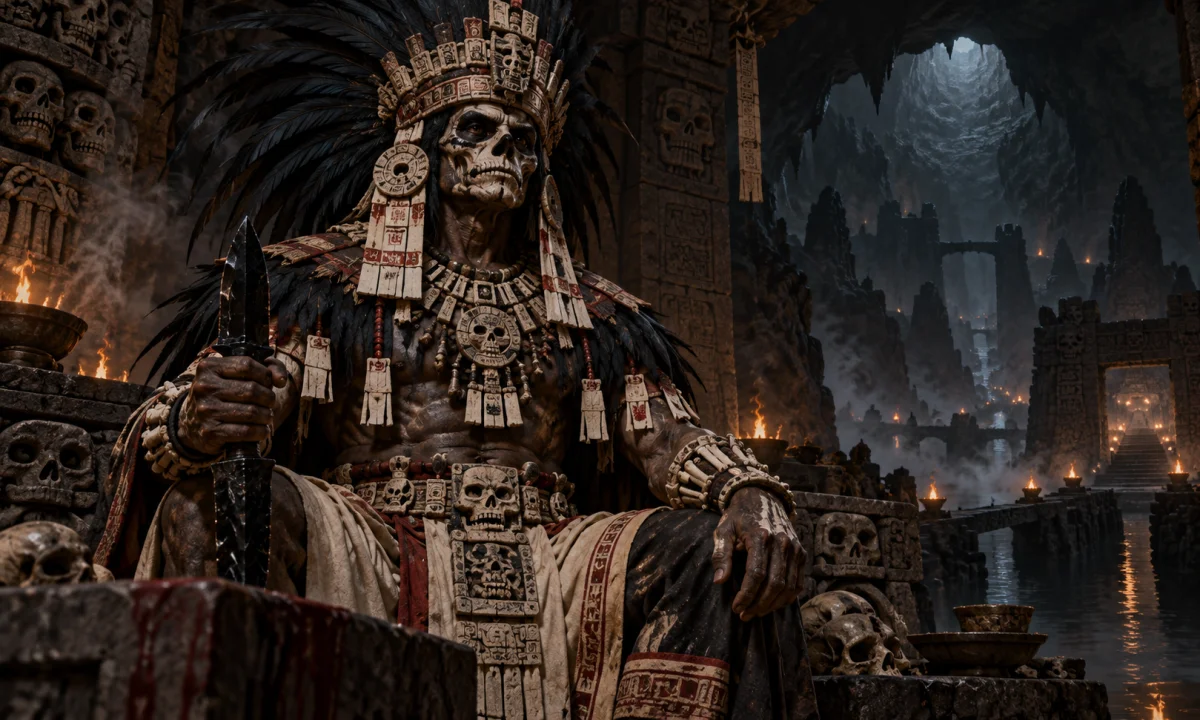
WORLD
WORLD
Tēzcatzontēcatl
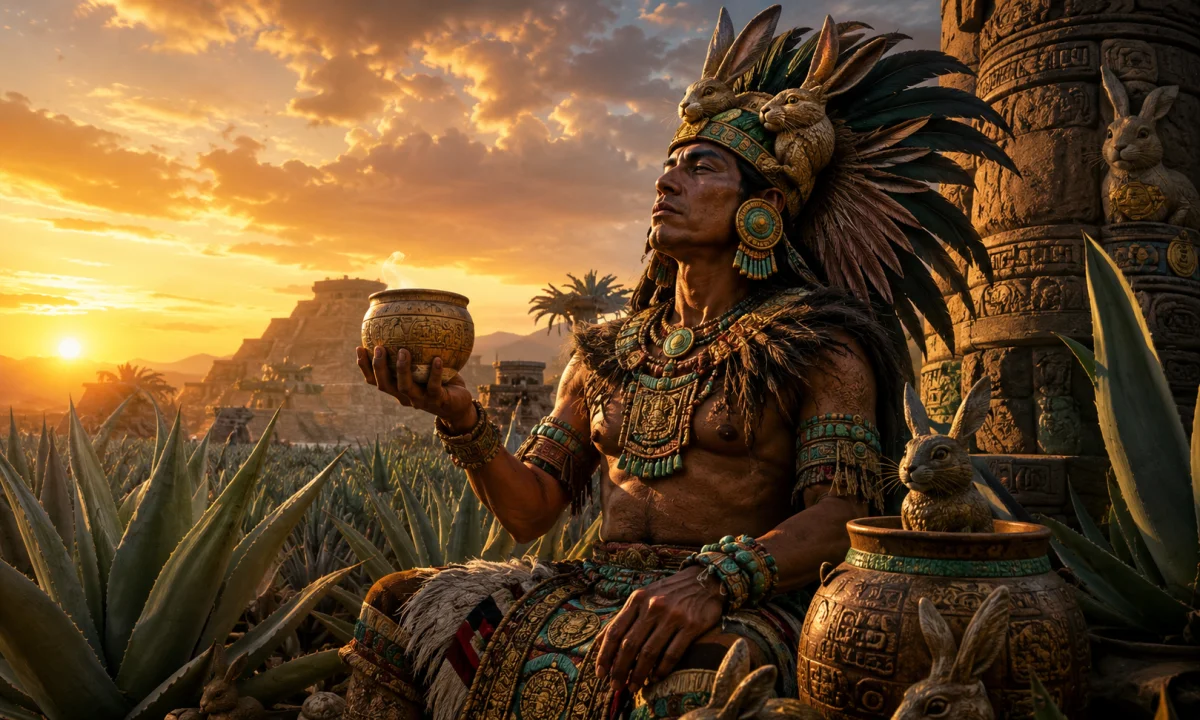
Tēzcatzontēcatl—also written Tezcatzontecatl, Tezcatzóncatl or Tezcatzoncatl—is a deity associated with pulque, intoxication and the religious culture of the Nahua peoples of central Mexico. He is commonly described as one of the Centzon Totochtin, the “Four Hundred Rabbits,” a collective of pulque gods whose many personalities expressed the different effects of drunkenness. His name, role and exact position within this group vary between surviving sources, so statements about him should not be treated as though they belonged to a single, uniform Aztec doctrine.
Cultural setting
Pulque was an alcoholic drink made from the fermented sap of the maguey, or agave, plant. In Nahuatl it was known as ōctli. Maguey was valuable for much more than its intoxicating sap: its leaves provided fibre, its thorns could be used in ritual acts, and its roots and other parts had practical uses. Pulque therefore belonged to a wider material and religious world rather than being merely a recreational beverage.
Among the Nahua, pulque could be associated with fertility, nourishment, divine power and altered states of consciousness. It also had regulated uses. Priests, rulers, warriors, the elderly and people participating in certain ceremonies might drink it in particular circumstances, while uncontrolled drunkenness could be condemned. The distinction between sacred or permitted intoxication and socially disruptive drunkenness is important when interpreting Tēzcatzontēcatl and the other pulque deities.
Aztec religious thought frequently represented natural forces and social practices through groups of related beings. Pulque was not governed by only one simple “god of alcohol.” Mayahuel was associated with the maguey plant and its life-giving sap, while Pātecātēcatl was connected with pulque, fermentation and the substances used in its preparation. Other named figures, including Tepoztēcatl, Papāztac, Totoltecatl and Tlilhua, appear in lists or traditions connected with the pulque gods. These figures could overlap in function, and colonial descriptions do not always agree about their identities.
Name and identity
The form Tēzcatzontēcatl reflects a scholarly way of marking vowel length in Nahuatl. Colonial and modern spellings often omit those marks, producing forms such as Tezcatzontecatl. The name is also written with different divisions and accents because sixteenth-century Spanish writers recorded Nahuatl words according to their own spelling conventions.
The meaning of the name is not entirely secure. It is sometimes translated in ways that connect it with a “mirror” or with a lordly or place-derived name, but such translations should be treated cautiously. The Nahuatl elements in the word are not interpreted consistently, and a tempting resemblance to Tezcatlipoca does not prove that the two names describe the same deity or that Tēzcatzontēcatl was simply an aspect of Tezcatlipoca.
His classification is likewise not perfectly fixed. Many modern reference works call him a god of pulque or drunkenness and identify him as one of the Centzon Totochtin. In other presentations, he appears as one named member among several pulque-related gods rather than as a clearly defined leader. The surviving evidence supports his connection with pulque, but it does not provide a complete biography or an agreed hierarchy among all the drink deities.
The Centzon Totochtin
The Centzon Totochtin means “Four Hundred Rabbits.” The number four hundred commonly conveyed an immense or uncountable multitude in Mesoamerican thought; it need not mean that worshippers believed in a precisely enumerated population of four hundred individual rabbit-shaped gods. The rabbit image reflects the unpredictable, varied and sometimes excessive effects of pulque. Different amounts, circumstances and personal dispositions could produce different kinds of behaviour.
The rabbits were therefore a religious way of describing the many forms intoxication could take. One person might become cheerful, another quarrelsome, another sleepy, another boastful or sexually uninhibited. The stories and names associated with the rabbit gods gave those changes a divine and moral dimension. Intoxication was not represented as a single force with one predictable result.
Tēzcatzontēcatl is regularly included among these beings, although the available sources do not always explain what specific type of drunkenness he personified. Modern summaries sometimes assign individual emotional or behavioural traits to each rabbit god, but many such assignments are uncertain. They may combine information from different colonial texts, later interpretations and modern attempts to systematise a group that was probably more fluid in pre-Hispanic practice.
Attributes and symbolism
Because Tēzcatzontēcatl is principally known through lists and brief references, his personal appearance is difficult to establish. There is no securely documented, universally accepted iconography that allows every image of a pulque deity to be identified as him. Figures in painted manuscripts may represent pulque gods collectively, ritual participants or other deities associated with maguey and fertility. Individual identification is especially difficult when a manuscript does not provide a caption or when its original ritual context is unknown.
The rabbit is his most important symbolic setting, but this does not necessarily mean that he was always imagined as an ordinary rabbit or as a human figure with rabbit features. In the Centzon Totochtin tradition, the animal represents the effects and unpredictability of pulque. Rabbits were also associated with fertility and prolific reproduction, making them suitable symbols in a religious system that connected maguey, sap, sexuality, nourishment and agricultural abundance.
His connection with intoxication should not be reduced to a modern idea of an “alcohol god.” Pulque could be understood as a potent substance with sacred force. To drink it was to engage with a material connected to a deity and to the life of the maguey. The Centzon Totochtin expressed both the attraction and danger of that force: delight, sociability and ritual power on one side, loss of control and disorder on the other.
Some depictions and descriptions of pulque ritual include bowls, vessels, maguey plants, rabbits and signs of ceremonial drinking. These motifs can establish a broad association with pulque, but they do not automatically identify Tēzcatzontēcatl. It is safer to distinguish between the visual language of the pulque cult as a whole and the limited evidence for this particular deity.
Myths and relationships
The best-known mythic material connected with the pulque gods concerns the discovery or distribution of pulque and the behaviour of the gods after drinking it. In traditions involving Mayahuel and Pātecātēcatl, maguey and fermentation are brought into a divine and cultural framework. These accounts vary considerably, and not every version names Tēzcatzontēcatl.
Another group of stories links pulque and drunkenness with the downfall or departure of Quetzalcoatl. In colonial accounts of Quetzalcoatl’s final days at Tollan, other gods or supernatural opponents cause him to drink pulque. The episode leads him to act in a manner inconsistent with his priestly or royal discipline and contributes to his leaving the city. The identity of the figures responsible, the details of the deception and the relationship of the episode to earlier traditions differ among sources.
Tēzcatzontēcatl is sometimes brought into discussions of this narrative because he belongs to the pulque-god complex. However, it is not justified to claim that he is consistently the single deity who intoxicates Quetzalcoatl. In some versions, named gods such as Tezcatlipoca play the central role; in others, the participants are described more generally. The association between Tēzcatzontēcatl and the Quetzalcoatl episode is therefore possible within the wider tradition but not a fixed feature of every surviving account.
Relationships among the pulque deities also vary. Mayahuel is often described as the mother or central female figure of the pulque group, while Pātecātēcatl is frequently presented as her partner or as an important male counterpart. The Centzon Totochtin may then be described as their children or descendants. These genealogies are not preserved in one complete, consistent mythological system, and the use of family terms in modern books can make the evidence appear more uniform than it is.
Sources and historical evidence
Knowledge of Tēzcatzontēcatl comes chiefly from colonial-era records produced after the Spanish conquest. These include Nahuatl-language accounts, Spanish descriptions of Indigenous religion and painted manuscripts. The most important information consists of divine-name lists, descriptions of ceremonies, explanations of religious concepts and references to pulque or the Centzon Totochtin.
Such records are valuable but require careful interpretation. Some were compiled by Spanish missionaries who wanted to describe, classify or criticise Indigenous practices. Others preserve testimony from Nahua informants, sometimes through several stages of translation and editing. A text may also combine traditions from different communities or present an Indigenous deity through categories familiar to Christian European readers.
Painted manuscripts provide additional evidence, but images do not always function like portraits. A figure may be identified by a name glyph, costume, ritual object or surrounding scene, and these clues can be damaged, ambiguous or interpreted differently by researchers. A figure associated with pulque in one context may not be Tēzcatzontēcatl in another. For that reason, claims about a distinctive costume, animal form or individual temple should be made only when the identification is well supported.
The absence of extensive stories about Tēzcatzontēcatl does not mean that he was unimportant to all worshippers. Many pre-Hispanic religious practices were transmitted through performance, local custom and ritual knowledge that was not preserved in the colonial record. It does mean that modern descriptions should acknowledge the limits of the evidence instead of reconstructing a detailed personality from his name alone.
Religious significance
Tēzcatzontēcatl illustrates how Nahua religion could treat an everyday substance as both materially useful and spiritually charged. Pulque connected agriculture, maguey cultivation, bodily nourishment, social behaviour and ceremonial practice. Its gods were not simply embodiments of intoxication in isolation; they belonged to a network of ideas about fertility, transformation, discipline and the boundaries of acceptable conduct.
The Centzon Totochtin also demonstrate that divine power could be plural and variable. Rather than assigning every consequence of drinking to one ruler-like deity, Nahua traditions could describe intoxication as a multitude of forces. The rabbit gods made room for differences between individuals and occasions. Their collective identity expressed the belief that the same substance could produce many outcomes.
Modern interpretations sometimes portray the pulque gods as a neat pantheon with fixed jobs, personalities and ranks. The evidence points to a less rigid picture. Names could be local, titles could overlap, and a deity’s importance could change according to the ritual setting. Tēzcatzontēcatl is best understood as a named participant in the broader religious complex surrounding pulque, not as a figure whose complete mythology has survived intact.
Distinction from similar names
Tēzcatzontēcatl should not be confused with Tezcatlipoca, one of the major Nahua deities associated with night, rulership, conflict, divination and the Smoking Mirror. The two names share a spelling element that is often connected with “mirror,” but similarity in written form does not make them identical. Tezcatlipoca has a much broader and better-documented mythic profile.
He should also be distinguished from Mayahuel, whose principal associations are the maguey plant and its nourishing sap, and from Pātecātēcatl, who is more directly connected in many sources with the preparation and fermentation of pulque. These deities may appear together in the same religious context, but they are not interchangeable names for one being.
Finally, Tēzcatzontēcatl is not simply another name for the entire Centzon Totochtin. The name refers to an individual deity within, or closely associated with, that collective. Since the membership and presentation of the group vary by source, some accounts may emphasise his individual identity while others treat him as one expression of the larger multitude of rabbit gods.
Later reception
Tēzcatzontēcatl has received far less attention in modern popular culture than Quetzalcoatl, Tezcatlipoca or Huitzilopochtli. When he appears in modern mythology websites, games, fantasy writing or other adaptations, he is often reduced to a generic god of alcohol or assigned a highly specific personality that is not securely preserved in the historical record.
Those portrayals belong to modern reinterpretation rather than established Aztec tradition. A historically grounded treatment keeps his documented association with pulque, the Centzon Totochtin and the wider religious importance of maguey, while recognising that his exact attributes, myths and name meaning remain uncertain.