WORLD
WORLD
Tekkeitsertok

Tekkeitsertok is a figure associated primarily with Greenlandic Inuit traditions and with the caribou on which many northern communities depended. He is commonly described in English as a master or guardian of caribou, and sometimes as a deity of hunting. The name and the details attached to it vary in spelling and interpretation, however. Inuit religious traditions were never a single uniform system, and accounts recorded in different regions do not always describe Tekkeitsertok in the same way.
Origins and cultural setting
Tekkeitsertok belongs to the religious world of the Inuit peoples of the Arctic, especially traditions associated with Greenland. Greenlandic Inuit communities developed their beliefs within environments where survival depended on intimate knowledge of animals, weather, ice, tides and seasonal movement. Caribou were particularly important in many inland and coastal regions. They provided meat, hides, sinew, bones and antler, and their movements shaped the timing and organisation of hunting.
In this setting, caribou were not regarded simply as mindless resources. Inuit traditions often present animals as beings with their own awareness, powers and forms of agency. Hunting therefore involved more than technical skill. It also required proper conduct toward animals, respect for customary rules and attention to the spiritual conditions that made success possible.
Many Inuit religious traditions speak of beings who control, protect or regulate particular species. These figures are sometimes called masters of animals in English-language discussions. A master of animals may determine whether game is available, withhold animals from disrespectful hunters or release them when people observe the necessary rules. Such beings should not automatically be understood as gods in the same sense as gods in the pantheons of ancient Greece or Rome. The terms used by missionaries, explorers and later scholars often imposed categories that do not correspond exactly to Inuit religious concepts.
Tekkeitsertok is best understood within this wider relationship between humans, animals and spiritual powers. His importance arises from the caribou’s central place in the subsistence economy and from the belief that successful hunting depended upon maintaining a proper relationship with the non-human world.
The name and the identity of the figure
The name appears in several spellings, including Tekkeitsertok and Tekkeitsertoq. Differences of this kind are common in records of Inuit traditions. Inuit languages contain sounds and grammatical forms that were represented inconsistently by European writers, and names were often written according to the spelling conventions of the recorder’s own language. A single English form should therefore not be treated as proof that every community used precisely the same name.
The meaning of the name is also not entirely secure in popular reference works. It is usually connected with the caribou and with authority over them, but brief dictionary-style accounts can give an impression of greater uniformity than the surviving traditions justify. Some descriptions call Tekkeitsertok the caribou god; others describe him more cautiously as the spirit, owner or master of caribou.
The distinction matters. Inuit religious life included powerful beings, local spirits, ancestors, animal persons and masters of species, but these beings did not necessarily form a fixed hierarchy. Nor did all Inuit groups share the same names, stories or explanations. Tekkeitsertok is consequently better presented as a culturally specific figure associated with caribou than as a universally recognised Inuit supreme deity.
Role as master of caribou
Tekkeitsertok’s central role is to govern or protect the caribou. In traditional interpretations, the animals are not entirely at the disposal of human hunters. Their availability may depend upon whether hunters behave correctly, respect ritual restrictions and use what they take from the animal appropriately.
The idea of a master of animals expresses a form of reciprocal responsibility. Humans need game, but they are not considered owners of it in an absolute sense. The animals come from a spiritual source and must be treated in ways that preserve the relationship between the human community and the animal world. Wastefulness, broken taboos or other forms of disrespect could be understood as reasons for hunting failure.
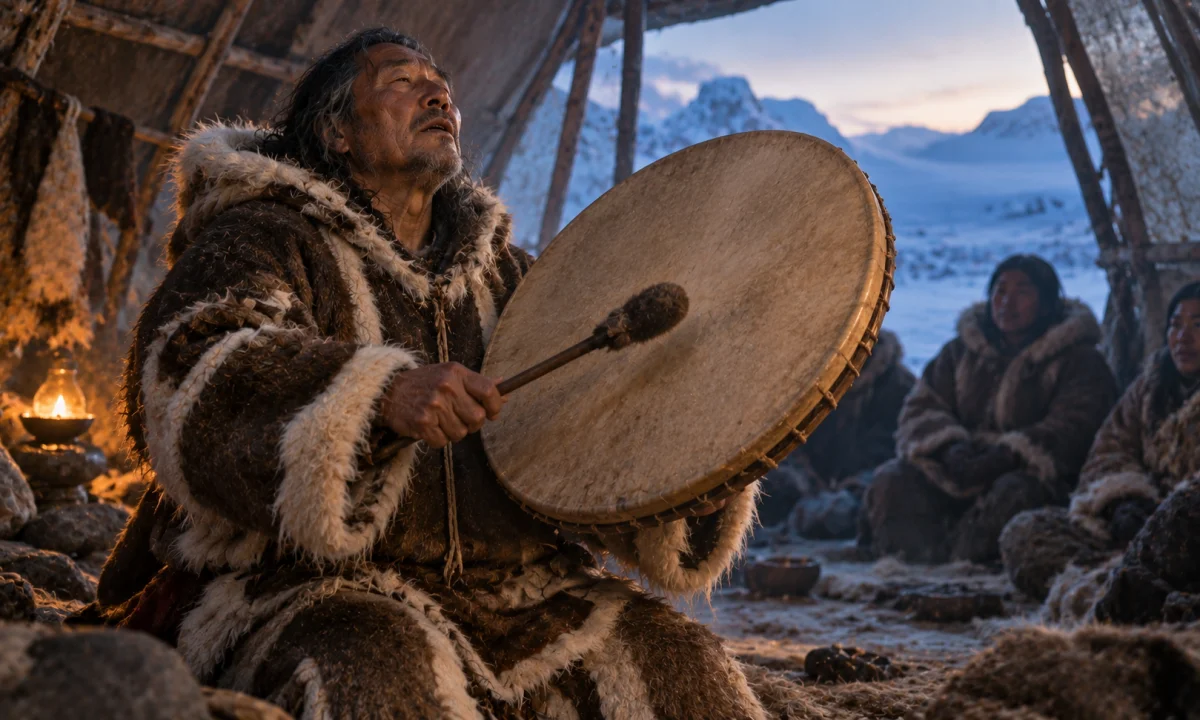
Accounts of figures such as Tekkeitsertok often connect them with the actions of shamans. When animals became scarce or hunting repeatedly failed, a shaman might seek an explanation in the spiritual realm. The shaman’s task could include discovering which rule had been broken, negotiating with a powerful being or restoring the balance that allowed animals to return. The specific ceremonies and beliefs differed between communities, and general descriptions should not be taken as a uniform ritual programme for all Greenlandic Inuit.
Tekkeitsertok’s authority is therefore not merely political. He is not simply a king of the caribou or a human-like ruler issuing commands. His power reflects the dependence of people upon animals and the belief that the conditions of hunting have spiritual as well as practical dimensions.
Appearance and supernatural powers
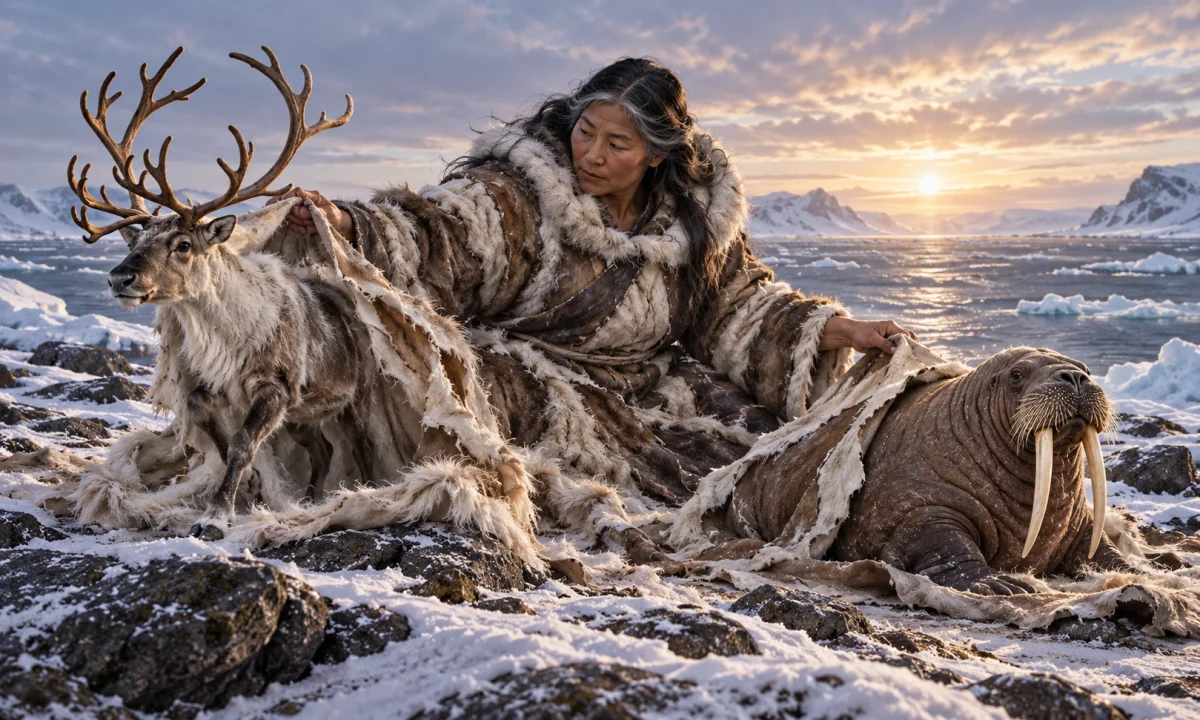
There is no single, widely established canonical appearance for Tekkeitsertok. Modern illustrations may depict him as a human man, a shamanic figure or a being accompanied by caribou, but such images should not be confused with a consistently preserved traditional description. The surviving information about him is generally more concerned with his function than with a detailed physical form.
His principal power is associated with the control, protection or distribution of caribou. Depending on the account, he may be imagined as keeping the animals in a spiritual dwelling, determining where they travel or deciding whether hunters may obtain them. These descriptions should be treated as elements of recorded tradition rather than as parts of a single canonical biography.
Like many powerful beings in Inuit traditions, Tekkeitsertok may be approached indirectly through ritual specialists rather than through ordinary personal devotion in the familiar sense of prayer to a temple god. The shaman, often called an angakkuq in Inuit contexts, could communicate with spirits and address problems affecting the community. This does not mean that every encounter with Tekkeitsertok followed one standard procedure. Inuit religious practice was local, adaptive and shaped by particular ecological conditions.
Caribou, hunting and religious responsibility
The importance of Tekkeitsertok becomes clearer when considered alongside the material importance of the caribou. A successful hunt supplied food during difficult seasons and provided materials for clothing, shelter, tools and transport. Caribou hides could be used for garments and other practical objects; sinew was valuable for thread; bones and antlers could be worked into tools and implements.
Because so much depended on the animal, hunting carried ethical obligations. In many Inuit traditions, animals were expected to give themselves to respectful hunters, while hunters were expected to observe rules governing the treatment of the body and the disposal or use of remains. The precise rules varied, but the underlying principle was widespread: animals were persons or spiritually significant beings, not merely objects.
Tekkeitsertok can therefore be interpreted as a personification of the relationship between caribou and human communities. His authority explains why abundance cannot be assumed and why hunting success may be lost when social or ritual obligations are neglected. He represents a world in which ecological dependence, moral conduct and spiritual power are closely connected.
This interpretation should not reduce the tradition to a simple “nature god” concept. The phrase can be useful as a rough introduction, but it may suggest a modern environmental abstraction rather than the specific obligations involved in hunting. Tekkeitsertok belongs to a lived religious system in which people, animals, spirits and the landscape participate in reciprocal relationships.
Stories and narrative traditions
Tekkeitsertok is not associated with a large, standardised cycle of surviving myths comparable to the stories of some better-known figures in world mythology. Many short summaries repeat a small number of ideas: he is connected with caribou, he has authority over their movements and he may be approached when hunters cannot find game. More elaborate details are not consistently documented across sources.
Some accounts describe him as dwelling beneath the ground or in a place connected with the hidden source of the caribou. Such descriptions fit a wider pattern in Arctic mythology, in which powerful beings live below the earth, beneath the sea or in other realms that shamans may visit. They should not automatically be treated as a universal feature of Tekkeitsertok’s identity, since the location and nature of his dwelling can vary or may come from later summaries.
The lack of a single biography is significant. Oral traditions are not necessarily organised around fixed sacred scriptures or a definitive version of every story. A figure’s importance may lie in ritual knowledge, remembered rules, local narratives and practical understanding rather than in a long sequence of adventures. The surviving record is also shaped by the conditions under which outsiders collected it. Missionaries, explorers and ethnographers often selected stories that fit their own categories and sometimes translated complex religious ideas into the language of “gods,” “demons” or “spirits.”
Relationship to other Inuit figures
Tekkeitsertok is sometimes confused with other powerful beings associated with hunting or with the control of animals. The most important distinction is between Tekkeitsertok and Sedna, known by different names in different Inuit regions. Sedna is widely associated with marine animals and with the sea, although the stories and names connected with her vary substantially. In many traditions, shamans must address her when sea mammals become unavailable. Tekkeitsertok, by contrast, is chiefly connected with caribou and terrestrial hunting.
Sedna is also sometimes called the “mother of sea animals” in English-language accounts, while Tekkeitsertok is labelled the “father” or “master” of caribou. These gendered family descriptions can be misleading if treated as a universal Inuit theology. They are convenient ways of explaining different animal powers, not evidence that all Inuit communities imagined a single family of animal deities.
Other Inuit traditions include figures connected with hunting, childbirth, weather, the moon, the sun and particular animal species. The names and functions of these beings differ from one region to another. A figure from the traditions of the Caribou Inuit, Netsilik, Iglulik, Yupik or another Arctic people should not be merged with Tekkeitsertok simply because both are associated with animals or hunting.
Cultural significance and interpretation
Tekkeitsertok offers an example of how religious belief can express ecological knowledge without being reducible to ecology. The figure reflects the practical reality that caribou populations move unpredictably, that weather can make hunting dangerous and that a community’s survival depends on restraint as well as courage. At the same time, the spiritual interpretation gives these realities a moral structure.
His tradition also challenges the assumption that religion is centred only on temples, formal priesthoods or written creeds. Inuit religious life was embedded in households, hunting parties, seasonal movement and relations with animals. Spiritual authority could be encountered in dreams, ritual practice, stories and the work of a shaman. A master of caribou was relevant because the community’s daily life was inseparable from the animal world.
It is important to avoid treating Tekkeitsertok as a timeless symbol detached from Inuit people. The figure belongs to specific cultural traditions that have been affected by colonialism, missionary activity, language change, state policies and changes in hunting practices. Written records preserve valuable information, but they do not represent the whole range of Inuit knowledge, and they may omit local or family traditions that were never recorded.
Later reception
Tekkeitsertok remains far less prominent in modern popular culture than figures such as Sedna. He sometimes appears in encyclopedias of mythology, lists of Indigenous deities and fantasy-inspired treatments of world mythology. These retellings often simplify him into a generic “god of caribou” or give him a fixed appearance and personality that are not securely supported by the traditional record.
Such adaptations can introduce the name to new audiences, but they should be distinguished from Inuit religious tradition. A game, novel or illustration may freely invent an appearance, family relationship, weapon or set of powers. Those additions belong to modern creative culture, not necessarily to the Greenlandic traditions in which Tekkeitsertok is known.