WORLD
WORLD
Tamano-no-mae
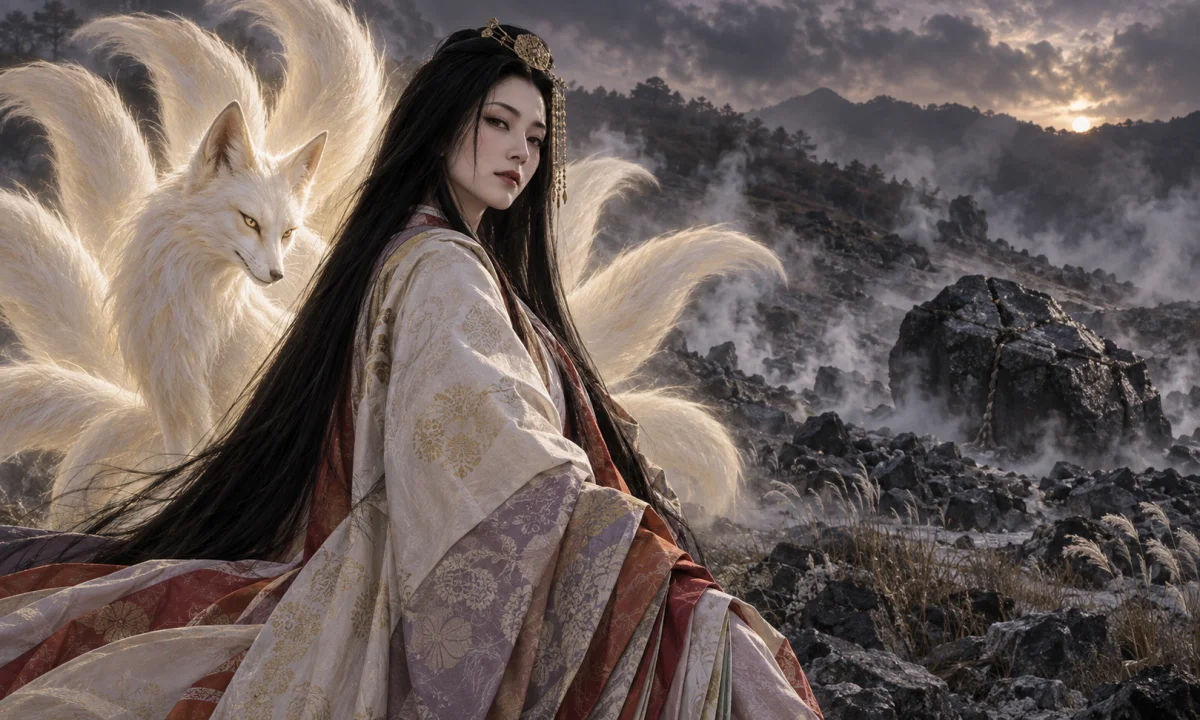
Tamano-no-Mae is a legendary fox woman in Japanese medieval and early-modern tradition. She is usually portrayed as an extraordinarily beautiful court lady whose presence brings illness and disaster to Emperor Toba. After her supernatural identity is discovered, she flees to the eastern provinces, where she is killed and becomes the spirit of the deadly Sesshō-seki, or “Killing Stone.” The story combines court legend, fox-spirit folklore, Buddhist ideas about suffering and release, and older East Asian tales of dangerous shape-shifting women.
Origins and cultural setting
Tamano-no-Mae is not a goddess with a continuous ancient cult, nor is she a securely attested historical person. Her story took shape in medieval Japan, especially in narrative traditions associated with otogizōshi, short prose tales that circulated from the Muromachi period onward. The legend also became important in Noh drama, illustrated books, popular theatre and other forms of early-modern entertainment.
The story is set during the reign of Emperor Toba, who ruled as emperor from 1107 to 1123 and later continued to exercise political influence as a retired sovereign. In the legend, a beautiful and highly accomplished woman appears at the imperial court under the name Tamano-no-Mae. Her origins are unclear, but she quickly gains the emperor’s favour. She is admired not only for her appearance but also for her intelligence, learning and ability to answer difficult questions.
The court’s admiration changes to alarm when the emperor becomes seriously ill. Physicians and ritual specialists cannot restore his health. The illness is eventually investigated through onmyōdō, the Japanese tradition of yin-yang divination, calendrical calculation and ritual knowledge. In many versions, the diviner Abe no Yasuchika identifies Tamano-no-Mae as a supernatural fox who has assumed human form. The exact names and roles of the diviners vary among retellings, and some versions give greater importance to Buddhist priests or other religious authorities.
The setting reflects the religious world of medieval Japan, where illness and political misfortune could be understood through several overlapping explanations. Disease might be attributed to natural causes, angry spirits, curses, possession or disturbances in the cosmic order. Court diviners, Buddhist monks and shrine specialists each had different forms of authority. Tamano-no-Mae’s exposure therefore represents more than the unmasking of a monster: it is also a contest between deceptive supernatural power and the ritual institutions of the court.
The name and identity of Tamano-no-Mae
The name is commonly written Tamano-no-Mae in English, although spellings such as Tamamo no Mae and Tamamo-no-Mae are also used. The Japanese name is 玉藻前. Tamamo can be understood as “jewel seaweed” or “precious aquatic plants,” a poetic expression rather than an ordinary personal name. The element mae appears in names and titles associated with women of the court, but its precise force in this legendary name is not always translated consistently. “Lady Tamamo” is therefore a practical rendering, while literal explanations of the name should be treated with some caution.
In the central Japanese tradition, Tamano-no-Mae is a kitsune, or fox spirit, capable of taking human form. More specifically, she is often identified as a nine-tailed fox, known in Japanese as a kyūbi no kitsune. The nine-tailed fox is part of a wider East Asian tradition in which foxes acquire exceptional age, intelligence and magical power. Japanese stories, Chinese tales and Korean traditions contain related but distinct fox beings; Tamano-no-Mae belongs specifically to the Japanese literary and theatrical development of this broader motif.
Her supernatural identity is not presented in exactly the same way in every source. Some narratives emphasize that she is a foreign or ancient demon who has appeared repeatedly throughout history. Others focus mainly on her life at the Japanese court and her transformation into the spirit of the stone. The most familiar version treats her as a single being with a long history of disguises, but the details of that history were assembled and altered by different storytellers.
Appearance, abilities and danger
Tamano-no-Mae’s most important power is shape-shifting. She appears as an ideal court woman rather than as an obvious animal or grotesque demon. Her beauty allows her to enter the highest levels of society, while her education and supernatural knowledge make her seem unusually gifted. The legend thus makes intelligence and refinement part of her disguise. She is dangerous not because she looks monstrous, but because she appears perfectly suited to the court.
Her powers are commonly associated with the ability to cause illness, drain vitality and manipulate political circumstances. In some retellings, her presence weakens the emperor through an unseen influence. In others, the court’s misfortune is linked to her demonic nature without a detailed account of how the harm is performed. The story does not provide a single consistent system of magic. Her power is better understood as the threatening force of a supernatural being concealed within the intimate space of imperial life.
Some illustrations and theatrical performances show her with a fox tail or other animal features, but traditional narratives often delay or conceal such signs. The dramatic effect depends on the contrast between her human appearance and her revealed identity. When the disguise fails, she is associated with a fox, sometimes a large and fearsome one, rather than with a separate species of demon.
The court discovery and the hunt
When Tamano-no-Mae is accused of causing the emperor’s illness, she leaves the court. In many versions, her true form is exposed through divination or through a ritual examination. Armed forces are then sent after her. The hunters are often named as Kazusa no Suke and Miura no Suke, though the presentation of these figures and the details of the pursuit differ between texts.
The chase leads eastward to the region of Nasu, in present-day Tochigi Prefecture. There, Tamano-no-Mae is killed by an arrow or other weapon. The location connects the supernatural tale with a real landscape, allowing the story to explain the origin of a dangerous natural feature. Her death does not end the threat. The fox spirit enters a stone, which thereafter becomes known as the Sesshō-seki.
The name Sesshō-seki is usually translated as “Killing Stone” or “Death-Dealing Stone.” According to the legend, anyone who approaches it may be poisoned or killed by the malignant force within it. The stone transforms an episode of court intrigue into a local sacred and dangerous place. A natural object becomes evidence of the continuing presence of a spirit, and the landscape preserves the memory of the creature that was supposedly defeated.
The Sesshō-seki and the spirit’s release
The story of the stone is especially important in the Noh play Sesshōseki. The play is associated with the medieval Noh repertory, although its authorship and precise early history are not certain. In the drama, a travelling Buddhist monk comes to the area and learns about the deadly stone. A woman appears and describes its history. She is eventually revealed as the spirit of Tamano-no-Mae or as the spirit bound to the stone.
The monk’s religious practice changes the meaning of the legend. The spirit is not simply destroyed by physical force. Through Buddhist teaching and prayer, it can be confronted, pacified and released from its tormented condition. The final emphasis is therefore not only on the punishment of a demon but also on the possibility of spiritual transformation.
Versions of the release story commonly associate it with Genno, a Buddhist monk remembered in Japanese tradition as a holy figure who encountered the stone and performed rites for the suffering spirit. The details of Genno’s identity and the chronology of the episode belong to the legend rather than to securely documented history. In some retellings, the stone is broken or its power is neutralized; in others, the central event is the spirit’s repentance and movement toward salvation.
This religious ending is characteristic of narratives in which a frightening being is also a suffering consciousness. Tamano-no-Mae remains responsible for violence in the story, but the Buddhist framework allows her condition to be understood through attachment, delusion, karmic consequences and the possibility of release. The stone is not merely a monster’s hiding place. It is also a symbol of a spirit trapped by its own violence and unable to pass peacefully into another state.
Earlier incarnations and East Asian connections
Later Japanese retellings often connect Tamano-no-Mae with earlier tales of destructive women in royal courts. The most common associations are with Daji, the beautiful consort of King Zhou in Chinese legend, and Bao Si, the consort of King You of Zhou. In these stories, the women are blamed for corrupting rulers and contributing to the collapse of dynasties. Japanese versions sometimes reinterpret them as manifestations or previous identities of the same nine-tailed fox.
These connections should not be treated as evidence that Daji, Bao Si and Tamano-no-Mae were originally one universally recognized figure. They belong to different historical and literary traditions. Their identification with one another was a later process of narrative combination, influenced by the movement of stories and religious ideas across East Asia. Some Japanese accounts also include an earlier Indian episode, but the details vary considerably and are not part of every version of the Tamano-no-Mae legend.
The combined genealogy gives the fox spirit an enormous historical reach. She becomes a being capable of appearing at the centre of several dynasties and cultures, repeatedly using beauty and political intimacy to bring down rulers. At the same time, this expanded story reflects medieval ideas about the movement of marvels across Asia rather than a single ancient myth preserved unchanged.
Meaning and interpretation
Tamano-no-Mae can be interpreted as a story about the instability of appearances. The court sees intelligence, beauty and perfect manners; religious specialists perceive a dangerous being concealed behind them. This contrast supports a familiar folklore theme: the human world is vulnerable when it assumes that outward refinement guarantees inner virtue.
The tale also expresses anxiety about the imperial court and the relationship between private desire and public order. The emperor’s affection for Tamano-no-Mae is not merely a romantic attachment. Because the emperor is the centre of the political world, his illness affects the entire state. A hidden supernatural presence in the court becomes a metaphor for corruption or disorder at the heart of government, although the story does not reduce itself to one fixed political interpretation.
The fox woman’s portrayal also belongs to a wider tradition of stories in which female beauty is associated with danger, seduction or political catastrophe. It is important not to treat this as a neutral description of women in Japanese culture as a whole. Rather, it is a recurring narrative pattern shaped by patriarchal court literature and by tales that explain social crisis through the influence of an alluring outsider. Tamano-no-Mae is distinctive because she is not merely seductive: she is learned, articulate and capable of occupying elite culture so convincingly that her difference remains hidden.
Her fox identity emphasizes the porous boundary between human and animal. Japanese fox traditions include mischievous, protective, erotic, frightening and morally ambiguous beings. Not every kitsune is evil, and the Tamano-no-Mae story should not be used as a definition of fox spirits in general. Her particular role is that of a powerful and destructive shape-shifter within a narrative about imperial illness and supernatural concealment.
Important distinctions
- Tamano-no-Mae and ordinary kitsune: Tamano-no-Mae is a specific legendary figure, often described as a nine-tailed fox. She is not another name for all Japanese fox spirits.
- Tamano-no-Mae and Inari’s foxes: Foxes associated with the kami Inari are commonly understood as messengers or sacred animals. They are not automatically identical with the hostile fox demon of the Tamano-no-Mae tale.
- Tamano-no-Mae and Daji: Daji is a figure from Chinese historical legend and literature. Japanese stories later connected her with Tamano-no-Mae, but the two figures should not be treated as historically identical.
- Tamano-no-Mae and Korean gumiho: The Korean nine-tailed fox, or gumiho, belongs to Korean folklore. It shares broad East Asian motifs with Tamano-no-Mae but comes from a distinct cultural tradition.
- Tamano-no-Mae and Kuzunoha: Kuzunoha is another famous Japanese fox woman, best known from legends and theatre involving the diviner Abe no Seimei. Her stories, relationships and moral character differ substantially from those of Tamano-no-Mae.
Later reception
The legend continued to develop through Noh, kyōgen, puppet theatre, kabuki, illustrated fiction and popular prints. The Sesshō-seki provided a particularly effective theatrical subject because it could be presented as both a physical object and a supernatural character. A performer could move between the beautiful court woman, the fox spirit and the tormented presence bound to the stone.
In the Edo period, the story was also adapted for audiences interested in spectacle, romance, supernatural horror and historical fantasy. Artists and playwrights frequently emphasized different aspects of the legend: the fox’s beauty, her monstrous transformation, the imperial setting, the hunt in Nasu or the Buddhist resolution. There is therefore no single visual form of Tamano-no-Mae that governs all traditional representations.
The Sesshō-seki remains associated with the Nasu area, where the legendary stone has become part of local cultural memory and tourism. Modern accounts may treat it as a scenic, historical or folkloric site rather than as an object of literal fear. The tale continues to give the landscape a narrative identity, linking volcanic terrain and local place tradition with one of Japan’s best-known fox legends.
Contemporary manga, anime, novels and video games often reuse Tamano-no-Mae as a name or character template. Modern adaptations may portray her as a villain, an antihero, a comic figure, a tragic spirit or a heroic supernatural companion. Some give her entirely new powers and relationships, including versions in which she is connected to broader “nine-tailed fox” fantasy conventions. Such portrayals are creative reinterpretations rather than authoritative statements about the medieval legend. The traditional figure remains rooted in the court illness story, the fox’s exposure, the death at Nasu and the haunted Sesshō-seki.