WORLD
WORLD
Kitsune
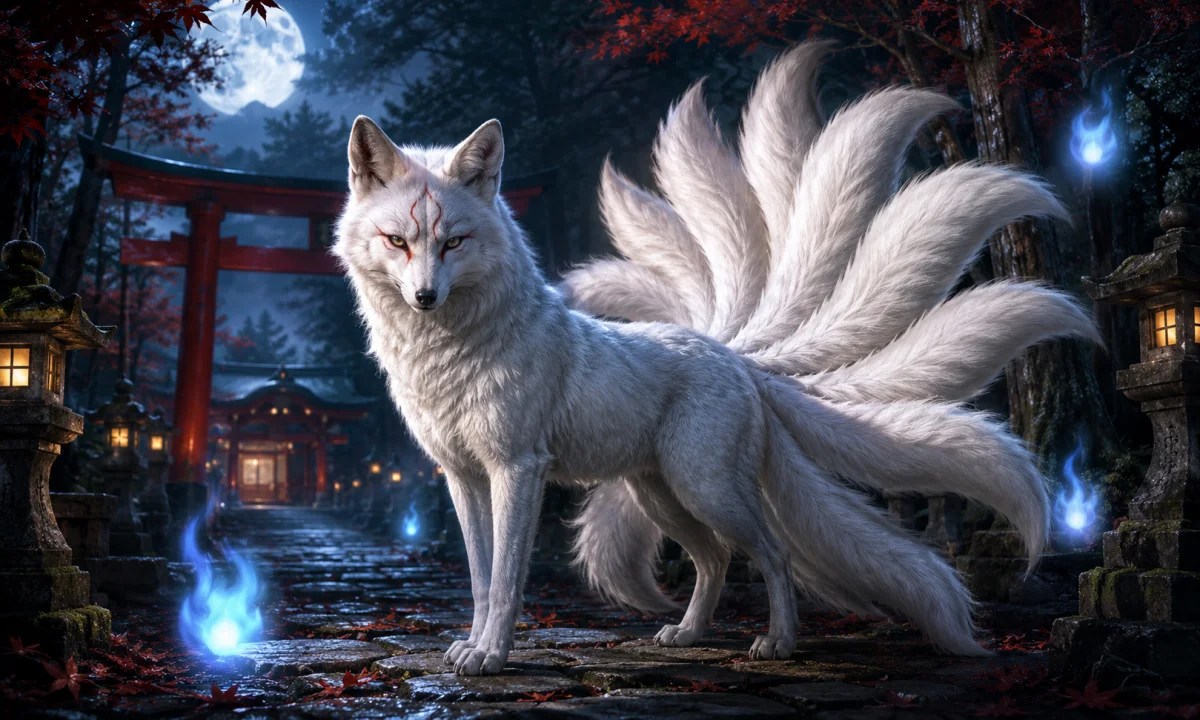
Kitsune are foxes in Japanese mythology, folklore and religious tradition. The word kitsune normally means “fox” in Japanese, but in stories it often refers to a fox with exceptional intelligence, supernatural powers and the ability to affect human lives. Kitsune may be helpful, dangerous, playful, romantic, deceitful or simply mysterious. They are not a single character or fixed species with one universally accepted nature; their identities and roles vary across regions, periods and kinds of story.
Origins and cultural setting
Foxes have lived throughout the Japanese archipelago for a very long time, and their nocturnal habits, sharp senses and elusive behaviour helped make them powerful subjects of folklore. A fox seen at the edge of a village, near a mountain path or beside a shrine could be interpreted as an ordinary animal, a supernatural being or an agent of a deity. This uncertainty is central to many kitsune tales.
Early Japanese written records contain references to foxes as omens or unusual animals, although the fully developed image of the shape-shifting kitsune emerged gradually. Chinese stories about fox spirits, including beings later known in Japan through literary and religious exchange, influenced Japanese ideas. However, the Japanese kitsune tradition is not simply a copy of Chinese fox mythology. Local beliefs, Buddhist narratives, shrine traditions, oral tales and regional customs all contributed to its development.
Medieval collections of Buddhist anecdotes and setsuwa, as well as later illustrated and popular literature, helped establish recurring themes: foxes disguising themselves as people, foxes marrying humans, foxes deceiving travellers and foxes rewarding kindness. Oral traditions preserved many local versions that do not fit neatly into the better-known literary patterns. Consequently, there is no single ancient “Kitsune myth” comparable to a story about one named god or hero.
The name and identity of the kitsune
In modern Japanese, kitsune is the ordinary word for a fox. In English-language discussions, it is often used more narrowly for a supernatural fox. The boundary between the ordinary animal and the magical being is deliberately uncertain in folklore. A fox may begin as an animal and acquire extraordinary abilities through age, experience or mysterious circumstances, but this is a common narrative pattern rather than a universal rule.
The origin of the word kitsune is not completely settled. Traditional explanations and later folk etymologies have connected it with ideas such as a fox returning repeatedly to a household, but these explanations should not be treated as established historical fact. The modern spelling and pronunciation developed through the history of the Japanese language, while older texts used different written forms and descriptions.
Kitsune are generally understood as yōkai, a broad category of uncanny beings and supernatural phenomena. Yōkai is not an exact equivalent of “monster.” It can include frightening creatures, mischievous spirits, strange transformations and beings that occupy an uncertain space between the natural and supernatural worlds. Some kitsune are also connected with religious devotion, especially worship associated with Inari. These categories overlap without being identical.
Appearance and supernatural abilities
The ordinary form of a kitsune is a fox, often imagined as the red fox familiar in Japan. In supernatural stories, a kitsune may become unusually large, old or intelligent. Its most famous ability is shape-shifting, particularly the transformation into a human being. Female forms are especially common in tales of fox women, but male, child and elderly forms also appear.
A transformed kitsune may imitate a person’s voice, clothing and mannerisms, although folklore frequently leaves a small clue that reveals the disguise. A tail glimpsed beneath a robe, a fox-like shadow, an inability to understand human customs or an unusual reflection may expose the transformation. Some stories present the disguise as nearly perfect, while others make the fox’s errors a source of comedy.
Other powers commonly attributed to kitsune include:
- Creating illusions or causing people to misunderstand what they see.
- Speaking human languages or acquiring human knowledge.
- Producing kitsune-bi, often translated as “fox-fire,” a mysterious light seen at night.
- Possessing or afflicting human beings, a condition known as kitsunetsuki.
- Changing the apparent size or location of objects and places.
- Using magical objects, such as a fox’s tail or a jewel, in certain regional and literary traditions.
Fox-fire is sometimes described as a chain or cluster of lights seen in darkness, especially in connection with a fox procession or an uncanny gathering. Explanations in folklore differ widely. It may be treated as magical flame, a deceptive light or a supernatural sign. It should not be confused with a single scientifically defined phenomenon, because traditional descriptions cover more than one kind of nocturnal light.
The number of tails is one of the most recognizable features of supernatural foxes. In many modern retellings, a kitsune gains a tail with age and reaches nine tails after becoming extremely powerful. This idea has roots in wider East Asian fox-spirit traditions and appears in Japanese accounts of the kyūbi no kitsune, or nine-tailed fox. The exact rules are not consistent across all Japanese folklore. Not every traditional kitsune has nine tails, and the one-tail-to-nine-tail progression is better understood as a widespread motif than as a universal law.
Foxes, age and transformation
Many tales suggest that an old fox becomes capable of human speech or transformation. Age is therefore associated with wisdom and magical strength, but it can also imply cunning and danger. A young or ordinary-looking fox may act as a simple trickster, whereas an ancient fox can challenge priests, officials or entire communities.
Folklore sometimes describes a fox attempting to transform by placing a leaf, bone or other object on its head. This image belongs especially to popular storytelling and visual representations, and it is not a rule followed by every traditional account. The fox’s ability to imitate humans is more important than any fixed ritual for changing shape.
Fox-human relationships can be affectionate, tragic or morally ambiguous. A fox may rescue a person, marry into a human family, bear children and live peacefully for years. In other stories, the fox deceives a traveller, steals food or brings misfortune. The supernatural spouse may leave when its true identity is discovered, especially if a taboo has been broken. Such tales often explore the difficulty of relationships between human society and the nonhuman world rather than presenting the fox as simply good or evil.
Helpful and harmful kitsune
Japanese folklore sometimes distinguishes between benevolent foxes and wild or troublesome ones, but the terminology is not completely standardized. A frequently used contrast is zenko, meaning “good fox,” and nogitsune, meaning “wild fox.” These labels are particularly important in some religious and folkloric contexts, yet their usage varies by source and region. They should not be treated as a universally fixed classification for every kitsune story.
Helpful foxes may guide lost travellers, protect a household, repay a gift or punish someone who has behaved cruelly. They can also serve as intermediaries between humans and sacred powers. Harmful foxes may cause confusion, steal possessions, lead people astray or possess vulnerable individuals. Even a benevolent fox may be dangerous if offended, exposed or treated without respect.
Stories about kitsunetsuki, or fox possession, were once used to explain unusual behaviour, illness or social disruption. In some historical settings, possession accusations could have serious consequences for individuals and families. Religious specialists might be called upon to remove the supposed fox influence. Modern medical and psychological understanding does not treat kitsune possession as a supernatural diagnosis, but the belief remains important for understanding the social history of Japanese folklore and religion.
Inari and the sacred fox
Kitsune are strongly associated with Inari Ōkami, a major Japanese kami connected in different periods with rice, agriculture, prosperity, commerce and household well-being. Foxes are commonly regarded as messengers or servants of Inari, especially at Inari shrines. White foxes are particularly prominent in shrine imagery and religious representation.
The fox is not simply another name for Inari. Inari is a kami, while the foxes associated with Inari are usually understood as messengers, attendants or sacred animals. The relationship has also changed over time. Shinto traditions, Buddhist institutions and local practices interacted in ways that produced different explanations of Inari and the foxes serving the kami. At some shrines, worshippers may speak of the foxes with deep reverence; in other contexts, fox imagery is primarily a recognizable emblem of the shrine.
Offerings of fried tofu are widely associated with foxes and Inari shrines, and the dish is often called aburaage. The common claim that foxes universally love fried tofu belongs more to popular tradition than to a simple religious rule. Customs and explanations differ, and the food should not be presented as proof that all foxes in Japanese mythology share one standardized preference.
Famous stories and narrative patterns
Fox marriages
One of the most enduring types of kitsune tale concerns a fox who becomes a human woman and marries a man. In some versions, the relationship is loving and the fox is revealed only through an accidental discovery. In others, the fox is exposed because the husband violates a promise or notices an animal trait. The fox may then leave the household, sometimes returning secretly to care for children.
The well-known story of Kuzunoha belongs to this broad tradition. Kuzunoha is a fox woman who lives as the wife of a human man and becomes the mother of the onmyōji Abe no Seimei in later narrative traditions. Details vary between versions, and the story developed through medieval and early modern literature, theatre and popular performance. Kuzunoha should not be treated as the name of all kitsune or as a universal mother figure in Japanese mythology.
Tamamo-no-Mae and the nine-tailed fox
Tamamo-no-Mae is a major literary and theatrical figure associated with the nine-tailed fox motif. In the best-known Japanese versions, a powerful fox disguises itself as a beautiful woman named Tamamo-no-Mae and enters the imperial court. Her identity is eventually suspected and revealed, after which the fox flees and is connected with further misfortune.
Tamamo-no-Mae’s story has links to older East Asian narratives about dangerous fox spirits who infiltrate courts by taking human form. Japanese versions developed their own setting, characters and religious interpretations. The story is not a description of ordinary kitsune belief, nor does every kitsune possess the malevolent power attributed to Tamamo-no-Mae. It represents one especially dramatic form of the fox-as-infiltrator motif.
The fox wedding
The expression kitsune no yomeiri, or “fox’s wedding,” refers to an uncanny event whose meaning varies. In some regions it describes a procession of lights seen at night, imagined as foxes celebrating a wedding. In others, it is associated with sunshowers: rain falling while the sun is shining. The connection between these phenomena and foxes is folkloric, not a single nationwide belief with one definitive explanation.
Fox weddings illustrate how kitsune traditions can attach supernatural meaning to unusual weather, distant lights or sounds heard in the countryside. They also show that Japanese folklore often treats the fox world as a parallel society, capable of holding ceremonies and observing customs hidden from human beings.
Symbolism and cultural significance
Kitsune often represent the instability of appearances. A person may not be what they seem, and an apparently ordinary animal may possess a human-like mind. This makes the fox a useful figure for stories about disguise, desire, social boundaries and the dangers of judging by appearances.
The kitsune’s ambiguous morality is equally significant. Unlike a purely evil demon, a fox may behave generously in one story and maliciously in another. Its conduct can depend on how humans treat it, whether it belongs to a sacred domain and whether its private nature has been respected. Such stories encourage caution toward both the natural world and unfamiliar people, while also expressing sympathy for beings excluded from human society.
Fox-human marriage tales frequently raise questions about identity and belonging. The fox spouse can create a family, speak, work and feel affection, yet remains vulnerable to discovery. The separation that follows may be presented as inevitable rather than as a simple punishment. In this way, the stories can be read as reflections on social rules, secrecy, loyalty and the limits of relationships between different kinds of beings. These are scholarly interpretations rather than meanings stated identically in every traditional version.
Distinctions from related beings
Kitsune should not be confused with every fox spirit in East Asian mythology. Chinese huli jing traditions and Korean gumiho or kumiho traditions include fox beings with their own histories, themes and regional meanings. Cultural exchange influenced Japanese stories, especially those involving nine-tailed foxes, but the beings are not interchangeable.
Kitsune are also distinct from the tanuki, another famous Japanese shape-shifting animal. Tanuki stories often emphasize playfulness, appetite, physical comedy and deception, although tanuki can also be dangerous or supernatural. Kitsune tales more frequently stress fox-fire, human disguise, possession, shrine associations and the uneasy relationship between foxes and human households. Individual stories may blur these broad patterns, but the animals remain separate figures.
Nor is every fox seen at an Inari shrine necessarily a kitsune in the folkloric sense. Shrine statues represent sacred messengers and religious symbolism, while folktales about foxes in the countryside may concern wild yōkai, ordinary animals or ambiguous beings. Treating all fox imagery as one uniform belief overlooks the differences between shrine practice, regional folklore, literary fiction and modern fantasy.
Later reception and modern adaptations
Kitsune became increasingly visible through woodblock prints, illustrated books, theatre, storytelling and other forms of popular culture during Japan’s early modern period. Artists and writers expanded the range of fox appearances, from comic tricksters to elegant supernatural women and terrifying spirit beings. These works helped preserve older motifs while also reshaping them for new audiences.
In contemporary popular culture, kitsune appear in manga, anime, novels, games, films and international fantasy. Modern versions may portray them as heroic guardians, magical school characters, romance figures or beings with an explicit nine-tailed power system. Some use terms such as yōkai, zenko and nogitsune in ways inspired by tradition but simplified for fiction. These portrayals can introduce audiences to Japanese folklore, but they are creative adaptations rather than complete representations of historical belief.
The continuing appeal of kitsune lies in their ability to occupy several boundaries at once: animal and person, trickster and guardian, ordinary fox and sacred messenger, guest and outsider. Japanese tradition does not reduce them to one moral or religious identity. Their stories remain varied because the kitsune itself is defined by transformation, and transformation leaves room for many different relationships between the human and nonhuman worlds.