WORLD
WORLD
Sudika-mbambi
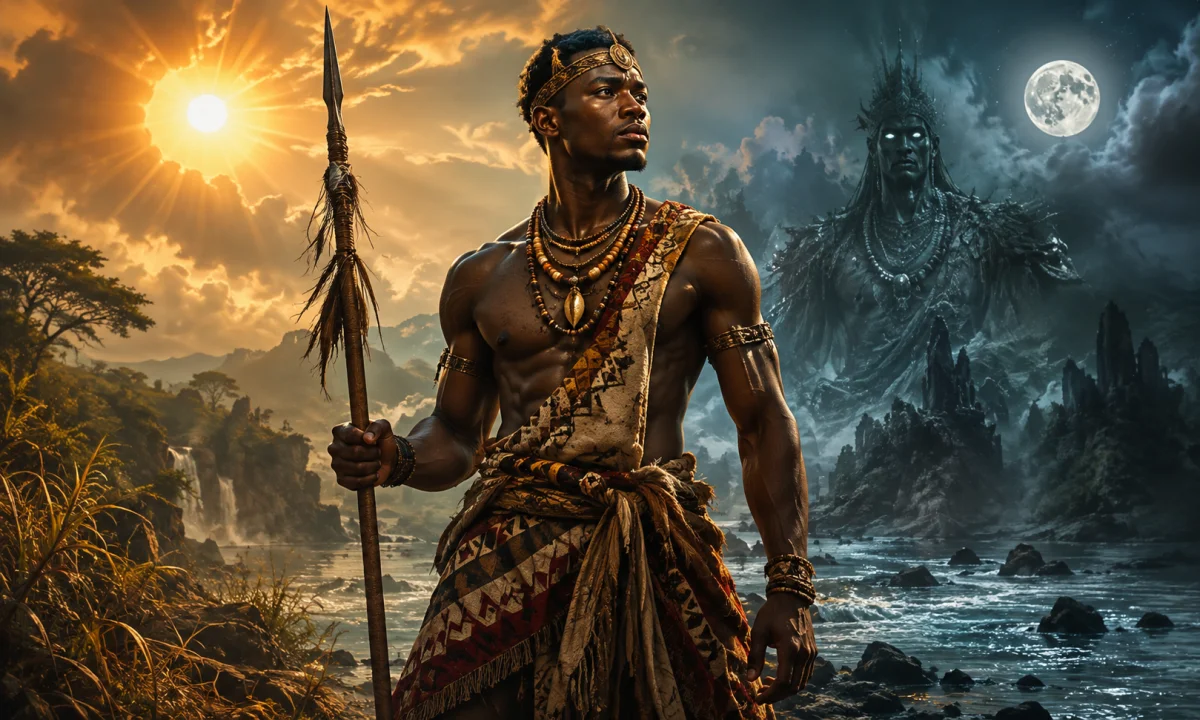
Sudika-mbambi is a heroic figure associated primarily with the oral traditions of the Mbundu, or Ambundu, peoples of Angola. He is usually presented not as a universally worshipped god, but as an extraordinary culture hero whose stories combine human adventure, supernatural ancestry, dangerous journeys and encounters with otherworldly powers. The spelling Sudika-mbambi is common in English-language reference works, although hyphenation, capitalization and vowel forms vary when Kimbundu names are written in different orthographies.
Cultural setting
The Mbundu are a Bantu-speaking people whose historical homeland lies mainly in west-central Angola, especially in the regions around the Kwanza River and the Angolan capital, Luanda. Their traditions developed within a complex religious environment that included reverence for ancestors, recognition of spiritual forces associated with places and natural phenomena, and belief in a supreme or distant creator in some local systems. Religious ideas and storytelling were not necessarily separated into the modern categories of “myth,” “folktale” and “history.” A heroic narrative could preserve moral teaching, explain relationships between the visible and invisible worlds, and entertain an audience at the same time.
Sudika-mbambi belongs to this wider narrative environment. The surviving material does not represent a single canonical scripture or one universally fixed biography. His adventures circulated through oral performance, and accounts recorded by outsiders may preserve only particular versions of a much larger body of storytelling. Consequently, descriptions of his birth, relatives, powers and principal adversaries are not entirely consistent.
Much of the written knowledge about Angolan oral literature was recorded by missionaries, colonial officials, ethnographers and other collectors during the nineteenth and twentieth centuries. Such records are valuable, but they must be read carefully. They often reflect the collector’s spelling system, translation choices and assumptions about what counted as a “god,” “hero” or “myth.” A written summary may also compress a long performance into a short plot outline, removing songs, dialogue, ritual references and local explanations that were important to the original audience.
Name and identity
The name appears in several forms, including Sudika Mbambi and Sudika-Mbambi. Variations are expected when a name from Kimbundu is represented in European writing systems. A change in punctuation or capitalization does not necessarily indicate a different character.
The element Mbambi may resemble names and words found in other Bantu languages, but similar-looking names should not automatically be treated as evidence that the figures are identical. Bantu languages are related, yet their vocabularies, sound systems and naming traditions differ. The spelling of a name in an English encyclopedia can also obscure distinctions that are clearer in Kimbundu.
Sudika-mbambi is best classified as a legendary hero or culture hero. Some descriptions call him a demigod or hero-god because his origin is linked with celestial or supernatural beings and because he performs feats beyond ordinary human ability. That terminology is a modern classification rather than a universally established Mbundu title. It should not be assumed that all Mbundu communities have treated him as a deity in the same way that a community might venerate an ancestor or address a spirit in ritual.
Supernatural ancestry and extraordinary birth
Many accounts place Sudika-mbambi’s origin between the human and cosmic realms. He is associated in some versions with the Sun and the Moon, or with other celestial powers. These relationships help explain why he possesses unusual strength, courage or knowledge. They also place his life within a universe where the boundaries between human beings, ancestors, spirits and heavenly bodies are permeable rather than absolute.
The details of his birth vary substantially. Some retellings emphasize that he was born under remarkable circumstances or displayed exceptional abilities from the beginning. Other accounts focus less on his parentage and more on the challenges he must face after entering the world. It is therefore safer to describe celestial descent as a recurring feature of his representation than to claim one definitive genealogy.
His extraordinary origin serves several narrative purposes. It marks him as a person set apart from ordinary society, gives him a reason to cross dangerous boundaries, and makes his encounters with monsters or spirits credible within the story’s logic. At the same time, his heroism is usually demonstrated through action rather than ancestry alone. A supernatural birth does not remove the need for endurance, judgment, loyalty and bravery.
Stories and heroic themes
The stories connected with Sudika-mbambi belong to a heroic cycle rather than to one short, standardized episode. In broad outline, he is a traveller and challenger who enters situations that ordinary people cannot resolve. He confronts powerful beings, passes through perilous spaces and uses exceptional abilities to overcome forces that threaten individuals or communities.
One recurring feature in summaries of the tradition is his connection with a close relative or companion, sometimes identified as Kabundungulu. The relationship and the events surrounding it are not reported identically in every account. In some retellings, a relative is endangered, lost or taken by a monstrous power, creating the need for a rescue or recovery journey. In others, the family relationship is part of a broader sequence of adventures rather than the central plot. Because the surviving records are fragmentary and differ in detail, the precise relationship should not be presented as fixed for all Mbundu traditions.
Several familiar heroic motifs appear in the material attributed to Sudika-mbambi:
- Crossing boundaries: the hero moves between ordinary human society and domains inhabited by spirits, monsters or celestial powers.
- Rescue and recovery: a journey may be undertaken to recover a relative, companion or valued person from an enemy or supernatural captor.
- Confrontation with dangerous beings: physical strength alone is not always enough; the hero must recognize threats and respond intelligently.
- Testing of character: courage, loyalty and perseverance are shown through ordeals rather than simply announced as qualities.
- Restoration of order: the hero’s success can return a person, object or community to its proper place.
These motifs are widespread in African and world folklore, but their presence does not make Sudika-mbambi interchangeable with every other heroic figure. The meaning of a journey depends on the local social and religious setting, the performance in which it appears and the particular version being told.
Abilities and symbolism
Sudika-mbambi’s powers are generally understood through his deeds. He is marked by unusual physical capacity, resilience and access to knowledge or assistance unavailable to an ordinary person. Some modern summaries describe him as possessing a magical weapon or other specific attributes, but such details are not equally secure across the recorded tradition. They should not be treated as universal features without qualification.
His importance lies less in a catalogue of powers than in the relationship between exceptional ability and social responsibility. A hero who can cross into a supernatural realm must still act on behalf of others. The stories therefore connect personal distinction with obligations to family, companions and community. Sudika-mbambi is not simply a warrior who seeks glory; he is a figure whose journeys have consequences for the restoration of relationships and the defeat of destructive forces.
The cosmic associations attached to him also support themes of opposition and balance. Sun and Moon symbolism can suggest the ordering of time, the alternation of light and darkness, and the relation between visible and hidden realms. However, interpretations of these symbols differ. It would be misleading to impose a single solar theology on all Mbundu communities or to assume that every story about Sudika-mbambi is primarily an explanation of celestial phenomena. In oral narratives, cosmic imagery may be genealogical, poetic or dramatic without functioning as a complete creation myth.
Oral tradition and variation
A major difficulty in discussing Sudika-mbambi is the tendency of reference books to turn a fluid oral tradition into a single character profile. Oral narratives can change according to the performer, audience, occasion and purpose. A storyteller may expand a battle, omit a genealogy, combine episodes or emphasize a moral issue that matters to the immediate audience. Different communities may also preserve related but distinct versions.
Translation creates another layer of uncertainty. Terms used for spirits, monsters, ancestors or powerful heroes do not always have exact English equivalents. A collector may call a being a “god” because the figure is supernatural, even though the original tradition distinguishes more carefully between a creator, an ancestral presence, a territorial spirit and a legendary person. Likewise, “monster” can flatten distinctions among an ogre, a dangerous animal, a spirit-being or an enemy described in symbolic language.
For these reasons, Sudika-mbambi should not be treated as the central god of all Angola, nor as a figure known in precisely the same form throughout the country. Angola contains many peoples, languages and religious histories. Mbundu traditions are not interchangeable with those of the Bakongo, Chokwe, Ovimbundu or other Angolan communities. A heroic figure from one tradition should not be made “pan-African” merely because later writers place several African mythologies in the same anthology.
Distinction from other African heroes
Sudika-mbambi is sometimes compared with better-known African heroes such as Mwindo of the Nyanga, Sundiata of Mande tradition or the Shilluk culture hero Nyikang. Comparisons can be useful when they draw attention to shared themes such as unusual birth, heroic travel, conflict with supernatural enemies and the restoration of social order. They do not establish that the characters are versions of one another.
Mwindo, for example, belongs to the oral epic tradition of the Nyanga of the eastern Democratic Republic of the Congo, while Sundiata is associated with Mande historical and epic traditions of West Africa. Their languages, historical settings, narrative cycles and cultural meanings are different. Sudika-mbambi likewise belongs within the Angolan Mbundu context. Similar story structures reflect the wide circulation of heroic motifs, not proof of a single continent-wide mythology.
Nor should Sudika-mbambi be confused with a historical Angolan ruler simply because some heroic narratives may preserve memories of political authority or social institutions. The available descriptions present him primarily as a legendary supernatural hero. They do not provide a secure basis for identifying him with a specific documented king or historical person.
Cultural significance
Sudika-mbambi can be understood as a figure of mediation. He connects ordinary people with the supernatural world, the living with powerful ancestral or cosmic forces, and individual courage with communal welfare. His journeys dramatize the risks involved in crossing boundaries, while his success suggests that disorder can be confronted through courage, intelligence and loyalty.
His stories also illustrate how African oral traditions resist simple divisions between religion and literature. A narrative may contain sacred imagery without being a liturgical text; it may discuss cosmic beings while functioning as entertainment; and it may preserve ethical expectations without presenting a formal creed. The significance of Sudika-mbambi is therefore not exhausted by asking whether he was “worshipped” in a narrow sense. His place in storytelling, memory and cultural imagination is also important.
Modern descriptions often present him as a symbol of African strength or as an example of an overlooked African superhero. Such comparisons can make the character accessible, but they are modern framing devices. They should not replace the Mbundu context or suggest that the original stories were created according to the conventions of contemporary comic-book fiction.
Later reception
Sudika-mbambi has appeared mainly in reference works, collections of African mythology and comparative discussions of heroic narrative rather than in a large, internationally established popular-culture franchise. Retellings may simplify his genealogy, assign him a fixed set of weapons or powers, or combine episodes from different accounts. These adaptations can introduce the name to new audiences, but they are interpretations rather than authoritative versions of the oral tradition.
The figure is most accurately approached with two ideas in mind: he is a significant legendary hero associated with Mbundu traditions of Angola, and the evidence for his stories is variable rather than uniform. Respecting that variation preserves both the richness of oral storytelling and the difference between a locally grounded tradition and a later standardized mythological character.