WORLD
WORLD
Nerrivik
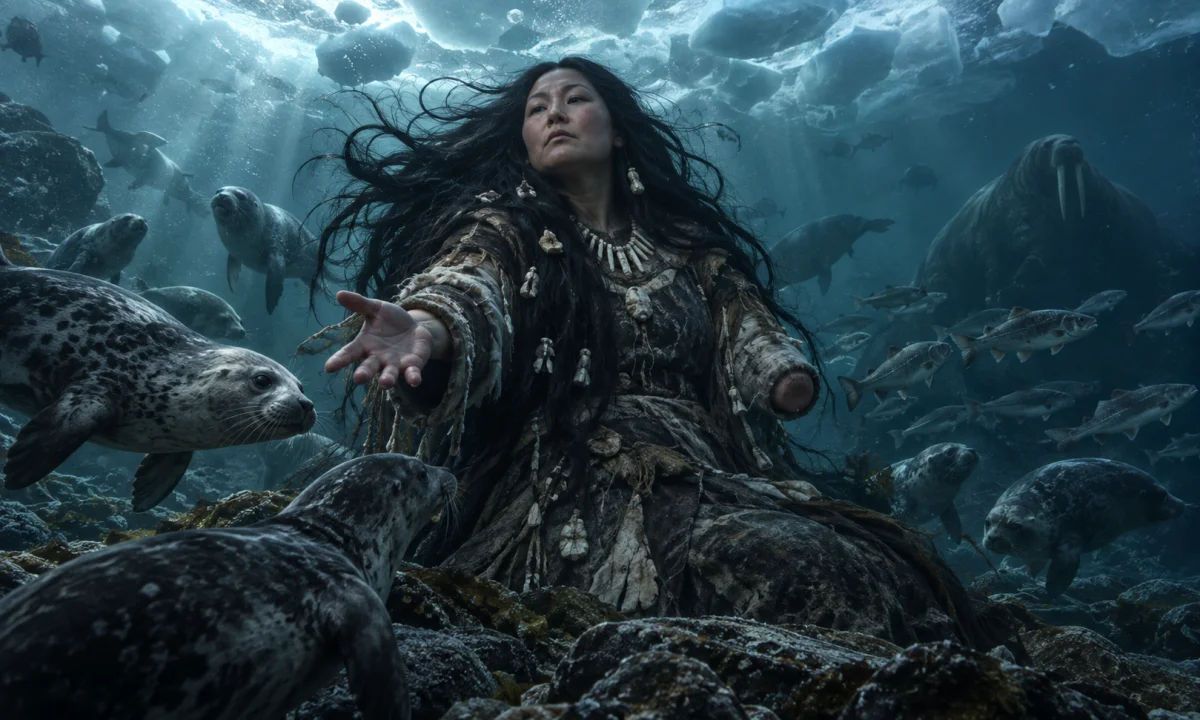
Nerrivik is a figure associated with the sea, marine animals and the survival of human communities in some Inuit traditions. Her name and stories vary across Inuit regions and languages, and she is often identified with other sea-mother figures, especially Nuliajuk and Sedna. These identifications are useful for comparison, but they should not be treated as proof that every Inuit community understood Nerrivik in exactly the same way.
Origins and cultural setting
Inuit religious traditions developed across the Arctic regions of Alaska, Canada and Greenland. They were transmitted primarily through oral teaching, ritual practice, family instruction and storytelling rather than through a single sacred scripture. As a result, names, episodes and interpretations could change from one community, language or historical period to another.
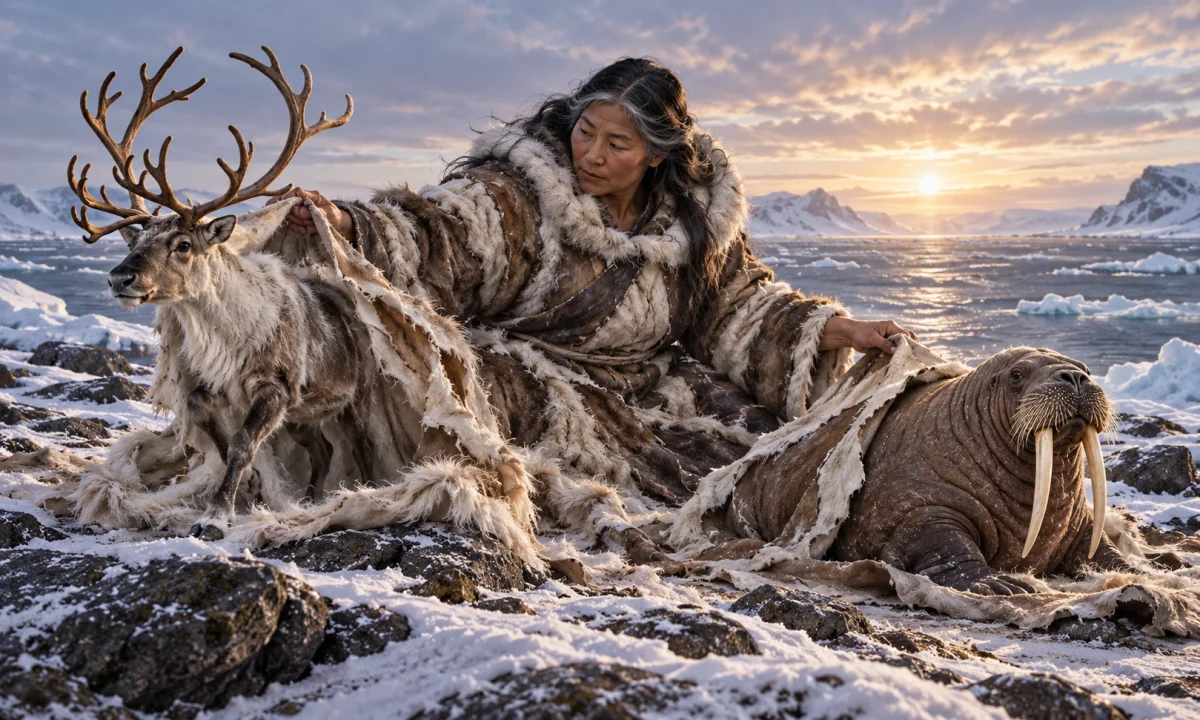
The sea was central to the lives of many Inuit communities. It provided seals, whales, walruses, fish and other animals, while also creating danger through storms, thin ice, cold water and sudden changes in weather. A figure such as Nerrivik therefore belonged to a religious world in which animals were not merely resources. They were living beings with spiritual significance, and their availability depended on maintaining a proper relationship among people, animals and the powers of the environment.
Older outside writers sometimes described Inuit beings as “goddesses” or “gods,” using categories borrowed from European mythology. That terminology can be convenient, but it can also be misleading. Nerrivik is not necessarily best understood as a goddess in the classical Greek or Roman sense, ruling a fixed domain from a divine hierarchy. Depending on the tradition, she may be understood as a powerful sea being, an ancestral woman, a guardian or controller of marine animals, or one form of a wider group of female figures connected with the ocean.
The name Nerrivik
The name Nerrivik is commonly explained in connection with food, eating or a place from which food is obtained. Translations are not always exact because Inuit languages have regional varieties and because a name may carry meanings that are difficult to reproduce in English. It is often rendered with ideas such as “food dish,” “food place” or “the place of food.”
This meaning is significant. Marine animals were the basis of life for many Arctic communities, and the sea could be imagined as the place from which nourishment came. Nerrivik’s name consequently emphasizes provision rather than abstract rulership. She is connected to the arrival, withholding and proper treatment of the animals on which people depend.
Names for related sea figures include Nuliajuk, Nuliajuq, Sedna and other regional forms. These names should not automatically be treated as interchangeable in every context. Some traditions distinguish them, while others use one name where another community uses a different name for a similar figure. English-language books have also sometimes combined accounts from widely separated regions under the best-known name, particularly Sedna.
Nerrivik and marine animals
Nerrivik’s central role is her relationship with the creatures of the sea. Seals, whales, walruses and fish are often imagined as being under the authority of a powerful female being beneath the water. When she is pleased, respected or properly approached, the animals may become available to hunters. When she is offended, neglected or troubled, the animals may remain beyond reach and the community may face hunger.
In this setting, hunting success is not simply a matter of technical skill. Hunters must observe rules governing conduct, sharing, clothing, tools, food and relations with other people. The spiritual condition of the community can affect the condition of the animals. Nerrivik’s control of marine life therefore expresses a broader principle: human survival depends on respectful relationships rather than unrestricted possession.
Her function is sometimes described as “withholding” animals, but this should not be understood only as punishment by an arbitrary deity. The stories often present scarcity as a sign that a relationship has been damaged and must be repaired. A ritual specialist, commonly called an angakkuq in Inuit contexts, may travel spiritually to the sea being, discover the cause of the problem and restore balance.
Appearance and location
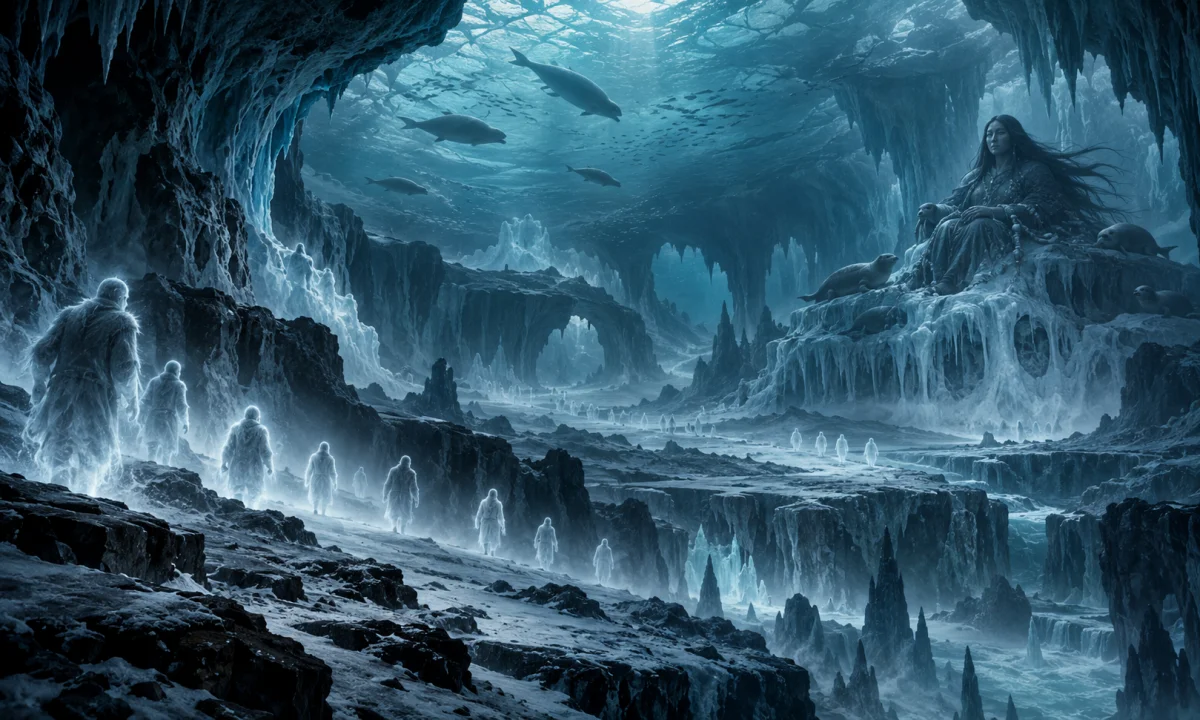
There is no single universally accepted appearance for Nerrivik. In traditions that identify her with Nuliajuk or Sedna, she is frequently portrayed as a woman living beneath the sea. Her underwater dwelling may be imagined as a place where marine animals gather or as a remote realm reached through spiritual travel.
Modern illustrations often give her a consistent visual form: a woman with long hair, a fish or seal-like lower body, or a strikingly beautiful and otherworldly appearance. Such images can be artistically effective, but they do not establish a traditional canonical appearance. Inuit oral traditions do not provide one standardized portrait comparable to an icon in a formal church tradition.
The sea dwelling itself is more important than fixed physical details. It marks the boundary between the human world and the realm of animals and spirits. Beneath the water, ordinary human rules of distance and movement no longer apply. The figure who lives there controls access to the food that sustains people above.
The tangled-hair episode
One of the best-known stories associated with Nerrivik and related sea-mother figures concerns tangled hair. The marine animals become unavailable, and the community suffers. An angakkuq discovers that the sea woman’s hair is matted or knotted. Because she has no one to care for it, the animals remain trapped or cannot be released.
The spiritual traveller approaches her and combs, washes or untangles her hair. Once the work is completed, the animals are freed and return to the hunting grounds. In some versions, the difficulty comes from neglect, grief, anger or a violation of ritual rules. In others, the story focuses less on a specific offence and more on the necessity of restoring order through care.
This story has several layers of meaning. Hair is both intimate and difficult to manage, and its condition makes the sea being’s distress visible. The angakkuq’s task is not to defeat her but to negotiate with her and provide practical assistance. The episode also presents spiritual healing as a form of relationship: the human representative must listen, recognize the problem and repair it before the community can receive food again.
Because the story appears in multiple regional forms, details should be treated cautiously. Some accounts call the being Sedna, others Nuliajuk or another local name, and not every version includes the same explanation for the animals’ disappearance. The tangled-hair motif is therefore best understood as part of a family of related traditions rather than as a single definitive myth of Nerrivik.
Stories of transformation and loss
Many accounts of the Inuit sea mother include a violent or tragic transformation. A young woman becomes associated with the sea after an event involving her father, a husband, a boat or a dangerous journey. When the people in a boat fear that they will die, someone may throw her into the water, and in some versions her fingers are cut off when she clings to the boat. Her severed fingers become seals, whales, walruses or other marine animals.
This narrative is not uniform and should not be assigned to every tradition under the name Nerrivik. The relationships among the characters change from one telling to another, and the event may be explained as betrayal, sacrifice, punishment or the origin of the sea animals. Some versions also differ in the body parts transformed and in the identity of the person responsible.
Where this story is connected with Nerrivik, it helps explain why the sea mother is both provider and potentially dangerous power. She is not a harmless personification of abundance. Her authority emerges from suffering, separation and the boundary between human life and animal life. The animals that sustain the community are linked to her body and history, making hunting a morally charged activity.
Relations with the angakkuq
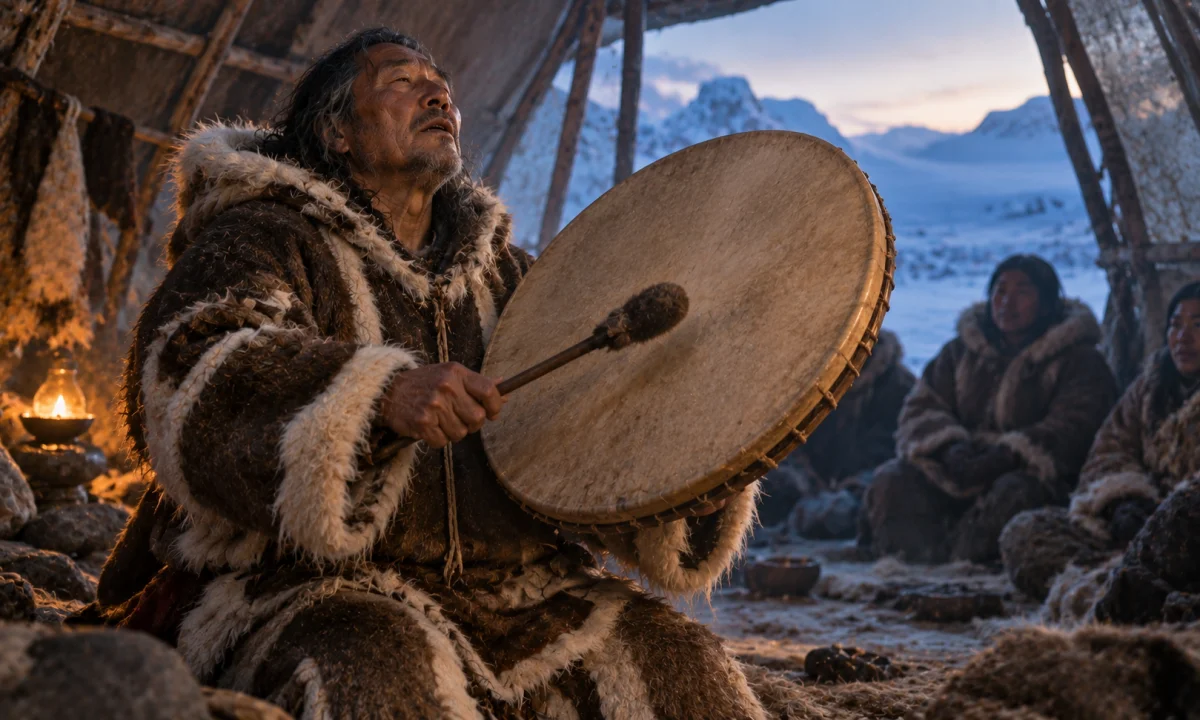
The angakkuq occupies a central role in many stories involving the sea mother. An angakkuq is not simply a “priest” in the European sense. The role could involve healing, divination, communication with helping spirits and mediation between humans and other-than-human powers. The precise meaning and social position of the role varied among Inuit communities.
When marine animals disappear, the angakkuq may undertake a dangerous spiritual journey to Nerrivik’s dwelling. The journey can involve passing through obstacles, negotiating with powerful beings or confronting the consequences of communal wrongdoing. The purpose is not merely to ask for animals but to identify and correct the condition that has prevented them from appearing.
Stories of this kind show that Nerrivik is part of a religious system rather than an isolated character. Her actions are connected with hunting ethics, confession, ritual observance, the treatment of the dead and the responsibilities of the community. A problem in one area of life may disturb the relationship with animals in another.
Symbolism and cultural significance
Nerrivik can be interpreted as a figure of dependence. Human beings depend on the sea, but the sea does not exist simply for human use. Its animals have their own spiritual status, and access to them requires restraint, knowledge and respect. The stories oppose the idea that abundance is guaranteed or that hunting success gives people unlimited ownership.
She also represents the uncertainty of Arctic life. Weather, ice and animal movements cannot be controlled by human wishes. A community may prepare carefully and still face hunger. Presenting the sea as the domain of a powerful being gives cultural form to this uncertainty while also providing a way to respond to it through ritual, ethical conduct and communal responsibility.
The figure’s gender is meaningful in many versions. A female sea being may be associated with nourishment, birth and the protection of animals, but she may also be dangerous, angry or difficult to approach. These traditions do not reduce femininity to gentleness. Nerrivik combines authority, vulnerability, fertility, grief and threat.
It is also important not to describe her simply as a “mother nature” figure. That phrase can flatten distinct Inuit ideas into a modern universal symbol. Nerrivik’s significance is rooted in specific relationships among hunters, animals, sea ice, food-sharing practices, spiritual specialists and the moral life of the community.
Nerrivik, Nuliajuk and Sedna
Confusion among these names is common. Sedna is the name most familiar to many English-speaking readers, especially through accounts based on Inuit traditions from particular regions. Nuliajuk or Nuliajuq is used in other Inuit contexts for a closely related sea woman. Nerrivik is another name associated with a provider or ruler of marine animals.
Some reference works present these figures as different names for one being. That can be a reasonable shorthand when discussing the broad Arctic pattern of a female sea power who controls animals. It becomes less accurate when it erases regional distinctions or implies that Inuit traditions possess one universal mythology. Similar stories may arise through shared cultural themes, historical contact or later collection and translation without making every named figure identical.
The safest description is that Nerrivik belongs to a network of related Inuit sea-being traditions. In some accounts she is effectively the same figure as Nuliajuk or Sedna; in others, the names and local understandings may carry their own significance. The evidence does not support a single fixed biography that applies throughout the Inuit world.
Sources and the limits of reconstruction
Knowledge of Nerrivik comes through oral traditions recorded by outsiders, Inuit elders, community knowledge holders, missionaries, ethnographers, linguists and later writers. These records are valuable, but they were shaped by the circumstances of collection. Translators may have selected familiar English terms such as “goddess,” while collectors sometimes combined accounts from different communities or treated one version as representative of all Inuit beliefs.
Traditional knowledge also changes through time. A story may be adapted for a particular audience, shortened in retelling or presented differently in a ceremonial, educational or family setting. The existence of several versions is not evidence that one must be false. Variation is a normal feature of oral traditions, especially across a vast region with many languages and communities.
For that reason, claims about Nerrivik should distinguish between a particular recorded version and Inuit tradition as a whole. Broad statements about her control of marine animals and connection with food are well established in descriptions of related sea-mother traditions. Specific details about her family, appearance, residence or transformation belong to particular regional narratives unless clearly identified otherwise.
Later reception
Nerrivik and related figures continue to appear in discussions of Inuit art, storytelling, cultural education and Arctic mythology. Contemporary Inuit artists and writers may reinterpret the sea mother in ways that address colonial history, environmental change, cultural continuity or the relationship between communities and the ocean. These works should not be treated as evidence that the same details belonged to older tradition, but neither should modern creativity be dismissed as unrelated to tradition.
Popular retellings often merge Nerrivik with the better-known Sedna and give her a single dramatic origin story or a standardized mermaid-like body. Such adaptations can introduce the figure to new audiences, but they are modern representations rather than a definitive account of Inuit belief. The traditional significance of Nerrivik lies less in a fixed image than in her continuing association with marine life, food, obligation and the difficult relationship between human beings and the sea.