WORLD
WORLD
Samebito
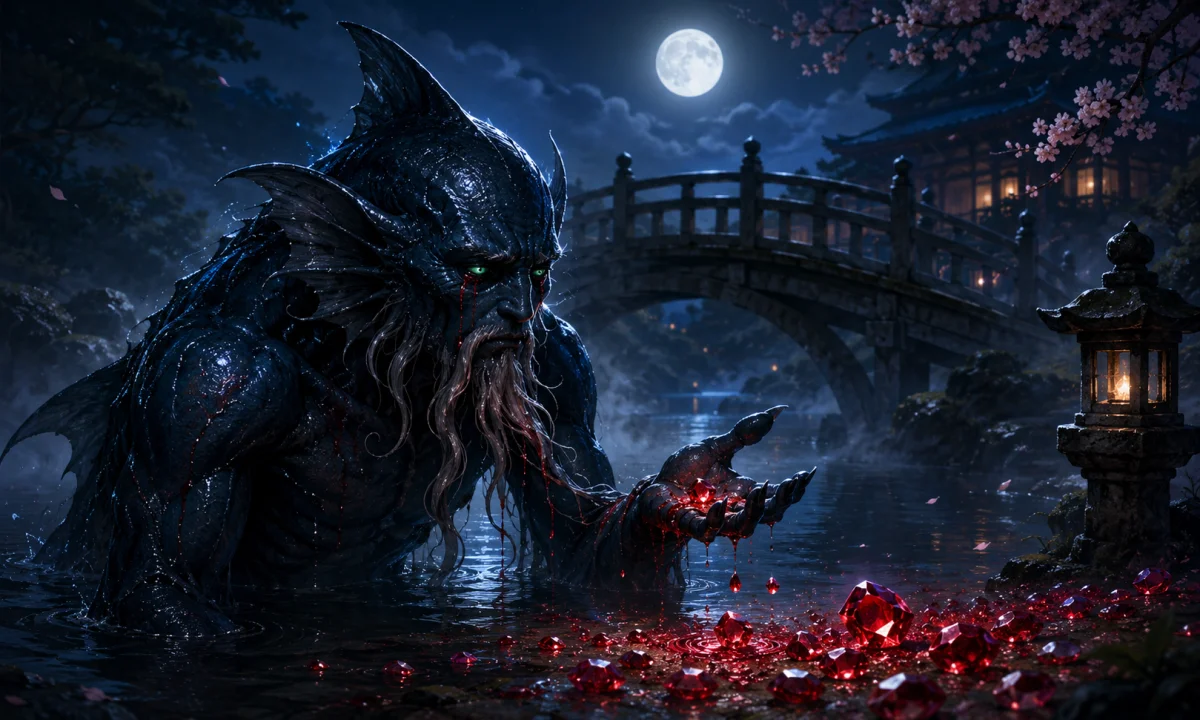
Samebito is a mysterious aquatic being associated chiefly with Japanese folklore and with the undersea world of the Dragon King. The name is usually written 鮫人 and can be translated as “shark person” or “shark-man.” In English-speaking cultures, Samebito is best known through Lafcadio Hearn’s story “The Gratitude of the Samebito,” published in Kwaidan: Stories and Studies of Strange Things in 1904. Unlike figures with a long and clearly documented religious tradition, Samebito has a limited and uncertain body of older evidence. Much of the image now connected with the name comes from Hearn’s literary retelling and later adaptations.
Origins and cultural setting
Samebito belongs to a broad imaginative world of Japanese water spirits, strange beings, dragons and supernatural inhabitants of rivers and seas. Japanese tradition contains many stories about underwater palaces, especially the palace of the Dragon King, commonly called Ryūgū-jō. This realm appears in legends such as the tale of Urashima Tarō and is connected with older East Asian ideas about dragon rulers, marine kingdoms and powerful beings beneath the water.
The Dragon King is not simply a European-style dragon. In Japanese religious and mythological traditions, dragons are often associated with water, rain, seas, rivers and the protection of sacred places. The Dragon King may be understood as a deity, a powerful supernatural ruler or a figure influenced by Buddhist and Chinese religious ideas. Stories set in his palace frequently describe a world that resembles human society but possesses supernatural wealth, strange customs and different rules concerning time and mortality.
Samebito is often placed within this undersea setting. However, the surviving evidence does not establish him as a major ancient deity with a standardized mythology. There is no single widely recognized canon of Samebito stories comparable to the legends of Susanoo, Amaterasu, or the Dragon King himself. The most influential account is Hearn’s story, and the exact relationship between that tale and earlier Japanese material is not always clear in modern retellings.
For this reason, descriptions of Samebito as an ancient, universally recognized Japanese monster should be treated cautiously. The figure has a genuine place in Japanese literary and folkloric reception, but his history is less securely documented than that of better-known beings such as the kappa, oni or yuki-onna.
The name Samebito
The Japanese name combines same, meaning “shark,” with hito or bito, meaning “person” or “human being.” The literal meaning therefore suggests a shark-like person or human-shaped shark. English-language writing generally preserves the Japanese form Samebito, although translations may use “shark-man,” “shark person” or “shark demon.” These translations are not always equivalent in tone. “Demon” can imply an evil being, while Samebito is not consistently portrayed as malicious.
The name itself does not prove that Samebito has a fixed biological identity as a half-shark creature. Folklore names can describe an appearance, a type of being, or a connection with a particular environment rather than provide a precise classification. In the best-known literary account, Samebito is an aquatic humanoid with features that are disturbing to humans but not necessarily those of an ordinary shark.
Appearance and supernatural qualities
Hearn’s description gives Samebito the appearance that has become standard in later popular imagination. He is presented as a frightening man from the sea, with a dark or black face, green hair, a vivid red mouth and an unsettling, otherworldly appearance. Some retellings emphasize eyes or jewels with a green, emerald-like brightness. Artistic depictions often exaggerate these features, showing Samebito as a black-skinned merfolk figure covered in scales or equipped with fins, although not every version includes all of these details.
His most distinctive supernatural quality is connected with tears that become precious jewels. In Hearn’s story, the tears of the Samebito are valuable gems, traditionally described in connection with emerald-like stones. This ability makes sorrow materially valuable, but it also creates an important moral tension. A human being might be tempted to cause or encourage grief in order to obtain wealth. The story therefore treats the Samebito’s tears not merely as treasure but as a test of compassion and self-control.
Samebito is also associated with the sea or with waterways leading to the Dragon King’s realm. He is comfortable in an aquatic environment and has a relationship with supernatural beings beneath the water. Some later descriptions give him powers such as changing form, surviving underwater or commanding marine creatures. These abilities are plausible extensions of the character, but they should not be assumed to belong to a single ancient tradition. The more elaborate the modern description becomes, the more likely it is to combine Hearn’s tale with general merfolk and yōkai imagery.
His appearance and conduct create a contrast between outward form and inner character. To a human observer, Samebito looks like a monster. Yet the central story presents him as capable of loyalty, gratitude and emotional sensitivity. His frightening face does not identify him as evil, and his supernatural wealth does not make him morally superior. He is an outsider whose value must be recognized beyond his appearance.
“The Gratitude of the Samebito”
The central story associated with Samebito concerns a poor samurai named Tōtarō. In Hearn’s version, Tōtarō lives in Kyoto after losing the position and security that once supported him. During a night encounter near a waterway, he discovers the strange being known as Samebito. The creature has come from the realm of the Dragon King and is separated from his underwater home.
Although Samebito’s appearance frightens him, Tōtarō offers assistance rather than attacking or abandoning him. The two become connected through this act of hospitality. Samebito is not treated simply as a threat to be defeated; he is a displaced being in need of help. This reversal is essential to the tale. The human character appears weak because he is poor, while the supernatural stranger appears dangerous because he is unfamiliar. Their relationship develops when Tōtarō responds to vulnerability rather than to appearance.
Samebito repays Tōtarō by providing precious stones formed from his tears. Through these jewels, Tōtarō’s financial circumstances change dramatically. The treasure allows him to escape poverty and gain a more secure position in human society. The exchange resembles other folklore stories in which a supernatural visitor rewards kindness, but the source of the reward is unusual: the jewels come from emotion rather than from a treasure chest.
The tale does not reduce this transformation to a simple promise that kindness always produces wealth. Samebito’s tears are linked to suffering, exile and homesickness, and their value creates an uncomfortable dependence. Tōtarō must confront the fact that his prosperity is connected to the sorrow of another being. The story’s emotional force lies in the friendship between the two characters rather than in the jewels alone.
Details differ among summaries and later retellings. Some versions focus mainly on Tōtarō’s rescue of Samebito and the reward he receives; others give greater attention to the creature’s eventual return to the Dragon King’s domain and to the difficulty of reconciling the human and underwater worlds. Because the early history of the story is not consistently documented in English-language accounts, plot elements should not automatically be treated as features of an ancient, fixed myth.
Classification as a yōkai
Samebito is frequently labelled a yōkai in modern reference works. The term yōkai is useful as a broad description of supernatural beings in Japanese folklore, but it does not represent a single religious species or an exact premodern classification system. It can encompass monsters, uncanny animals, spirits, transformations and unexplained phenomena. Applying the label to Samebito signals his place in modern discussions of Japanese supernatural culture, not necessarily a formal classification used by all historical sources.
In Hearn’s English prose, the being may be called a “demon” or described in terms familiar to Western readers. This wording reflects the vocabulary of translation and adaptation. Samebito is not automatically equivalent to a Buddhist demon, an oni, or a malevolent spirit. His role in the story is closer to that of an otherworldly visitor whose character is revealed through his relationship with a human host.
Symbolism and interpretation
Samebito’s story can be interpreted through several themes found in folklore and literary fairy tales.
- Hospitality toward the unfamiliar: Tōtarō helps a being who looks frightening and belongs to a world he does not understand. The story questions the assumption that strange appearance indicates evil.
- Gratitude across cultural boundaries: The human and the aquatic being do not share the same home, customs or physical nature, yet they form a bond through reciprocal trust.
- Wealth born from sorrow: The jewel-like tears make emotional pain profitable. This can suggest both the transforming power of suffering and the danger of treating another person’s grief as a commodity.
- Exile and belonging: Samebito is associated with displacement from the Dragon King’s realm. His contact with Tōtarō provides temporary refuge but does not erase the separation between his world and the human world.
- Appearance and moral judgment: The story separates ugliness or strangeness from wickedness. The apparently monstrous figure behaves more generously than many ordinary people might expect.
The tale also reflects the attraction of the underwater palace as a space beyond ordinary society. Such realms often contain miraculous riches, but they are not simply places where humans can live without consequences. Contact with them may bring gifts, danger, altered identity or a painful return to ordinary life. Samebito stands at the boundary between these worlds.
Distinction from similar beings
Samebito and the ningyo
Samebito is sometimes described as a Japanese merfolk figure, but he should not be identified automatically with the ningyo. The word ningyo literally means “human fish” and can refer to fish-like beings in Japanese legends. Traditional ningyo stories often concern their rarity, their strange flesh, or the consequences of capturing them. Samebito, by contrast, is specifically associated with the shark-person name, the Dragon King’s realm and the jewel-producing tears in Hearn’s account. The two figures may be visually combined in modern art, but they have different narrative identities.
Samebito and the kappa
The kappa is a water-dwelling yōkai associated especially with rivers, ponds and irrigation channels. Kappa stories commonly portray them as dangerous, mischievous or bound by unusual rules of courtesy. Samebito is not a kappa. His undersea origin, humanoid appearance and connection with the Dragon King distinguish him from the small, amphibious river spirit of kappa folklore.
Samebito and the Ryūjin
The Dragon King, or Ryūjin, is a powerful dragon deity or supernatural ruler connected with the sea. Samebito is not the Dragon King. He is portrayed as a subject, servant or inhabitant of the Dragon King’s domain. Treating the two as interchangeable obscures the hierarchy and setting that give Samebito his identity.
Samebito and Western merfolk
Modern illustrations often make Samebito resemble a European mermaid or merman. The comparison is understandable because both are aquatic humanoids, but the cultural backgrounds differ. Samebito’s most important context is Japanese storytelling about the Dragon King, yōkai and encounters between humans and beings from the water. He is not simply a Japanese name for the Western mermaid tradition.
Later reception
Samebito’s modern reputation is largely shaped by the continued circulation of Hearn’s Kwaidan. The story introduced the figure to many English-speaking readers and helped establish the visual and narrative features now associated with him. Later fantasy writers, illustrators, role-playing games and digital media have used the name for aquatic humanoids, often expanding his abilities or turning him into a monster, companion or guardian.
These modern uses are creative adaptations rather than evidence that every added feature belongs to traditional folklore. A version of Samebito with fins, a shark’s head, magical combat abilities or a detailed underwater kingdom may be effective in fantasy, but such elements should be distinguished from the more limited image preserved through Hearn’s tale. The traditional and literary figure is especially notable not because he is a standard villain, but because his frightening appearance conceals a capacity for gratitude and friendship.
Samebito therefore occupies an unusual position in Japanese mythology and folklore. He is connected to ancient-looking images of dragon kings and underwater palaces, yet his best-known story is a comparatively modern literary presentation whose earlier sources are difficult to establish with certainty. The enduring image of the black-faced, green-haired shark-man with jewel-like tears comes from this meeting of Japanese supernatural motifs, moral storytelling and Hearn’s interpretation of the strange.