WORLD
WORLD
Kappa
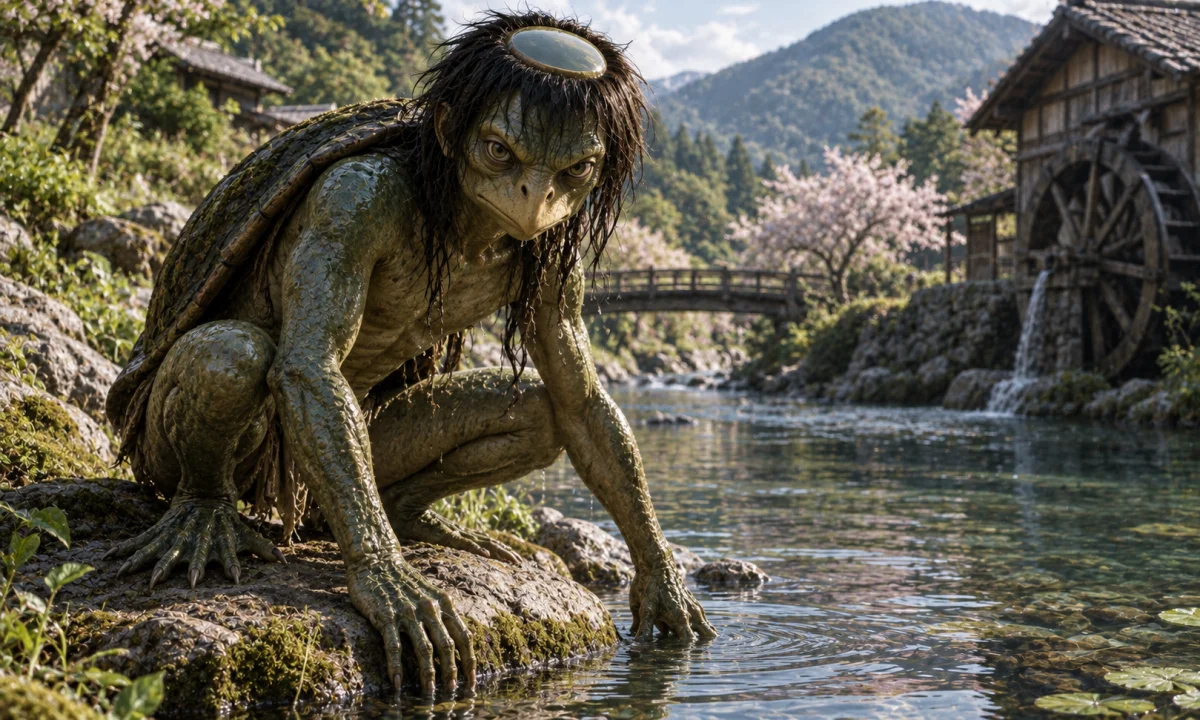
The kappa is a water-dwelling being of Japanese folklore, traditionally associated with rivers, ponds, irrigation channels and other bodies of fresh water. Its name is commonly written 河童, literally “river child,” although the creature has many regional names and forms. Kappa are often described as small, humanoid beings with a beaked mouth, webbed hands and feet, a shell or turtle-like back, and a dish-shaped depression on the top of the head. This dish is said to contain water, the source of the kappa’s strength. Depending on the story, a kappa may be dangerous, mischievous, helpful, courteous or bound by strict supernatural rules.
Origins and cultural setting
Kappa traditions developed within the broader world of Japanese folk belief, where rivers and wetlands were both useful and hazardous. Water supplied drinking water, supported rice cultivation, carried boats and powered mills, but it could also cause drowning, floods and disease. Communities therefore imagined the unpredictable forces of water through stories about spirits, monsters and local guardians.
The kappa was not originally a single, universally defined creature. Older and regional traditions describe various water beings that later came to be grouped under the modern category of kappa. In some places they were said to inhabit a particular river or pond; in others they were associated with an entire district. Their behaviour could change according to local customs and the moral concerns of the community telling the story.
Japanese folk religion has often allowed several types of belief to overlap. A river spirit might be understood in relation to Shinto ideas about the sacred presence of natural places, while Buddhist imagery and demonology also influenced the way supernatural beings were described in written and artistic works. This does not mean that kappa were uniformly worshipped as Shinto gods or classified as Buddhist demons. They are better understood as folkloric water beings whose meaning could shift between local religious practice, cautionary storytelling and popular entertainment.
Some communities treated particular waters as the dwelling place of a kappa and made offerings or observed customs intended to prevent accidents. Such practices varied greatly. There was no single nationwide kappa cult with one official doctrine, and surviving accounts do not present a fixed theology for the creature.
The name kappa and regional identities
The word kappa is now the standard name, but it was not the only name used in traditional accounts. Regional terms include kawatarō, often translated as “river boy,” and enkō, especially in parts of western Japan. Other local names and descriptions were used for beings that resembled the kappa or occupied a similar role.
The written form 河童 can be read as “river child,” but the history of the word and the development of the creature’s familiar image are not completely certain. Scholars have connected kappa traditions with older local water spirits, tales of dangerous beings living near rivers, and broader East Asian traditions concerning aquatic or dragon-like creatures. These connections are matters of interpretation rather than proof that one clearly identifiable creature was simply imported from another culture.
It is also important not to assume that every Japanese water spirit called by a local name was identical to the kappa of modern popular culture. Some beings had different appearances, personalities or ritual functions. The names could overlap, and later writers and illustrators helped standardise traditions that had originally been diverse.
Appearance
The best-known kappa has a child-sized humanoid body, green or yellow-green skin, a beak, webbed fingers and toes, and a shell resembling that of a turtle. It may have a hunched posture, sparse hair or a crown-like rim around the head. In older descriptions and illustrations, however, the appearance is less consistent. Kappa may be shown with the features of a monkey, frog, turtle or strange human child.
The most distinctive feature is the dish on the head. It is usually represented as a shallow, round depression that holds water. According to many stories, the kappa’s supernatural strength depends on the water remaining in the dish. If the water is spilled, the kappa becomes weak or is forced to return to its river. A person can sometimes escape a kappa by bowing deeply. The kappa, being excessively concerned with etiquette, bows in return, causing the water to pour from its head.
This story reflects the importance of formal politeness in Japanese social imagination, but it is also a typical folktale device: a dangerous creature can be overcome by observing its own habits and rules. Not every kappa story includes the head dish, and the details of the creature’s strength differ from one tradition to another.
Water, danger and behaviour
Kappa are primarily associated with fresh water rather than the open sea. They are said to lurk in rivers, ponds, canals, marshes and water-filled agricultural areas. Stories often warn children not to swim alone or to approach deep water carelessly. In this sense, the kappa served as a vivid explanation for drowning accidents and as a memorable figure of discipline.
Traditional tales may accuse kappa of grabbing swimmers, pulling people underwater or attempting to take a person’s shirikodama, a legendary ball associated with the human body and located near the anus. The shirikodama is a folkloric idea, not an anatomical organ. Stories involving it are grotesque and comic at the same time, turning fear of drowning into an image of a monster seeking a bizarre prize.
Other accounts describe kappa as fond of mischief rather than murder. They may steal vegetables, make offensive noises, challenge people to contests or interfere with farmers and travellers. Some traditions give them an interest in wrestling, especially sumo. A kappa may challenge a human to a bout, and its great strength can make it a formidable opponent. Yet a clever person may defeat it by exploiting the water in its head or by using politeness to make it bow.
Kappa are also sometimes portrayed as capable of cooperation. A captured kappa may promise not to harm a community, provide information about medicinal plants or repay a debt. In some stories, a kappa helps a farmer with irrigation or teaches a human a useful skill after being treated fairly. Such tales do not make the creature wholly benevolent. They show instead that the kappa belongs to a moral world in which supernatural beings can respond to promises, courtesy, punishment and reciprocity.
Cucumbers and offerings
Kappa are famously associated with cucumbers. Stories say that the creature enjoys them, and cucumbers may be offered to kappa or thrown into the water as a protective gesture. The association is especially strong in later descriptions and has become one of the most recognisable features of the kappa.
The custom also appears in the name of kappamaki, a type of sushi roll filled with cucumber. The exact cultural relationship between the food name and older kappa belief is part of a broader history of wordplay and popular association, but the connection is now firmly established in Japanese culture. The presence of cucumbers in a story does not, by itself, indicate a religious offering; in many modern contexts it is simply a humorous reference to the folkloric creature.
Important narrative patterns
The bow and the spilled water
One of the most widespread narrative patterns concerns the kappa’s excessive politeness. A traveller or villager sees the creature preparing to attack and bows. The kappa instinctively returns the greeting, spilling the water from its head. The human then refills the dish or persuades the kappa to make a promise. Versions differ in whether the kappa becomes an ally, apologises or retreats permanently.
The story makes the kappa both threatening and ridiculous. Its physical power is balanced by a social weakness: it cannot easily resist the conventions of respectful behaviour. The tale also reflects a recurring feature of folklore in which intelligence and self-control defeat brute strength.
Challenges to humans
In many traditions, kappa challenge humans to wrestling matches or other contests. Their bodies may be small, but they possess extraordinary strength when the water dish is full. Human characters survive by trickery, by making the creature bow, or by forcing it away from the river. These stories can be read as comic accounts of how an apparently weak person overcomes a dangerous opponent through knowledge of local customs.
Agreements and obligations
Some tales present encounters between kappa and humans as negotiations. A kappa may be caught in a trap, wounded by a farmer or compelled to swear that it will no longer attack people. In return, it may offer a service or reveal a secret. The kappa’s promise is meaningful because folklore often gives supernatural beings a strict relationship to oaths and social obligations.
These stories should not be reduced to a single moral. Some emphasise the danger of breaking a promise; others portray the kappa as an unruly neighbour who can be managed through diplomacy. The creature’s status may shift from monster to trickster, depending on the local version.
Symbolism and interpretation
The kappa expresses several concerns at once. It is a personification of dangerous water, especially for children and inexperienced swimmers. It also represents the uncertain boundary between cultivated land and wild nature. A canal or pond may be part of ordinary village life, yet it remains a place where forces beyond human control are imagined to reside.
The creature’s mixed anatomy reinforces this ambiguity. It is neither fully human nor fully animal. Its beak, shell, webbing and aquatic habits connect it to animals, while its speech, etiquette, appetite and social relationships make it recognisably human. Folklore often uses such hybrid beings to explore the limits of human identity and the difference between civilisation and the wild.
The kappa can also be interpreted as a figure of social discipline. Children are warned away from hazardous water, while adults are reminded that manners, promises and cleverness matter even in encounters with supernatural danger. The comic elements prevent the stories from becoming purely terrifying. Fear is made manageable through rules: do not approach the water carelessly, protect yourself with knowledge, and understand the habits of the being you face.
Interpretations connecting kappa with drowned children, foreign creatures or specific religious beings should be treated cautiously. Some scholars have proposed such links, and particular local traditions may support them, but no single origin explains every kappa story. The surviving folklore is layered, regional and changeable.
Written and artistic traditions
Kappa became increasingly recognisable in printed books and illustrated works during the Edo period, when commercial publishing expanded and artists collected, classified and reshaped supernatural tales. The eighteenth-century artist Toriyama Sekien included a kappa-like figure in his influential illustrated catalogue of yōkai. Such works helped circulate images of supernatural beings beyond the communities where particular stories had originated.
Illustrations did not merely record an unchanging tradition. Artists selected features, exaggerated them and placed local beings into broader categories of monsters and spirits. The turtle-like shell, dish-shaped head and beak became especially influential in the formation of the familiar modern image. Written encyclopaedias, collections of legends and later school materials continued this process of standardisation.
Because the kappa tradition was transmitted through both oral and written culture, no single text can be treated as the definitive account. A local tale, an Edo-period illustration and a twentieth-century children’s story may all use the word kappa while presenting noticeably different creatures.
Distinguishing kappa from similar beings
Kappa are sometimes confused with other Japanese supernatural figures, but the distinctions are useful. A tengu is primarily a mountain or forest-associated being, often depicted with wings, a long nose or a bird-like face. A kappa is linked mainly to fresh water and is recognised by the head dish and aquatic features.
Oni are ogre-like beings commonly shown with horns, fangs and clubs. They belong to a different group of traditions, although folklore and modern entertainment may place oni and kappa together as generic monsters. A yuki-onna, or snow woman, is associated with winter landscapes and deadly cold rather than rivers and ponds.
Japanese folklore also contains various local river spirits and water monsters that are not simply interchangeable with kappa. Terms such as kawatarō and enkō may refer to regional forms or related traditions, but their exact relationship to the standard kappa varies by place and source. Similar-looking beings in Chinese, Korean or other East Asian traditions should likewise not be treated as identical without specific evidence of historical connection.
Modern reception
In modern Japan, the kappa is often less frightening than its traditional reputation suggests. It appears in children’s books, cartoons, toys, advertising, mascots and local festivals. Towns associated with kappa legends may use the creature to promote tourism, mark a river or pond, or celebrate regional identity. Statues and public signs can turn a once-dangerous water spirit into a friendly symbol of a neighbourhood.
Modern portrayals frequently preserve the dish, shell, beak, webbed limbs and love of cucumbers while softening the violence of older stories. A kappa may be presented as shy, comic or environmentally conscious. Such representations are adaptations, not evidence that all traditional communities imagined the creature in the same way.
The kappa has also become familiar internationally through manga, anime, games and films. These works may give it new powers, personalities or relationships and may combine it with other monsters for dramatic effect. The enduring appeal of the figure lies in its unusual combination of menace and absurdity: it is a creature of dangerous rivers, but also a fussy, rule-bound being that can be defeated by a bow, a cucumber or a well-timed act of courtesy.