WORLD
WORLD
Raiju
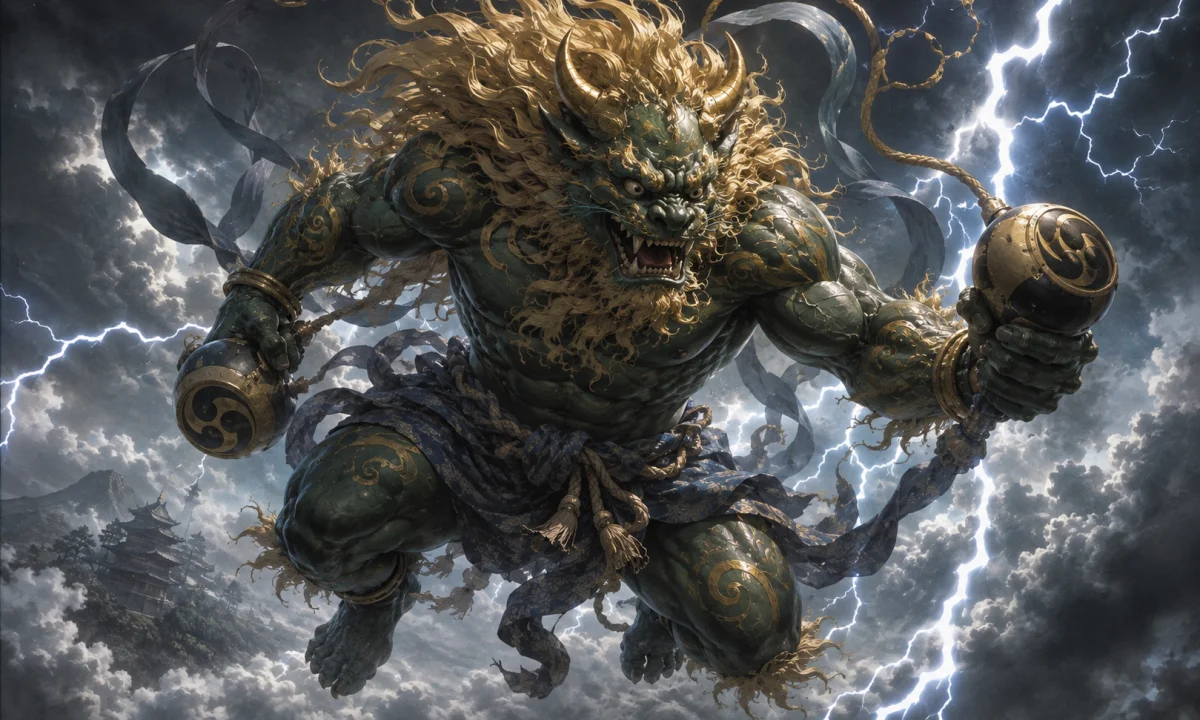
Raiju (雷獣, usually read raijū) is a creature of Japanese folklore associated with thunder and lightning. Its name means “thunder beast,” from rai, “thunder,” and jū, “beast” or “animal.” Unlike a single god with one established appearance, Raiju is a flexible folkloric being whose form and behaviour vary considerably among regional traditions, illustrated books and later retellings.
Raiju is often described as the companion, servant or animal manifestation of Raijin, the Japanese thunder deity. That relationship is common in popular explanations, but it is not entirely uniform across older material. In some accounts Raiju is an independent thunder-associated creature; in others, it is closely connected with the divine power that produces storms. The name may therefore refer both to a particular supernatural animal and to a broader class of beings believed to accompany or embody thunder.
Origins and cultural setting
Ideas about thunder in Japan developed within a religious environment shaped by Shinto traditions, Buddhism and long-standing beliefs about powerful beings inhabiting the natural world. Thunder was not understood merely as a physical sound. It could be treated as the action of a kami, a dangerous spirit, a sign of divine displeasure or a force connected with rain and agricultural fertility.
Raijin, also known as Raiden in some contexts, became the most familiar personification of thunder. He is commonly represented as a fearsome deity surrounded by drums, whose striking produces thunder. Raiju belongs to the same imaginative world, but it is more animal-like and less formally defined. Rather than receiving a major, standardized cult of its own, it appears mainly in stories, local reports, encyclopedic descriptions, pictures and explanations of unusual natural events.
Japanese folklore frequently gives animal form to forces that are difficult to control or explain. Foxes, badgers, cats, snakes and many other animals can become supernatural beings under particular circumstances. Raiju follows this pattern, although its defining feature is its connection with storms. A strange animal seen near a lightning-struck tree, or an unfamiliar creature found after a violent storm, could be interpreted as a thunder beast.
Descriptions of Raiju became especially visible in the early modern period, when writers and artists collected accounts of unusual beings and natural wonders. Illustrated yokai catalogues, popular books and encyclopedic works helped preserve several competing images of the creature. These sources should not be treated as a single sacred scripture or as evidence that every Japanese community shared the same belief. They show how people recorded, interpreted and reimagined local traditions.
Name and identity
The characters 雷獣 literally mean “thunder beast.” The spelling identifies Raiju by its association with thunder rather than by a fixed biological or mythological species. This helps explain why descriptions of it differ so much. A Raiju may resemble one familiar animal in one account and a completely different creature in another.
The word is sometimes written in English as raijū, with a macron marking the long vowel, or as raiju, raijuu or raichū in less consistent romanizations. Raijū is the most useful scholarly transliteration of the Japanese reading 雷獣, while “Raiju” is the spelling most often encountered in English-language discussions.
There is no universally accepted classification for Raiju. It is often called a yokai, a broad modern term for supernatural beings and strange phenomena in Japanese folklore. This classification is reasonable, but the categories used in modern yokai studies do not always correspond neatly to the language or conceptual divisions of earlier periods. Historical Japanese sources could describe a thunder beast as an animal, spirit, omen or manifestation without requiring it to belong to a rigid supernatural taxonomy.
Appearance and changing forms
Raiju has no single canonical appearance. Common forms include a small dog, wolf, cat, weasel, badger-like animal or other four-legged creature. Some descriptions make it resemble a ball of fur or a compact, restless animal that moves rapidly through the air. Other images give it a more unusual body, combining features from several animals.
Illustrations from the early modern period often show Raiju as a creature climbing or clinging to a tree. This image reflects the belief that thunder beasts were connected with trees struck by lightning. It also gave artists a way to distinguish Raiju from the more human-shaped Raijin. The animal may be shown with sharp claws, a long tail, pointed ears or a compact body, but these details are artistic choices rather than stable traditional attributes.
Some modern depictions portray Raiju as a wolf-like or feline creature surrounded by electricity. Such images draw on older associations with storms but are not necessarily faithful to any one historical description. The familiar “electric animal” appearance is a modern visual shorthand for lightning and should not be mistaken for a universally established feature of Japanese folklore.
Thunder, lightning and trees
Raiju’s principal power is its relationship with thunder and lightning. In traditional accounts, the creature may descend from the sky, move through the air or accompany a storm. It is not always said to create lightning by itself. In many interpretations, Raiju is the animal presence of thunder: a being carried by the storm or released when the sky becomes violent.
Stories linking Raiju with trees are among the most persistent elements associated with the creature. A tree struck by lightning could be damaged, split or set on fire, and a mysterious animal might supposedly be found nearby. This transformed a natural event into a narrative involving a hidden supernatural inhabitant. Trees also held religious significance in Japan, where sacred groves and old trees could be treated as places of spiritual presence. The thunder beast therefore occupied a setting that was already charged with religious and folkloric meaning.
Some traditions claim that Raiju hides in trees during a storm. This motif should be treated as a recurring folkloric image rather than a rule governing every account. The precise behaviour varies: the creature may run across rooftops, leap between trees, fall from the sky or remain concealed until the storm passes.
The navel and storm-protection beliefs
A widely repeated story says that Raiju becomes agitated during thunderstorms and tries to enter or scratch a person’s navel. Because of this danger, people are sometimes said to have covered their stomachs, slept face down or pulled blankets over themselves during storms. The motif is now one of the best-known details associated with Raiju.
Its historical status is less straightforward than modern summaries often suggest. Navel-protection beliefs and warnings about exposing the stomach during thunder are found in Japanese folklore and popular culture, but the idea that Raiju consistently hunts human navels is not a universal feature of all older accounts. It appears to have been strengthened and standardized through retellings, children’s explanations and later media.
The belief nevertheless fits a broader pattern in which storms make hidden dangers active. Covering the body offered a simple protective action when thunder was frightening and its causes were not understood in modern meteorological terms. The navel, as the centre of the abdomen and a visible reminder of birth and bodily vulnerability, could become the focus of a warning intended to teach caution during dangerous weather.
Relationship with Raijin
Raiju is frequently described as Raijin’s animal companion. In paintings and popular accounts, Raijin may be shown with a thunder beast nearby, while the god’s drums symbolize the sound of thunder itself. This pairing is understandable because both figures belong to the same storm mythology.
However, Raiju should not simply be treated as another name for Raijin. Raijin is a deity or divine thunder figure; Raiju is a thunder beast or supernatural animal. Their roles overlap, but their identities are distinct. Raijin has a more recognizable religious and iconographic status, while Raiju is more variable and primarily folkloric.
The relationship also reflects the way Japanese traditions combine divine, Buddhist and folkloric imagery. A kami, a Buddhist guardian figure, a local spirit and an animal yokai could be placed within overlapping explanations of the natural world. These categories were not always separated according to modern ideas of religion, mythology and folklore. A thunder beast could therefore be understood as an attendant of a deity without becoming a deity in its own right.
Stories, reports and regional variation
Accounts of Raiju often take the form of reports rather than long mythic narratives. A person sees an unfamiliar animal during a storm; a tree is struck and something strange is found in its branches; a creature appears to fall from the sky; or an animal behaves in a way that witnesses consider unnatural. These short accounts give Raiju an ambiguous quality. They resemble encounters with a real animal while retaining the possibility of supernatural explanation.
Early modern Japanese authors showed considerable interest in strange animals, unusual events and local marvels. Collections of curiosities and illustrated books brought together stories from different areas, sometimes preserving regional details and sometimes reshaping them for entertainment. As a result, one book may present Raiju as a cat-like creature while another gives it the form of a dog, weasel or composite animal.
These variations are not necessarily contradictions. Folklore changes as it travels between communities, storytellers and artistic media. A storm animal observed in one region could be identified with a local species, while an illustrator elsewhere might use an animal associated with speed, cunning or nocturnal activity. The lack of a fixed form is part of Raiju’s traditional character.
Meaning and cultural significance
Raiju represents the uncertainty and danger of severe weather. Thunderstorms could bring welcome rain, especially to farming communities, but they could also destroy crops, damage buildings, kill people and start fires. A being that was both energetic and dangerous expressed this double character well.
The creature’s animal shape also makes an enormous natural force easier to imagine. Thunder may be heard but not seen, while lightning is sudden and difficult to predict. Giving the storm a fast-moving beast creates a visible agent for an invisible process. The beast can hide, leap, scratch, climb and flee, turning an impersonal event into something that can be approached through story.
Raiju can therefore be understood as more than a simple “Japanese lightning monster.” It belongs to a network of beliefs about sacred landscapes, divine weather, animal transformation and the interpretation of unexplained events. Its stories show how folklore can preserve older religious ideas while also responding to everyday observation and fear.
Distinctions from similar figures
Raiju is sometimes confused with several other beings connected with storms or unusual animals.
- Raijin: Raijin is the thunder deity, commonly depicted with drums. Raiju is the thunder beast associated with storms and sometimes with Raijin.
- Kaminari: Kaminari means thunder and can refer to the sound or phenomenon itself. It may also appear in expressions and folklore connected with thunder, but it is not simply another name for Raiju.
- Inugami and other animal spirits: Inugami are dog spirits in particular Japanese traditions, while Raiju is defined by its connection with thunder. A dog-like appearance does not make a Raiju an inugami.
- Thunder dragons and Chinese storm beings: East Asian religious and folkloric traditions contain dragon-like beings associated with rain and thunder. These influences belong to a wider regional history, but a dragon should not automatically be identified as Raiju.
- Modern electric animals: Creatures from contemporary games, animation and fantasy fiction may borrow the name Raiju or its storm theme. Their powers and designs are modern inventions unless they are specifically presented as adaptations of traditional folklore.
Later reception and popular culture
Raiju has become increasingly recognizable outside Japan through books about yokai, fantasy art, games, animation and other forms of popular culture. Modern artists often give it a sleek feline, canine or wolf-like body covered in sparks, making it visually suitable for stories about electricity and combat. Some works portray it as a benevolent guardian, while others make it a dangerous monster or a creature that can be captured and used.
These adaptations are culturally relevant because they have helped spread the name internationally, but they should be separated from the older tradition. A game creature with a fixed elemental attack, a particular colour scheme or a detailed family history may be inspired by Raiju without representing a historical Japanese belief. Traditional accounts provide a broad thunder-beast motif, not a single official design or standardized set of abilities.
In Japan, the image of the storm animal also continues through educational storytelling, illustrated folklore, exhibitions and discussions of yokai. The navel story remains especially popular, although it is often presented humorously or as an old-fashioned warning. Raiju’s continuing appeal lies in its ability to connect a familiar natural event with a strange animal presence: when thunder shakes the sky, folklore imagines that something alive may be racing through the storm.