WORLD
WORLD
Pukkeenegak

Pukkeenegak is a figure associated in some English-language accounts with Inuit traditions of childbirth, fertility, pregnancy and the care of children. Her name and role are not documented through a single pan-Inuit mythology, however. Inuit peoples live across a vast Arctic region, including Alaska, Canada and Greenland, and their religious traditions contain important regional differences. Pukkeenegak should therefore be understood as a figure attributed to particular Inuit traditions or interpretive sources, rather than as a universally defined goddess of all Inuit communities.
Origins and cultural setting
Inuit religious traditions developed within Arctic societies whose lives depended on hunting, fishing, cooperation, kinship and a detailed knowledge of animals, weather, sea ice and the land. Spiritual power was not necessarily separated into the fixed “gods” familiar from Greek or Roman mythology. Many beings could possess inua, a term often translated as “its person,” “its spirit” or “its owner,” although the meaning is more complex than any single English translation suggests.
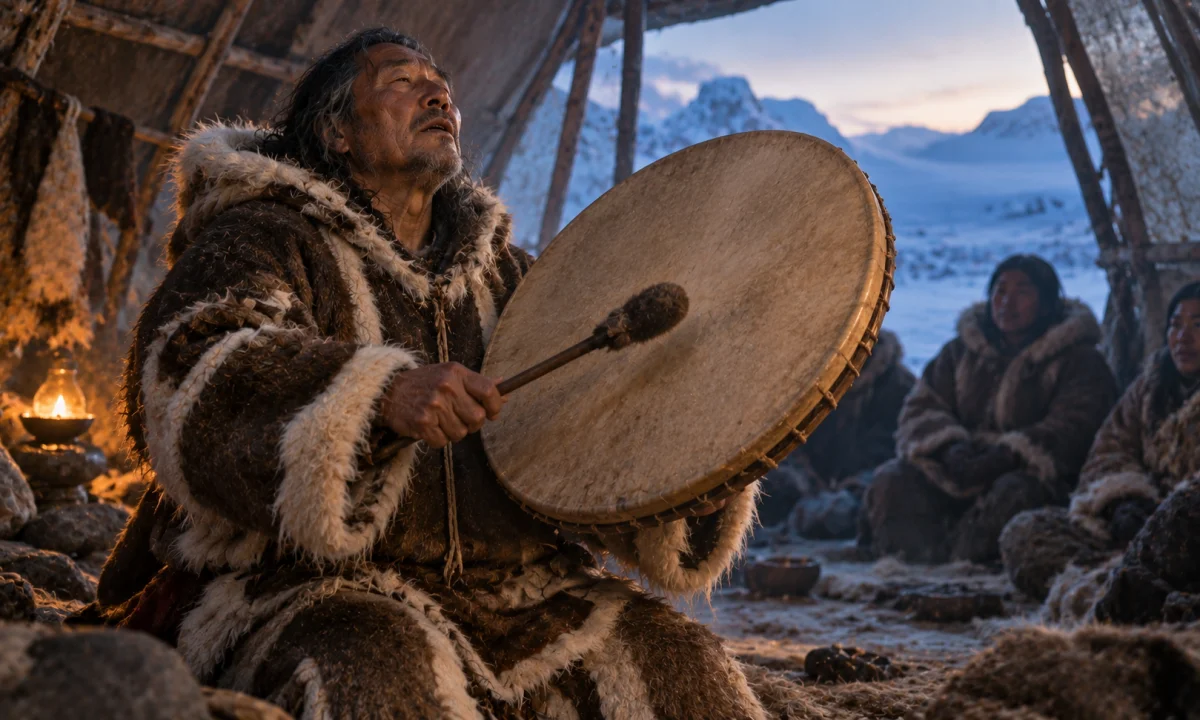
Human beings, animals, places, tools and natural forces could all have spiritual significance. Ritual specialists, commonly called angakkuit in Inuit contexts, mediated between people and the unseen world. Their responsibilities could include healing, divination, restoring relations with animals and addressing spiritual causes of illness or misfortune. Ideas about birth, bodily health, family continuity and the protection of infants belonged to this wider religious environment.
Most Inuit traditional knowledge was transmitted orally. Stories, songs, ritual knowledge and explanations of customary behaviour were preserved through performance and teaching rather than through a single sacred book. Accounts written by outsiders often recorded only selected versions of local traditions, and their spellings and interpretations were shaped by the languages and assumptions of the writers. This is one reason why information about Pukkeenegak is less extensive and less consistent than information about better-known figures such as Sedna.
Name and identity
The spelling Pukkeenegak is widely used in English-language discussions of Inuit mythology, especially in lists that identify her with childbirth, fertility and children. Closely related spellings may appear because Inuit names have been written in different regional orthographies and romanization systems. A spelling found in an English source does not automatically represent a single standardized form across all Inuit languages.
The meaning of the name is not securely established in general English-language reference material. It is safest not to treat popular translations as exact etymologies. Some modern summaries present Pukkeenegak as a goddess of childbirth; others extend her sphere to pregnancy, fertility, infants or the raising of children. These descriptions may reflect related ideas, regional interpretation or the tendency of modern mythology lists to combine several aspects into one brief entry.
Calling Pukkeenegak a “goddess” is also a translation choice. The word is convenient for readers familiar with classical mythology, but it can suggest a rigid pantheon of individually defined deities. Inuit spiritual traditions do not always organize supernatural beings in that way. A more cautious description is that Pukkeenegak is a female spiritual figure associated in some accounts with reproduction, birth and children.
Role in childbirth and family life
Pukkeenegak’s principal attributed role is the protection or oversight of childbirth. In this context, she represents the powerful and dangerous transition by which a new person enters the community. Birth was not only a biological event. It affected family relationships, naming, obligations, ritual conduct and the future strength of the group.
Figures connected with childbirth can have several functions at once. They may be invoked to explain fertility, guard a pregnant woman, protect a newborn or embody the continuity between generations. Pukkeenegak is consequently described in some sources as a figure of fertility and children, rather than only as a patron of the moment of delivery.
These associations should not be turned into a detailed mythology without evidence. There is no single, widely attested canonical story in which Pukkeenegak performs a fixed sequence of actions comparable to the major narrative cycles associated with some other mythological figures. Nor is there a universally accepted account of her family, home, appearance or personal history. Her importance in available summaries lies primarily in her sphere of responsibility.
Inuit understandings of health and reproduction were connected to practical knowledge as well as spiritual belief. Midwives, older women and other knowledgeable members of a community played essential roles in pregnancy and birth. A supernatural protector did not replace human care. Religious ideas gave meaning to danger, uncertainty and responsibility, while social knowledge and experience guided the actual work of looking after mothers and infants.
Attributes and appearance
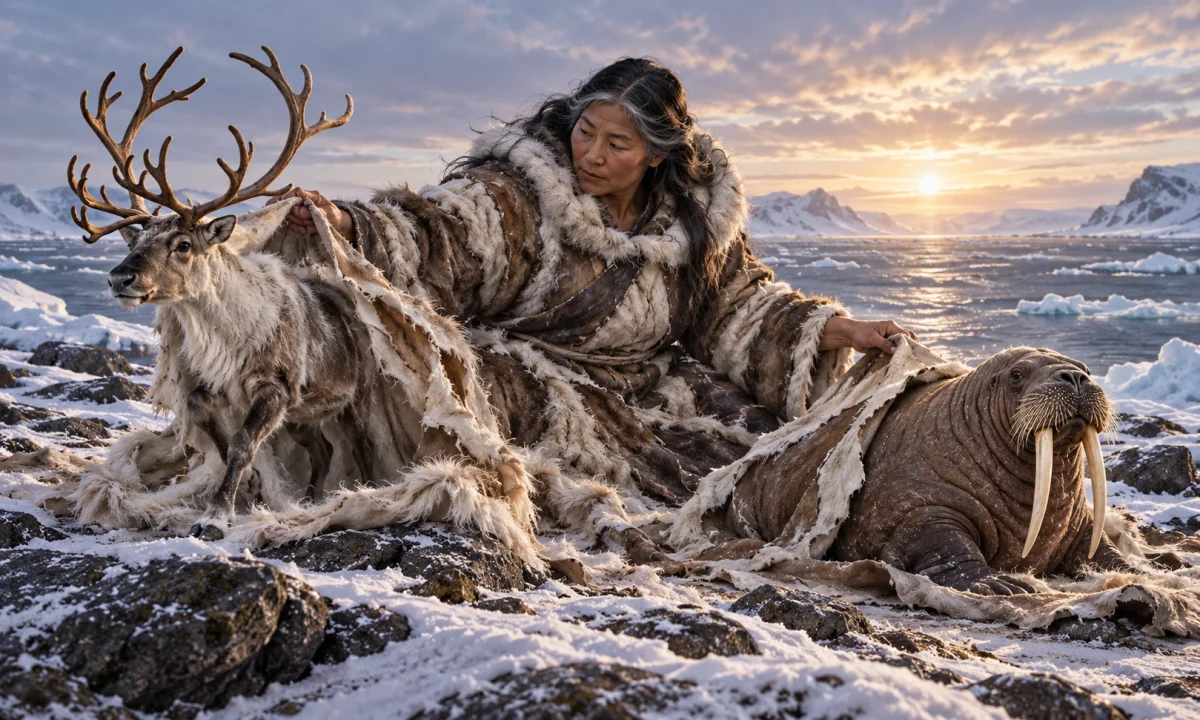
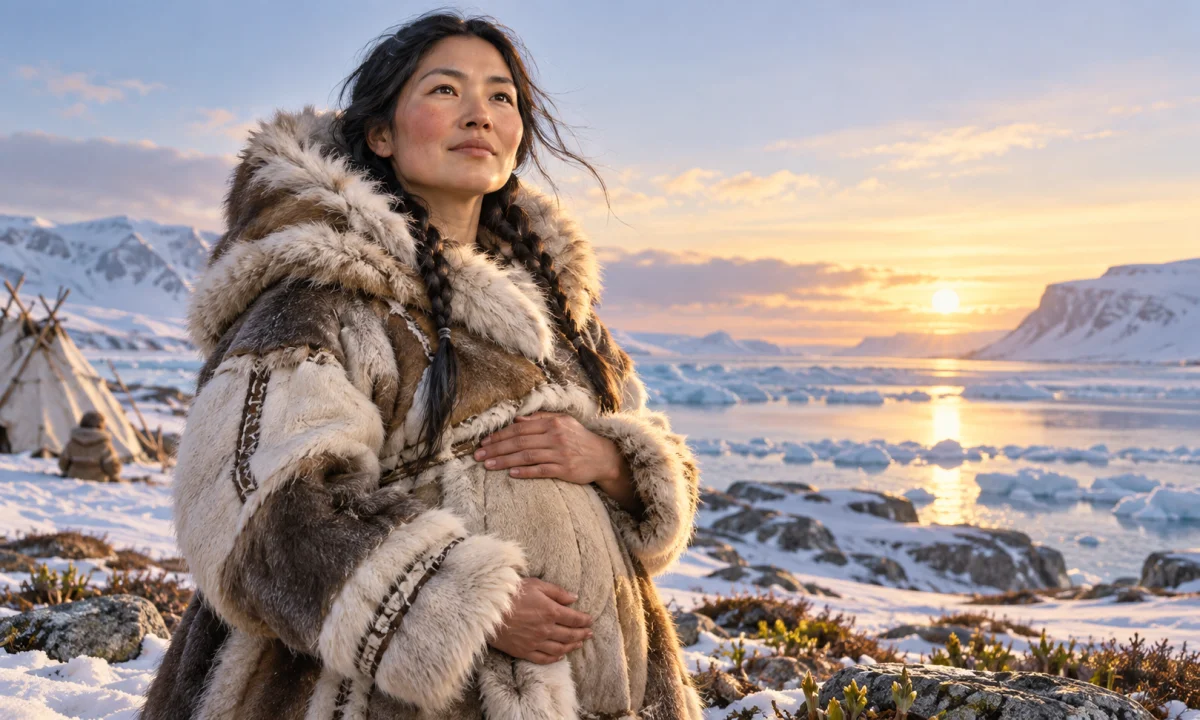
Traditional descriptions of Pukkeenegak’s appearance are not consistent or sufficiently widespread to establish a standard form. She is not associated with a universally recognized costume, animal companion, weapon or emblem. Images found in modern mythology collections should therefore not be assumed to reproduce an ancient Inuit representation.
Her most stable attributes are thematic rather than visual. They include:
- childbirth and the arrival of new life;
- fertility and pregnancy;
- the protection of infants and children;
- the continuation of families and communities; and
- the spiritual significance of reproduction and care.
These themes are especially meaningful in Arctic communities, where survival depended on cooperation among relatives and on the transmission of knowledge from one generation to the next. Children were not merely symbols of abstract fertility. They were future members of a community whose skills, relationships and memory were essential to collective life.
Stories and regional variation
Unlike figures supported by numerous recorded narratives, Pukkeenegak is often encountered as a brief name with a short description. This may indicate that the surviving record is incomplete, that the name belongs to a localized tradition, or that later writers extracted a figure from a larger religious context and presented her as an independent deity. It is also possible for one name or role to be represented differently in different Inuit-speaking regions.
The absence of a long written narrative does not mean that the figure was unimportant. Oral traditions are not measured by the same standards as literary mythologies. A spiritual being may be known through ritual practice, a name, a specialist’s knowledge, a set of prohibitions or a collection of short teachings rather than through a single elaborate tale. Written records also tend to preserve dramatic stories more readily than ordinary religious practice.
For this reason, claims that Pukkeenegak is the wife, daughter or servant of another famous Inuit being should be treated carefully. Such relationships are sometimes repeated in popular compilations, but they are not part of a uniformly attested Inuit genealogy. There is no reliable basis for assigning her one fixed place in a universal family tree of Inuit spirits.
Relationship to other Inuit figures
Sedna and Nuliajuk
Pukkeenegak is sometimes confused with Sedna, also known in some traditions as Nuliajuk or under other regional names. Sedna is a powerful sea-associated figure in many Inuit traditions, although her name, story and precise role vary considerably. Narratives about her often concern marine animals, hunting success, pollution or violations of customary rules. An angakkuq may need to travel to her realm or appease her when animals become unavailable.
Pukkeenegak’s usual association is different. She is connected with birth, fertility and children rather than primarily with the sea animals on which Arctic communities depended. The two figures should not be merged merely because both are described in English as female supernatural beings or “goddesses.”
Pinga
Pinga is another Inuit figure whose sphere may include hunting, animals, fertility and the welfare of human beings, depending on the tradition being described. Because fertility and reproduction can overlap with broader ideas of abundance and survival, Pinga and Pukkeenegak may appear near one another in comparative lists. They are nevertheless distinct names and should not be treated as different spellings of the same figure.
Sila and other spiritual powers
Sila is a particularly complex concept and name in Inuit religious thought. It can refer to the air, weather, the world, intelligence, consciousness or a powerful spiritual principle, depending on context and region. Sila is not simply a childbirth goddess, and Pukkeenegak should not be identified with Sila because both may be described broadly as spiritual powers.
Other traditions include household spirits, helping spirits, animal beings and figures associated with illness, death, weather or the landscape. The boundaries between categories can be fluid, and English labels such as “goddess,” “spirit,” “monster” and “deity” often simplify distinctions that were more context-dependent in Inuit languages and practices.
Cultural significance
Pukkeenegak’s attributed domain highlights the importance of reproduction and child care within Inuit social life. Pregnancy and birth involved physical risk, emotional uncertainty and communal responsibility. A figure associated with these experiences could express hopes for a safe delivery and the survival of a vulnerable child, while also acknowledging that birth lay partly beyond human control.
The figure can also be read as a reminder that Inuit mythology is not limited to dramatic tales about sea monsters, hunters or dangerous journeys. Spiritual meaning could be found in ordinary activities and life stages: making clothing, preparing food, caring for babies, observing birth customs and maintaining respectful relations among family members. A tradition that preserves a birth-associated spiritual being reflects the value placed on the continuation of human relationships and knowledge.
Interpretation must still avoid turning Pukkeenegak into a generic symbol of “motherhood” detached from Inuit culture. Inuit communities are diverse, and family roles, birth practices and religious beliefs have changed over time. The figure belongs within particular cultural histories rather than within a universal category of mother goddesses.
Written records and modern representations
Much of the information circulated about Pukkeenegak comes through modern English-language summaries rather than through a large, consistently documented body of traditional narratives. Such summaries can be useful introductions, but they frequently compress regional traditions into a few sentences. They may also present an uncertain identification as though it were universally accepted.
Modern mythology websites, school materials and popular reference lists sometimes portray Pukkeenegak as a fully defined goddess with a fixed appearance, genealogy and set of powers. Those details should be distinguished from the more limited and recurring association with childbirth, fertility and children. A polished illustration or an invented narrative can be a contemporary creative interpretation, not evidence of an old Inuit belief.
There is no major, widely recognized modern popular-culture tradition centred on Pukkeenegak comparable to the use of Sedna or other mythological figures in novels, films and games. When she appears in contemporary retellings, she is generally presented as a symbol of birth, protection or Arctic femininity. Such portrayals may introduce new traits and should not be used to reconstruct the historical traditions of Inuit communities.