WORLD
WORLD
Ochosi
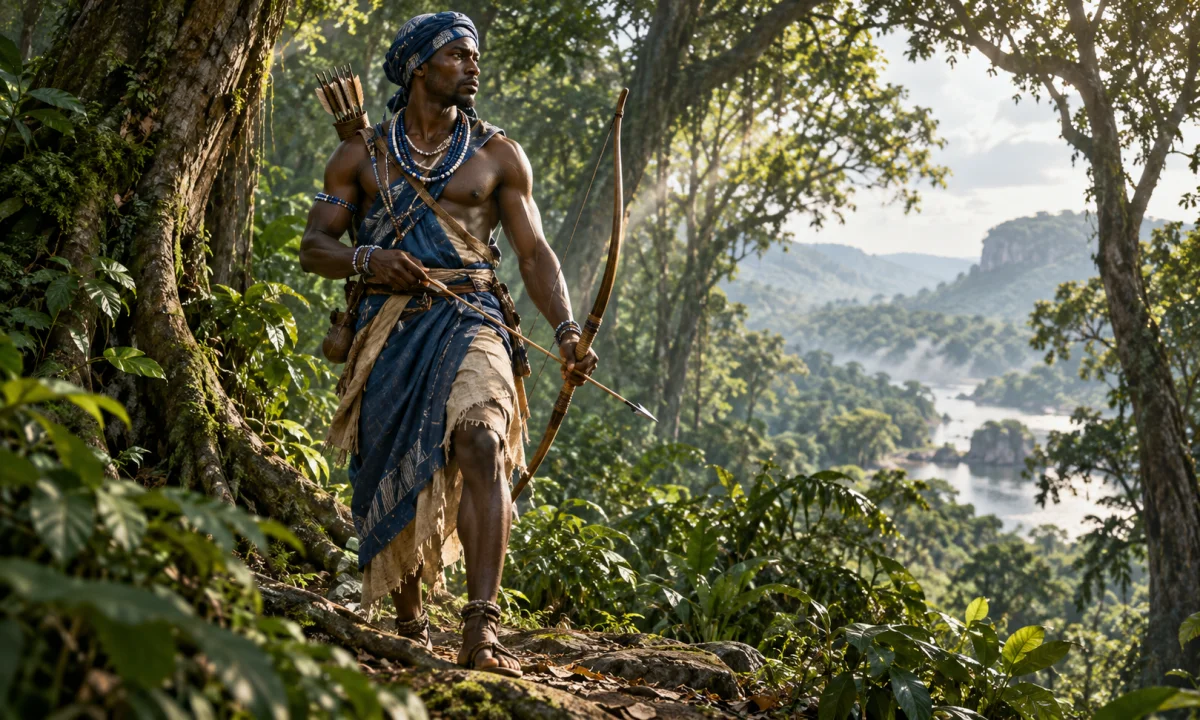
Ochosi—written in Yoruba as Ọ̀ṣọ́ọ̀sì and known by related spellings such as Oshosi or Oxóssi—is an òrìṣà of Yoruba religious tradition. He is especially associated with hunting, the forest, tracking, accuracy and the knowledge required to find what is hidden. In several Yoruba-derived religions of the Atlantic world, including Cuban Lukumí and Brazilian Candomblé, he also became strongly connected with justice, prisoners, legal judgment and the protection of people who are wrongly accused. His identity is not completely uniform across all communities: some attributes belong particularly to particular regional or diasporic traditions rather than to every form of Yoruba religion.
Ochosi in Yoruba religious tradition
Yoruba religion developed among Yoruba-speaking peoples of West Africa, especially in present-day southwestern Nigeria and neighbouring parts of Benin and Togo. It is not based on a single scripture or a single universally fixed mythology. Religious knowledge has been preserved through oral teaching, ritual practice, praise poetry, divination verses, songs, family traditions and the institutions of temples and priesthoods. As a result, accounts of an òrìṣà may differ between towns, lineages and ritual specialists.
The òrìṣà are divine powers and sacred personalities involved in the relationship between human beings, the natural world and the supreme source of existence, often called Olódùmarè or Ọlọ́run. They are not simply “gods” in the narrow sense of independent beings with identical functions everywhere. An òrìṣà may be associated with a natural force, a profession, a place, a moral quality, an ancestral lineage or a group of human specialists. Ochosi belongs to this complex religious world as a hunter whose knowledge of the forest has spiritual as well as practical importance.
Hunting was historically more than the pursuit of animals. Hunters needed to read tracks, understand the habits of creatures, navigate difficult terrain, recognise medicinal plants and work with weapons. In many West African societies, hunting associations also possessed specialised ritual knowledge and maintained relationships with the forest. Ochosi therefore represents skilled perception, patience, disciplined action and the ability to reach a goal that cannot be found by ordinary means.
Name and identity
The Yoruba name is commonly written Ọ̀ṣọ́ọ̀sì, although spelling conventions vary. Diacritics indicate features of Yoruba pronunciation and tones that are often omitted in English-language writing. “Ochosi” reflects a Spanish-influenced form used especially in discussions of Cuban Lukumí religion. “Oshosi” is another common English rendering, while Oxóssi is the Portuguese form widely used in Brazil.
These names generally refer to related religious traditions, but the figures should not automatically be treated as identical in every detail. Yoruba Ọ̀ṣọ́ọ̀sì, Cuban Ochosi and Brazilian Oxóssi have historical connections, yet their rituals, songs, colours, stories and theological interpretations were shaped by different communities. Enslaved Africans and their descendants preserved religious knowledge under conditions of displacement, persecution and cultural change. The resulting traditions are continuations of Yoruba religion, but they are not simple copies of one another.
The name is sometimes explained through associations with hunting or the hunt, but confident popular etymologies are not always supported by a single agreed linguistic explanation. It is safer to treat the name as belonging to a particular sacred tradition rather than assigning it a simple literal translation.
Role as hunter and forest deity
Ochosi’s central image is that of the hunter with the bow and arrow. The bow represents readiness and controlled strength; the arrow represents concentration, direction and the ability to strike a precise target. Stories and prayers often present him as a figure who does not waste effort. He observes carefully, follows signs and acts at the right moment.
His forest setting is equally important. The forest is a place of abundance, danger and hidden knowledge. It contains food, medicinal plants and materials necessary for life, but it can also conceal predators, hostile forces and unfamiliar paths. A hunter must respect the forest rather than treating it as an empty wilderness. Ochosi’s connection with it therefore expresses both mastery and dependence: the hunter succeeds through knowledge of a living environment.
In Yoruba religious thought, the hunter can also serve as a mediator between settled communities and the less controlled spaces beyond them. He knows routes that others do not know and can bring necessary resources back to the town. This makes Ochosi a symbol of provision and survival, but also of independence, vigilance and the responsibility that comes with specialised knowledge.
Descriptions of Ochosi’s appearance vary. A hunter’s bow, arrows, hunting tools and sometimes animal imagery are common signs. Particular shrines may use weapons, metal objects or representations connected with the forest. Colours, numbers, animals and ritual objects are not universal attributes and may differ according to the community or religious house. Images showing a single arrow or an exceptionally accurate shot often emphasise his precision, but they should not be assumed to define every Yoruba representation.
Justice, truth and the search for what is hidden
Ochosi’s association with justice is especially prominent in the Yoruba diaspora. A skilled hunter finds what is concealed, identifies a trail and distinguishes the true path from misleading signs. These qualities readily became metaphors for investigation, judgment and the pursuit of truth. In Cuban Lukumí, Ochosi is commonly invoked in matters involving law, imprisonment, accusation and the release of people who have been unjustly confined.
This does not mean that Ochosi is simply a divine judge in every Yoruba context. His primary identity in many descriptions of Yoruba religion remains that of a hunter and forest-related òrìṣà. The strong legal dimension developed through particular historical and ritual traditions, especially in the Caribbean. It reflects both inherited symbolism and the lived experiences of communities dealing with colonial law, forced labour, imprisonment and social vulnerability.
The link between hunting and justice also has a broader symbolic logic. The hunter must identify the correct target, avoid harming what should be spared and accept the consequences of a mistaken shot. In this sense, Ochosi can represent disciplined judgment rather than arbitrary violence. His power is not merely the ability to kill; it is the ability to discern, pursue and act with accuracy.
Relationships with other òrìṣà
Ochosi is frequently associated with Ògún, the òrìṣà of iron, tools, warfare, labour and technological skill. A hunter traditionally depends on weapons, knives and other iron implements, while the forge and the forest represent complementary forms of specialised knowledge. In some Yoruba and Yoruba-derived traditions, Ogun and Ochosi are closely linked as figures who clear paths and make difficult movement possible.
In Cuban Lukumí, Ochosi is particularly well known as one member of a grouping with Eleguá and Ogun. Eleguá governs crossroads, communication and openings; Ogun governs iron, roads, labour and force; Ochosi finds the way, tracks the objective and reaches what is distant or hidden. This arrangement is central to many Lukumí interpretations, but it should not be projected without qualification onto every Yoruba community.
Genealogical relationships also vary. Some stories describe Ochosi as the child of particular òrìṣà, while other traditions give different parentage or focus less on family relationships than on ritual affiliation. Popular summaries sometimes present one family tree as universally accepted, but Yoruba mythology contains multiple local and textual traditions. A statement about Ochosi’s parentage should therefore be identified as belonging to a particular source or religious community.
Stories and oral traditions
No single canonical biography of Ochosi exists across Yoruba religion. His stories occur within a wider body of narratives, including ìtàn—traditional accounts—and verses associated with Ifá divination. The significance of a story may depend on the divination context in which it is recited. A narrative can explain a ritual obligation, illustrate the consequences of impatience or show how a person overcame an obstacle; it is not necessarily intended as a complete life story.
One widespread type of story depicts Ochosi as the hunter capable of accomplishing a task that defeats others. A difficult target, an elusive animal or a dangerous disturbance threatens a community, and ordinary hunters fail because they lack the required patience or skill. Ochosi succeeds through observation and exact timing. In some versions from Yoruba-derived traditions, the target is a mysterious bird or other extraordinary creature associated with hostile supernatural forces. The details, identities and moral emphasis vary considerably.
Another group of stories highlights the hunter’s relationship with authority and social order. Ochosi may be asked to locate something lost, protect a settlement or use his knowledge to restore balance. Such narratives can praise courage, but they also warn that strength without discernment is dangerous. The successful hunter is not simply the most powerful person; he is the one who understands signs and acts appropriately.
In diaspora traditions, stories may also explain Ochosi’s relationship with imprisonment and release. These accounts are often connected with his role as a protector of prisoners or people involved in legal cases. They should be understood within the religious history of communities in Cuba and Brazil rather than treated as unchanged ancient Yoruba narratives.
Worship and ritual significance
Devotion to Ochosi may involve prayers, songs, offerings, initiation, divination and the maintenance of a shrine. Ritual practice differs widely, and details are often taught privately within religious lineages. It is therefore misleading to describe one universal set of offerings or ceremonies. Food, plants, colours, sacred objects and ritual procedures can vary according to location and priestly tradition.
His worship may be sought by hunters, people who work with the land or forest, and those asking for guidance in situations requiring precision and patience. In Yoruba-derived religions of the Americas, devotees may also appeal to him for assistance with legal difficulties, protection from false accusations or help in finding a path through complicated circumstances.
Divination is important in many Yoruba religious settings because it identifies the spiritual conditions surrounding a problem and prescribes an appropriate response. Ochosi is not merely a supernatural solution to every difficulty. Religious practice emphasises correct conduct, ritual responsibility and attention to the signs revealed through recognised methods. The hunter’s qualities—careful observation, restraint and accurate action—therefore have an ethical dimension.
Ochosi and similar figures
Ochosi should not be merged with every African or Afro-diasporic deity associated with hunting. Different cultures have their own hunter figures, forest spirits and divine patrons, with distinct histories and ritual systems. Similar imagery does not prove identity. The use of a bow, association with animals or connection with the wilderness may appear in many traditions without making the beings equivalent.
Within Yoruba religion, Ochosi is also distinct from Ògún, despite their close relationship. Ogun’s defining associations include iron, metalworking, roads, tools, warfare and labour, whereas Ochosi’s central themes are hunting, tracking, the forest and precision. They may work together in stories or ritual practice, but they are not two names for the same òrìṣà.
Ochosi is likewise not simply another name for Erinlẹ, a Yoruba òrìṣà associated in different traditions with healing, hunting, water and the forest. Some regional practices may bring their spheres close together, and outside descriptions can confuse them because both may be portrayed as hunters. Their names, cults and ritual identities should nevertheless be kept distinct unless a specific tradition explicitly identifies them.
Yoruba diaspora and modern reception
Ochosi’s presence in Cuba, Brazil and other parts of the Americas reflects the survival and transformation of Yoruba religious traditions under slavery and colonial rule. In Cuba, Ochosi became part of Lukumí practice, where his legal and protective aspects are especially visible. In Brazil, Oxóssi is a major figure in Candomblé, particularly in traditions connected with Ketu Yoruba heritage, and is widely associated with the forest, hunting, abundance and knowledge of medicinal plants. These forms are living religions, not merely historical remnants.
Outside religious practice, Ochosi may appear in books, artwork, music, games and general discussions of mythology. Such representations often reduce him to a “hunter god” or combine attributes from Yoruba, Cuban and Brazilian traditions without explanation. Artistic reinterpretation is not the same as evidence about historical Yoruba belief. A responsible description distinguishes traditional worship and community-based interpretation from modern symbolic or fictional use.
Ochosi’s enduring significance lies in the range of meanings attached to the hunter: knowledge of the natural world, provision for the community, patient investigation, accurate judgment and the ability to find a way through hidden or difficult places. Those meanings remain shaped by the particular Yoruba or Yoruba-derived tradition in which his name is invoked.