WORLD
WORLD
Obambou
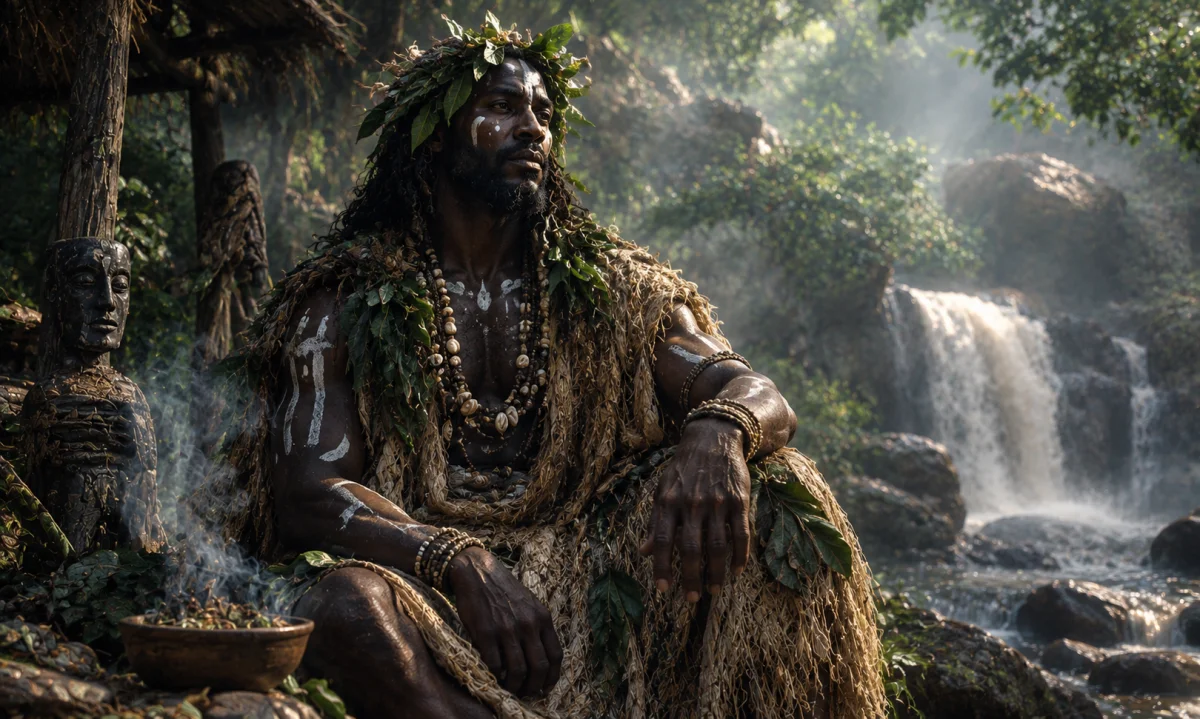
Obambou is a name associated with a frightening spirit or revenant in traditions linked to Gabon and the wider region of Central Africa. Accounts in English-language folklore collections often describe the Obambou as a being connected with the dead, the forest, illness or nocturnal danger. The description is not uniform, however. Unlike figures preserved in a single extensive mythology or canonical religious text, Obambou appears mainly through brief references, variant spellings and oral traditions recorded unevenly by outsiders.
For that reason, there is no universally accepted portrait of the being. Some modern descriptions call it a ghost, while others use terms such as vampire, forest spirit or undead creature. These labels can be useful as rough comparisons, but they should not be treated as proof that Obambou belongs to the same category as European vampires or any other African supernatural figure.
Origins and cultural setting
Obambou is generally placed in Gabon, a country whose cultural traditions include those of Fang, Punu, Mitsogo, Nzebi, Kota and many other peoples. Gabon is home to several distinct religious and storytelling systems rather than one unified “Gabonese mythology.” Beliefs about ancestors, spirits of the wilderness, sorcery, illness and the dangers of night vary between communities and regions.
Many Central African traditions understand the inhabited world as existing alongside a spiritual environment. The dead may remain important to the living as ancestors, but death does not necessarily make every deceased person benevolent. A person who died violently, received improper burial, was accused of witchcraft or remained attached to earthly affairs could be imagined as spiritually dangerous. Such beliefs do not create a single standard type of ghost; instead, they provide a cultural setting in which stories of revenants and harmful spirits can be understood.
The forest also has a complex place in Gabonese religious thought and folklore. It may be a source of food, medicine and sacred knowledge, but it can also be a place of concealment, initiation, wild animals and forces beyond ordinary human control. A being associated with the forest is therefore not automatically evil. Its danger may come from its distance from settled human life and from the uncertainty surrounding encounters with it.
Information about Obambou is limited compared with the traditions of better-documented African figures. Oral narratives were often recorded selectively, and many early descriptions were written by travellers, missionaries, colonial officials or collectors who translated unfamiliar ideas into European categories. Modern websites and encyclopaedic lists have also repeated short descriptions without always identifying the community, language or original storyteller concerned. This makes it difficult to establish a single ancient account or a definitive set of beliefs.
The name and its variants
The spelling Obambou is common in modern English-language references, but Obambo and other forms may also appear. The variation may reflect differences between French and English orthography, attempts to represent an African-language word using the Latin alphabet, or the transmission of a name through several secondary sources. A spelling difference does not by itself prove that two names refer to different beings.
At the same time, similar-looking names should not automatically be merged. Without a clear linguistic or ethnographic connection, a figure called Obambo in one record may not be identical to an Obambou described elsewhere. The safest approach is to treat the name as referring to a reported Gabonese or Central African supernatural figure while acknowledging that its precise local identity remains uncertain.
The word is sometimes presented as though it had one fixed translation, but no broadly established English equivalent can be supplied with confidence. “Ghost,” “spirit of the dead” and “vampire” describe interpretations rather than necessarily being literal translations of the name.
Identity and classification
The most consistent feature in descriptions of Obambou is its connection with the dead or with a dangerous return from death. It is often classified as a revenant: a dead person or death-related spirit believed to trouble the living. In other accounts, it is treated more generally as a malevolent supernatural being that inhabits or moves through the forest.
The term “vampire” appears in some modern summaries because Obambou is associated with nocturnal attacks, the draining of vitality or the spread of sickness. This comparison should be used cautiously. In European folklore, a vampire is usually defined by a recurring pattern involving a corpse, blood consumption and return from the grave. The available descriptions of Obambou do not establish such a detailed and consistent pattern. Some may refer to spiritual harm, wasting illness or death rather than literal blood-drinking.
It is also possible that different storytellers or collectors used the same name for related but distinct ideas. In oral traditions, a name may identify a class of threat, a particular spirit, or a narrative role rather than a single character with a stable biography. As a result, Obambou is better understood as a variable folklore figure than as a fully standardized mythological personage.
Reported appearance and behaviour
Descriptions of Obambou do not provide a dependable physical appearance. Some modern accounts portray it as ghostlike or shadowy, while others leave its form unspecified. Claims that it has a particular size, colour, face or animal shape should therefore be treated as variant additions rather than universal characteristics.
Several recurring elements are associated with the figure:
- Nocturnal activity: Obambou is usually discussed as a danger encountered after dark, when ordinary social safeguards are weaker and the boundary between the familiar world and the spirit world is thought to become more uncertain.
- Connection with the dead: The name may refer to a returning dead person, a ghost produced by an improper death or a spirit that causes fear because it resembles the dead.
- Association with the forest: The being is often placed in wooded or remote areas, especially spaces beyond the protection of a settlement.
- Harm to the living: Accounts connect it with sickness, weakness, misfortune or death. Whether this harm is understood as physical attack, spiritual affliction or the work of sorcery varies between descriptions.
- Fear and avoidance: The figure functions as a warning about dangerous places, dangerous hours and encounters that cannot be explained within ordinary social life.
These features should not be turned into a rigid checklist. A belief in a harmful ghost does not require a particular costume or anatomy, and the absence of a detailed description may be significant: the frightening quality of such a being can lie precisely in its uncertainty.
Stories and narrative patterns
No widely recognized cycle of Obambou stories survives in a form comparable to the major epics of some African cultures. Published references tend to offer descriptions rather than long narratives with named heroes, family relationships or a sequence of adventures. There is no securely established account of Obambou’s birth, death, powers, allies or defeat.
Where the figure is treated as a revenant, the implied story pattern begins with a troubling death or a failure to maintain the proper relationship between the dead and the living. The deceased then returns, appears near a settlement or forest path, and becomes associated with illness or unexplained deaths. In this kind of narrative, the central problem is not usually a heroic battle against a monster. It is the need to identify the source of danger, restore social or ritual order, protect the community and acknowledge the dead appropriately.
Other accounts treat Obambou less as an individual and more as a general nocturnal menace. In these versions, its role resembles that of a warning figure in many oral traditions: it gives form to fears surrounding isolation, predatory animals, unfamiliar sounds and the vulnerability of people travelling after sunset. Such stories can discourage children from entering dangerous areas or adults from undertaking unnecessary journeys at night.
Because the surviving descriptions are so brief, it is not possible to claim that one of these patterns is the original or authentic story. Nor is there sufficient evidence to assign Obambou a fixed relationship with a creator deity, a named ancestor, a witch or another supernatural being.
Religious and cultural interpretation
Obambou can be interpreted within several themes common to African religious traditions, while avoiding the assumption that all African cultures share identical beliefs. One theme is the continuing relationship between the living and the dead. Ancestors may be respected as protectors and sources of moral authority, but death can also raise questions about unfinished obligations, improper rites or spiritual contamination. A dangerous revenant dramatizes what happens when the boundary between the two communities is disturbed.
Another theme is the interpretation of unexplained illness. Before modern medical explanations were available, or when illness appeared sudden and socially significant, communities might understand it through concepts of sorcery, spirit attack, broken taboos or ancestral displeasure. A spirit such as Obambou could provide a narrative explanation for weakness or death without reducing the experience to a simple monster story.
The figure may also represent the moral consequences of social disorder. Folklore about the dead returning often reflects concerns about violence, betrayal, greed, neglect of funerary responsibilities or conflicts that remain unresolved. These interpretations are possibilities rather than proven statements about every tradition using the name Obambou. The available evidence does not justify assigning one universal moral lesson to the figure.
It is important not to describe such beliefs as merely primitive versions of horror fiction. In their original contexts, accounts of spirits could be connected with mourning, healing, ritual authority, family responsibilities and practical decisions about where and when people should travel. The supernatural explanation formed part of a wider religious and social framework.
Distinction from similar figures
Obambou should not be automatically identified with every African being described in English as a vampire or forest monster. West African traditions include the Adze, associated especially with Ewe-speaking communities, and the Obayifo, a witch-like figure in Akan folklore. Southern African traditions include the impundulu, a lightning-associated bird or supernatural servant in some accounts, while the Asanbosam is a separate forest being associated with Akan traditions.
These figures have their own languages, cultural settings and narrative histories. Similarities such as nocturnal activity, illness, blood, sorcery or residence in the wilderness may arise because many societies use supernatural imagery to express danger and uncertainty. Such shared themes do not establish a common identity or a direct historical relationship.
Obambou is also distinct from Mami Wata, a broad and diverse group of water-associated spirit traditions found in parts of Africa and the African diaspora. Mami Wata traditions can involve beauty, wealth, healing, danger and spiritual power, but they are not simply another name for a revenant or nocturnal forest spirit.
Evidence and uncertainty
The greatest difficulty in discussing Obambou is the lack of a clearly documented primary tradition. There is no generally recognized sacred book devoted to the being, and no securely established canonical narrative. Much of what circulates today comes from short folklore entries, repeated summaries and modern compilations. Those materials may preserve a genuine local belief, but they can also compress several ideas into a single label.
Descriptions should therefore be separated into levels of certainty. It is reasonable to say that Obambou is reported in connection with Gabon or Central Africa and that it is commonly treated as a dangerous spirit or revenant. It is less certain that every account refers to the same being. Claims about exact physical features, blood-drinking habits, supernatural powers or a specific ethnic origin require supporting evidence that is not consistently available.
The uncertain record does not make the figure meaningless. It shows how oral traditions can be transformed when names move between languages, colonial records, popular folklore books and the internet. It also demonstrates why a cautious description is preferable to a dramatic but unsupported monster profile.
Modern reception
In contemporary popular culture, Obambou is sometimes presented as an African vampire or cryptid. This treatment usually emphasizes fear, attack and exotic mystery while removing the figure from the religious and social setting in which beliefs about the dead, illness and the forest may have developed. A fictional version can use the name freely, but it should not be mistaken for a complete representation of Gabonese tradition.
There is no widely established body of major novels, films, games or television productions devoted specifically to Obambou. Its modern presence is more noticeable in online lists of legendary creatures and supernatural beings than in a sustained popular franchise. Those lists often standardize uncertain details, so descriptions that give Obambou a precise appearance or a fully developed set of powers may reflect recent popularization rather than an old, consistently transmitted tradition.
For cultural and historical purposes, Obambou is best approached as a poorly documented but recurring name for a dangerous spirit or revenant associated with Gabonese and Central African folklore. Its reported links with death, night, forest spaces and illness are more reliable than any single account of its appearance or methods. The gaps in the record are part of the subject’s history and should be acknowledged rather than filled with invented mythology.