WORLD
WORLD
Nataska

Nataska is an ogre-like figure in Hopi katsina tradition, associated especially with public ceremonial performances connected with discipline, social teaching and the seasonal religious cycle. English-language sources often describe Nataska as a frightening visitor who warns children against disobedience, but this description is incomplete. In Hopi religious life, a katsina is not simply a fictional character or theatrical monster. Katsinam are sacred beings represented in ceremonies by initiated performers wearing masks and other regalia, and their significance depends on Hopi community, language and ritual context.
Hopi religious and cultural setting
The Hopi are an Indigenous Pueblo people whose villages are located on mesas in northeastern Arizona. Hopi religious traditions include ceremonies concerned with rain, agriculture, fertility, social harmony, the well-being of communities and the relationship between human beings and the wider world. Within this religious system are the katsinam, a plural term commonly rendered in English as “kachinas.” The singular is often written katsina.
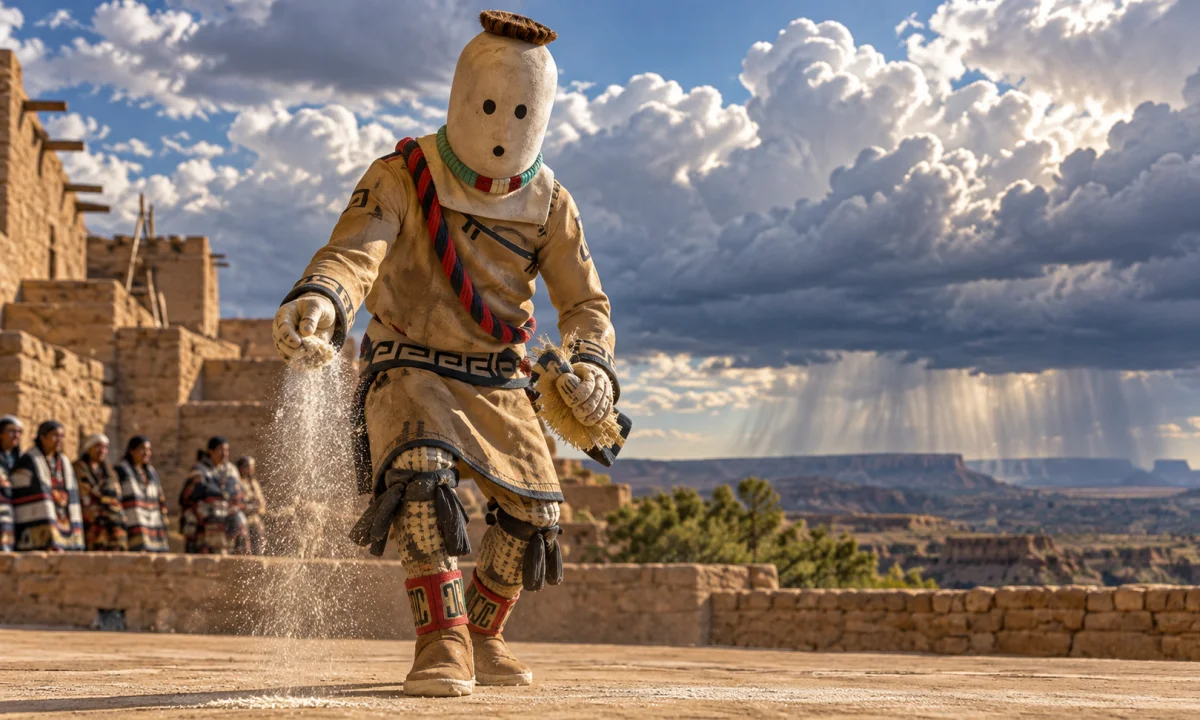
Katsinam include beings associated with clouds, rain, plants, animals, ancestors, places and particular spiritual powers. Some are benevolent, some are formidable, and many have roles that cannot be reduced to a simple division between “good” and “evil.” They appear during a seasonal ceremonial period through masked dancers, songs, processions and other ritual actions. A performer representing a katsina is not merely acting out a story for entertainment. The performance participates in a religious relationship between the community and the sacred being represented.
Public accounts of Nataska usually place the figure within the winter Powamuya, commonly known in English as the Bean Dance or Bean Ceremony. Powamuya is associated with the preparation and growth of beans and with wider concerns for agricultural renewal. The ceremony also includes instruction and initiation, particularly for young people who are being introduced more fully to religious knowledge. The presence of frightening ogre figures gives moral instruction a memorable and emotionally powerful form.
Name and identity
The name appears in several spellings, including Nataska, Natacka and Nata'aska. English transcriptions of Hopi terms vary because older writers used different systems for recording Hopi pronunciation, and because popular publications have often simplified or altered Indigenous names. The exact meaning and linguistic structure of the name should therefore not be treated as certain without reference to Hopi-language expertise.
Nataska is generally classified in English as an ogre katsina. In some descriptions, the name refers to a chief or principal ogre; in others, it is used more broadly for a type of frightening ceremonial being or for a group of related ogre figures. These differences may reflect regional practice, differences between Hopi villages, variation in transcription, or the tendency of outside observers to group distinct beings together. There is no universally reliable reason to assume that every figure labelled “Nataska” in museums, books or art catalogues represents precisely the same ceremonial identity.
It is also important not to treat Nataska as a Hopi equivalent of a European devil, demon or folkloric bogeyman. The ogre imagery expresses danger and authority, but Nataska belongs to a particular Hopi religious system. The figure’s meaning comes from ceremonial relationships, community expectations and the broader katsina tradition rather than from a general category of evil spirits.
Appearance and ceremonial character
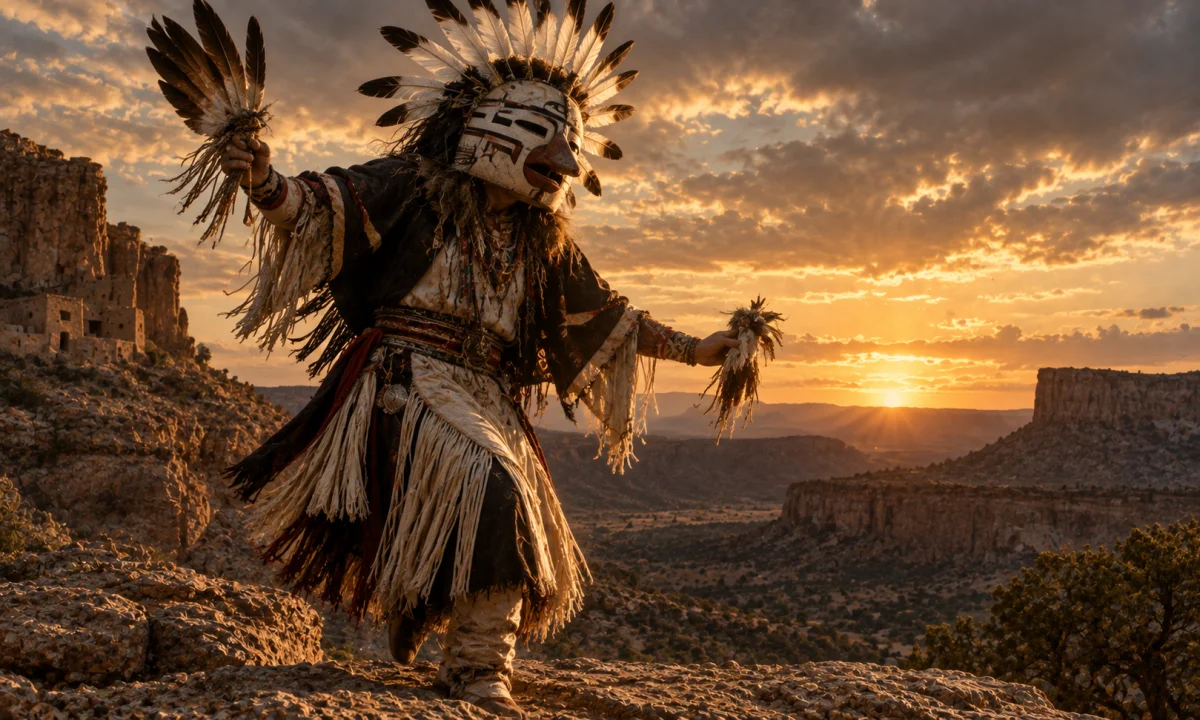
Descriptions of Nataska masks often emphasize a threatening appearance. Publicly reproduced examples may show a dark or strongly coloured face, exaggerated eyes, a large mouth or teeth, hair, horns or other features associated with an imposing ogre. These details are not uniform. Mask design can vary according to village tradition, period, performer, artist and the particular ceremonial context. A carved figure sold under the name Nataska may also simplify or reinterpret features that have a more specific meaning in a ceremony.
Nataska’s visual force is part of the figure’s social function. The mask creates an encounter with an apparently powerful being rather than with an ordinary human visitor. A child confronted by an ogre is meant to feel that rules and responsibilities have consequences. Adults, too, may understand the performance as a reminder that communal life requires restraint, generosity and respect for religious obligations.
Some public descriptions say that Nataska carries weapons or threatening objects. Such details should be treated cautiously, since attributes can differ between representations and some accounts may confuse Nataska with other ogre katsinam. The safest general description is that Nataska is represented as a physically imposing and intimidating being whose appearance signals authority, danger and the power to punish wrongdoing.
Role in stories and ceremonies
The most familiar accounts portray Nataska and related ogre figures as visitors who enter or approach the community during the Powamuya season. They may ask for food or other offerings, question households and demand that children demonstrate proper behaviour. In widely circulated descriptions, children who have been disobedient are threatened with punishment, while children who behave appropriately are reassured or rewarded.
These accounts are sometimes presented as though Nataska exists only to frighten children. That interpretation misses the wider ceremonial setting. The figure’s threatening role is connected with instruction, initiation and the maintenance of social values. Fear is used within a religious and educational framework, not as an isolated form of entertainment. The performance can teach that children belong to a community with obligations to family, elders, ceremonial institutions and the natural world.
Public accounts also differ over whether Nataska acts alone, leads a group of ogres or appears alongside other frightening katsinam. In some descriptions, a chief ogre is accompanied by other masked figures who extend the visit or help enforce its demands. Names and relationships reported in English sources are not always consistent, and it is unwise to construct a fixed cast of characters from museum labels or popular summaries alone.
The appearance of ogres during a ceremony connected with beans and agricultural renewal also has symbolic force. Beans are grown in ritual settings and their development provides an image of life emerging through care, discipline and cooperation. Nataska’s intimidating presence belongs to the same world of cultivation: growth requires attention, and community life requires responsible conduct. This does not mean that Nataska is simply a personification of beans or agriculture. Rather, the figure operates within a ceremony whose religious concerns include growth and collective well-being.
Nataska and related Hopi figures
Confusion can arise because Hopi ceremonial traditions include several frightening or ogre-like beings. A particularly important figure is Soyok Wuhti, often described in English as an ogress or “White Ogre Woman.” Soyok Wuhti has her own identity and should not automatically be treated as Nataska in female form. Although public descriptions sometimes place the two figures within the same ceremonial setting, their names, roles and representations are not interchangeable.
Other katsinam may also appear threatening because they punish improper behaviour, control access to ritual spaces or embody dangerous aspects of the natural and supernatural world. A dark mask, large teeth or an aggressive gesture does not by itself prove that a representation is Nataska. Identification depends on the name, village tradition, mask design, accompanying songs and the ceremonial circumstances in which the figure appears.
Nataska should likewise be distinguished from generic “kachina monsters” found in tourist writing and fantasy material. Such labels often combine unrelated Hopi beings or treat every masked figure as a single type of spirit. The Hopi katsina system is more complex. Its beings have individual names and responsibilities, and some distinctions are meaningful only within specific ceremonial and linguistic contexts.
Religious meaning and interpretation
Nataska can be understood as a figure of discipline and accountability, but even this interpretation should not be made exclusive. The ogre’s threats draw attention to behaviour, yet the ceremony also presents the community as a place where instruction, correction and protection are connected. The frightening visitor is part of a social order rather than an enemy standing outside it.
The figure may also be interpreted through the relationship between visible performance and hidden religious knowledge. A masked dancer makes a sacred presence accessible to the community while preserving the distinction between ordinary human identity and the katsina being represented. The mask does not merely disguise the performer; it helps establish a ritual transformation of presence. For this reason, descriptions that treat Nataska as a stage character can be misleading.
Anthropologists and other outside observers have recorded Hopi ceremonies, masks and oral traditions, but written accounts do not provide a complete or neutral record of Hopi religion. Early ethnographic descriptions were shaped by the assumptions of their authors and sometimes presented restricted ceremonial knowledge to a general audience. Names were spelled inconsistently, local differences were simplified and religious beings were sometimes classified according to European categories such as “gods,” “spirits” or “demons.” Modern readers should distinguish those external descriptions from Hopi understandings and from knowledge that remains protected within Hopi communities.
There is no single ancient Hopi scripture that gives a complete biography of Nataska. Information comes from a combination of oral tradition, ceremonial practice, community teaching, historical observation and artistic representation. Because ceremonies are living traditions rather than frozen survivals, details may change over time or differ between villages. A difference between two descriptions does not automatically indicate that one is false; it may reflect a local or contextual variation.
Carvings, masks and outside representations
Nataska is represented in Hopi carving and painting, especially in works made for collectors, museums and the wider art market. These objects are often called “kachina dolls,” although many Hopi artists and specialists prefer terms such as katsina carving. Historically, carved figures could be used to teach children about katsinam and to make the forms of ceremonial beings familiar. Contemporary carvings may also function as works of art, cultural expression and statements of individual artistic style.
A carving labelled Nataska should not automatically be regarded as a sacred mask or as a complete substitute for the ceremonial being. A carving is a representation made by an artist, while a masked performer participates in a ceremony through movement, song, community recognition and ritual setting. The object’s title may reflect the artist’s intention, a dealer’s classification or a collector’s terminology, and these are not always identical.
Commercial images can also exaggerate the figure’s frightening qualities. A simplified “Hopi ogre” may be marketed as a generic symbol of punishment or mystery, detached from Powamuya and from Hopi religious teaching. Such uses often erase the difference between a living Indigenous tradition and a decorative monster motif.
Modern reception
Nataska has not become a major figure in mainstream global popular culture in the way that some classical gods, Norse beings or European monsters have. Its modern visibility comes mainly through discussions of Hopi katsina traditions, museum collections, Indigenous art and general reference works on Native American mythology. When the name appears in fantasy lists or monster catalogues, it is usually separated from the ceremonial context that gives the figure meaning.
Respectful modern discussion keeps several distinctions clear: Nataska is a Hopi ceremonial being rather than a generic demon; a katsina mask is part of a religious practice rather than merely a costume; and written outsider descriptions cannot represent the full range of Hopi knowledge. The figure’s frightening appearance is real within its ceremonial role, but fear is only one element of a larger system concerned with instruction, responsibility, agricultural renewal and the continuity of community life.