WORLD
WORLD
Naberius
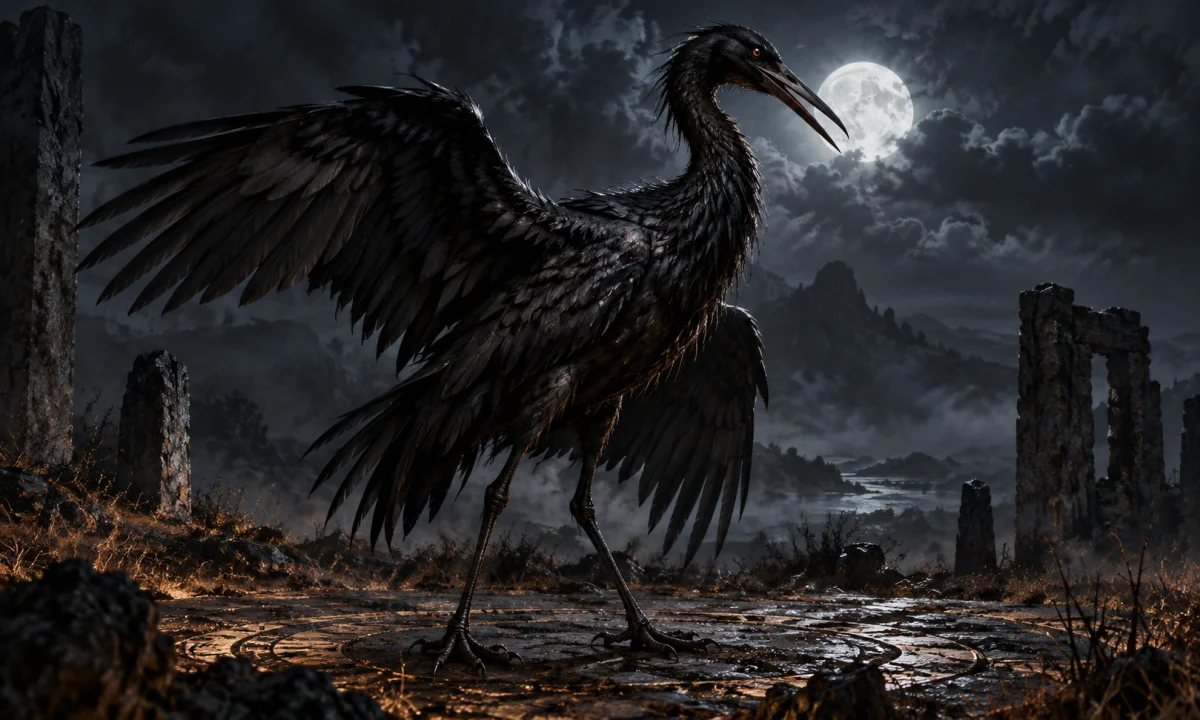
Naberius is a demon in the learned demonological tradition associated with European grimoires, especially the Ars Goetia, the first part of the seventeenth-century work commonly known as the Lesser Key of Solomon. He is usually described as a marquis who appears as a dark bird, speaks with a hoarse voice, and grants skill in the arts, particularly rhetoric. The same or a closely related name appears as Naberus in earlier demonological writing, and some texts connect the figure with Cerberus, although that identification is uncertain rather than a settled fact.
Origins in European demonology
Naberius belongs to a system of spirits developed through the medieval and early modern study of magic, theology and demonology. He is not a god or monster from an ancient pagan religion with an independent mythology preserved in classical literature. Instead, he appears in catalogues that classify demons according to rank, name, appearance, abilities and the number of spirits supposedly commanded by each one.
The most influential surviving description occurs in the Ars Goetia. This text presents seventy-two spirits that a ritual practitioner is instructed to summon and control through divine names, seals, ceremonial procedures and commands. Naberius is listed as the twenty-fourth spirit in the standard sequence. The catalogue assigns him the rank of marquis and says that he governs nineteen legions of spirits.
The Ars Goetia was printed in the seventeenth century, but its material draws on earlier manuscripts and on traditions that circulated before the work took its familiar form. Its descriptions should therefore be understood as products of Christian European occult literature, not as evidence for a continuous ancient cult of Naberius.
An important earlier source is Johann Weyer’s Pseudomonarchia Daemonum, included in editions of his work on demonic deception during the sixteenth century. Weyer’s catalogue contains a figure called Naberus. The spelling and details differ from the later Ars Goetia, but the descriptions are sufficiently similar that the two names are generally treated as related within the grimoire tradition. Exact lines of transmission are difficult to reconstruct because demonological texts survive in multiple manuscripts and editions, with variations in spelling and wording.
Name and identity
The name is found in several forms, including Naberius, Naberus and, in some discussions, forms linked to Cerberus. These variations do not necessarily represent separate beings. Early modern scribes and printers frequently altered names while copying texts, especially names taken from foreign languages or from older manuscripts. As a result, spelling alone cannot establish a distinct identity.
Weyer’s entry is particularly important because it presents Naberus with the additional name Cerberus. This has led many later writers to treat Naberius as a demonic form of the three-headed hound of Greek mythology. That interpretation is possible as a later literary association, but the evidence does not show that Naberius and the classical Cerberus were originally the same figure.
The resemblance between the names may have encouraged the association. Demonological authors often connected Christian demon catalogues with figures from classical mythology, biblical literature or earlier religious traditions. Such connections could transform a familiar mythic name into an infernal title. They do not, by themselves, prove that the older figure and the grimoire spirit shared a continuous tradition.
Rank and place in the hierarchy
In the Ars Goetia, Naberius is a marquis. This is a political and aristocratic title borrowed from human systems of rank. Grimoires use titles such as king, duke, prince, marquis, president and earl to organize the spirit world into a hierarchy resembling a court or military government.
The title does not derive from a known ancient religious office. It reflects the social and political language of medieval and early modern Europe, when aristocratic rank provided a familiar model for imagining supernatural authority. Naberius’s position as a marquis indicates status within the catalogue, while the stated command of nineteen legions gives him a place in its imagined military structure.
The number of legions is part of the classification system rather than a detail supported by historical records. The texts offer no independent evidence that such legions were worshipped communities or that practitioners encountered them outside the ritual framework described by the grimoires.
Appearance and voice
Naberius is associated with a dark bird. The Ars Goetia is commonly translated as describing a black crane, although other versions and interpretations render the bird differently. Weyer’s description of Naberus uses the image of a crow. Because the sources vary, no single bird form can be treated as universally authoritative.
Some modern accounts describe Naberius as a raven, but that wording is often a generalized adaptation of the older bird imagery rather than a precise reflection of every source. The difference matters because cranes, crows and ravens carry different associations in European symbolism. A crane may suggest watchfulness, vigilance or an unusual supernatural manifestation, while crows and ravens are frequently connected with death, battlefields, prophecy and ill-omened knowledge. The original texts do not provide a developed symbolic explanation for the bird.
The spirit is also said to speak with a hoarse voice. This is one of the more consistent features in the descriptions. The roughness of the voice may reinforce the unsettling nature of the apparition, but the texts do not explain its meaning. It should not be confused with a detailed mythology about a bird-headed demon; the catalogue offers a brief ritual description rather than a narrative account of Naberius’s life or origin.
In the Ars Goetia, the bird form is followed by a human form in the course of the manifestation. The wording and visual details vary among editions, and the text does not describe a stable physical appearance for the human shape. Naberius is therefore better understood as a spirit capable of changing manifestation than as a being with one universally fixed body.
Abilities and functions
Naberius’s principal area of influence is learning and eloquence. The Ars Goetia says that he makes people skilled in the arts and sciences, with special emphasis on rhetoric. Rhetoric traditionally means the disciplined use of language for persuasion, public speaking and formal argument. In a culture where education and advancement depended heavily on verbal performance, this was a significant power.
The association with rhetoric gives Naberius a distinctive place among the spirits in the catalogue. His function is not primarily physical strength, prophecy or treasure-finding. Instead, he is linked to the ability to speak effectively, present arguments convincingly and acquire intellectual or artistic competence. The description reflects the importance of classical education in early modern learned culture, where rhetoric was one of the central subjects of formal schooling.
Naberius is also credited with restoring lost dignities and honours. This wording can refer to social standing, official office, reputation or recognition that has been taken away. The power creates a connection between eloquence and status: a person who can argue persuasively may regain authority or persuade others to acknowledge an earlier position.
The promise is not presented as a moral teaching. The grimoire does not say that Naberius restores honour only to the innocent or the deserving. Like many powers attributed to spirits in ceremonial catalogues, it is described as an effect available through ritual command. The text’s concern is practical and operational rather than ethical.
Stories and relationships
Naberius has no substantial narrative cycle comparable to the myths of Cerberus, Lucifer or other well-known supernatural figures. The grimoire entry is essentially a catalogue notice. It gives a name, rank, appearance, voice, abilities and number of legions, but it does not recount a birth, rebellion, battle, punishment or relationship with other demons.
The most notable supposed relationship is the connection with Cerberus in Weyer’s text. Cerberus is the guardian dog of Hades in Greek mythology, most famously described in classical sources as a monstrous multi-headed hound. His task is to prevent the dead from leaving the underworld and, in some accounts, to keep the living from entering. Naberius, by contrast, is a bird-form spirit associated with rhetoric and recovered honours.
These differences are substantial. The classical Cerberus is an underworld guardian within a mythological family and landscape; Naberius is a ranked spirit in an early modern grimoire. The shared or similar name may reflect reinterpretation, scribal development or an attempt to associate a demon with a famous classical guardian. It is not evidence that Naberius possesses Cerberus’s traditional canine body, three heads or underworld function.
Symbolism and interpretation
Naberius can be interpreted as an example of how demonological catalogues transformed ordinary human ambitions into supernatural powers. Eloquence, learning, public reputation and recovered social rank were valuable but insecure forms of power. By assigning them to a demon, the grimoire places intellectual and political advancement within a morally dangerous supernatural framework.
The figure also illustrates the uneasy status of rhetoric in Christian European thought. Persuasive speech could serve justice, education and public order, but it could also deceive. A spirit who grants rhetorical ability might therefore represent both legitimate learning and the fear that language can manipulate audiences without regard for truth.
The bird imagery adds another layer of ambiguity. Birds can cross boundaries between earth and sky, observe human activity from above and appear suddenly in places associated with death or wilderness. Yet no surviving description establishes a single intended symbolism for Naberius. Interpretations involving crows, ravens, cranes or omens belong partly to later readers and should be distinguished from the short, practical descriptions preserved in the grimoires.
Distinguishing Naberius from similar figures
- Cerberus: the Greek mythological guardian of the underworld, traditionally a monstrous dog. The association with Naberius occurs in demonological writing, but the two figures do not share the same established mythology.
- Nergal: a Mesopotamian god associated in different periods with war, plague, the underworld and destructive heat. The name and religious setting are unrelated to Naberius, despite occasional modern attempts to connect many underworld figures.
- Ravens and crows in folklore: birds of omen, prophecy or death appear in many cultures. Their presence in Naberius’s description does not make him identical with any particular raven spirit, prophetic bird or deity.
- Other marquises of the Goetia: Naberius shares his rank with several other catalogued spirits, but rank alone does not indicate kinship or a common origin.
It is also useful to distinguish the grimoire Naberius from modern fictional characters that borrow his name. A novel, game or film may give him a canine body, several heads, a new family history or powers unrelated to rhetoric. Those inventions belong to modern adaptation rather than to the surviving early modern descriptions.
Later reception
Naberius has continued to appear in occult reference works, encyclopaedic lists of demons and fictional settings inspired by ceremonial magic. Modern writers often simplify his name to Naberus, associate him directly with Cerberus, or emphasize the raven-like appearance. Such treatments can make the figure more recognizable, but they frequently combine details from different sources or add attributes absent from the older catalogues.
In popular culture, the name is especially useful because it carries several suggestive elements at once: a dark bird, a prestigious infernal title, mastery of rhetoric and a possible link with the guardian of the dead. These associations provide material for fiction, but they should not be mistaken for evidence of a unified traditional mythology.
Within the historical demonological tradition, Naberius remains a relatively compact figure: a marquis of the goetic hierarchy, appearing in a dark bird form, speaking hoarsely, granting eloquence and learning, and restoring lost honours. His uncertain relationship with Cerberus demonstrates how names and identities could shift as classical mythology, Christian demonology and manuscript traditions were brought together.