WORLD

Nain Rouge
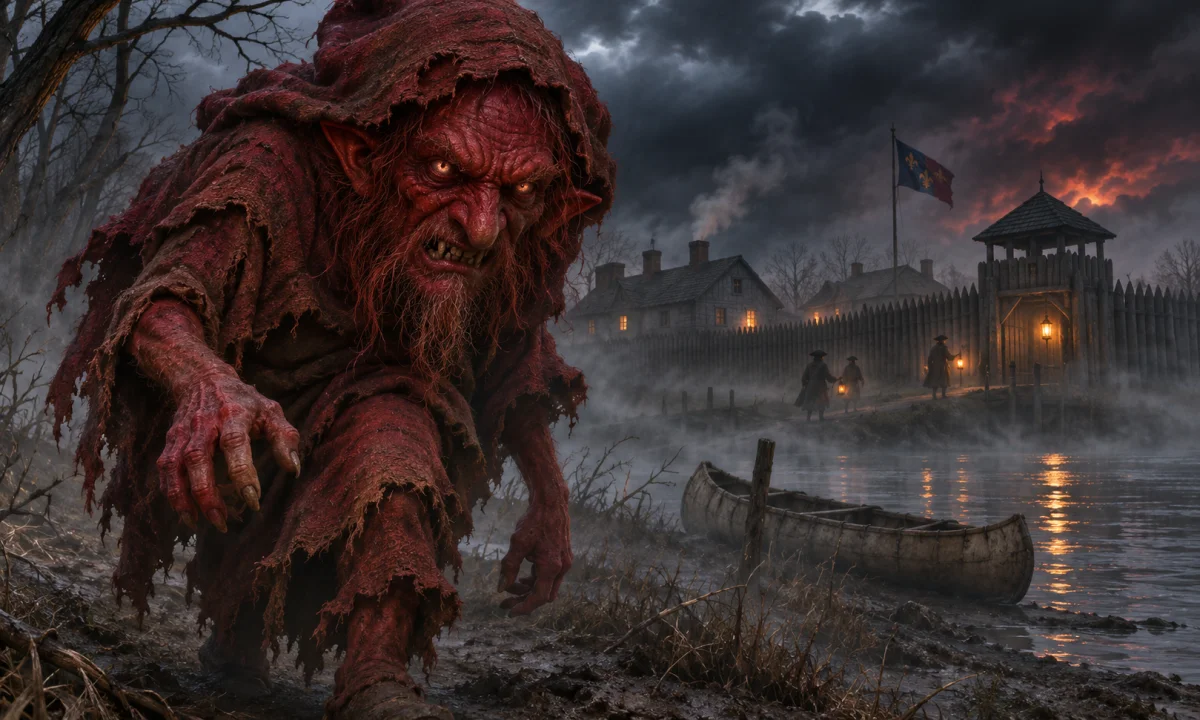
The Nain Rouge is a legendary red dwarf or goblin-like being associated especially with Detroit, Michigan. Its French name means “red dwarf,” and the figure belongs to the folklore of the city’s French colonial past and later urban traditions. In many stories, the Nain Rouge appears as an ill-tempered, grotesque creature whose presence predicts violence, disaster or political misfortune. It is often described as a hostile spirit, although some interpretations treat it as a guardian or symbolic embodiment of Detroit rather than a simple monster.
Origins and cultural setting
Detroit was founded as a French colonial settlement in the early eighteenth century. In 1701, Antoine de la Mothe, sieur de Cadillac, established Fort Pontchartrain du Détroit on the river connecting Lake Erie and Lake St Clair. The Nain Rouge is traditionally connected with Cadillac and with the founding of the settlement, but the story is not supported by a surviving contemporary account from 1701. Its supposed encounter with Cadillac appears in later retellings, and the details vary considerably.
The figure probably developed through a mixture of French-language folklore, local storytelling and Detroit’s changing historical memory. French settlers brought traditions about dwarfs, goblins, household spirits and other troublesome beings. The name nain rouge is ordinary French in form rather than the title of a universally recognized figure from a single canonical French myth. There is no clear evidence that every French settler used the name for one specific supernatural being.
Some modern discussions propose that the Detroit legend may also reflect or have been influenced by Indigenous traditions from the Great Lakes region. Such claims should be treated cautiously. The available tradition does not establish a direct identity between the Nain Rouge and any particular Indigenous spirit, and the cultural histories of the region contain many distinct nations and religious traditions. Similarities in stories about supernatural guardians, omens or small beings do not by themselves prove a common origin.
The Nain Rouge is therefore best understood as a regional folkloric figure whose precise beginnings remain uncertain. Its association with Detroit is much more secure than any claim about a single ancient source.
Name and identity
In French, nain means “dwarf” and rouge means “red.” The expression can therefore be translated directly as Red Dwarf. English-language writing usually retains the French name, sometimes spelling it with a capital letter as Nain Rouge. Pronunciation varies among English speakers, while the French pronunciation is approximately “nan roozh,” with the final sound like the sound in the French word for “red,” rouge.
The name describes the being’s appearance rather than placing it in a precise religious category. It is not a demon in the strict theological sense, nor is it an established saint, deity or spirit from a formal religious system. “Monster” is a useful modern category for the creature because many stories portray it as frightening and destructive, but traditional descriptions are closer to those of a local goblin, omen-bearing spirit or uncanny dwarf.
The Nain Rouge has no single authoritative identity. In one interpretation it is a malevolent creature that wishes harm on Detroit. In another, it is a warning spirit whose appearance announces that the city or its leaders have violated an unseen order. A third interpretation treats the Nain Rouge as Detroit itself: unruly, resilient, dangerous to outsiders and impossible to reduce to a single respectable image.
Appearance
Descriptions differ, but the Nain Rouge is generally imagined as a small humanoid figure with a disturbing face. Common features include a red or deeply flushed complexion, glowing eyes, tangled hair and a wide mouth filled with decayed or sharp teeth. Some accounts describe a body covered in coarse hair, while others portray an old, ugly dwarf dressed in ragged clothing.
Later popular descriptions often add red or black clothing, claw-like hands, animalistic feet or a foul smell. These details are not consistent across all versions and should not be treated as fixed attributes. The creature’s most stable characteristics are its small size, red appearance and threatening or ominous nature.
The Nain Rouge is often said to move quickly and unpredictably. It may laugh, shriek, leer at passers-by or vanish before anyone can catch it. In some accounts, it is physically aggressive, scratching or biting those who approach. In others, the terror comes from its appearance and timing rather than from a direct attack. Seeing it is the important event: the sighting marks danger that may soon affect an individual, a government or the whole city.
The Cadillac legend
The best-known story connects the Nain Rouge with Antoine de la Mothe Cadillac. According to later versions, Cadillac encountered the creature while travelling near the settlement he was establishing. The being either warned him, mocked him or demanded that he leave. Cadillac responded with anger, sometimes striking at it or insulting it. The Nain Rouge then supposedly declared that Detroit would suffer because of his actions.
There is no single established form of this tale. Some versions portray Cadillac as frightened by the creature; others make him arrogant and violent. In certain retellings, the Nain Rouge gives a prophecy concerning Detroit’s future. In others, it simply disappears after cursing Cadillac or the settlement. The story’s value lies less in its historical reliability than in the way it links the supernatural figure to the city’s foundation.
Historically, Cadillac’s settlement, the later city of Detroit and the Nain Rouge legend belong to different kinds of evidence. Cadillac and Fort Pontchartrain are documented historical subjects. The encounter with the red dwarf is folklore. No known contemporary record proves that Cadillac met such a being, and the tale should not be presented as an eyewitness account from the colonial period.
Disaster, war and the city’s misfortunes
Once the creature had become associated with Detroit, storytellers connected it with episodes of danger in the city’s history. Later accounts claim that the Nain Rouge appeared before battles, defeats, fires, political crises or periods of social unrest. These stories give the figure a role similar to that of a harbinger: it does not always cause the disaster, but its appearance announces that misfortune is close.
Retellings have associated the Nain Rouge with events involving Detroit’s colonial and military past, including conflicts around control of the settlement. Other versions connect it to destructive fires and later civic troubles. Such associations were generally made after the events rather than recorded beforehand. The stories therefore reveal how communities interpret their history, but they do not provide independent evidence that a supernatural creature was present.
The legend is especially suited to a city with a complicated history of changing rulers, economic upheaval, industrial expansion and decline. A threatening figure who appears whenever Detroit approaches crisis can represent the fear that disaster is always waiting just outside ordinary life. At the same time, the Nain Rouge can suggest that the city repeatedly survives the very forces that seem ready to destroy it.
Guardian, curse or trickster?
The Nain Rouge is frequently called a curse-bringer, but its role is more ambiguous than that label suggests. Some accounts say that it protects Detroit by warning people about danger or punishing those who behave arrogantly. Others portray it as a spiteful creature that wants the city to fail. These interpretations are not necessarily compatible, and folklore does not require them to be resolved into one official version.
Its connection with Cadillac allows the legend to express tensions surrounding colonial authority. The founder is a powerful outsider who claims land and establishes a settlement, while the small red being refuses to submit to him. Read symbolically, the Nain Rouge may represent the limits of human control over a place. The city can be surveyed, fortified and governed, yet it still retains an unpredictable presence that resists official narratives.
The creature’s ugliness is also significant. It is not a noble guardian in the style of a civic emblem, and it does not embody orderly prosperity. Its misshapen body, bad temper and association with catastrophe make it an image of the uncomfortable or rejected aspects of urban life. Yet Detroit’s continued attachment to the figure has transformed that ugliness into a form of local identity.
Sources and development of the tradition
The Nain Rouge does not survive through one medieval poem, sacred text or traditional epic. The legend has been transmitted through oral storytelling, local histories, newspaper accounts, folklore writing and modern community events. Because each medium reshaped the material, details such as the creature’s clothing, powers and relationship with Cadillac have changed over time.
Claims that the Nain Rouge has been continuously known in exactly the same form since 1701 are difficult to establish. A traditional story may preserve older motifs without preserving an unchanged text. The absence of an early written record does not disprove local storytelling, but it does mean that specific statements about the legend’s age require caution.
The figure’s French name has also encouraged people to search for a direct European equivalent. French folklore contains many kinds of small supernatural beings, including household spirits, goblins and wandering apparitions. However, the Detroit Nain Rouge should not automatically be identified with any one of them. Shared features such as small stature, trickery or frightening appearances are widespread in folklore.
Distinction from similar beings
The Nain Rouge is sometimes compared with the redcap, a murderous goblin from border folklore associated with parts of Britain. Both figures may be red, hostile and linked with violence, but they are not the same being and arise from different regional traditions. The redcap is usually described within a particular body of British goblin lore, whereas the Nain Rouge is specifically associated with Detroit and its French-colonial cultural memory.
Nor is the Nain Rouge simply another name for a European dwarf, an elf or a generic demon. “Dwarf” in the English translation describes its size, not a fixed membership in the dwarfs of Germanic mythology. Likewise, its frightening appearance does not make it a devil in Christian doctrine. The creature belongs to local legend rather than to a clearly defined supernatural hierarchy.
It should also be distinguished from Indigenous beings of the Great Lakes region. Indigenous nations have their own diverse traditions, languages and sacred histories, and the Nain Rouge cannot be used as a substitute for them. Comparisons should identify specific documented relationships rather than treating all small or uncanny spirits as interchangeable.
Modern reception
The Nain Rouge remains a recognizable symbol of Detroit. Modern retellings often emphasize the creature as an embodiment of the city’s rebellious, chaotic or durable character. Artists, writers and local storytellers have reimagined it in illustrations, fiction, theatre and public celebrations. These creative uses are modern interpretations, not evidence that the newer details belong to the older folklore.
A contemporary Detroit event known as the Marche du Nain Rouge uses the legend in a public ritual. Participants parade through the city, confront or symbolically drive away an effigy of the Nain Rouge, and celebrate the removal of misfortune. The event is a modern civic and cultural tradition rather than an unchanged colonial ceremony. Its imagery draws on the older creature, while its organization, symbolism and public form belong to contemporary Detroit.
Modern culture has also softened or redirected the Nain Rouge’s role. A figure once presented chiefly as an omen of disaster can become a mascot, an artistic subject or a symbol of resistance to outsiders’ expectations. The old tension remains: the Nain Rouge may threaten Detroit, protect it or personify its unruly spirit, depending on the storyteller and the purpose of the retelling.
Within the broader category of mythical monsters, the Nain Rouge is therefore unusual not because it belongs to a vast ancient pantheon, but because a relatively localized legend has become attached to the history and identity of a modern city. Its power comes from that relationship: the red dwarf is frightening precisely because it is imagined as part of Detroit’s own landscape, memory and fate.