WORLD
WORLD
Orias
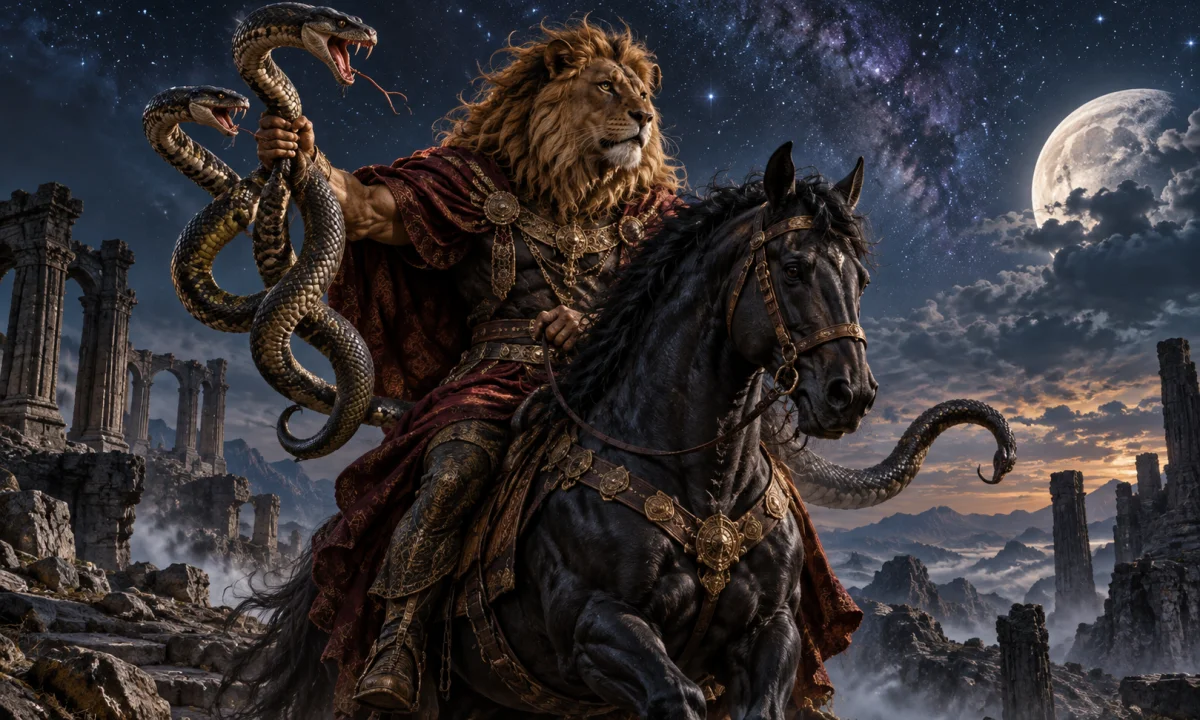
Orias is a demon in early modern European demonological literature, best known as the fifty-ninth spirit in the Ars Goetia, the first part of the Lesser Key of Solomon. He is also called Oriax in some versions of the tradition. The texts describe him as a marquis who appears as a lion riding a horse with a serpent’s tail, while holding two large hissing serpents. His attributed powers concern astrology, the supposed virtues of the stars, social favour, status and transformation. Orias belongs to the learned grimoire tradition of Christian Europe rather than to an ancient, independently documented cult.
Origins in European demonology
Orias is preserved in manuscripts and printed works that classify spirits according to rank, appearance, powers and the number of infernal legions under their command. This system is associated with ceremonial magic and demonological writing from the sixteenth and seventeenth centuries. It should not be treated as a straightforward record of a single ancient religion. The descriptions were produced within a Christian worldview in which spirits connected with magic, astrology and forbidden ritual could be represented as demons.
The best-known account appears in the Ars Goetia, a work transmitted in manuscripts of the Lesser Key of Solomon. The Lesser Key is generally associated with the seventeenth century, although its individual materials draw on older magical and demonological traditions. Orias also appears in the earlier demonological catalogue known as Johann Weyer’s Pseudomonarchia Daemonum, published in 1577, where the name is given as Oriax or in a closely related form. The existence of these related entries shows that the figure was circulating in demonological lists before the later popularity of the Ars Goetia.
These works were not neutral descriptions of supernatural beings. They were written by Christian authors and compilers who placed spirits within a moral and theological framework shaped by the ideas of demons, illicit magic and spiritual danger. Some grimoires present the spirits as beings who may be summoned or constrained by ritual authority, but this does not mean that Orias was part of public religious worship in the way a god, saint or local folkloric spirit might be.
Name and textual identity
The two principal forms of the name are Orias and Oriax. Spelling variation is common in manuscripts copied by hand, especially when names were transmitted through Latin, English and other European textual traditions. The relationship between the forms is generally understood as a difference within the same demonological entry, not evidence for two clearly separate beings.
Pronunciation is not securely established by the surviving texts. English-language occult writing commonly uses a pronunciation close to “OR-ee-as,” but other pronunciations may be encountered. The spelling Oriax can suggest a different final sound, although no universally authoritative pronunciation comes from the historical sources.
Orias should not be confused with every spirit whose name begins with “Ori-” or with figures whose names resemble it in modern lists. Demonological catalogues contain many similar-sounding names, and later occult authors sometimes standardised, altered or reorganised them. Claims that Orias is identical with a deity from an unrelated ancient pantheon require evidence beyond a visual resemblance or a similarity of names.
Rank and classification
In the Ars Goetia, Orias is described as a marquis. The title belongs to the hierarchical vocabulary of European aristocracy and is used by grimoire writers to organise infernal spirits into ranks such as kings, dukes, princes, marquises, presidents and earls. It should not be assumed that these ranks represent a consistent supernatural bureaucracy shared by all religions or even by all grimoires.
The same entry states that Orias governs thirty legions. A legion in this context is a conventional unit in the catalogue’s imagined or ritual hierarchy. The number is part of the textual classification and should not be treated as historical evidence for an actual army or as a detail supported by an independent ancient tradition.
His status as a marquis places him among spirits associated with authority, influence and the granting of worldly advantages. The powers assigned to him are not limited to abstract astrological knowledge. They also include changes in social standing and the ability to make a person acceptable or favourable to others.
Appearance and symbolic imagery
Orias is said to appear as a lion riding a horse. The horse has a serpent’s tail, and Orias holds two large serpents in his right hand. This composite form combines several animals that carry strong symbolic associations in European religious and literary culture.
- The lion can suggest sovereignty, courage, violence or royal authority. Within Christian symbolism, it may also carry associations with pride or dangerous power, depending on the context.
- The horse is often connected with movement, status, warfare and the ability to carry a powerful rider. Its presence may reinforce Orias’s elevated rank and active, commanding character.
- The serpent has varied meanings, including hidden knowledge, transformation, danger, healing and temptation. In Christian demonological contexts, serpents frequently evoke the biblical association of the serpent with deception and transgression, though their symbolism is not limited to that meaning.
The sources do not provide a detailed physical description beyond this striking combination of forms. They do not explain why these animals were selected, and no single interpretation can be proven from the text alone. The imagery may have been intended to communicate majesty, threat, occult knowledge and otherness rather than to encode a precise theological message.
Astrology and the virtues of the stars
Orias’s primary intellectual office is connected with astrology. The Ars Goetia says that he teaches the arts of astrology and knows the virtues of the stars. In the intellectual world of early modern Europe, astrology was not always sharply separated from astronomy, medicine, natural philosophy and other forms of celestial study. At the same time, Christian authorities often distinguished acceptable observation of the heavens from forms of astrology believed to rely on illicit divination or demonic assistance.
The phrase “virtues of the stars” belongs to a broad magical and astrological vocabulary. It refers to supposed influences, qualities or powers associated with celestial bodies, zodiacal signs and planetary configurations. In natural magic, the heavens were sometimes considered to transmit forces that could affect earthly materials and events. In demonological literature, a spirit who understands these influences could be presented as a dangerous source of forbidden knowledge.
The text does not make Orias the personification of a particular planet, constellation or zodiac sign. Nor does it identify him with a known ancient astral god. His connection with the stars is a function assigned to him by the grimoire tradition, and it should not be expanded into a separate mythology unsupported by the surviving descriptions.
Transformation, rank and social favour
Orias is also credited with the ability to transform people. The wording in the goetic tradition is brief and ambiguous. It does not clearly state whether the transformation is physical, social, spiritual or symbolic. Later readers have interpreted it in different ways, but the historical text itself does not provide a narrative explaining what form such a change takes.
Another power attributed to Orias is the granting and confirmation of dignities. In early modern language, dignity could refer to honour, office, rank, prestige or elevated social position. This power fits his aristocratic title as a marquis and links him with ambitions involving recognition and advancement. The description may reflect a concern common in magical literature: the desire to gain authority, success or a favourable place within human society.
Orias is further said to make people favoured by both friends and enemies. This is a form of social influence rather than simple physical force. It suggests the ability to alter reputation, personal relationships or the attitudes of others. Such promises appear elsewhere in magical and occult traditions, where love, friendship, obedience, eloquence and public approval are treated as powers that a ritual practitioner might seek.
These abilities can be read symbolically as a cluster. Astrology represents knowledge of hidden celestial patterns; transformation represents change of condition; dignity represents advancement; and favour represents control over social perception. Together they portray Orias as a spirit of elevated status and influence rather than primarily as a destroyer, tempter or keeper of the dead.
Stories and relationships
Orias has no extensive mythological cycle in the surviving goetic material. Unlike figures from epic, scripture or oral folklore, he is not given a life story, family, birthplace or sequence of adventures. The texts offer a catalogue entry rather than a narrative. There is no well-established account of his birth, rebellion, imprisonment or relationship with a specific devil or angel.
The descriptions also do not assign him a consort, parent, rival or permanent companion. His place in the hierarchy is defined by his title, his appearance, his powers and the number of legions attributed to him. Later occult works may elaborate on these details, but such additions should be recognised as later interpretation rather than material found in the earliest available descriptions.
The absence of a narrative is significant. It means that much modern discussion of Orias necessarily relies on interpreting a small number of formulaic statements. Elaborate biographies, detailed personalities or complex mythologies presented in contemporary fiction and occult media are not part of the core historical tradition unless they can be traced to later adaptations.
Orias and related demonological catalogues
The entry for Orias belongs to a larger catalogue tradition in which spirits are arranged according to names, ranks, visible forms, powers and legions. Similar catalogues appear in several early modern works, but they are not identical. Names can change, orders can be rearranged and descriptions can be shortened or expanded as texts are copied.
Weyer’s Pseudomonarchia Daemonum is particularly important for understanding the textual history of Oriax. The work presents a related description of a marquis who appears as a lion riding a horse with a serpent-like tail and who is associated with astrology, transformation, rank and favour. The later Ars Goetia preserves a closely corresponding entry under the form Orias. This continuity supports treating Orias and Oriax as variant forms of one catalogue figure, while still allowing for differences between editions and manuscripts.
The name should nevertheless be kept distinct from other spirits. For example, Orobas is a different goetic spirit with a separate entry, rank and set of powers. Similar spelling or shared association with divination does not make the two beings identical. Likewise, Orias is not the same figure as Orcus, the Roman underworld deity, or as any ancient “lion demon” simply because later artwork may give them comparable features.
Religious and cultural significance
Orias illustrates how early modern Christian demonology could absorb and reorganise themes from astrology, social hierarchy and magical practice. The figure’s identity is not based on a known pre-Christian shrine, festival or priesthood. Instead, it emerges from written systems that classified forbidden or suspect supernatural knowledge. His inclusion in a demonic hierarchy reflects the religious concerns of the texts that preserve him.
The figure also shows that demonological literature was concerned with more than physical harm. Orias is not chiefly described as a plague-bringer or a torturer. His powers address knowledge, prestige, reputation and advancement—desires that could be morally charged within Christian teaching when pursued through illicit magic. The demon becomes a literary and theological representation of influence sought outside accepted religious channels.
His composite form reinforces that tension. The lion and aristocratic title suggest grandeur, while the serpents introduce danger and ambiguity. The result is a being who appears powerful and knowledgeable but whose authority is framed as demonic. This combination is characteristic of many grimoire spirits: they offer useful or attractive abilities, yet their classification warns readers that the source of those abilities is spiritually hazardous.
Modern occultism and popular culture
Orias remains known chiefly because of the continuing publication of the Ars Goetia and related occult manuals. Modern practitioners may treat the catalogue as a ritual system, a symbolic psychology or a source of names and sigils. These approaches belong to later occult reception and do not establish how early modern readers originally understood every detail.
Contemporary illustrations often emphasise the lion, the horse, the serpent tail and the two serpents, sometimes adding armour, crowns, astrological symbols or elaborate landscapes. Such images can be visually effective, but they are artistic interpretations rather than fixed features of the historical descriptions. Games, novels, comics and other fantasy works may also use Orias as a character or name, often changing his appearance, alignment, powers or relationships for narrative purposes.
When Orias appears in modern fiction, he should therefore be distinguished from the marquis described in the early demonological catalogues. The historical figure is a concise entry in a grimoire tradition: a marquis associated with astrology, celestial virtues, transformation, dignity and social favour, with a lion-and-horse form marked by serpentine features. Beyond those elements, the surviving tradition leaves considerable room for interpretation and does not provide a complete mythology.