WORLD

Inkanyamba
Inkanyamba is a powerful serpent-like being associated chiefly with Zulu oral tradition in KwaZulu-Natal, South Africa. It is especially linked with waterfalls, rivers, summer storms and violent changes in the weather. In many accounts, Inkanyamba lives beneath or near a great waterfall and rises into the sky during the rainy season, where its movement is connected with thunder, lightning, whirlwinds or dark storm clouds.
The creature is often described in English as a “water dragon” or “flying serpent”. Those labels are useful approximations, but they can also make Inkanyamba sound more uniform than the surviving traditions actually are. Descriptions vary between communities and retellings. Some portray a vast snake; others give it a more elaborate, dragon-like body, sometimes with wings, a crest or other unusual features. There is no single canonical text that fixes its appearance, powers or stories.
Origins and cultural setting
Inkanyamba is most strongly associated with the Zulu-speaking communities of southeastern South Africa. Its best-known location in modern accounts is Howick Falls, on the uMngeni River in KwaZulu-Natal. The waterfall has long been treated as a striking and dangerous place, and stories of a huge being dwelling in or beneath its waters have become closely attached to the site.
The tradition belongs to an oral cultural environment in which rivers, pools, caves and waterfalls may be understood as spiritually significant places rather than merely physical features. Such locations can be beautiful, fertile and life-giving, but also hazardous. Sudden floods, whirlpools, falling rocks and unpredictable storms give them an atmosphere of power that is easily expressed through stories of supernatural inhabitants.
Inkanyamba should not be treated as a universally defined “Zulu monster” with one agreed mythology. Oral traditions change as they are transmitted, and accounts recorded by outsiders may reflect translation choices, local storytelling conventions or the expectations of visitors. Modern tourist descriptions have also helped standardise some versions of the creature, particularly the image of a gigantic flying serpent living at Howick Falls.
Written information about Inkanyamba is comparatively limited when set beside the large bodies of literature concerning better-documented figures in European or Mediterranean mythology. Much of the material consists of oral testimony, local traditions, newspaper accounts, folklore collections and descriptions produced for visitors. These different forms of evidence should not be assumed to preserve exactly the same belief. A local religious or cultural interpretation may be transformed when it is presented as a “legend”, a “monster” or a potential undiscovered animal.
The name and classification
The name is commonly written Inkanyamba, and it may also appear with a lowercase initial vowel or with spelling variations reflecting different systems of representing isiZulu. The initial i- is part of the form in which the name is often written, rather than evidence that the being has a separate personal name in the same sense as a classical god.
In English-language writing, Inkanyamba is usually classified as a mythical monster, dragon or water serpent. These categories are convenient for comparison, but they do not necessarily reflect the way the being functions within its cultural setting. Inkanyamba is not simply an animal that happens to be unusually large. Its significance comes from its relationship with water, storms, dangerous landscapes and the boundary between the visible and invisible worlds.
It is also misleading to describe Inkanyamba automatically as a god. Some accounts treat it as a powerful supernatural creature or spirit, while others emphasise its connection with natural forces. The surviving descriptions do not establish a single religious status that applies everywhere. Terms such as water spirit, serpent being or supernatural guardian may be more cautious than imposing a rigid category from another mythology.
Appearance
The most consistent feature is a very large, serpent-like body. Inkanyamba is often said to inhabit deep water, and the creature’s size is sometimes described in exaggerated terms appropriate to a being that can affect an entire landscape. Its body may be imagined as long enough to coil around rocks or vanish into the depths of a waterfall.
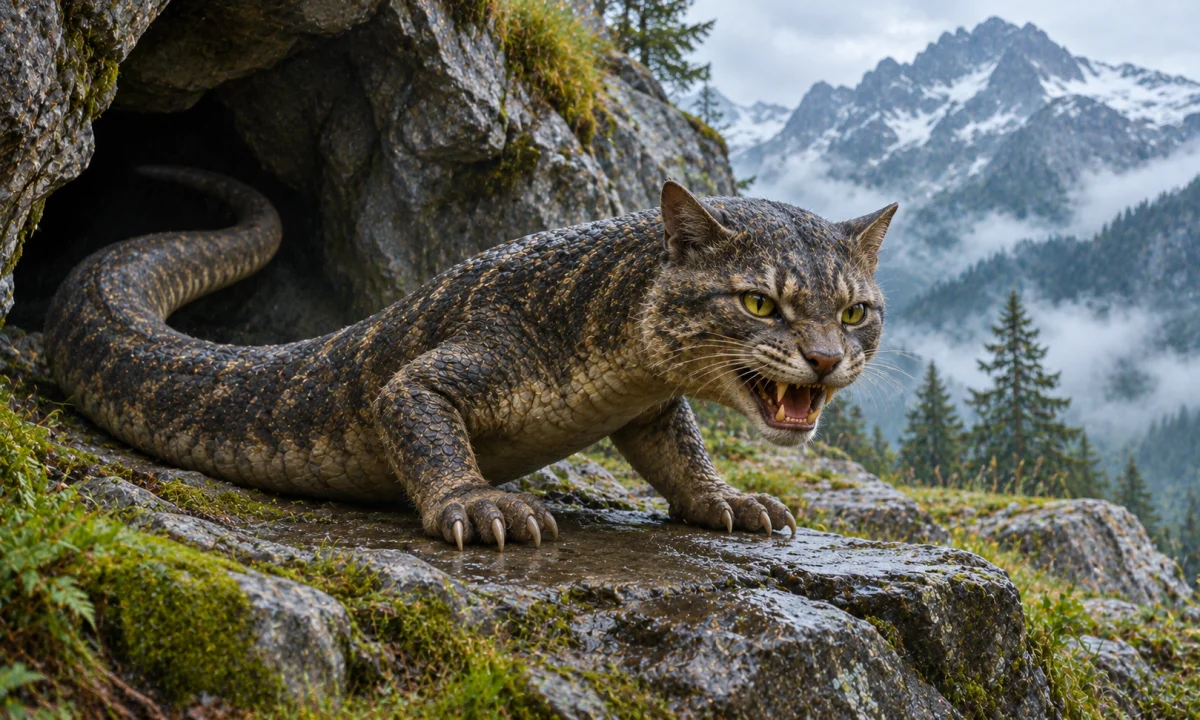
Descriptions of its head and limbs are much less consistent. In some retellings it resembles an enormous snake. In others it has a more dragon-like profile, with a prominent head, mane, crest, fins or wings. Some modern illustrations present it as a European-style dragon, while other images show a South African water serpent with no wings at all. These visual forms should not be treated as equally ancient or equally traditional.
Accounts that give Inkanyamba the ability to fly may not always mean flight in the literal, bird-like sense. The being is frequently connected with the upward movement of storms, spiralling wind and water rising into the sky. Later retellings often turn this association into the image of a winged serpent travelling through the clouds. The distinction matters because the storm itself may be the central phenomenon, while the creature’s physical wings are a later artistic interpretation.
Waterfalls, storms and powers
Inkanyamba’s principal power is its connection with turbulent water and severe weather. The creature is commonly associated with thunderclouds, lightning, heavy rain and whirlwinds. In some versions, it emerges or becomes active during the summer rainy season. Its movements are said to accompany or cause storms, making it a supernatural explanation for weather that arrives with sudden force.
Howick Falls provides an especially vivid setting for these stories. Water plunges into a deep gorge, producing spray, noise and shifting patterns of mist. Storms can transform the surrounding river and cliffs, and the waterfall’s appearance changes with rainfall and light. Such conditions readily support stories of a hidden being whose presence is revealed through water, cloud and sound.
The association does not necessarily mean that Inkanyamba is a simple personification of weather. A personification turns a natural process into a symbolic character, while a traditional supernatural being may be regarded as an inhabitant or agent within a spiritually meaningful landscape. The available accounts do not permit one interpretation to be imposed on every version.
Inkanyamba is sometimes described as dangerous to people who approach its dwelling carelessly. This warning has a practical as well as a religious dimension. Waterfalls and deep rivers are genuinely hazardous, and a story about a powerful being beneath the water can reinforce respect for a dangerous place. As with many traditions concerning water monsters, fear, reverence and environmental caution may operate together.
Stories and local variants
There is no single foundational episode comparable to the creation myths or heroic cycles preserved in a written epic. Instead, Inkanyamba appears in a range of shorter accounts and explanatory traditions. These may describe where it lives, when it becomes visible, what kind of weather announces its presence and what can happen to people who disturb its domain.
One recurring pattern presents the being as dwelling under a waterfall or in a deep pool. When storms gather, Inkanyamba is said to rise, travel through the air or circle above the water. Thunder and lightning then become signs of its activity. The story links a hidden creature to events that are difficult to predict and potentially dangerous, while also giving the landscape a distinctive identity.
Other versions are less concerned with a detailed narrative and more concerned with recognition. A twisting cloud, a sudden whirlwind, an unusual disturbance on the water or the sound of a storm may be interpreted as evidence that Inkanyamba is near. In such accounts, the being is part of a way of reading the environment rather than a character who participates in a long sequence of adventures.
Differences between accounts may reflect genuine local variation rather than errors that must be corrected. One storyteller may emphasise a serpent beneath the falls, another a storm-being moving above them, and a modern illustrator may combine both images into a winged dragon. Treating one version as the only authentic form can obscure how oral traditions actually work.
Meaning and cultural significance
Inkanyamba can be understood as a figure of the boundary between visible nature and spiritual power. Waterfalls and rivers sustain life, yet they can also destroy through floods and drownings. Storms bring rain needed for crops but may also damage homes, fields and roads. A being that controls or embodies these forces expresses their double character: necessary, impressive and dangerous.
The creature’s association with a particular landscape is also important. Inkanyamba is not merely a generic serpent placed in an unspecified fantasy world. Its identity is tied to places with their own histories, names and local meanings. Stories about such a being can help mark a site as special, reminding listeners that the landscape deserves attention and respect.
Calling Inkanyamba a “monster” can therefore be incomplete. In modern genre language, a monster is often an enemy that exists to be defeated. Traditional accounts do not always give Inkanyamba that role. It may be feared, respected or avoided, but it is not necessarily a villain pursuing human beings. Its danger may arise from its nature and domain rather than from a moral desire to harm.
The tradition also shows why comparisons with dragons from Europe or Asia should be made carefully. Serpents and dragons are widespread symbols, but similar shapes do not prove a shared origin. Inkanyamba developed within southern African cultural and environmental contexts. Its relationship with waterfalls, storms and local geography is more significant than its superficial resemblance to a dragon in another tradition.
Distinctions from similar beings
Inkanyamba is not simply the isiZulu word for a snake. Ordinary snakes and generic snake imagery belong to a much broader category, while Inkanyamba refers to a particular supernatural being or complex of traditions. Translation can blur this distinction when a specialised name is reduced to “snake” or “water snake”.
It should also be distinguished from the Impundulu, a lightning-associated bird found in southern African folklore. Both figures may be connected with storms and electrical displays, but they are not the same being. Impundulu is characteristically avian, whereas Inkanyamba is principally serpent-like and linked especially with water and waterfalls.
Nor should Inkanyamba automatically be merged with mermaids, river nymphs or other African water spirits. Traditions from across Africa contain many beings associated with rivers, lakes and fertility, but shared aquatic symbolism does not establish identity. Mami Wata, for example, belongs to a broad and complex set of West and Central African and diasporic traditions; she is not simply another name for Inkanyamba.
Descriptions of Inkanyamba as a “cryptid” also require caution. A cryptid is normally presented as an animal whose existence is claimed but not accepted by mainstream zoology. Inkanyamba belongs primarily to mythology, oral tradition and spiritual interpretation. Treating it as a zoological animal can strip away the cultural meaning of the stories and encourage unsupported claims that every account describes a literal undiscovered reptile.
Later reception and popular culture
Inkanyamba has become increasingly visible in tourism, popular folklore writing, illustrations and online discussions of legendary creatures. The Howick Falls connection has encouraged a compact and memorable version of the story: a giant serpent lives beneath the falls, rises during storms and can sometimes be seen in the clouds or spray. This version is effective for public storytelling, but it represents a selection from a wider and less uniform tradition.
Modern artwork often gives Inkanyamba wings, horns, bright scales or the body of a European dragon. Such images can be imaginative adaptations rather than records of traditional Zulu descriptions. Popular culture also sometimes presents the creature as an aggressive monster to be hunted or defeated, changing a spiritually significant water being into a fantasy antagonist.
The enduring appeal of Inkanyamba lies in the way it joins a recognisable landscape to forces that remain partly beyond human control. A waterfall, a summer storm and a sudden whirl of wind become signs of a living presence. Preserving that connection requires distinguishing local tradition from later embellishment and recognising that the creature’s importance is not limited to whether anyone has physically observed a giant serpent.