WORLD
WORLD
Obyzouth
Obyzouth is a female child-threatening demon known chiefly from late antique and Byzantine religious and magical traditions. The name appears in several spellings, including Obizuth, Obizouth, Obyzouth and Abyzou. These forms are often treated by scholars as variant transliterations or developments of the same demonic name, although the surviving evidence is not uniform. In the traditions associated with her, Obyzouth represents a danger surrounding pregnancy, childbirth and early infancy, especially the unexplained death or illness of newborn children.
Origins and cultural setting
The most important literary witness to Obyzouth is the Testament of Solomon, a Greek religious work attributed to King Solomon but produced much later than the biblical period. Its date, composition and religious background remain subjects of scholarly debate. The text combines biblical ideas about Solomon’s wisdom with themes drawn from Jewish demonology, Greek religious culture, astrology, ritual magic and Christian-era interpretations of older traditions.
In the Testament of Solomon, Solomon questions and controls various spirits while constructing the Temple. The work presents demons as beings with names, powers and particular areas of influence. Their activity is not described as independent mythology alone: the narrative places them within a world governed by divine authority, angelic power and Solomon’s command. The demon’s appearance in such a text therefore reflects both popular beliefs about harmful spirits and the work’s larger interest in classifying and subordinating them.
Obyzouth belongs to a broad family of ancient and medieval traditions concerning female spirits who endanger mothers and children. Infant mortality was common in the ancient world, and childbirth was physically dangerous for mothers as well as newborns. Religious explanations for these dangers frequently involved hostile spirits, divine punishment, fate, human ritual failure or the actions of witches. A demon such as Obyzouth gave a personal form to dangers that were otherwise difficult to explain or control.
The evidence does not establish a single continuous cult of Obyzouth extending unchanged from antiquity into the Middle Ages. Instead, the name appears within different literary, magical and protective contexts. Similar beliefs could also be expressed through other figures, protective angels, sacred names and local spirits.
Name and identity
The spelling Obyzouth is one of several ways of representing the name in English. Transliteration from Greek and the differences between manuscripts can produce forms such as Obizuth, Obizouth and Abyzou. The exact etymology of the name is uncertain. It should not be confidently derived from a particular Hebrew, Greek or other ancient word without qualification.
Abyzou is especially common in modern academic and popular discussions, while Obizuth is close to the form found in many translations of the Testament of Solomon. Obyzouth can therefore be understood as a variant name rather than automatically as a separate demon. The different forms do not necessarily indicate different personalities or traditions, although individual texts may give them different characteristics.
Obyzouth is generally classified as a female demon, but ancient writers did not always use categories in the same systematic way as modern demonology. The Greek word often translated as “demon” could refer to a supernatural being without always implying the later Christian concept of a devil. In the Testament of Solomon, however, the spirits are portrayed as dangerous and hostile beings who must be restrained through sacred authority.
Role and harmful activities
Obyzouth’s central role is that of a demon who attacks women and children during the vulnerable period surrounding birth. She is associated particularly with the killing or strangling of infants. The tradition presents her as a threat that may approach a child at night, when the household is asleep and protective attention is reduced.
Her danger is not limited to physical violence in a narrow sense. The figure also embodies the fear of miscarriage, premature birth, sickness in newborns and the sudden death of a child. Later descriptions and interpretations sometimes connect her with attacks on pregnant women or with the loss of a child before or shortly after birth. Because the sources vary, these details should not be treated as a single fixed biography.
Unlike a demon whose main function is temptation, possession or the spreading of a particular disease, Obyzouth is defined by a specific social and bodily danger. Her sphere is the household at the moment when a new child is expected. This places her alongside protective traditions involving birth attendants, mothers, midwives, amulets and guardians of infants.
The demon’s threat also reflects the vulnerability of women in childbirth. In many cultures, childbirth was surrounded by ritual precautions because it involved blood, physical danger and a transition between states of life. Obyzouth can be read as a personification of the dangers believed to gather around that transition. She is not merely a monster who happens to attack children; her identity is closely tied to reproduction, birth and the fragile boundary between life and death.
Appearance and supernatural character
The surviving descriptions do not provide a universally fixed physical form. Obyzouth is generally imagined as female, but her identity is more securely defined by her actions than by a stable visual appearance. The literary tradition gives her the ability to appear in different forms, a feature common among demons and other dangerous spirits.
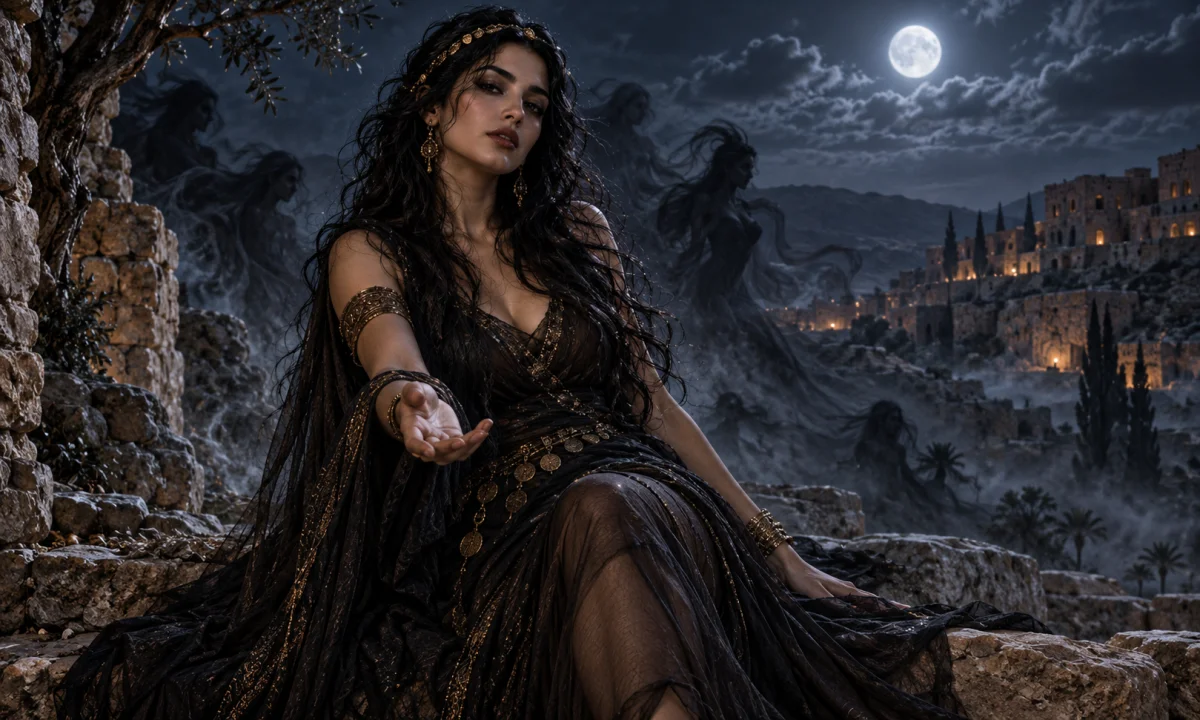
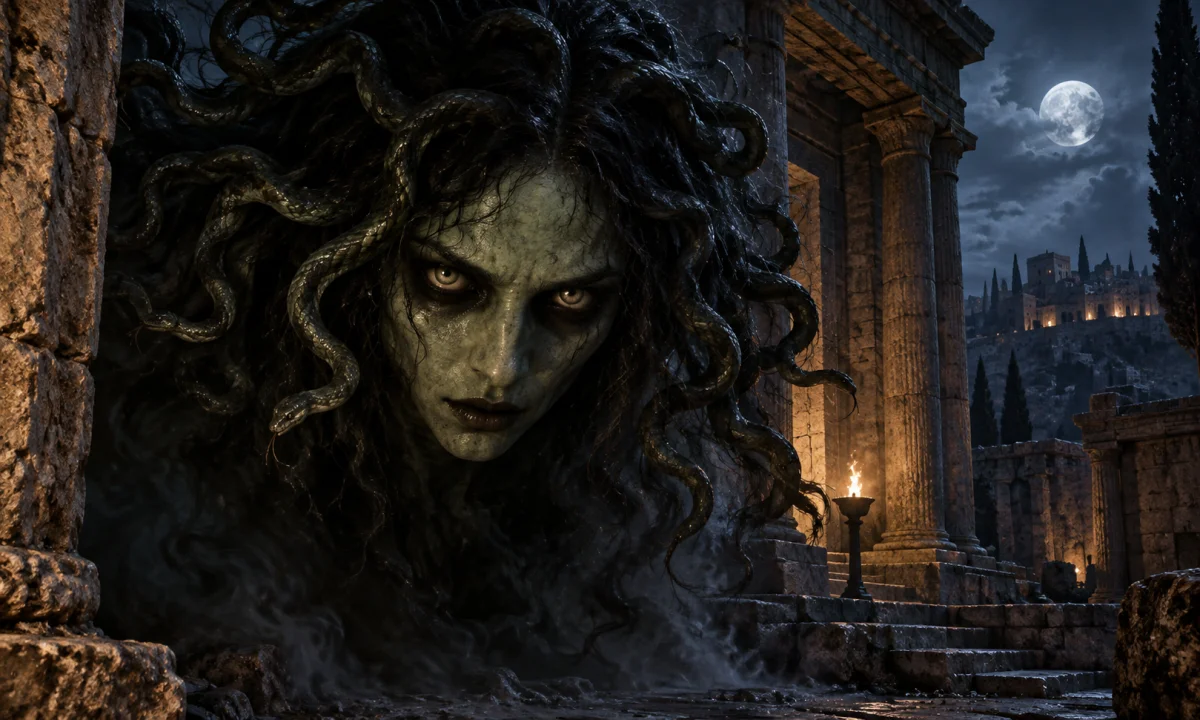
Later artistic and folkloric representations often depict her as a woman with loose or disordered hair. In some images and modern reconstructions, she is shown as a frightening female figure holding or threatening a child. Such scenes communicate her role clearly, but they should not all be assumed to reproduce a single ancient description. Much of the familiar visual appearance associated with Obyzouth comes from later interpretation, illustration and comparison with other child-threatening female spirits.
Her shapeshifting quality has symbolic importance. A demon who can alter her appearance cannot be recognized easily by ordinary people. The danger may therefore be imagined as hidden within an apparently familiar environment, including the home. The contrast between a female human form and murderous supernatural behavior also creates an image of distorted motherhood or corrupted protection.
Obyzouth is sometimes described in modern accounts as having a monstrous, serpentine or winged body. These features may reflect broader demonological and artistic conventions rather than a consistent attribute in the earliest textual evidence. Serpents, wings, long hair and hybrid bodies were all common ways of representing supernatural beings, but the presence of one feature in a later picture does not prove that it belonged to the original tradition.
Protection and ritual control
The Testament of Solomon presents Solomon as able to compel demons through divine authority. Obyzouth’s power is consequently set within a framework in which sacred names, commands and angelic assistance can restrain hostile spirits. The precise wording of protective formulas differs among translations and related magical traditions, so no single formula should be presented as the universal “spell” against her.
Protective practice in the wider Jewish, Christian and Greco-Roman world often included written amulets, spoken prayers, invocations of angels and the use of sacred names. Such objects might be placed near a mother or child, worn on the body or displayed in the home. Their purpose was apotropaic: they were intended to turn away evil, rather than to worship the spirit they named.
The use of a demon’s name in a protective text may seem paradoxical. In magical and religious traditions, however, identifying a harmful being could be part of gaining power over it. A written name, divine command or angelic invocation could establish that the demon was known and subject to a higher authority. This pattern appears in many traditions involving dangerous spirits, not only in material associated with Obyzouth.
Relationship to Lilith and other figures
Obyzouth is frequently compared with Lilith, especially because both figures are associated in later discussions with childbirth, infants and threats to families. The comparison is understandable, but Obyzouth and Lilith should not simply be treated as the same demon.
Lilith has a complex history. The name is connected with ancient Mesopotamian ideas about night spirits and later Jewish traditions, where Lilith develops into a distinctive female supernatural figure. In medieval Jewish texts and subsequent folklore, she may be portrayed as a danger to pregnant women and newborns. Obyzouth, by contrast, is most directly associated with the Greek Testament of Solomon and related Byzantine or magical traditions.
Later writers sometimes grouped several female child-threatening spirits together, and modern demonological sources may list Obyzouth as an aspect, companion or alternative name of Lilith. These identifications are not consistently supported by the earliest evidence. Similar functions do not prove identical origins. Obyzouth should therefore be discussed as her own figure while acknowledging that later traditions sometimes connect her with Lilith.
She can also be compared with other childbirth demons, including spirits known from Mesopotamian, Jewish, Greek and Byzantine sources. Such figures may share characteristics such as attacking infants, appearing at night or being repelled by amulets. They belong to a wider pattern of protective folklore, but they are not automatically versions of Obyzouth.
Interpretation and cultural significance
Obyzouth provides an example of how communities have given supernatural form to medical and social anxieties. Before modern knowledge of infection, neonatal illness and the physiological dangers of childbirth, sudden losses could appear mysterious and morally overwhelming. A hostile spirit offered one possible explanation, while protective rituals offered a sense of action in circumstances that were otherwise uncontrollable.
The figure also reveals the importance of the household as a religious space. The threat is not located only in wilderness or distant lands. It enters the room of the mother and child, particularly at night, and turns a place of family security into a place requiring ritual defense. This pattern appears widely in folklore concerning demons that attack sleepers, infants or women after childbirth.
From a historical perspective, belief in Obyzouth should not be reduced to a simple expression of ignorance. Protective traditions could provide emotional support, communal identity and practical ritual roles for families and religious specialists. Amulets and prayers also recorded the names of feared dangers and the sacred powers believed capable of overcoming them.
At the same time, the figure reflects the unequal burdens placed on women and mothers. Miscarriage, infant death and complications of childbirth could be interpreted as failures of protection or purity, leaving women vulnerable to blame. A demonological explanation could externalize danger, but it could also reinforce fears about female bodies and reproductive life.
Later reception
Obyzouth has attracted renewed attention through modern writing on demons, ancient magic and female supernatural beings. Contemporary authors often emphasize her role as a “child-stealing” or “child-strangling” demon and place her beside Lilith, Lamia and other dangerous female figures. These comparisons can be useful when they are clearly presented as comparative mythology, but they may blur differences between historical traditions.
Modern occult books, fantasy fiction, role-playing games and online demon encyclopedias sometimes give Obyzouth a detailed appearance, hierarchy, mythology or set of powers. Many of these additions are creative inventions rather than features securely attested in ancient sources. A depiction with a fixed rank in Hell, a standardized sigil or a large family of demonic relatives should therefore be treated as modern adaptation unless its origin is clearly established.
The most historically grounded image remains that of a female demon connected with danger to mothers and infants, known through a late antique Greek literary tradition and through variant forms of her name in later magical and religious contexts. Her story belongs to the wider history of protective belief: the attempt to name, understand and ritually resist the dangers surrounding birth.