WORLD

Chasca
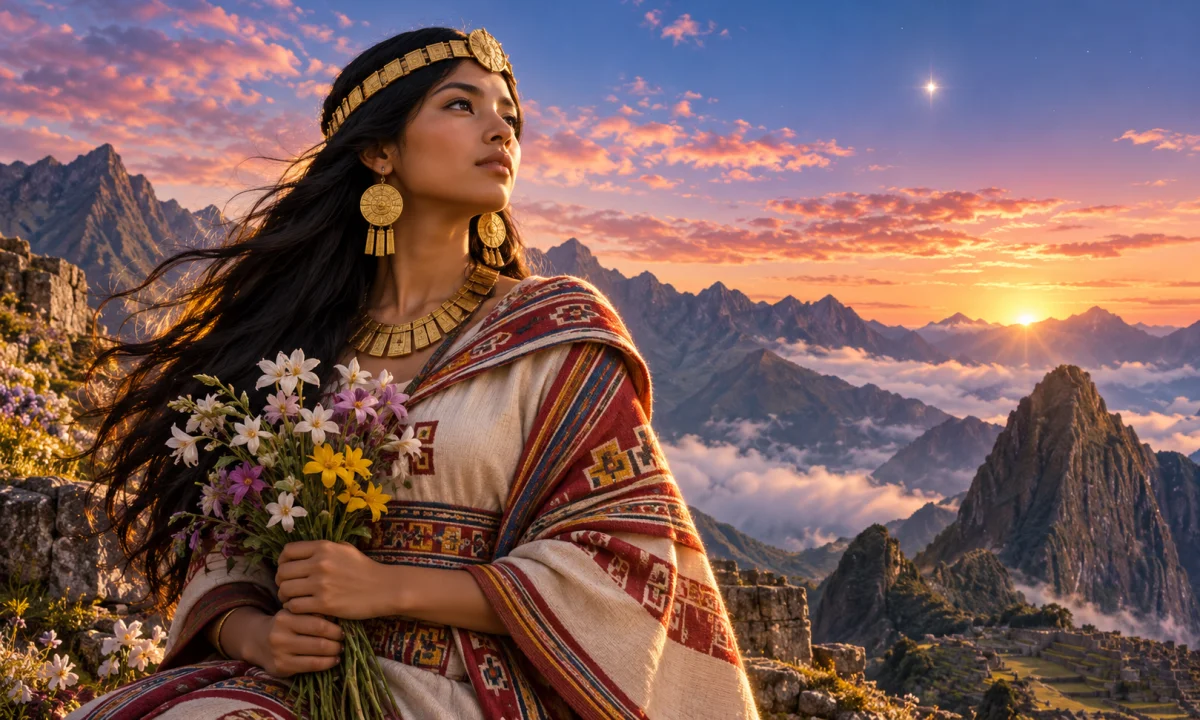
Chasca, also written Ch'aska or Chaska, is a celestial figure associated in Inca and wider Quechua tradition with the planet Venus, especially when it appears as the morning star. Colonial-era accounts also connect Chasca with dawn, beauty and the brightness that precedes the rising Sun. The surviving evidence does not present a single, universally consistent biography. Instead, the name appears within several overlapping descriptions of a brilliant heavenly body, a divine attendant of the Sun and a figure whose beauty was compared with long, shining hair.
Origins and cultural setting
Chasca belongs to the religious world of the Andes, particularly the imperial Inca tradition centred in and around Cusco. Inca religion placed great importance on the movements of the Sun, Moon, planets and stars. The sky was not regarded as a remote, separate realm. Celestial bodies participated in the organisation of time, agriculture, ritual and political authority.
The Inca state incorporated traditions from many Andean communities, and the religious meanings of heavenly bodies could vary between regions and languages. The name Chasca is closely related to Quechua terms for a star or bright celestial object. In many modern discussions, Chasca is identified specifically with Venus, the exceptionally bright planet that can be seen shortly before sunrise or after sunset. Its visibility and changing position made it especially significant to societies that carefully observed the sky.
Knowledge of Chasca comes mainly through early colonial descriptions written after the Spanish conquest. These writers recorded Indigenous beliefs in Spanish, often using Christian categories such as “goddess,” “planet,” “servant” or “angel.” Their accounts are valuable but incomplete. They were shaped by translation, colonial assumptions and the attempt to fit Andean religious ideas into European systems of mythology. There is no surviving Inca scripture that provides a definitive account of Chasca, and no single canonical story can be treated as the complete tradition.
The name Chasca and the identity of the figure
The spelling Chasca reflects Spanish attempts to represent an Andean name. Other forms include Chaska and Ch'aska, with the apostrophe indicating a consonant distinction in some modern systems of Quechua transcription. The precise spelling may therefore vary according to the language variety, historical source or editorial practice.
The name is often translated in connection with a star, brightness or the morning star. Some sources use Chasca Coyllur or a closely related form. Coyllur derives from a Quechua word associated with a star, though colonial spellings are inconsistent. The expression is sometimes interpreted as “star” or “star with hair,” linking Chasca with the image of a radiant, long-haired being. Because the forms were recorded by different writers and in different contexts, the relationship between every use of “Chasca,” “Chasca Coyllur” and other star names cannot be established with complete certainty.
Chasca is commonly described as feminine in modern retellings, and some colonial interpretations call her a goddess. Other descriptions present Chasca less as a human-like goddess and more as the planet Venus itself or as a divine celestial attendant. These categories are not necessarily mutually exclusive in Andean religious thought. A sacred being could be understood through its visible manifestation, its role in the cosmos and its relationship with other powers at the same time.
Chasca as the morning star
The most consistent association is with Venus as the morning star. Venus is often the brightest object in the sky after the Sun and Moon. When it rises before the Sun, it appears to announce the coming day. This made it an appropriate companion or herald of the Sun in Inca cosmology.
Some early descriptions call Chasca a servant, page or attendant of the Sun because the planet appears near the Sun and may precede it across the morning sky. Such language should not be understood as evidence of a simple human-style hierarchy. It reflects an attempt to describe a regular celestial relationship. Chasca’s brightness and position made the figure a sign of the Sun’s approach, giving the planet a role in the transition between night and day.
Venus can also appear as the evening star, after sunset. Because of this, the same celestial body could be connected with both the opening and closing of the day. Modern summaries sometimes describe Chasca as a deity of dawn and dusk on this basis. That is a reasonable interpretation of the planet’s appearances, but the surviving records do not all describe an independent goddess who governs both moments in the same manner. The association with dawn is better documented than a fully developed mythology of twilight.
Appearance and symbolism
Chasca is frequently imagined as young, radiant and exceptionally beautiful. In artistic and literary retellings, the figure may have long, shining hair, an image connected with the expression “star with hair.” This hair can be understood as a poetic representation of rays, brilliance or the trailing appearance of a celestial body rather than as a firmly established physical feature in every traditional account.
Beauty was not merely decorative in this context. Brightness, order and splendour were important qualities in the religious language of the Andes. A celestial body that announced sunrise could symbolise renewal, regularity and the dependable return of light. Chasca’s radiance therefore linked the figure with the life-giving power of the Sun without making Chasca identical to the Sun.
Some modern accounts also describe Chasca as a protector of young women, children or virgins. These claims appear in popular summaries and may reflect attempts to connect the figure with beauty, youth and purity. However, the evidence for a clearly defined protective office is less secure than the association with Venus and dawn. It is safer to describe such roles as later or uncertain interpretations unless a particular historical tradition is being discussed.
Relationship with the Sun
Inca religion gave central importance to Inti, the Sun, whose cult was closely connected with imperial authority. The Inca ruler was associated with the Sun and took part in ceremonies that affirmed the sacred order of the state. Chasca’s place near the Sun in the sky allowed the figure to be understood as an attendant or herald of this major divine power.
This relationship also illustrates a broader feature of Andean cosmology: celestial observation was connected with social and ritual organisation. The rising and setting of heavenly bodies helped mark seasons, agricultural activity and ceremonial time. A bright planet that appeared predictably before sunrise could function as a practical sign as well as a sacred presence.
It would be misleading, however, to assume that Chasca was simply the Inca equivalent of a deity from Greek or Roman mythology. Venus in classical traditions was associated with love and sexuality because the planet was identified with Aphrodite or Venus. The Inca and Quechua meanings of the planet were shaped by Andean ideas about cosmic order, solar power and the observation of the sky. Similar astronomical objects do not imply identical gods.
Stories and the limits of the evidence
Chasca does not possess a large, securely preserved cycle of myths comparable to the stories of figures such as Manco Cápac, Mama Ocllo, Viracocha or the Inca warrior gods. The colonial record tends to preserve brief identifications and descriptions rather than long narratives. As a result, many popular accounts that present Chasca as a character with detailed adventures are likely to be modern elaborations.
The lack of a surviving narrative should not be taken to mean that Chasca was unimportant. In many religious traditions, a deity’s significance is expressed through ritual, calendrical observation, names and relationships rather than through an extensive story. The prominence of Venus in the sky would itself have provided a powerful and recurring religious presence.
There is also a danger in treating colonial descriptions as if they had recorded an unchanged “Inca mythology.” The Inca Empire ruled numerous communities with their own languages, ritual practices and sacred landscapes. A name used in Cusco might not have had exactly the same meaning elsewhere. Spanish writers sometimes grouped distinct local beliefs under broad labels such as “gods” or “idols.” Consequently, interpretations of Chasca must allow for regional variation and for uncertainty introduced by translation.
Venus and Andean astronomy
The Inca and other Andean societies observed the sky with close attention. The movement of the Sun was essential to the calendar, while stars and other celestial bodies helped structure seasons and ritual time. The importance of Venus is especially plausible because its brightness makes it easy to observe without instruments.
Chasca’s identification with Venus does not mean that every appearance of Venus had one fixed meaning. The planet’s periods of visibility, its disappearance before reappearing on the opposite side of the Sun and its position relative to the horizon could all contribute to different interpretations. Ancient observers may have distinguished the morning and evening appearances even when both were understood as manifestations of the same celestial power.
Colonial writers did not always describe Andean astronomy with technical precision. Some used familiar European terms such as “morning star,” while others translated Indigenous explanations into theological language. Modern researchers therefore compare written accounts with linguistic evidence, archaeological alignments and broader patterns in Andean cosmology. Such comparisons can clarify context, but they do not produce a complete or certain biography for Chasca.
Distinction from similar figures
Chasca should not automatically be merged with every Andean being connected with stars, dawn or beauty. The name is sometimes confused with other celestial figures because colonial spellings varied and because many Andean traditions personified heavenly bodies. A reference to a star goddess in a modern retelling may not refer to Chasca specifically.
Chasca is also distinct from Quilla, the Moon, who appears in Inca religious traditions as a major female celestial power. The Moon had her own cycles, rituals and relationships, and should not be treated as another name for Venus. Likewise, Chasca is not simply another form of Inti, the Sun, even though the two are closely associated in descriptions of the morning sky.
Nor should Chasca be confused with unrelated figures named Chasca or Chaska in later fiction, local folklore or other cultural settings. Similar spellings may arise from the use of Quechua words for stars or from modern naming practices rather than from a shared mythological identity.
Cultural significance
Chasca represents the importance of the sky within Andean religious thought. The figure is not only a personification of a bright planet but also a meeting point between observation and devotion. Venus could be seen, measured and anticipated, yet it could also be treated as an active presence within a sacred universe.
The image of Chasca arriving before the Sun expresses a transition from darkness to light. It suggests order, expectation and the dependable rhythm of the heavens. In a society where agriculture and ceremony depended on seasonal timing, these qualities carried practical and religious significance.
The figure also demonstrates why Andean traditions should be studied on their own terms. Labels such as “goddess,” “planet” and “morning star” each capture only part of the meaning. Chasca can be discussed as a divine being, a celestial body, a poetic image and a sign within a wider cosmological system, provided that these interpretations are not presented as identical or equally certain.
Chasca in modern representation
Chasca appears occasionally in modern books, games, fantasy fiction and popular treatments of mythology. These works may give the figure a detailed personality, elaborate costume, magical powers or a fixed family of divine relatives. Such features should be regarded as creative adaptations unless they can be connected to an identifiable Andean tradition.
Modern illustrations often emphasise flowing hair, stars, dawn colours and a youthful feminine form. These motifs draw on the associations with brilliance and the “star with hair” interpretation, but they do not establish a single traditional appearance. Responsible representations distinguish the documented association with Venus from imaginative additions made for contemporary storytelling.
Chasca is best understood as an uncertain but meaningful figure of Andean celestial religion: most securely connected with Venus, especially the morning star, and interpreted in relation to dawn, the Sun and radiant beauty. The surviving evidence supports respect for the figure’s importance while requiring caution about detailed biographies, fixed powers and claims that go beyond what the historical record can securely show.