WORLD
WORLD
Lemminkäinen
Lemminkäinen is one of the best-known heroes of Finnish mythology, especially through the Kalevala, the nineteenth-century epic compiled by Elias Lönnrot from Finnish and Karelian oral poetry. He is portrayed as handsome, daring, sexually confident and highly impulsive, with a talent for singing, magic and warfare. His adventures include dangerous courtship, impossible tasks in the northern land of Pohjola, a descent into the realm of the dead, and a dramatic resurrection carried out by his grieving mother.
Lemminkäinen is not best understood as a single, clearly defined god from an ancient Finnish pantheon. His character in the Kalevala is a literary and folkloric composite, formed from songs that circulated in different regions and could use several names and traditions for related or overlapping heroes. He may appear as Ahti, Ahti Saarelainen or Kaukomieli, although these names do not always refer to exactly the same figure in every tradition. The surviving epic presents him as a heroic human or semi-supernatural adventurer rather than as a creator deity or ruler of the gods.
Origins in Finnish and Karelian oral tradition
The stories associated with Lemminkäinen belong to the wider tradition of Finnic oral poetry. For centuries, singers in Finland and Karelia performed verses in a distinctive trochaic metre, often called the Kalevala metre. These poems preserved myths, charms, heroic narratives, wedding songs and accounts of journeys between the human world and the realms of the dead. They were not originally arranged as one continuous epic with a fixed cast of characters.
During the nineteenth century, Elias Lönnrot collected oral poetry from singers and shaped selected materials into the Kalevala, first published in 1835 and substantially enlarged in 1849. The resulting work is central to Finnish literary and national history, but it should not be treated as a transcript of one ancient book or as a perfectly preserved pre-Christian scripture. Lönnrot combined variants, rearranged episodes and sometimes connected figures who may have been separate in local performance traditions.
This background is particularly important for Lemminkäinen. Some songs portray an Ahti or Kaukomieli who is a reckless lover, while others give him different family connections, adventures or names. The figure in the Kalevala therefore reflects both traditional material and the epic structure imposed by Lönnrot. There is no reliable evidence for a single historical person behind him, nor for a universally accepted ancient cult devoted specifically to Lemminkäinen.
Name and identity
The name Lemminkäinen is connected with the Finnish word lempi, which can refer to love, affection or sexual attraction. The name suits his role as a passionate and often irresponsible lover. In the epic, he is also called Kaukomieli, a name commonly understood as suggesting a far-ranging or adventurous mind. Ahti and Ahti Saarelainen are other important names associated with him.
Interpretations of these names vary. In Finnish tradition, Ahti can also be an independent water-related figure, especially in later mythological classifications. That Ahti should not automatically be identified with Lemminkäinen in every context. The Kalevala brings several strands together, but the names may have had separate histories before the epic was compiled.
Lemminkäinen is usually described as the son of Lempi, with his mother playing one of the most important roles in his story. His father is less prominent and is not consistently central to the narrative. In some accounts, he is associated with Saari, an island or island-like place, which contributes to the epithet Ahti Saarelainen, meaning roughly “Ahti of the island.”
Character and attributes
Lemminkäinen is an archetypal reckless hero. He possesses courage and exceptional ability, but he repeatedly creates danger through pride, impatience and disregard for warnings. He is a skilled warrior and a powerful singer, and his knowledge of words and spells gives him abilities that are not merely physical. Like other heroes of Finnic poetry, he may use ritual speech to influence people, animals and the forces of the landscape.
His beauty and charm attract women, but his relationships are often unstable. He pursues women aggressively, boasts about his conquests and treats social obligations lightly. These qualities make him entertaining and impressive, but they also make him a disruptive figure. He does not represent ideal wisdom or moral order. Instead, his stories repeatedly show the dangers of uncontrolled desire, vanity and confidence.
Unlike a god with a fixed sphere of authority, Lemminkäinen has no single domain. He is connected with travel, erotic adventure, feasting, warfare, magical contests and the boundary between life and death. His identity is defined through action and crisis rather than through formal divine office.
Kyllikki and the island women
One of the most significant episodes concerns Kyllikki, a woman from the island of Saari. Lemminkäinen wants to marry her, but she is reluctant. In the Kalevala, he takes her away and eventually persuades or compels her to become his wife. Their marriage is founded on mutual promises: Kyllikki is not to attend village dances, while Lemminkäinen is not to go to war.
The arrangement soon fails. Kyllikki goes out to dance, breaking her promise. Lemminkäinen responds by abandoning her and setting out on a military or heroic expedition. The episode is not a simple romantic courtship. It reflects the unequal and coercive dimensions of heroic marriage narratives, in which a male hero may claim a woman through force or social power. It also establishes a recurring pattern in Lemminkäinen’s life: an oath is made, desire overrules it, and the result is separation and danger.
Other island episodes emphasize Lemminkäinen’s success with women. He boasts that he has won the affection of many women of Saari, although one woman, Kyllikki, remains especially important. These songs present him as a dangerous seducer rather than a faithful husband. His erotic reputation is part of his traditional characterization, but it should not be confused with the attributes of a fertility god or love deity.
The quests in Pohjola
Lemminkäinen’s adventures are also connected with Pohjola, the northern land ruled by the powerful mistress commonly called Louhi. Pohjola is not simply a geographical place. In the epic tradition it functions as a rival realm, a land of sorcery, marriage negotiations and supernatural obstacles. Its relationship with the southern land of Kalevala changes from episode to episode, and it is not equivalent to the Christian concept of hell.
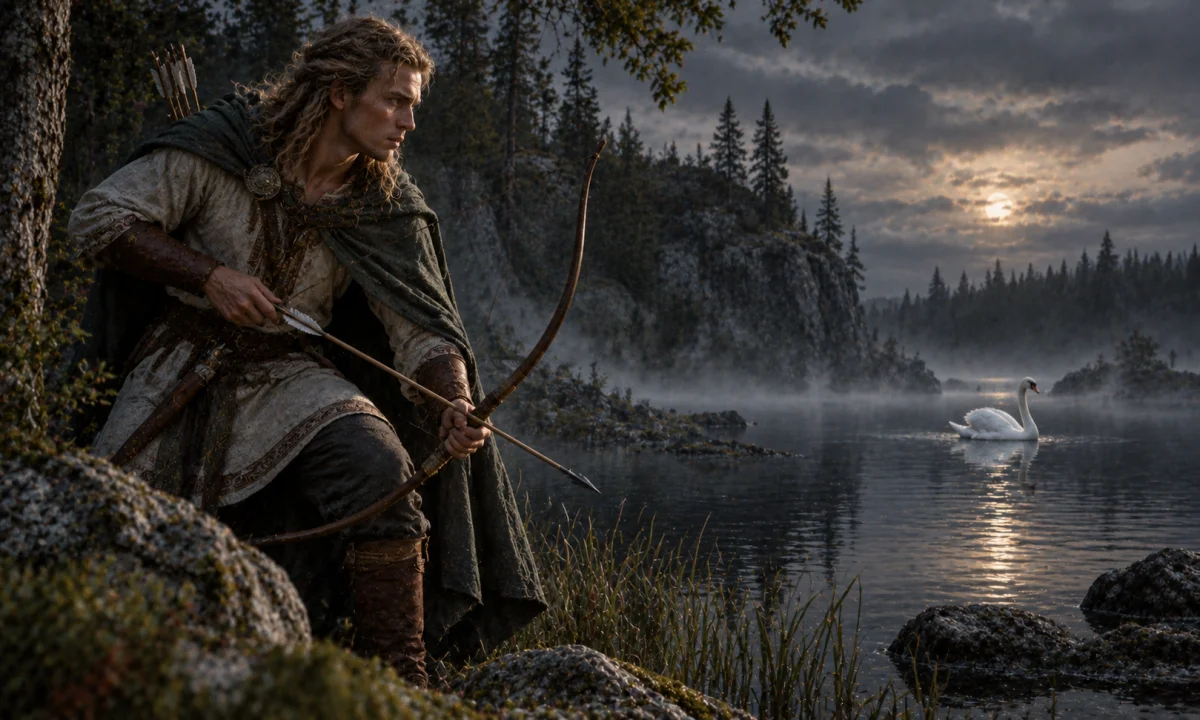
In one sequence, Lemminkäinen seeks the daughter of Pohjola or attempts to win a place among the northern people. He is assigned extraordinary tasks associated with the powers of Hiisi, a word that can refer in different contexts to a sacred grove, a spirit or a hostile supernatural being. The tasks include capturing the elk of Hiisi, obtaining the horse of Hiisi and bringing back the swan of Tuonela.
The first two tasks are dangerous tests of magical and physical ability. The swan, however, leads directly to the crisis that defines Lemminkäinen’s story. Tuonela is the realm of the dead, associated with the dark river that separates the living from the deceased. The swan of Tuonela is therefore not merely an animal to be hunted. Its presence marks the boundary between ordinary heroic adventure and a journey into death.
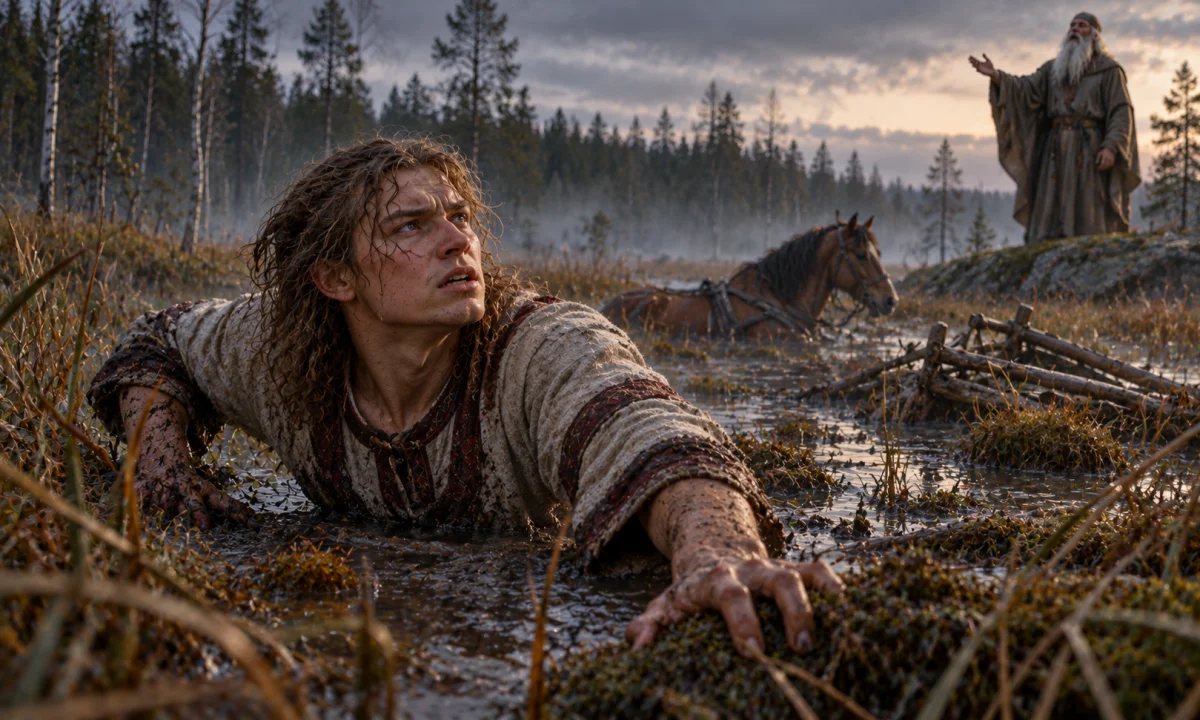
While Lemminkäinen approaches the river, a hostile figure attacks him. In the Kalevala, this is a blind shepherd who has a grievance against him and strikes him with a weapon or launches a fatal attack. The details and identities connected with this episode vary in retellings, but the central pattern is consistent: the boastful hero is killed at the threshold of the underworld while pursuing an impossible prize.
Death and restoration by his mother
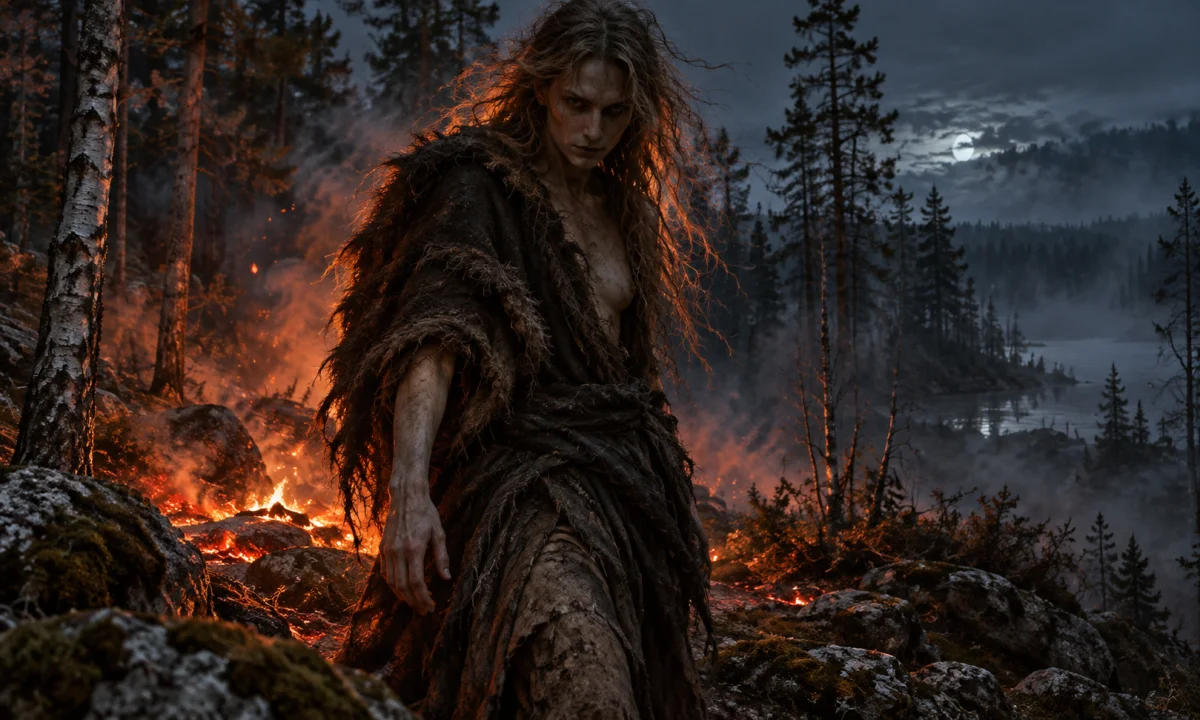
Lemminkäinen’s mother becomes the true central figure of the resurrection episode. When she learns that her son has disappeared, she searches for him and travels toward Tuonela. The journey portrays a mother crossing one of the most dangerous boundaries in Finnic mythology. She questions the inhabitants of the underworld and seeks the remains of her son.
His body has been dismembered and scattered in the river. With a rake, his mother gathers the pieces from the water. She reassembles his body and calls upon supernatural assistance to restore him. A bee is sent to obtain healing substance or honey from a distant divine or heavenly source. Through this combination of maternal devotion, ritual action and otherworldly medicine, Lemminkäinen returns to life.
The restoration is not presented as a simple triumph over death. In some versions, his body must first be made whole before life can return, and the process depends on knowledge that his mother does not initially possess. The episode resembles a healing charm: words, bodily reconstruction and magical substances work together. It also gives the mother a power and determination that exceed her son’s abilities. Lemminkäinen may be the famous adventurer, but his survival depends on her.
This story is one of the strongest examples in the Kalevala of the emotional force of family loyalty. The mother’s grief is active rather than passive. She does not merely mourn; she enters the realm of the dead, challenges its separation from the living and reconstructs the hero. The episode has consequently attracted interpretations involving maternal love, ritual healing, initiation and the cyclical movement between destruction and renewed life. Such interpretations are scholarly readings rather than fixed explanations stated by the original singers.
Lemminkäinen and the wider epic world
Lemminkäinen is one of several major male figures in the Kalevala, alongside Väinämöinen, Ilmarinen and Joukahainen. These figures are not interchangeable. Väinämöinen is an ancient singer, culture hero and master of powerful words. Ilmarinen is a smith and maker of extraordinary objects, including the Sampo. Joukahainen is a younger rival whose defeat by Väinämöinen begins one of the epic’s important chains of events.
Lemminkäinen’s relationship with these figures is shaped by the structure of the compiled epic rather than by a single systematic mythology. He sometimes joins expeditions against Pohjola and participates in conflicts involving the northern realm. In later sections, he appears as one of the companions involved in an attack on Pohjola, where he is associated with boldness, appetite and comic irreverence as well as heroic violence.
The episodes do not form a perfectly consistent biography. His marriage, his journeys, his deaths and his connections to different places may derive from distinct songs. The Kalevala creates continuity between them, but variations in names and motives remain evidence of the older oral tradition’s flexibility.
Religious and cultural significance
Finnish pre-Christian religion did not possess a single canonical mythology comparable to the organized pantheons described in some classical traditions. Local beliefs included reverence for ancestors, spirits of places, beings connected with forests and waters, and powers addressed through ritual poetry. The old songs were used in contexts that could be practical as well as narrative, including healing, weddings and protective magic.
Lemminkäinen’s stories belong to this religiously inflected poetic world, but they do not prove that he was worshipped everywhere as a god. The underworld, magical speech, sacred landscapes and supernatural beings in his narratives reflect traditional cosmology, while the heroic plots also contain humour, social criticism and entertainment. It is more accurate to describe him as a legendary hero shaped by mythic traditions than as a universally recognized Finnish deity.
His repeated movement between desire and disaster gives the stories a distinctive moral and psychological pattern. Lemminkäinen’s courage is real, but courage without restraint becomes recklessness. His ability to sing and fight cannot protect him from the consequences of arrogance. The fact that his mother must save him also undermines the idea that heroic independence is sufficient. Survival depends on kinship, memory and knowledge transmitted across generations.
Distinction from similar figures
Lemminkäinen should not be confused with Ahti in every use of that name. Ahti may refer to an independent figure associated in some Finnish mythological accounts with the sea or waters, while Lemminkäinen’s association with Ahti comes from overlapping poetic traditions and the form of the Kalevala. Nor should he be identified automatically with Väinämöinen, even though both are powerful singers and prominent heroes. Väinämöinen is generally an older culture-bringing sage, whereas Lemminkäinen is a younger, more impulsive adventurer.
He is also distinct from Hiisi, which can denote a spirit or supernatural power rather than one specific hero, and from Tuoni, a figure or power connected with the realm of the dead. Lemminkäinen travels into Tuonela, but he is not its ruler. Modern summaries sometimes simplify these relationships, yet the names belong to different layers of Finnish and Finnic tradition.
Later reception
Lemminkäinen became an important symbol of Finnish cultural identity after the publication of the Kalevala. His stories helped inspire literature, visual art, theatre and music, particularly during the period when Finnish artists were seeking national subjects in the nineteenth and early twentieth centuries. The most famous musical treatment is probably Jean Sibelius’s orchestral work Lemminkäinen Suite, composed in the 1890s and revised later. Its movements draw on episodes from the epic, especially the swan of Tuonela, but the music is a modern artistic interpretation rather than a reconstruction of ancient performance.
Modern novels, games, illustrations and fantasy works may present Lemminkäinen as a warrior, magician or romantic antihero. These versions often simplify the complicated oral background and make him more consistently heroic than he is in the traditional narratives. The older figure remains more ambivalent: attractive but irresponsible, powerful but vulnerable, and repeatedly rescued from the consequences of his own daring.