WORLD
WORLD
Tuonela
Tuonela is the realm of the dead in Finnish mythology and in the related Finnish-Karelian poetic tradition. It is often described as a dark and distant land beyond a dangerous river, inhabited by the dead and ruled or personified by figures associated with death. Tuonela is not simply equivalent to the Christian idea of hell: traditional Finnish descriptions present it primarily as the destination of the dead, a shadowy otherworld from which return is difficult and usually unnatural.
Origins and cultural setting
Ideas about Tuonela belong to the broader religious and folkloric traditions of Finnic-speaking peoples, especially the Finnish and Karelian communities whose oral poetry was collected in the nineteenth century. These traditions were not preserved as a single, unified mythology with one official system of gods. Beliefs varied between regions, historical periods and genres of oral expression. The image of Tuonela therefore comes from several overlapping sources, including epic songs, incantations, funeral customs and popular beliefs about the dead.
The best-known literary presentation of Tuonela appears in the Kalevala, the Finnish national epic compiled by Elias Lönnrot from oral poems and published in expanded form in 1849. The Kalevala is extremely important for the modern understanding of Finnish mythology, but it is not a direct transcript of one ancient book or a single traditional narrative cycle. Lönnrot selected, rearranged and combined materials from different performers and regions. Some features of the epic's Tuonela may therefore reflect the structure of the compiled poem as well as older oral traditions.
Christianity had been present in Finland for centuries before the collection of the Kalevala, and Christian concepts influenced later folk belief and poetic language. Even so, Tuonela is not merely a Finnish translation of hell. Its imagery preserves an older conception of the world of the dead as a separate, perilous country with its own inhabitants, boundaries and laws.
The name and its meaning
The name Tuonela is formed from Tuoni, a Finnish word connected with death and the realm of the dead. Depending on context, Tuoni can refer to death itself, the underworld, or a personified power associated with death. The ending -la commonly indicates a place, so Tuonela can be understood broadly as “the place of Tuoni” or “the land of death.”
Another name found in Finnish tradition is Manala, meaning the realm or dwelling of the dead. The terms Tuonela and Manala are often treated as equivalent in translations and modern discussions, although their use can vary according to the poem or source. Tuoni and Tuonela should not automatically be treated as the same thing: Tuoni may be a personification or power, while Tuonela is primarily the place associated with the dead.
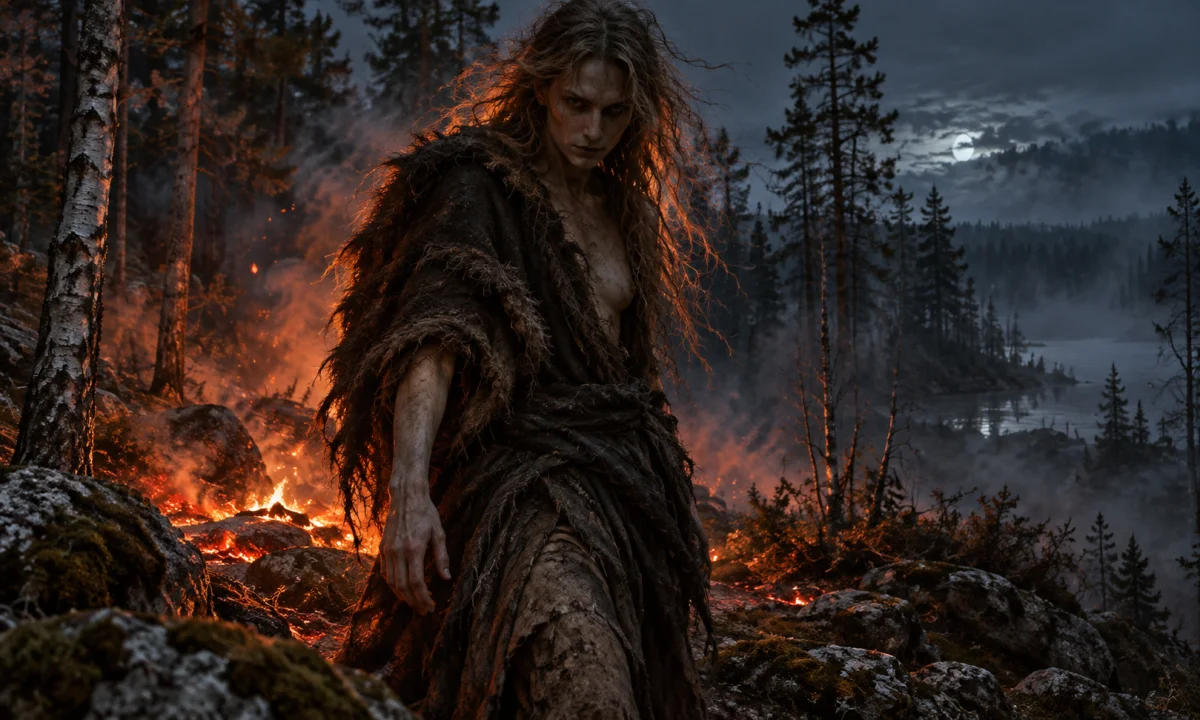
Tuonetar is commonly described as the mistress, female ruler or personification of Tuonela. In the Kalevala, she appears as a powerful and threatening figure who encounters Väinämöinen during his journey to the land of the dead. The exact relationships among Tuoni, Tuonetar and the other beings of Tuonela are not presented consistently enough to form a single family tree. Later retellings often make Tuonetar the wife or counterpart of Tuoni, but this should be understood as a conventional interpretation rather than a universally fixed ancient doctrine.
Tuonela as a land of the dead
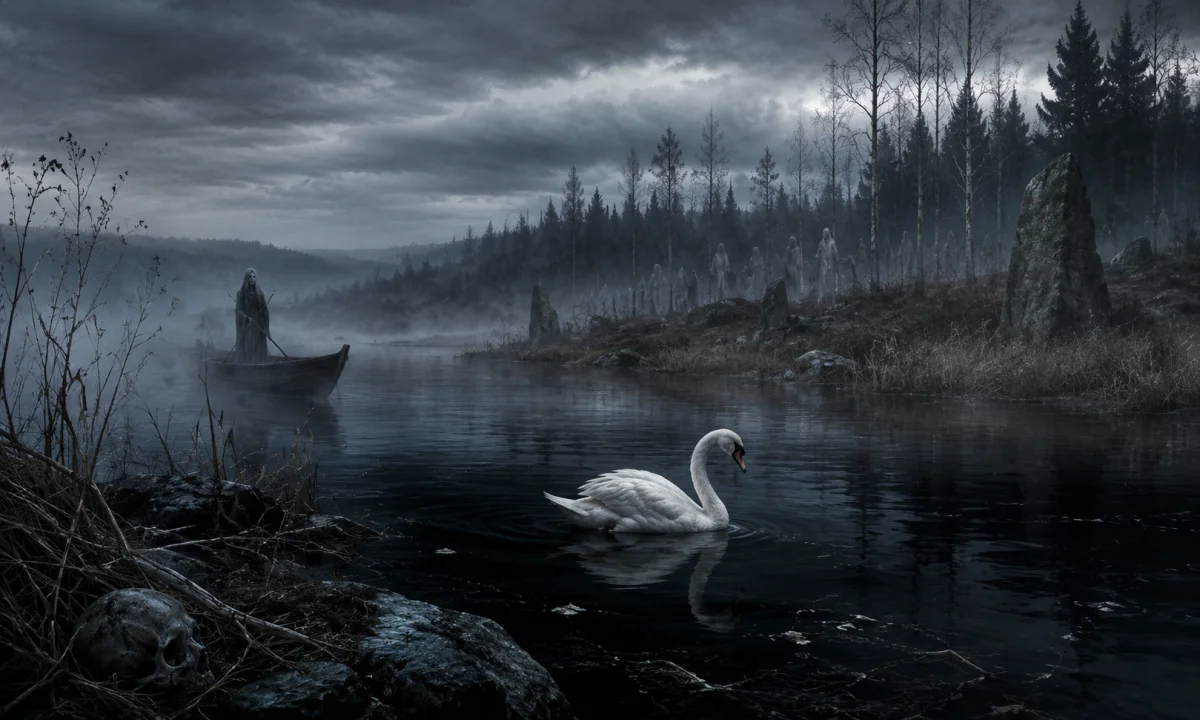
Tuonela is imagined as a remote and gloomy region separated from the world of the living. Its boundary is frequently associated with water, especially the river of Tuonela. The river is not merely a geographical feature. It represents the division between life and death, and crossing it means entering a realm governed by different rules.
Descriptions of Tuonela emphasize darkness, coldness, stillness and danger. The dead are not necessarily presented as suffering criminals undergoing punishment. Instead, they belong to a condition from which ordinary human beings cannot easily return. The realm is threatening because it is fundamentally incompatible with life. A living visitor risks becoming trapped, transformed or killed if he or she remains there too long.
Some traditional descriptions give the dead a continuing existence in Tuonela, while others portray them as diminished, shadow-like or deprived of the vitality they possessed in life. Finnish ideas about the soul were varied, and folk belief did not always reduce the person to one simple spiritual component. Consequently, the atmosphere of Tuonela can differ between sources: it may appear as a populated underworld, a place of decay, a prison-like country, or a poetic image of death itself.
There is no strong basis for treating Tuonela as a carefully organized moral afterlife divided into rewards and punishments. The distinction between the virtuous and the wicked is not its central feature. What matters most is the separation between the living and the dead, the danger of crossing the boundary, and the extraordinary knowledge or power required to return.
Beings associated with Tuonela
Tuoni is connected with death and the underworld. In some interpretations he functions as the lord of the dead, while in others the name is closer to a personification of death or the dead land itself. He is less clearly defined than a major Olympian-style god with a stable biography, and accounts that present him as a fully individualized ruler should be treated with caution.
Tuonetar is more visibly characterized in the Kalevala. She is a guardian and inhabitant of Tuonela who recognizes that Väinämöinen is alive when he attempts to enter the realm. Her presence reinforces the idea that Tuonela is not an empty landscape but a territory protected by supernatural beings. She may also be associated with the household or family of death, although the details vary in interpretation.
The Kalevala also mentions children or daughters of Tuonela in connection with the realm's dangerous waters and inhabitants. These figures are not always described in the same way across translations, and their roles should not be turned into a fixed pantheon. Some are guardians, some are personifications of the hazards of death, and some appear only within particular episodes.
The Swan of Tuonela is another important figure. In the epic, Lemminkäinen is required to obtain or shoot a swan on the river of Tuonela as part of a dangerous task. The swan is not simply a decorative animal; it belongs to the otherworld and marks the boundary that the hero must cross. Its exact symbolic meaning is open to interpretation, but it can represent remoteness, death, silence and the unattainable nature of the underworld.
Väinämöinen's visit to Tuonela
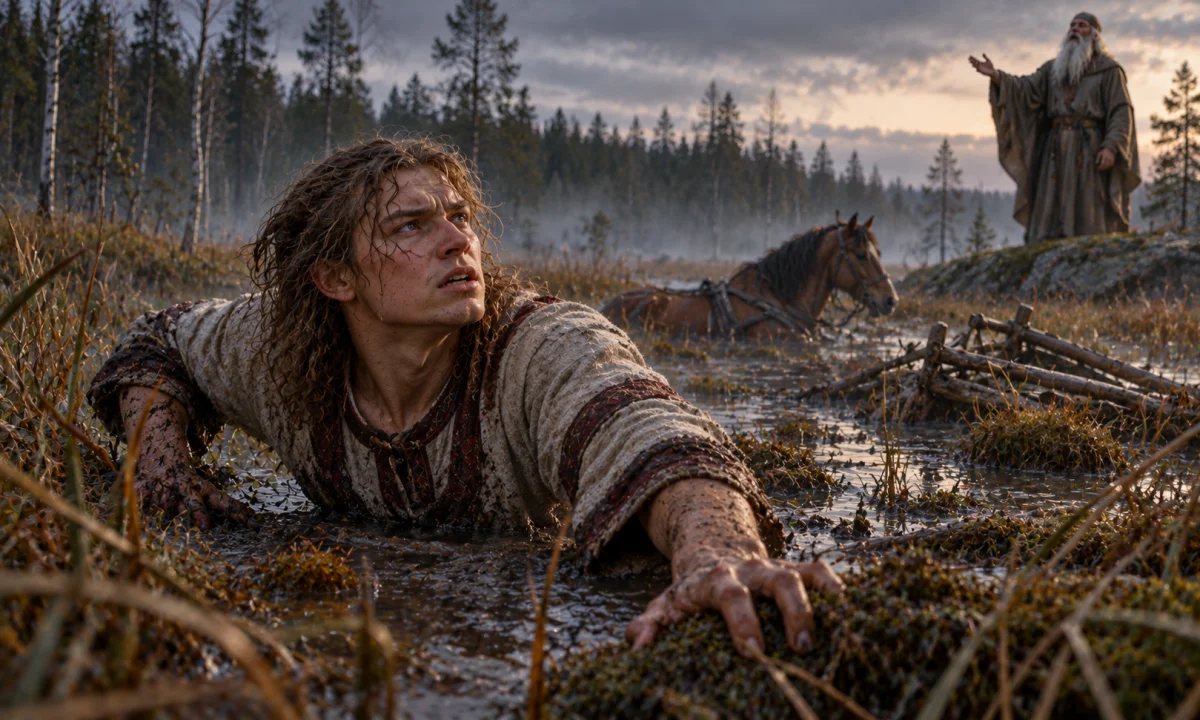
One of the most significant episodes involving Tuonela concerns Väinämöinen, the wise singer and central culture hero of the Kalevala. He travels to the land of the dead in search of powerful words needed for a spell or construction. The story reflects an important motif in northern European and circumpolar traditions: a living sage seeks secret knowledge from the dead, but the underworld does not give up its wisdom freely.
Väinämöinen reaches Tuonela and is questioned about his presence there. He attempts to conceal the true reason for his visit, but Tuonetar recognizes that he is living. The food or drink offered to him is presented as a sign of the realm's hostility and otherness rather than ordinary hospitality. In many translations, the drink is associated with creatures such as snakes or worms, emphasizing that the customs of Tuonela are repellent to the living.
Väinämöinen eventually learns that the knowledge he seeks cannot be obtained in the manner he imagined. He escapes through transformation and ingenuity, using his magical power to pass through a trap or barrier. The details differ among translations and interpretations, but the central pattern remains clear: the hero enters the land of the dead, discovers that it is dangerous even for a great magician, and must struggle to regain the world of the living.
The episode does not portray death as a place that can be visited casually. Väinämöinen's survival depends on exceptional knowledge and supernatural ability. His journey also establishes a limit to heroic power: even a renowned sage cannot simply command the dead to surrender every secret.
Lemminkäinen and the river of Tuonela
Tuonela is also central to the story of Lemminkäinen, a reckless and charismatic hero. As part of a series of challenges connected with his pursuit of a bride in Pohjola, he is ordered to shoot the Swan of Tuonela. While attempting the task, he is attacked and killed by a guardian or rival associated with the river. His body is dismembered and cast into the water.
Lemminkäinen's mother later learns of his fate and journeys to Tuonela. Using a rake, she gathers the pieces of his body from the river. Her grief, determination and magical skill enable her to restore him to life, although the episode is not a simple denial of death. His revival depends on extraordinary intervention and does not mean that the boundary between the two worlds has ceased to exist.
The story gives Tuonela a particularly physical and dangerous character. It is not only a destination reached after natural death; it can also be entered by a living person who undertakes a forbidden quest. The river becomes the site of murder, dismemberment and recovery, while the mother's search expresses the power of kinship and mourning. At the same time, the narrative preserves the idea that returning from Tuonela is an exceptional event, not an ordinary possibility.
Lemminkäinen's story should not be confused with Väinämöinen's visit. Both heroes enter Tuonela, but they do so for different purposes and have different experiences. Väinämöinen seeks knowledge and escapes; Lemminkäinen seeks the underworld swan, is killed and is restored through his mother's efforts.
Symbolism and religious significance
Tuonela's most important symbol is the boundary. The river separates the familiar world from the realm of the dead, while the journey toward it represents a movement away from human society, ordinary speech and physical safety. Water frequently serves as a transition between worlds in mythology, but in Finnish epic poetry it is also a practical danger: it must be crossed, navigated or searched.
The underworld's darkness can be read as an image of death, but interpretations should not be reduced to a single modern psychological meaning. In traditional contexts, Tuonela belongs to a religious and poetic understanding of the cosmos. It is a real supernatural location within the imagined structure of the world, not merely a metaphor invented by later writers.
Tuonela also embodies the danger of acquiring forbidden knowledge. The dead possess information unavailable to ordinary people, yet they cannot be approached without risk. This theme is especially clear in Väinämöinen's journey. The wisdom of the ancestors has authority, but the living cannot fully control or exploit it.
The stories connected with Tuonela further express the emotional force of mourning. Lemminkäinen's mother crosses into the world of death because she refuses to accept the loss of her son. Her actions show grief as a form of magical and practical labor: she searches, gathers, repairs and calls life back into the body. This does not erase the finality associated with Tuonela, but it gives family devotion a central place in the struggle against death.
Distinguishing Tuonela from related figures and places
Tuonela is a place or underworld, not a single monster. It should not be described as though it were one humanoid spirit with a fixed appearance. Tuoni may be personified, and Tuonetar may act as a ruler or guardian, but the names do not establish a simple equivalent of Hades, Hel or the Devil.
Tuonela is also distinct from Pohjola. Pohjola is a northern land in the Kalevala, associated with Louhi and with the families, conflicts and magical objects of the epic. It is sometimes portrayed as strange or hostile, but it is not simply another name for the land of the dead. A journey to Pohjola and a journey to Tuonela are different narrative events.
Nor is Tuonela identical to Kalma. Kalma is a Finnish term associated with death, the smell of a corpse and the presence of the dead, and it can appear in poetic or folkloric contexts connected with graves and mortality. The concepts overlap, but they should not be merged into one specific underworld deity or location.
Later reception
Tuonela became especially influential through the Kalevala, whose publication helped define Finnish national culture during the nineteenth century. Artists, composers and writers drew on its underworld imagery as a symbol of death, memory, national history and the mysterious landscape of the North.
The most famous musical adaptation is The Swan of Tuonela, an orchestral work by Jean Sibelius, composed in 1895 and later included in the Lemminkäinen Suite. Sibelius transforms the epic episode into a slow, atmospheric tone poem centered on the swan and its mournful setting. The work is a modern artistic interpretation, not a traditional Finnish ritual or an ancient musical description of Tuonela.
Contemporary fantasy, games and popular fiction sometimes use Tuonela as a convenient name for a generic realm of the dead. Such adaptations may combine it with ideas from Greek, Norse or Christian underworlds. They can introduce memorable new imagery, but those inventions should be distinguished from the Finnish and Finnish-Karelian traditions in which Tuonela is a perilous land of the dead, guarded by supernatural inhabitants and separated from the living by the river of death.