WORLD
WORLD
Joukahainen
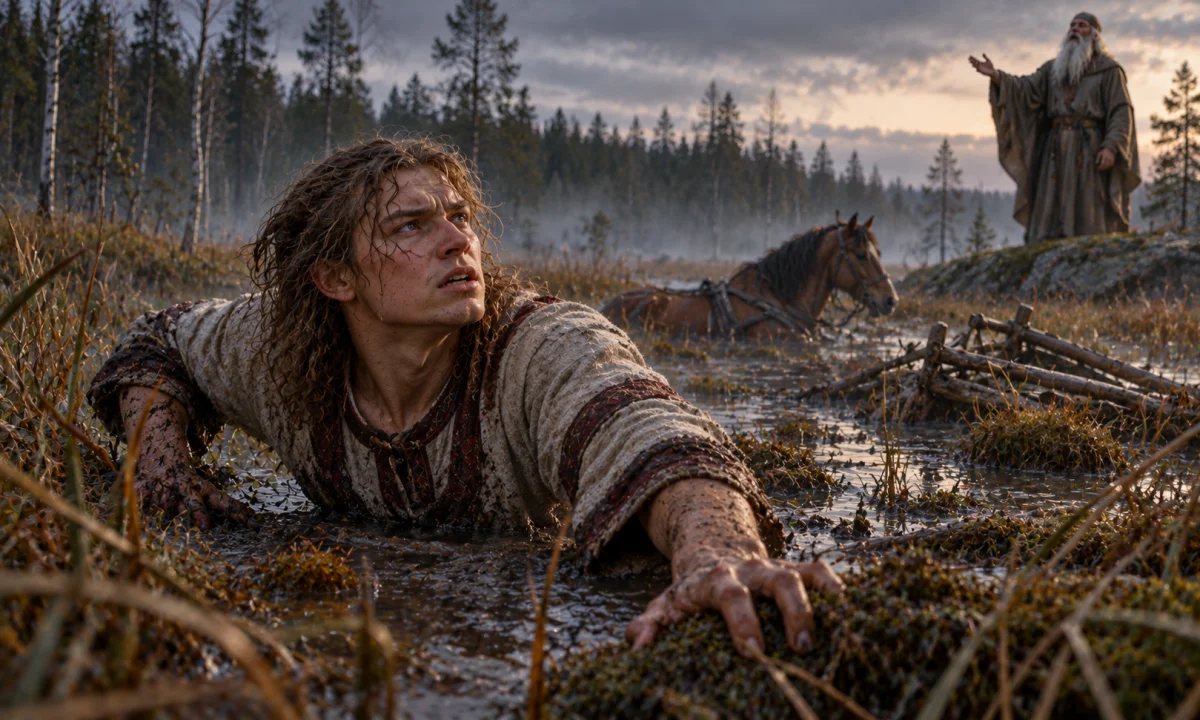
Joukahainen is a young human figure in Finnish mythic poetry, best known from the Kalevala, Finland’s national epic. He is a proud and inexperienced singer who challenges the older sage Väinämöinen to a contest of knowledge and magical song. His defeat has serious consequences: to escape Väinämöinen’s spell, Joukahainen promises his sister Aino as a bride, setting in motion one of the Kalevala’s most tragic episodes.
Origins in Finnish oral tradition
Joukahainen does not come from a single ancient book or a clearly defined pre-Christian religion. His stories belong to the oral poetic tradition of Finland and neighbouring regions, especially the tradition of singing long alliterative poems known as runo-singing. These poems were transmitted by performers for generations before they were written down.
The best-known form of Joukahainen’s story appears in Elias Lönnrot’s Kalevala. Lönnrot compiled and arranged material collected from oral singers during the nineteenth century. The Kalevala, first published in an earlier form in 1835 and in a substantially expanded form in 1849, is therefore both a record of traditional poetry and a literary composition shaped by its editor. Its episodes may preserve older mythic motifs, but the epic as a whole should not be treated as an unchanged transcript of a single ancient Finnish religious text.
Joukahainen appears near the beginning of the epic, in the runes describing his conflict with Väinämöinen. His story helps establish the importance of knowledge, speech and song in the world of the Kalevala. In this poetic universe, a powerful singer does not merely entertain an audience. Correct knowledge expressed in the right words can alter nature, defeat enemies and determine the fate of people.
Name and identity
The name is usually written Joukahainen in Finnish. Its precise origin and meaning are not certain, and popular explanations should not be presented as established etymology. The name may have variants in different recordings and editions of traditional poetry, but the figure in the Kalevala is generally recognisable by his rivalry with Väinämöinen and by his connection with Aino.
Joukahainen is not normally classified as a god, a nature spirit or a demon. He is a mythic human hero, although the boundaries between human beings, culture heroes and supernatural figures are not always sharply defined in Finnish epic poetry. He possesses access to magical song, but he is not portrayed as the equal of Väinämöinen. His importance lies less in divine status than in his role as a flawed young challenger.
In the epic, Joukahainen is associated with Lapland. The poetry uses traditional terms and imagined geographical relationships that do not always correspond neatly to modern maps or to the identities of present-day northern peoples. The old term sometimes translated as “Lapp” reflects historical language found in the tradition; it should not be taken as a precise modern ethnic classification.
The challenge to Väinämöinen
Joukahainen’s principal story begins when he encounters Väinämöinen on the road. Both travellers demand that the other give way, and the disagreement develops into a contest. Joukahainen is young, proud and eager to prove that he possesses superior knowledge. Rather than showing respect to the older singer, he boasts about his learning and the antiquity of his experience.
His claims become increasingly extravagant. He presents himself as someone who knows the origins of the world and who was present at events belonging to the distant past. In some translations, his assertions include confused or deliberately absurd descriptions of the creation of natural features. His speech is not simply ignorant; it is a display of empty confidence. He wants the prestige of knowledge without possessing the wisdom that Väinämöinen represents.
Väinämöinen exposes the weakness of Joukahainen’s claims and challenges him to a singing contest. The contest is not a performance judged for beauty alone. In the logic of the poem, a true master of song has deep knowledge of the world and can make words act upon reality. Väinämöinen sings with such power that Joukahainen is forced backward into the landscape.
In the best-known episode, the ground gives way beneath Joukahainen. He becomes trapped in a marsh or bog, while his horse and equipment are also caught in the spell. The precise details can differ between translations and versions of the poetry, but the central image remains the same: the boastful challenger is literally overwhelmed by the power of a wiser singer’s words.
Joukahainen finally begs for mercy. He offers valuable objects and possessions in exchange for his release, but Väinämöinen refuses these payments. The young man then makes a more serious offer: he promises his sister Aino as a wife for Väinämöinen. Väinämöinen accepts the bargain, and Joukahainen is freed.
Joukahainen and Aino
The promise concerning Aino reveals the consequences of Joukahainen’s pride. He has treated his sister as something that can be exchanged to settle his own debt. The poem does not present the arrangement as a happy family decision. Aino is distressed when she learns that she is expected to marry the much older Väinämöinen.
Aino’s story is usually told in the runes that follow Joukahainen’s defeat. Her mother welcomes the prospect of such a distinguished marriage, but Aino rejects it. She grieves over the loss of her youth and freedom, and she refuses to accept the role chosen for her by her brother and family. Her resistance is one of the most emotionally powerful elements in the Kalevala.
Eventually Aino goes into the forest and later to the shore. The exact details vary in translation and in the relationship between different traditional versions, but the outcome is tragic. Aino enters the water and does not return as a human being. In the epic’s supernatural transformation, she is associated with a fish. When Väinämöinen later catches a strange fish, it reveals or suggests that it is Aino and then escapes him.
The Aino episode has been interpreted in several ways. It can be read as a story of coercive marriage, a lament for the loss of a young woman’s autonomy, a death-and-transformation myth, or a poetic expression of grief and the danger of crossing between human and natural worlds. The text itself does not offer a single modern explanation. Aino’s fate is connected to Joukahainen’s bargain, but her character and story cannot be reduced to being merely his sister.
Joukahainen’s mother is pleased by the proposed marriage, while Aino suffers. This contrast reflects a conflict between family expectations and individual choice. It also shows that Joukahainen’s actions affect people who were not participants in his contest. His boastful challenge has consequences far beyond his personal humiliation.
His later hostility towards Väinämöinen
Joukahainen does not simply accept his defeat. In a later episode, he tries to take revenge on Väinämöinen by shooting at him. The attack fails to destroy the older singer, but it contributes to a dangerous sequence in which Väinämöinen is thrown into the sea and carried away. The incident reinforces Joukahainen’s character as resentful and impulsive: when he cannot overcome Väinämöinen through knowledge, he turns to violence.
The revenge episode also broadens the conflict between the two figures. At first, their dispute appears to be a contest between an older master and a boastful youth. After Joukahainen’s humiliation and the loss connected with Aino, the rivalry becomes personal. His actions help drive the larger adventures of Väinämöinen and connect the early runes to the epic’s wider chain of dangers, rescues and magical contests.
Joukahainen is not a consistent villain in the manner of a supernatural enemy. He is capable of fear, anger and regret, but the epic does not give him the wisdom or moral authority associated with Väinämöinen. His poor decisions arise from pride and frustration rather than from a grand plan to destroy the world.
Attributes and symbolic role
Joukahainen’s most important attribute is his claimed knowledge. He wants to be recognised as an ancient and powerful singer, yet his boasts reveal that he does not understand the subjects he discusses. His failure illustrates the difference between memorised or invented assertions and knowledge grounded in experience, tradition and wisdom.
He also represents youthful arrogance. Age in the Kalevala is not automatically a guarantee of virtue, but Väinämöinens’s age signifies long experience and a deep connection with the origins of things. Joukahainen has ambition without maturity. His desire to surpass an established master leads him to challenge someone he cannot defeat.
The contest between the two singers gives language a physical and magical dimension. Väinämöinen’s song reshapes the environment, while Joukahainen’s speech cannot protect him from the consequences of his ignorance. The episode may be understood as a poetic celebration of traditional expertise: the person who truly knows the old words and the origins of things holds power over the person who merely boasts.
Joukahainen’s bargain involving Aino adds another layer of meaning. His pride is not only foolish; it is socially destructive. He attempts to settle his personal debt by transferring the burden to his sister. In this respect, his story explores the relationship between male rivalry, family authority and the limited choices available to women in traditional social settings. Modern readers and artists have often focused more strongly on Aino’s suffering than on Joukahainen’s defeat.
Relationship with Väinämöinen
Joukahainen is one of the clearest contrasts to Väinämöinen in the Kalevala. Väinämöinen is an ancient culture hero, singer and wise man whose power is connected with creation, memory and mastery of language. Joukahainen is young, competitive and insecure. He wants the status associated with Väinämöinen but lacks the knowledge that gives that status meaning.
The contrast is not simply between good and evil. Väinämöinen can be proud, and his treatment of Joukahainen is not gentle. He uses his superior magic to humiliate and endanger the younger man. The encounter therefore contains an element of generational conflict: an established master defends his authority against a younger rival who seeks recognition too quickly.
Joukahainen’s promise of Aino also links the two men through an unequal exchange. Väinämöinen receives the offer of marriage, but Aino refuses the arrangement. Her refusal exposes the limits of the agreement made between the two male figures. A bargain between men cannot fully determine the life of the woman whose future has been traded.
Joukahainen in Finnish cultural memory
The Kalevala became a major work of Finnish national culture during the nineteenth century. Its characters, including Joukahainen, entered literature, visual art, education and public discussions of Finnish identity. The epic was important to the cultural movement that sought to define a distinct Finnish heritage, although its materials came from a broad oral tradition extending beyond modern national borders.
Artists have frequently represented the meeting of Joukahainen and Väinämöinen, the magical singing contest and Joukahainen’s attempt at revenge. Aino’s story has received particularly extensive attention in Finnish art. Paintings such as Akseli Gallen-Kallela’s Aino Triptych helped establish a visual image of the episode, even though such works are interpretations of the epic rather than ancient illustrations of an original myth.
Later retellings often make Joukahainen more psychologically complex than he appears in a straightforward summary of the Kalevala. Some present him as a frightened young man trapped by expectations of masculinity; others emphasise his arrogance, resentment or responsibility for Aino’s fate. These are modern literary and artistic readings, not fixed meanings universally shared by the older tradition.
Distinction from similar figures
Joukahainen should not be confused with Väinämöinen, the older singer whom he challenges. Both are associated with song, but their roles are oppositional. Väinämöinen is the authoritative master of ancient knowledge, while Joukahainen is the inexperienced challenger whose false confidence is defeated.
He should also be distinguished from Aino. Aino is Joukahainen’s sister in the Kalevala and has her own tragic narrative. She is not simply another name for Joukahainen, a female version of him or a supernatural being identical with the fish encountered later in the story. The fish episode is a transformation and recognition motif within Aino’s story.
Nor is Joukahainen identical with every young singer, hunter or northern warrior appearing in Finnish and Karelian oral poetry. Traditional songs contain many figures whose names, roles and relationships vary between local performances. The Joukahainen of the Kalevala is specifically the boastful rival of Väinämöinen and the brother who promises Aino in exchange for his freedom.