WORLD

Antero Vipunen
Antero Vipunen is a mysterious giant and ancient keeper of magical knowledge in Finnish mythology, best known from the Kalevala, Finland’s national epic. He is usually described as a being who has been dead for a very long time, yet whose body remains powerful and whose mind still contains the words of primordial wisdom. His most important appearance occurs when Väinämöinen seeks the secret words needed to complete a magical boat.
Vipunen is not a god in the same sense as figures belonging to a clearly organised pantheon. He is better understood as a legendary giant, sage and supernatural singer within the world of Finnish and Karelian oral poetry. His exact nature varies between interpretations and poetic traditions. Some readings emphasise his enormous body and connection with the earth; others portray him primarily as an exceptionally ancient wise man whose knowledge survives death.
Origins in Finnish and Karelian tradition
The best-known account of Antero Vipunen comes from the Kalevala, particularly the seventeenth poem, or runo, of the completed nineteenth-century epic. The Kalevala was compiled and edited by Elias Lönnrot from Finnish and Karelian oral poems collected in the nineteenth century. It is therefore important to distinguish the epic as a literary work from the much older oral traditions that supplied many of its characters, episodes and poetic formulas.
Finnish traditional poetry was performed in a distinctive trochaic metre and preserved stories about culture heroes, magical specialists, ancestral beings, monsters and the powers of words. In this setting, knowledge was not merely a collection of facts. Certain words, especially words concerning origins, could have practical magical force. A skilled singer or ritual expert who knew the origin of an object, illness or power could influence it through song.
Vipunen belongs to this world of ancient verbal knowledge. He is associated with words that are older and deeper than ordinary human instruction. His wisdom has not been learned in a school or passed down through an ordinary family line. It is imagined as knowledge accumulated across an immense span of time and preserved in a being whose existence reaches back toward the beginnings of the world.
There is no clear evidence that Antero Vipunen received a regular cult or that people worshipped him as a god. His importance comes from narrative and poetic tradition rather than from a documented system of religious observance. Describing him as a figure of Finnish mythology is appropriate, but treating him as a universally recognised member of a fixed Finnish pantheon would be misleading.
Name and identity
The figure is commonly called Antero Vipunen, although Vipunen is also used on its own. The form “Antero” is a Finnish form of the Christian name Andrew, and its presence does not necessarily indicate a separate ancient being. In the epic tradition, “Antero Vipunen” functions as the established name of the character.
The meaning and original history of “Vipunen” are not completely certain. Interpretations of the name have been proposed, but no single explanation is universally accepted. The uncertainty is increased by the fact that Finnish and Karelian oral poetry existed in regional versions, with differences in wording, names and descriptions. It is therefore safer to treat the name as belonging to a traditional poetic figure than to claim a definitive etymology.
Descriptions of Vipunen also shift in emphasis. He may be called a giant, an old man, an ancient singer or a being lying within the earth. These descriptions need not be contradictory. In oral mythology, a supernatural figure can possess human features while also being vast enough to resemble a landscape. Vipunen’s body is presented as both a corpse and a living magical environment.
Appearance and supernatural qualities
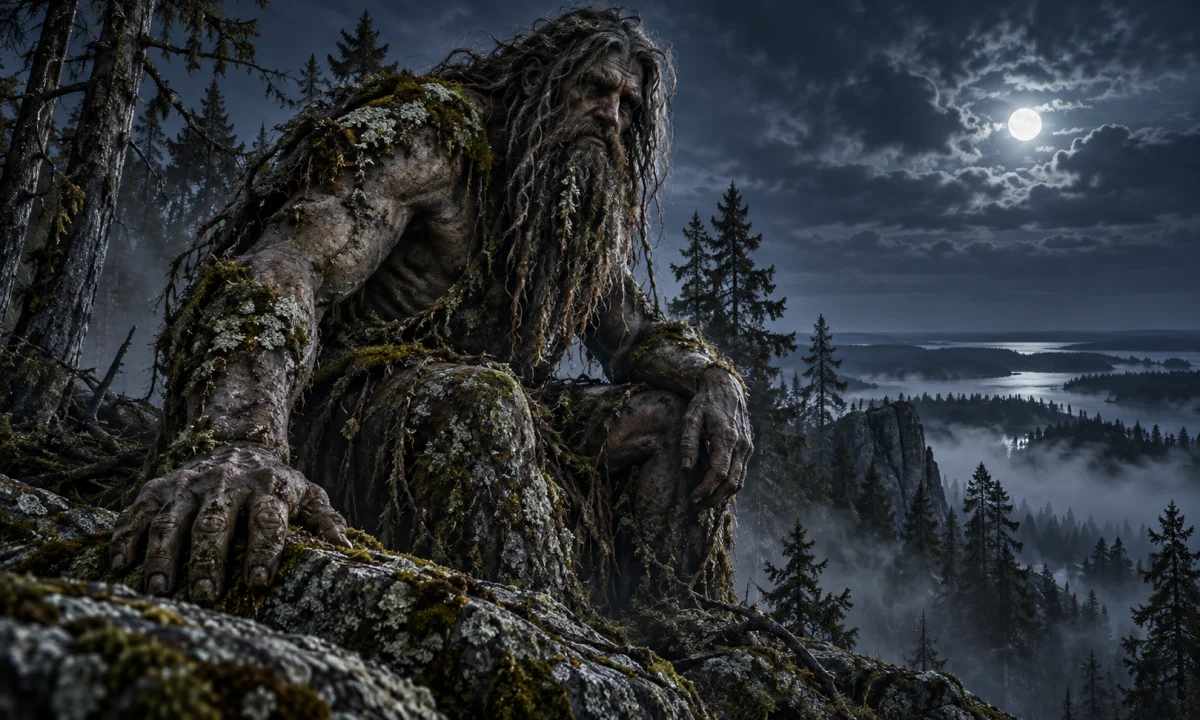
Vipunen is famous for the extraordinary state of his body. He has been dead for so long that vegetation grows over him. Trees, grass and other signs of the natural world cover or emerge from his remains. The image makes it difficult to separate the giant from the landscape around him. He is not simply buried in a forest; in a symbolic sense, he has become part of the forest and the earth.
Although dead, Vipunen retains formidable power. His mouth, stomach and body become central locations in the story, and his voice remains capable of producing songs of immense authority. His most important attribute is not physical strength but knowledge of origins. He knows words that Väinämöinen cannot obtain through ordinary effort.
Vipunen’s wisdom is also associated with memory. He represents a time before the present generation of heroes, perhaps before the current order of the world. When Väinämöinen approaches him, he is seeking access to a reservoir of knowledge that has survived from an earlier and more mysterious age. The giant’s long death does not erase his wisdom; instead, it seems to preserve it.
His body may be interpreted as a mythic image of the earth itself. Forests grow from him, and entering him resembles descending into a hidden or underworld-like realm. This does not make Vipunen identical with Tuoni, the ruler of the Finnish realm of the dead, or with Tuonela, the land of the dead. Those are separate elements of Finnish mythology. Vipunen is a distinct figure whose burial and bodily imagery create an unusual passage between the living world, the dead and the natural landscape.
Väinämöinen’s search for the secret words
The central episode begins when Väinämöinen needs additional magical knowledge. In the Kalevala, he is working on a boat and finds that his skill is insufficient to complete it. He knows many spells and songs, but some essential words are missing. The problem is significant because magical craft depends on knowing the correct words, particularly words connected with the origin or creation of the thing being made.
Väinämöinen learns that Antero Vipunen possesses the knowledge he requires. Vipunen is not living in an ordinary dwelling. He lies buried in the earth, and the passage of time has allowed the forest to grow over his body. Väinämöinen therefore travels to a place where the boundary between grave, hill and living woodland has almost disappeared.
The hero attempts to rouse the ancient being. Accounts and translations differ in the precise details of this encounter, including the methods used to disturb Vipunen and the order of events inside the giant’s body. In the best-known form of the story, Väinämöinen enters or is swallowed into Vipunen’s mouth and finds himself inside the giant.
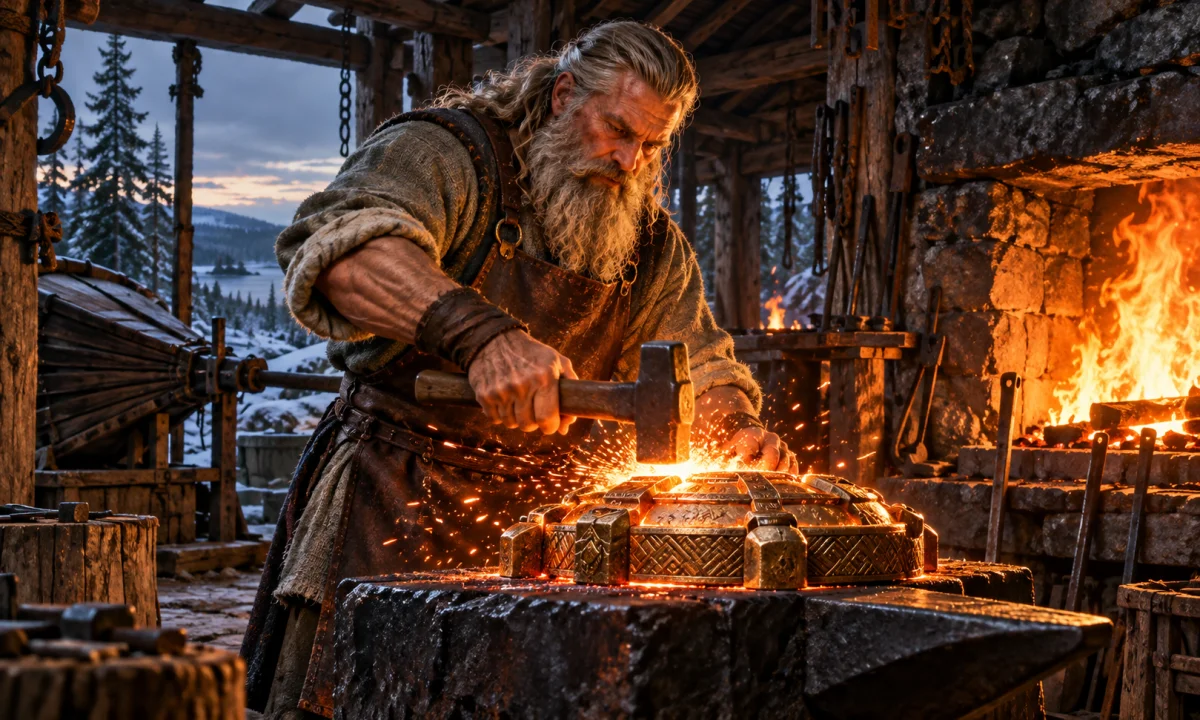
Once inside, Väinämöinen does not simply ask politely for instruction. He makes himself impossible to ignore. He creates an uncomfortable or painful disturbance within Vipunen, and some versions describe him as building a forge or using tools inside the giant’s body. The image is grotesque and comic as well as heroic: a master craftsman turns the interior of a dead giant into a workshop.
Vipunen eventually responds by singing. His songs contain the ancient knowledge that Väinämöinen needs. The giant’s response is not just a surrender to physical pain. Singing is the proper medium of his authority. He is awakened as an ancient singer, and the solution comes through the transmission of words rather than through a fight decided by weapons.
After receiving the necessary knowledge, Väinämöinen can continue his work. The episode presents the hero’s success as dependent on humility as well as cleverness. Even a powerful and knowledgeable singer such as Väinämöinen must seek instruction from a source older than himself.
The meaning of entering the giant
The journey into Vipunen’s body has several possible meanings, and no single interpretation explains every feature of the episode. On the simplest narrative level, it is an extraordinary adventure in which a hero confronts a supernatural giant. At a deeper level, it resembles a descent into the earth in search of hidden wisdom.
Väinämöinen’s entrance into the body can be compared with an initiation. He must pass through an unsettling and dangerous experience before he gains the knowledge needed to complete his task. The ordeal reverses ordinary expectations: the dead giant becomes a teacher, while the living hero becomes a supplicant inside the teacher’s body.
The forge imagery adds another layer. Fire, metalworking and craft transform raw material into something usable, just as the encounter transforms inaccessible knowledge into words Väinämöinen can employ. At the same time, the scene does not present knowledge as clean or effortless. Wisdom is reached through discomfort, confrontation and physical descent.
Vipunen may also be understood as a figure of embodied tradition. His knowledge is not stored in a written book. It is held in a body that has become part of the land. The trees growing from him suggest that the natural world itself preserves memory. This interpretation fits the importance of landscapes, ancestors, graves and spoken formulas in northern European folklore, although it should be treated as a scholarly and symbolic reading rather than as a statement of a single traditional doctrine.
Relationship with Väinämöinen
Vipunen and Väinämöinen are connected primarily as singers and possessors of magical knowledge. Väinämöinen is one of the principal culture heroes of the Kalevala, renowned for his music, wisdom and command of powerful words. Vipunen is older, more remote and more deeply associated with buried or primordial knowledge.
The encounter does not portray them as relatives, allies or permanent enemies. Their relationship is temporary and functional: Väinämöinen needs something only Vipunen can provide. The episode establishes a hierarchy of experience rather than a simple contest of strength. Väinämöinen may be the active hero of the story, but Vipunen is the deeper source of the knowledge that makes the hero’s work possible.
Both figures are connected with the power of song, but they represent different stages of tradition. Väinämöinen travels, acts and solves problems in the human world. Vipunen remains buried, preserving knowledge from an earlier age. The younger or more active singer must therefore penetrate the realm of the older one and receive what cannot be discovered by ordinary ingenuity.
Distinction from other Finnish mythological beings
Antero Vipunen should not be confused with Väinämöinen, even though both are wise singers. Väinämöinen is a central hero who appears throughout the Kalevala; Vipunen is a single ancient figure whose most important role is to provide him with secret words.
Vipunen is also not the same as Tuoni, the ruler of the dead, or Tuonela, the land associated with death. His corpse and underground setting may evoke the realm of the dead, but he is not its ruler. Nor should he be automatically identified with a generic Finnish earth god or forest god. Traditional Finnish mythology contains many beings connected with natural places, but Vipunen’s defining feature is his role as a buried source of ancient song.
Finally, Vipunen is not simply another name for a generic giant from Scandinavian mythology. Finnish and Karelian oral poetry has its own narrative structures, poetic language and cultural setting. Comparisons with giants and primordial beings from neighbouring traditions can be useful, but they do not erase the specific identity of the figure in the Kalevala.
Cultural significance and later reception
Antero Vipunen became widely known beyond regional oral tradition through the publication and cultural influence of the Kalevala. During the nineteenth century, the epic played an important role in the formation of Finnish literary and national identity. Vipunen’s episode contributed to the image of Finland as a land with a deep poetic heritage, ancient songs and a distinctive mythological past.
His story has attracted artists and writers because it combines unusual visual elements: a forest growing over a buried giant, a hero entering the giant’s body and a supernatural song emerging from death. Illustrations and retellings often emphasise Vipunen’s immense scale, turning him into a landscape-like figure with trees on his back or shoulders. Such depictions are creative responses to the epic rather than fixed descriptions shared by every oral version.
In modern Finland, Vipunen is generally encountered through literature, education, art, folklore studies and cultural references rather than through an active religious tradition. Contemporary retellings may simplify the episode into a tale of a giant who guards secret knowledge, but the traditional context is more complex. The story is concerned with the authority of inherited words, the danger of seeking forbidden or inaccessible knowledge and the dependence of even a great hero on an older source of wisdom.
For that reason, Antero Vipunen remains one of the most memorable figures associated with the Kalevala. He is neither a conventional monster nor an ordinary dead man. He is a buried singer whose body has become part of the earth and whose voice preserves the words needed to restore the work of a living culture hero.