WORLD
WORLD
Kyllikki
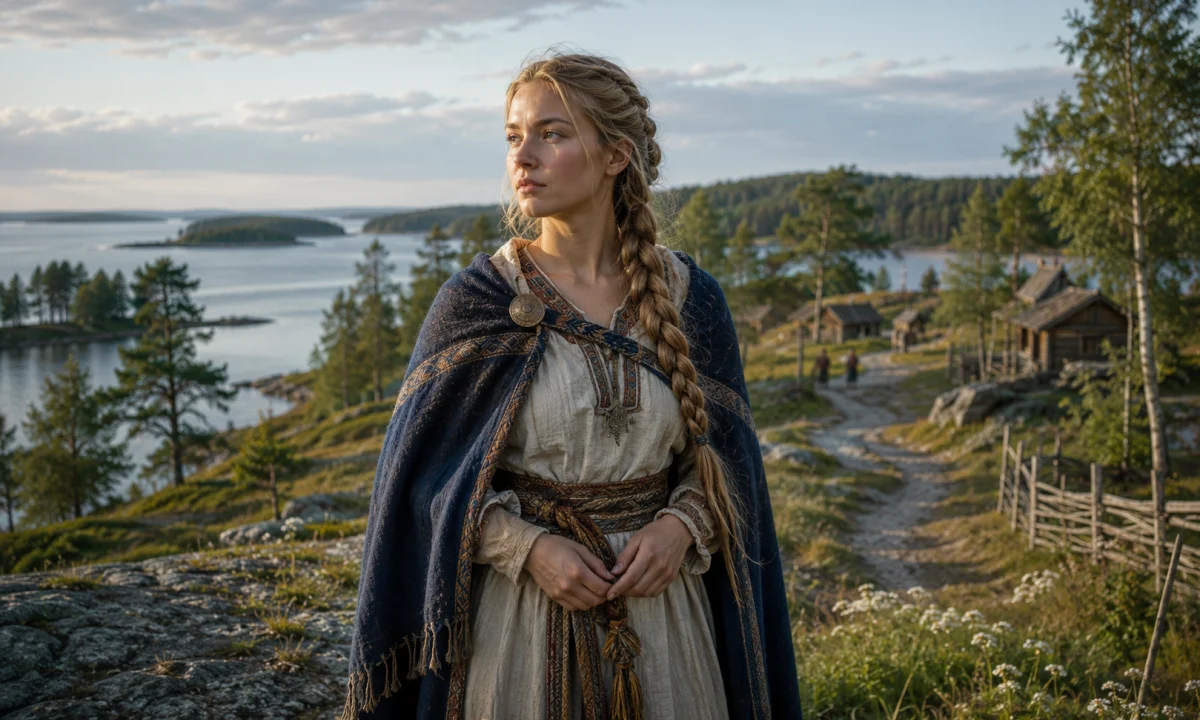
Kyllikki is a human heroine of the Finnish and Karelian oral-poetry tradition, best known as the wife of Lemminkäinen in the Kalevala. She is not a goddess, spirit or supernatural creature. Her story belongs to the cycle of songs about Lemminkäinen, a handsome but reckless hero whose adventures involve courtship, warfare, magic and repeated violations of social and sacred boundaries. Kyllikki’s importance lies especially in the tension between her independence and the demands placed upon her as a bride and wife.
Origins in Finnish and Karelian tradition
Kyllikki is known primarily through the Kalevala, the Finnish national epic compiled by Elias Lönnrot from oral poetry collected in Finland, Karelia and neighbouring regions. The epic was published in an earlier form in 1835 and in a substantially expanded form in 1849. It presents a continuous mythic narrative, but the poems from which it was made existed in many local versions and were not originally a single, fixed story.
The poems were performed in the traditional Finnish-Karelian metre often called Kalevala metre. Their subjects include creation, marriage, heroic expeditions, magic contests, death and the relations between human communities and the supernatural world. Because the oral tradition was fluid, details of characters and events could vary according to performer, region and historical period.
Kyllikki should therefore not be treated as the universally defined figure of a pre-Christian Finnish religion. There is no surviving ancient Finnish scripture that presents her biography, and the Kalevala itself is a nineteenth-century literary composition based on older material. Lönnrot arranged, combined and sometimes reshaped traditional poems in order to create a large national epic. The Kyllikki episode preserves important traditional motifs, but its exact literary form reflects both oral poetry and Lönnrot’s editorial work.
Name and identity
Kyllikki of Saari is the form most commonly associated with the character. In Finnish, saari means “island”, so the expression can be understood as identifying her with an island community or an island setting. Whether Saari should always be imagined as a specific geographical island is less certain. In the epic it functions as a distinctive place associated with young women, courtship and social life, while the underlying oral poems may have used the name in somewhat different ways.
The meaning and original history of the name Kyllikki are not entirely certain. It became established as a Finnish female given name through the popularity of the Kalevala, but its appearance in oral poetry predates its modern use as a personal name. Interpretations of its linguistic origin should be treated cautiously, since Finnish and Karelian poetic names may have been preserved, altered or reinterpreted over long periods.
Kyllikki is sometimes described loosely as a “mythological woman” or even as a goddess. That classification is misleading. In the traditional narrative she is a mortal maiden who becomes Lemminkäinen’s wife. She has no clearly defined divine ancestry, supernatural powers or independent cult. Her story is mythic and heroic in its setting, but her role is that of a human woman caught in the obligations and dangers of heroic society.
Kyllikki and the island of Saari
The episode involving Kyllikki appears in the part of the Kalevala commonly known as “Lemminkäinen’s Isle” or “Lemminkäinen on Saari”. Lemminkäinen travels to Saari after hearing of its beautiful women. He is a figure of extraordinary confidence, driven by desire for fame, adventure and sexual conquest. His reputation is not that of a patient or respectful suitor. He often treats courtship as another form of heroic challenge.
The women of Saari initially reject or mock him, and this response is significant. Lemminkäinen may be attractive and bold, but he is also an outsider. He does not automatically possess the social standing required to marry one of the island’s women. The narrative depicts a community in which women have their own social world and are able to judge, refuse or ridicule a would-be suitor.
Kyllikki is the woman who becomes associated most closely with Lemminkäinen’s visit. In many versions and retellings, he pursues her persistently and eventually takes her away, with the story containing elements of abduction or forced courtship. Other presentations place greater emphasis on her eventual consent or on the couple’s mutual agreement to marry. These differences matter: the narrative does not offer a single modern-style romance in which both people possess equal freedom from the beginning.
The traditional heroic framework often presents the taking of a bride as an act of masculine power. Modern readers may instead recognise coercion, unequal social power and the restriction of Kyllikki’s choices. Both perspectives should be distinguished. The story reflects older ideas about courtship and heroic authority, but recognising its traditional context does not require treating those actions as acceptable by modern ethical standards.
The marriage bargain
After Kyllikki becomes Lemminkäinen’s wife, the couple make a pact. Kyllikki promises that she will not go to the village dances, while Lemminkäinen promises that he will not go to war. The agreement places domestic loyalty and public adventure in opposition. Kyllikki is expected to remain within the household, while Lemminkäinen is expected to restrain the warlike impulses that define his heroic identity.
The pact is important because it gives Kyllikki a voice in the relationship. She is not merely a prize won by the hero; she makes a demand and receives a promise in return. At the same time, the bargain is restrictive for both parties. Her movement and social life are controlled, while Lemminkäinen’s identity as a warrior is constrained. The arrangement is less a stable marriage than an attempt to contain two incompatible forms of freedom.
In the best-known sequence, Kyllikki breaks her promise by going to a dance. Lemminkäinen responds by breaking his own vow and setting out for war, particularly toward Pohjola. The two violations are presented as linked, but they are not identical in character. Kyllikki’s action concerns social pleasure and participation in village life; Lemminkäinen’s leads him back into violent and dangerous heroic activity.
Some versions and retellings vary in the order, emphasis or motivation of these events. The oral background means that details cannot always be assigned to one original, authoritative form. The account in the Kalevala is the most influential version, but it is not the only possible expression of the tradition.
Relationship with Lemminkäinen
Kyllikki’s relationship with Lemminkäinen is marked by attraction, conflict, promises and mistrust. Lemminkäinen is commonly represented as impulsive, boastful and sexually aggressive. He seeks admiration and adventure, but he is poor at accepting limits. Kyllikki, by contrast, is connected with the social and domestic world that he repeatedly abandons.
This contrast does not make Kyllikki a simple symbol of passive domesticity. Her refusal of Lemminkäinen, her participation in the life of Saari and her breach of the marriage pact all show resistance to the role he wants her to occupy. She is also capable of making choices that have consequences. Yet the power balance between them remains unequal, especially because the relationship begins with Lemminkäinen’s pursuit and removal of her from her home.
The couple’s story can therefore be read as a warning about promises made without trust. Lemminkäinen wants a wife who will accept the restrictions of marriage, but he himself refuses the discipline required of a husband. Kyllikki agrees to a confined domestic role, but she cannot or will not surrender her ties to communal life. Their separation is not caused by a single villainous act alone; it grows from a relationship built on incompatible expectations.
Role in the Lemminkäinen cycle
Kyllikki’s episode precedes the more famous adventures in which Lemminkäinen travels toward Pohjola and faces dangerous tasks. In the wider cycle, his behaviour contributes to a pattern of reckless action followed by loss, pursuit and rescue. He repeatedly crosses boundaries, whether by insulting powerful figures, seeking impossible marriage connections or entering places governed by hostile forces.
Kyllikki’s presence helps establish the human cost of that restlessness. Before Lemminkäinen becomes the fugitive hero rescued by his mother, he has already damaged his marriage and abandoned the domestic world. The story shows that heroic fame does not necessarily produce honourable conduct. Lemminkäinen can win admiration through boldness while still failing in loyalty and self-control.
She should not be confused with Lemminkäinen’s mother, who plays a major role in later episodes. His mother searches for him and restores him after his destruction at the River of Tuonela, the realm of the dead. Kyllikki is associated with his marriage and separation; she is not the woman who performs that rescue. Nor is she Aino, another prominent young woman in the Kalevala whose tragic story involves Väinämöinen. These women belong to different narrative episodes and have different relationships with the male heroes around them.
Appearance and powers
The poetry presents Kyllikki chiefly through her youth, beauty and social identity as a maiden of Saari. Descriptions can vary in translation and in the underlying poetic material, but she is not given a catalogue of supernatural attributes. She does not transform herself, cast spells or rule a natural element. Her significance comes from her decisions and from the conflict between her wishes and Lemminkäinen’s demands.
Her connection with dancing is particularly meaningful. In the story, the village dance is not simply a private amusement. It represents community, courtship, public visibility and participation in ordinary social life. Lemminkäinen’s prohibition attempts to detach Kyllikki from that world and keep her within the household. Her return to the dance can thus be interpreted as an assertion of social belonging as well as a violation of a promise.
For Lemminkäinen, warfare represents the opposite movement: departure from the household into the dangerous public sphere of heroic action. The pact between them sets dancing and war in parallel, but the parallel also exposes a gendered imbalance. The wife’s freedom is treated as a threat to marital order, while the husband’s violence is treated as part of his heroic identity. This tension has made the story especially open to modern reinterpretation.
Interpretations of Kyllikki
Older readings often treat the episode as a moral lesson about fidelity. Kyllikki breaks her word, Lemminkäinen breaks his, and the marriage fails because neither honours the agreement. Such a reading reflects the importance of oath-taking in heroic and traditional narratives, where spoken promises can have social and sometimes supernatural force.
Other interpretations focus on the unequal terms of the pact. Kyllikki is expected to give up a public social life in exchange for Lemminkäinen’s temporary renunciation of war, even though warfare is central to his own self-image. From this perspective, her dance is not merely frivolous disobedience but a refusal to accept isolation. Lemminkäinen’s reaction reveals possessiveness and a readiness to punish her for seeking the freedom he claims for himself.
Folklorists and literary scholars also distinguish between the oral tradition and the finished epic. The Kalevala organises the material into a national narrative with recurring characters and a broad dramatic structure. Kyllikki’s literary identity is therefore partly the result of Lönnrot’s arrangement. It is difficult to know how consistently every feature of her character appeared in the oral poems before they were collected and edited.
For Finnish cultural history, Kyllikki is significant because she belongs to the same body of poetic material that helped shape modern ideas of Finnish national literature. Her story preserves images of courtship, marriage, communal dancing and heroic masculinity, while also showing how an epic assembled from oral traditions can become a modern cultural symbol.
Later reception
Since the nineteenth century, Kyllikki has appeared in Finnish literary, artistic, theatrical and musical responses to the Kalevala. Adaptations often simplify the episode into a tragic romance between the adventurous Lemminkäinen and the faithful or rebellious Kyllikki. Some emphasise her beauty and victimhood; others give greater weight to her independence and to the coercive aspects of the courtship.
Modern retellings may also treat Kyllikki as a symbol of a woman resisting the narrow domestic role assigned to her. Such interpretations are later readings rather than claims about a single original meaning. The traditional poems do not provide a modern feminist manifesto, but their conflicts allow contemporary artists and readers to question the assumptions of heroic marriage and masculine authority.
The name Kyllikki has also survived as a Finnish given name, helped by the continuing cultural importance of the Kalevala. A person named Kyllikki in modern Finland is not necessarily invoking the epic character, just as the use of a mythic name does not establish religious belief. The literary heroine remains culturally recognisable, but she belongs to Finnish epic tradition as a mortal woman whose story is preserved through oral poetry and its later literary adaptation.