WORLD
WORLD
Sampo

Sampo is a mysterious and much-discussed object in Finnish mythology, best known from the national epic Kalevala. In traditional Finnish oral poetry and later literary retellings, the Sampo is a wonder-working source of prosperity, but its exact nature is not fixed. Different songs and interpretations describe it in different ways: as a mill, a talisman, a cosmic pillar, or a symbol of abundance itself. Because the surviving tradition is poetic and fragmentary, the Sampo is best understood not as a single clearly defined artifact, but as a powerful mythic emblem whose meaning changed across oral and literary transmission.
The Sampo belongs to the mythological world of Finland and the wider Finnic oral tradition of the eastern Baltic region. Its most famous appearance is in Elias Lönnrot’s 19th-century compilation Kalevala, which drew on older rune songs collected from Finnish and Karelian singers. In that tradition, the Sampo is linked above all with wealth, fertility, and the well-being of a community. It is often associated with the smith Ilmarinen, the wise elder Väinämöinen, the northern mistress Louhi, and the heroic struggle over who controls prosperity.
Sources and cultural setting
Knowledge of the Sampo comes primarily from oral poetry recorded in the 18th and 19th centuries and from the Kalevala, first published in 1835 and expanded in 1849. The surviving songs do not always agree with one another. Some describe events surrounding the forging or obtaining of the Sampo; others mention it only briefly or in passing. Because of this, modern readers encounter a mythic object whose meaning is partly reconstructed by scholars and partly shaped by Lönnrot’s editorial decisions.
In the older oral material, the Sampo is not a universally standardized holy relic with a single official description. It is better understood as a poetic image that may have drawn on several older motifs at once: the wonder-mill that produces grain, salt, and money; the world-supporting pillar or axis; and the idea of a source of endless good fortune. The Kalevala brought these possibilities together into one powerful symbol, making the Sampo central to Finnish national mythology.
Name, meaning and classification
The word Sampo has no single universally accepted explanation. Its linguistic origin is uncertain, and scholars have proposed different interpretations over time. Some have connected it with words for a smith’s anvil or a piece of metalwork; others have suggested broader relationships to ideas of support, prosperity, or sacred craftsmanship. No derivation is agreed upon with certainty.
Classifying the Sampo is also difficult. It is not a deity, spirit, or hero in the usual sense. It is an object, but one with extraordinary functions and symbolic weight. In mythic terms it sits somewhere between a treasure, a magical device, and a cosmological symbol. The ambiguity is important: the tradition does not require the Sampo to be one fixed kind of thing.
Appearance and nature
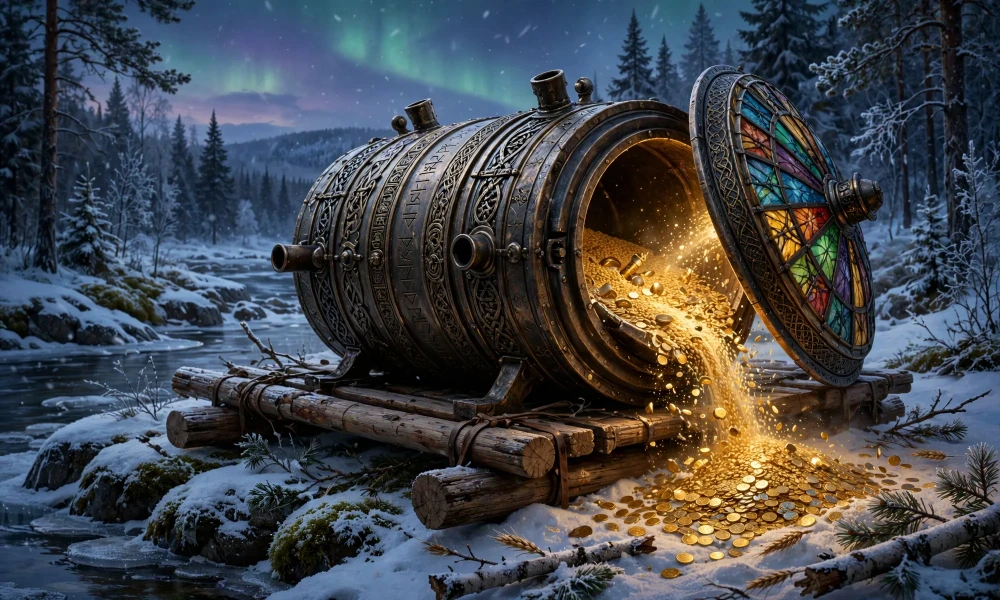
The Kalevala does not give a stable visual description of the Sampo that resolves all uncertainty. It is often understood as a beautifully made object with a top or lid that turns, producing riches. In some retellings it is imagined as a mill, because of the famous image of its grinding or turning action. In other interpretations it resembles a decorated chest, a loom, a pillar, or even a set of magical mechanisms combined into one artifact.
One reason for the uncertainty is that the word and the idea are embedded in metaphorical poetry. The older songs use formulaic language, and later translators and interpreters sometimes rendered these images in ways that made the Sampo seem more concrete than it may have been in oral performance. As a result, the Sampo should not be reduced to a literal machine in the modern sense, even though the “mill” interpretation has become common.
Its essential quality is not appearance but function: the Sampo is a source of abundance. It is tied to material prosperity, but also more broadly to the flourishing of life. In the mythic imagination, it stands for the power to make grain, wealth, and perhaps even social order continually renew themselves.
Role in the mythic cycle
The best-known Sampo narrative centers on its creation by the smith Ilmarinen. In the Kalevala, the northern mistress Louhi, ruler of Pohjola, asks for the Sampo in exchange for her daughter’s hand. Ilmarinen undertakes the task and forges the marvelous object with great skill. The Sampo is then placed under Louhi’s control in Pohjola, where it becomes the source of that land’s prosperity.
After the forging, the stories move toward conflict over ownership. Väinämöinen, Ilmarinen, and Lemminkäinen later travel to Pohjola to take back the Sampo. The episode is one of the epic’s great adventures: the heroes steal the object, but Louhi pursues them, and in the struggle the Sampo is lost at sea and broken. Only fragments remain, falling into the water or reaching the shore. In some interpretations, these fragments explain the ongoing fertility and blessings of the world, though this is a poetic rather than literal explanation.
These episodes highlight a recurring mythic pattern: a community’s prosperity is concentrated in a single sacred object, then contested, moved, and finally dispersed. The loss of the Sampo does not simply represent defeat. It also suggests that abundance cannot be fully owned by one person or one land. The myth turns wealth into something unstable, shared, and subject to fate.
Symbolism and meaning
The Sampo has been interpreted in many ways, and no single interpretation is universally accepted. Some scholars emphasize its economic meaning: it may represent the dream of inexhaustible production in a subsistence culture, where harvests, salt, and trade goods were vital. In that reading, the Sampo embodies the desire for security against scarcity.
Others focus on cosmological symbolism. The Sampo has sometimes been compared with the axis mundi, the world pillar found in many mythological systems, because it appears to connect productivity, order, and the structure of the world. This interpretation is not explicitly stated in the sources and should be treated as scholarly interpretation rather than traditional doctrine. Still others understand the Sampo as a ritual or poetic image of craftsmanship, showing the magical authority of the smith.
It is also possible to see the Sampo as a social symbol. In the Kalevala, control of the Sampo is closely connected to power, status, and collective welfare. The struggle over it reflects tensions between different regions and social groups, especially the heroic community of Kalevala and the northern domain of Pohjola. The object is therefore not just a treasure but a narrative focus for questions of ownership, labor, exchange, and dependency.
Louhi, Ilmarinen and the forged wonder
Three figures are especially important in the Sampo cycle. Ilmarinen, the divine smith, is the artisan who makes the object. His role emphasizes skill, endurance, and creative power. In mythic terms, he is the one capable of transforming raw material into something that can sustain a whole people.
Louhi, the mistress of Pohjola, is the one who secures the Sampo and guards it. She is often portrayed in the Kalevala as formidable, ambivalent, and politically powerful. She is not simply a villain in any straightforward sense; rather, she is a northern counterpart to the heroes, controlling resources and demanding compensation. Her possession of the Sampo marks Pohjola as a place of great power and danger.
Väinämöinen, the wise singer and culture hero, helps lead the later attempt to seize the Sampo. His involvement connects the object not only to smithcraft but also to song, strategy, and communal action. The Sampo cycle therefore brings together several fundamental mythic roles: maker, guardian, and seeker.
Variants in tradition
The idea of the Sampo varies significantly across sources. In some rune songs, the Sampo is mentioned as though its audience already knows what it is, which suggests that the mythic object may have had a broader life in oral tradition than the surviving texts can fully reveal. In other versions, the emphasis falls not on the object itself but on the act of taking it, breaking it, or using its fragments.
Because of this variation, it is not safe to claim that all older Finnish singers understood the Sampo in exactly the same way. The object may have been familiar as a traditional motif without being rigidly defined. Scholars have therefore treated it as a case where oral tradition preserved an important symbol whose precise original meaning cannot now be recovered with certainty.
Some later interpreters have tried to identify the Sampo with concrete historical objects such as early mills, altars, treasure chests, or ritual poles. These identifications remain speculative. They can be interesting as theories, but they should not be presented as established fact. The strongest evidence indicates only that the Sampo belonged to a poetic world where magical production and cosmic blessing were imagined through material form.
Relationship to fertility and prosperity
The most consistent feature of the Sampo is its connection to abundance. It is frequently understood as producing grain, wealth, and other necessities, though the exact list varies by retelling and interpretation. In a premodern agricultural culture, such an image would have carried obvious emotional force. A source of perpetual production would mean relief from hunger, conflict, and uncertainty.
That association also helps explain why the Sampo is so often treated as something worth fighting over. In a world where subsistence depended on weather, labor, and luck, the fantasy of a self-generating source of plenty would be deeply compelling. The myth turns that longing into a narrative of craftsmanship, rivalry, and loss.
At the same time, the Sampo is not simply a magical guarantee of wealth. The myth implies that prosperity must be made, protected, and negotiated. The forging of the Sampo is a laborious act; its possession triggers conflict; its destruction does not eliminate the need for work or community. Its power is real within the story, but it is never easy or secure.
Distinction from similar or confused figures
The Sampo is sometimes confused with other mythic objects because the word is unusual and its form is unclear. It should not be treated as a deity, a spirit, or a named person. It is also distinct from ordinary magical tools in folk tales, even when it resembles them. Its importance comes from its role in a large epic cycle and from its symbolic association with collective prosperity.
It is also important not to merge the Sampo with unrelated items from other mythologies simply because they are wonder-working artifacts. Similarities with world pillars, mills of abundance, or sacred treasures in other traditions may be suggestive for comparison, but they do not prove identity or direct borrowing. The Sampo belongs specifically to the Finnish and Karelian mythic and poetic environment.
Interpretation in Finnish cultural history
The Sampo became especially significant in the 19th century, when Finnish intellectuals and artists sought to define national identity through folklore and epic poetry. In that setting, the object came to symbolize not only mythic abundance but also the cultural richness of the Finnish tradition itself. The Kalevala helped elevate it from a regional oral motif into a national emblem.
For some readers, the Sampo came to represent creativity, sovereignty, and the struggle to retain cultural inheritance. For others, it symbolized the power of the Finnish language and poetic heritage. These later meanings are historical developments of the modern period, not necessarily reflections of the oldest oral layers, but they are an important part of the Sampo’s reception.
Modern popular culture
Modern literature, visual art, games, and speculative fiction sometimes borrow the Sampo as a symbol of hidden power or inexhaustible wealth. These uses are often inspired by the Kalevala rather than by earlier oral variants, and they may simplify the object into a clearly defined magical machine. That is a creative adaptation rather than a faithful preservation of the older tradition.
Such modern retellings are most useful when they are clearly separated from the traditional material. They show how durable the Sampo has been as an image of abundance and mystery, but they do not settle its original meaning. In contemporary culture, the name often signals ancient Finnish myth in a broad sense, even when the details are newly imagined.
Why the Sampo remains compelling
The continuing fascination of the Sampo lies in its ambiguity. It is at once a treasure, a machine, a symbol, and a story about the fragility of prosperity. Traditional sources do not define it neatly, and that openness has allowed generations of readers, singers, artists, and scholars to project different meanings onto it.
In Finnish mythology, the Sampo stands at the intersection of craft and wonder, abundance and conflict, local tradition and national identity. Its importance is not that it can be translated into a single modern category, but that it preserves a distinctly mythic way of thinking about the sources of life’s goods and the price of controlling them.