WORLD
WORLD
Ilma
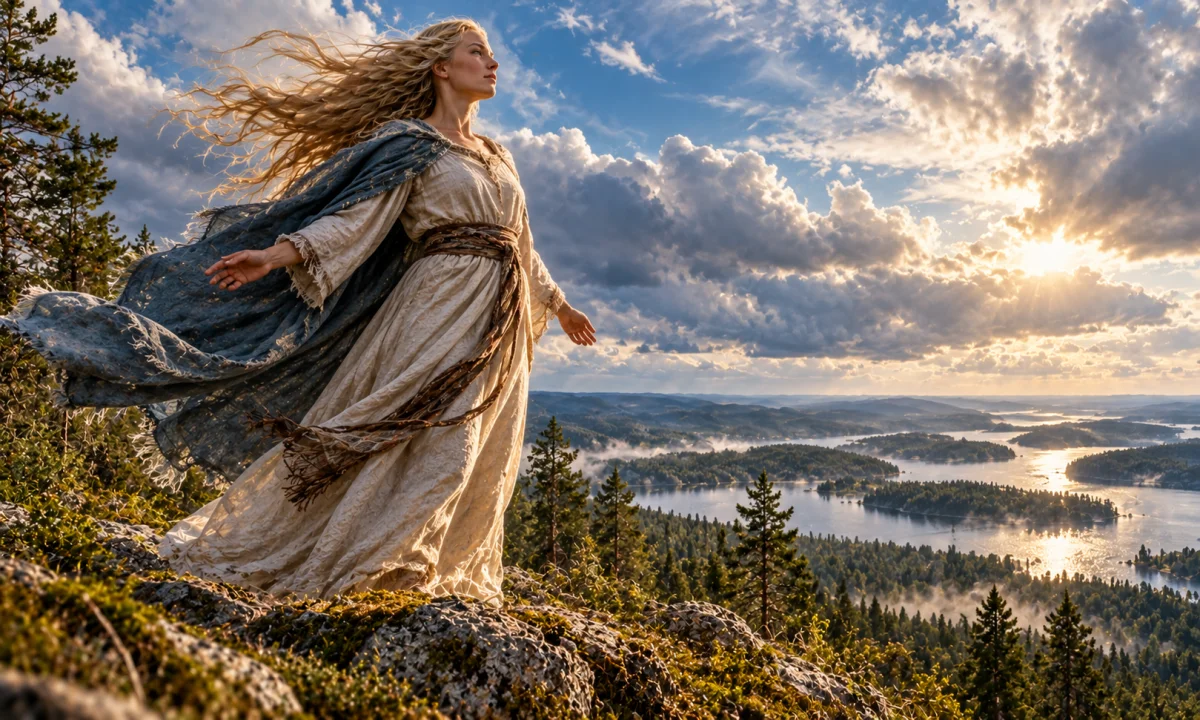
Ilma is a name associated with air, atmosphere and weather in Finnish mythology, but its status as a distinct traditional deity is uncertain. In Finnish, ilma means “air” and can also refer to the weather or the visible atmosphere. Some modern summaries of Finnish mythology treat Ilma as a personification or god of the air. However, the surviving Finnish mythic material does not provide a well-defined, universally recognised figure named Ilma with a stable biography, cult or body of stories. The name is more securely connected with related figures such as Ilmatar, the spirit of the air in the Kalevala, and Ilmarinen, the divine smith and culture hero.
The meaning of Ilma
The Finnish word ilma has a broad range of meanings. It may signify air, open space, the sky’s atmosphere or weather conditions. In traditional agrarian society, such meanings were closely connected: wind, clouds, rain, frost and clear skies affected travel, fishing, hunting and the success of crops. Air and weather were therefore not abstract ideas but powerful parts of everyday life.
When the word is used as a mythological name, it can be understood as a personification of this atmospheric realm. Yet a personification is not necessarily the same thing as a clearly attested god. Finnish oral poetry often uses natural forces, places and elements in poetic or symbolic ways without assigning them one fixed personality. A word meaning “air” may appear in a mythic expression without referring to a separate divine individual.
This distinction is important because many descriptions of Finnish mythology were assembled from different kinds of evidence. Oral poems, local folklore, nineteenth-century collections and later comparative interpretations do not always preserve the same names or classifications. A short entry in a modern list of deities may give Ilma a more definite identity than the traditional evidence allows.
Finnish mythological background
Pre-Christian Finnish religion was not recorded in a single sacred book. Its traditions survived mainly through oral poetry, charms, ritual formulas, legends and local customs. These materials were collected especially from the eighteenth and nineteenth centuries onward, when singers in Finland and Karelia still preserved long bodies of traditional verse.
The best-known literary presentation of this material is the Kalevala, compiled by Elias Lönnrot and published in expanded form in 1849. The Kalevala is an important source for Finnish mythic themes, but it is not a direct transcript of an ancient Finnish religion. Lönnrot arranged, edited and combined poems from different regions and performers. Characters who may have had separate local traditions were placed within a connected epic narrative, and some relationships were shaped by the demands of that composition.
Earlier evidence also exists, including lists of Finnish pagan beings recorded during the Reformation period. These records were written by Christian observers and often presented traditional figures in a polemical or simplified framework. They are valuable, but they do not provide a complete map of Finnish religious belief. The absence of a name from such a record does not prove that no local tradition used it, while the presence of a name does not necessarily establish a standard national deity.
Ilma and the spirit of air
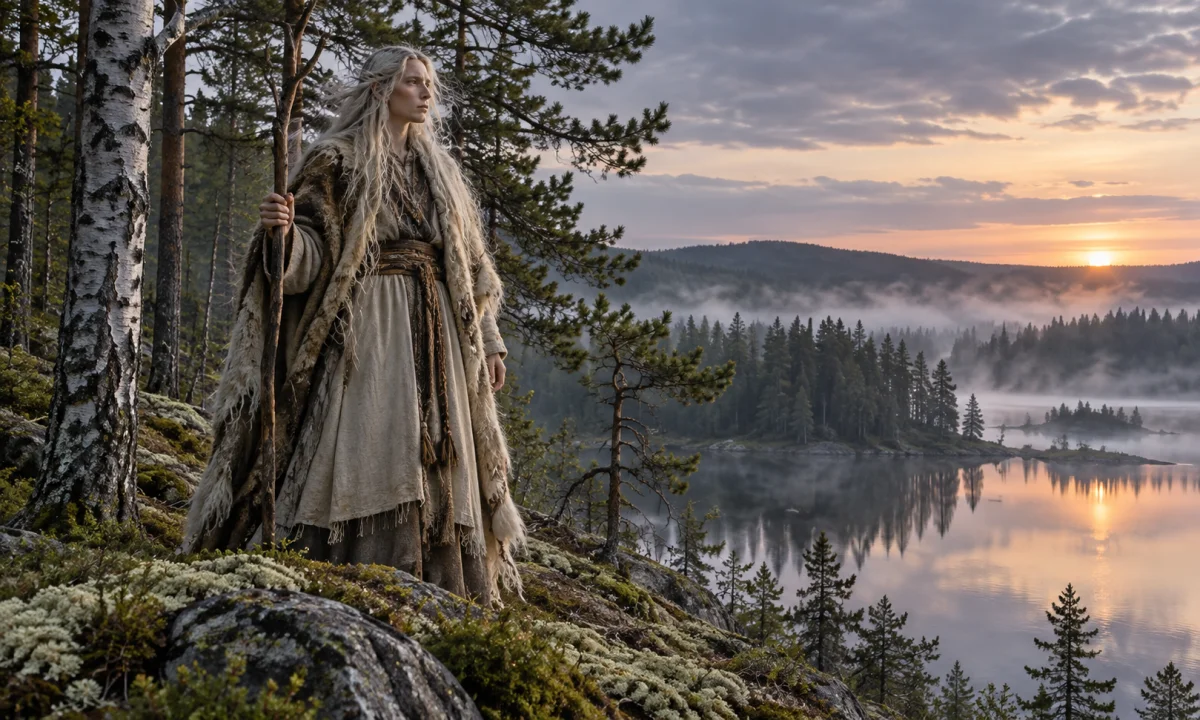
The figure most closely associated with the air in the Kalevala is Ilmatar. Her name is formed from ilma, “air,” together with the feminine suffix -tar, and is commonly understood as “daughter of the air” or “female spirit of the air.” In the opening rune of the Kalevala, Ilmatar is described as living in the wide spaces of the air and becoming involved in the beginnings of the world.
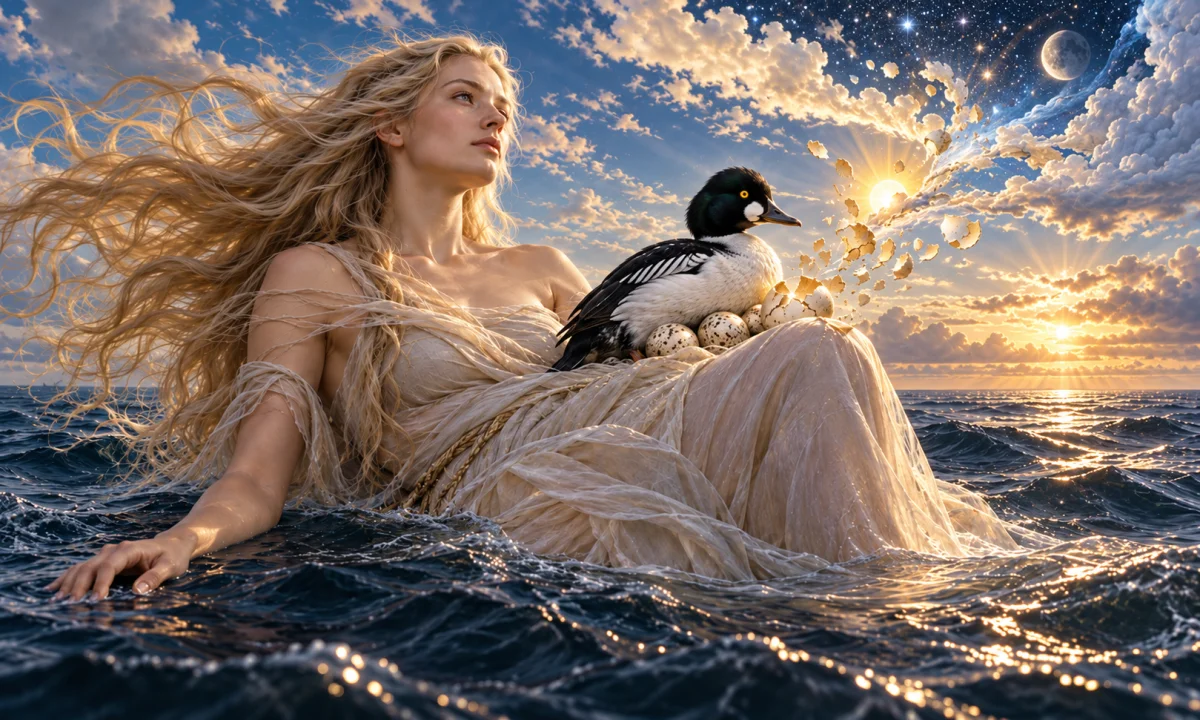
According to the epic account, Ilmatar descends into the primeval waters. A wild duck lays eggs upon her knee, and when the eggs fall and break, their fragments become parts of the cosmos: the sky, the earth, the sun, the moon and the stars. The imagery presents Ilmatar as a figure connected with creation, but the story does not necessarily describe her as the sole creator in the sense used by many theological systems. It is a poetic account of cosmic formation in which water, bird, egg and air participate.
Ilmatar later becomes the mother of Väinämöinen, one of the principal heroes of the Kalevala. The epic therefore links the atmospheric realm with the birth of its most ancient singer and culture hero. Some popular accounts call Ilmatar a goddess of air, while others describe her more cautiously as a spirit or maiden. The variation reflects both the flexibility of Finnish mythological categories and the fact that the Kalevala is a literary compilation rather than a systematic theology.
Ilma and Ilmatar should not automatically be treated as the same figure. Ilmatar is a named female being with a prominent role in the Kalevala. Ilma, by contrast, is sometimes used as a personified name for air or as a reconstructed or simplified deity in later descriptions. The similarity of the names shows a linguistic relationship, but it does not by itself establish that they were originally identical.
Relationship with Ilmarinen
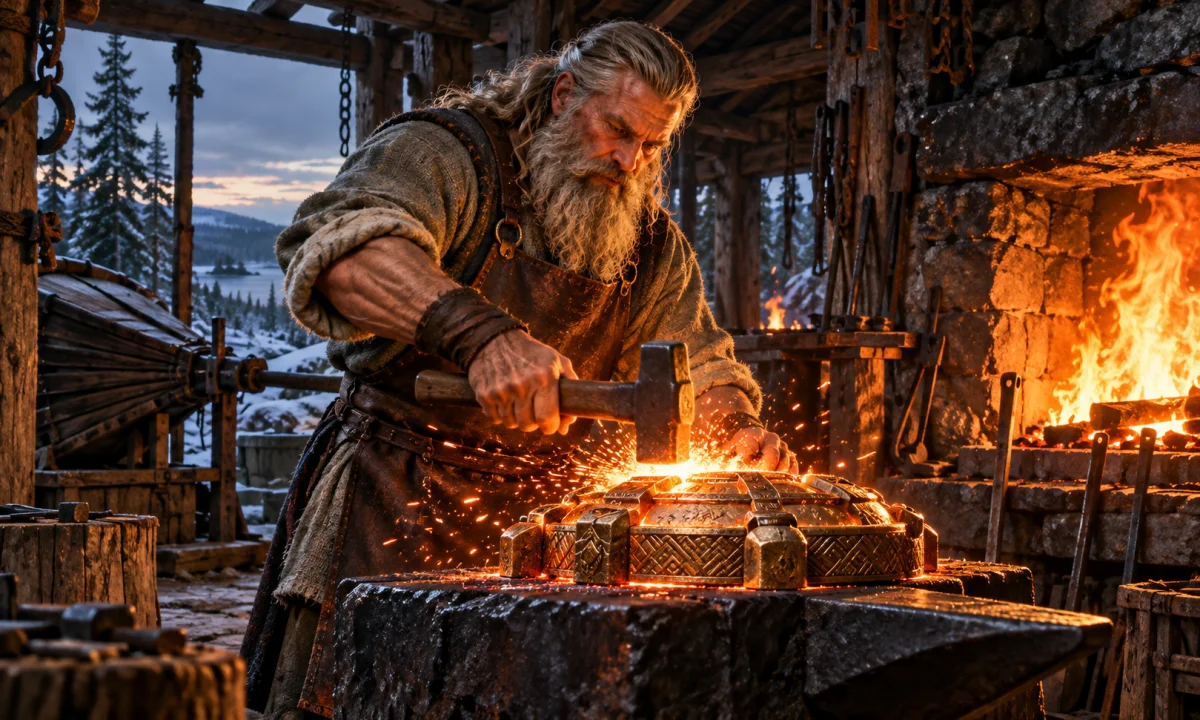
Ilmarinen is another figure whose name is closely connected with ilma. He is the immortal smith of Finnish epic tradition, famous for forging the Sampo, a mysterious object associated with prosperity and abundance. He also fashions the vault of the sky in some accounts and is linked with extraordinary acts of craftsmanship.
The name Ilmarinen has often been interpreted as an “air-being” or as a name connected with the atmospheric realm, although its precise historical development and original meaning are matters for linguistic and folkloric discussion. In the Kalevala, Ilmarinen is not simply a god of air. His most prominent identity is that of a master smith, maker and technical wonder-worker. His association with the sky may preserve older ideas about a supernatural craftsman shaping the structure of the world, but the epic does not present him as a character subordinate to a deity named Ilma.
Ilmarinen’s importance has led some later writers to connect all names beginning with ilm- as though they belonged to one clearly organised divine family. That approach is too certain. Shared roots, similar poetic themes and overlapping functions can indicate historical relationships, but they do not prove a fixed pantheon or a precise genealogy.
Air, weather and the Finnish divine world
Weather powers occupy a more securely documented place in Finnish traditional belief than Ilma as an individual. Ukko is widely known as a powerful sky and weather being, especially associated with thunder, rain and agricultural fertility. In charms and ritual language, Ukko could be invoked in matters involving storms, crops and the control of natural forces.
Descriptions of Ukko vary by source and region. He is often compared with the thunder gods of neighbouring Indo-European traditions, but such comparisons can obscure specifically Finnish patterns. Finnish religion developed within a northern cultural environment shaped by Finno-Ugric traditions, contact with Sámi and Baltic peoples, Scandinavian influence and later Christianisation. Similar functions do not always indicate identical origins.
In this setting, “air” was part of a larger network of natural powers. The sky, winds, clouds, thunder, rain and seasonal changes could be addressed through charms or represented through mythic language. A person might seek favourable weather for farming, safe conditions for travel or protection from destructive storms. These practices were often local and practical rather than centred on a single national temple or uniform priesthood.
Attributes and symbolism
Because Ilma is not securely established as a character with a consistent traditional mythology, descriptions of a definite appearance or set of powers should be treated cautiously. There is no widely preserved Finnish cycle that gives Ilma a standard human form, family, weapon or dwelling.
When Ilma is interpreted symbolically as the air, several themes may be associated with the name:
- Breath and life: Air is necessary for breathing and can be understood as a boundary between life and death.
- Movement: Wind makes the invisible perceptible, carrying sound, scent, seeds and weather across the landscape.
- Change: Weather shifts rapidly, making the atmosphere a natural symbol of uncertainty and transformation.
- Connection between realms: The open air lies between the earth and the heavens, a position reflected in the role of Ilmatar as a being of the air who becomes connected with the creation of the world.
- Fertility and survival: Rain and seasonal weather were essential to crops, pasture and the availability of game.
These are interpretive associations rather than a list of powers attributed to a securely documented deity named Ilma. They arise from the meaning of the word and from wider Finnish ideas about the atmosphere and sky.
Stories and the problem of attribution
The creation episode involving the duck’s eggs is sometimes described in simplified retellings as the myth of Ilma. In the traditional and literary material most commonly discussed, however, the central figure is Ilmatar, not an otherwise undefined deity called Ilma. Likewise, stories about weather, thunder or the sky are more often connected with Ukko or with other beings than with Ilma by name.
This makes attribution particularly important. A story may contain air as a cosmic element without personifying it. It may mention Ilmatar without referring to Ilma. It may feature Ilmarinen in a celestial or creative role without making him the child, companion or servant of an air god. These figures belong to related linguistic and mythological fields, but they should not be merged simply because their names resemble one another.
Finnish mythological terminology also changed through the work of collectors, translators and interpreters. A collector might preserve a local name, while a later editor might standardise it or fit it into a broader mythological system. Modern reference works sometimes assign each natural element its own deity, following the categories of classical mythology or nineteenth-century comparative religion. Such categories can be useful for orientation, but they may not reflect how Finnish-speaking communities themselves organised their traditions.
Ilma and neighbouring traditions
The Finnish word ilma has parallels in other languages of the wider Uralic world, where related words can carry meanings connected with air, weather or the sky. Similar linguistic forms have encouraged scholars to investigate ancient concepts of the upper world and atmospheric power. These comparisons may illuminate old patterns of vocabulary, but they do not establish that every related word once referred to one shared deity.
Finnish tradition also developed through long contact with neighbouring cultures. Scandinavian, Baltic, Slavic and Sámi influences affected vocabulary, ritual practice and storytelling. Thunder gods, sky powers and weather charms may show convergent features because farming and travel make weather important in every northern society. Claims that Ilma is a direct equivalent of a particular foreign god therefore require evidence and should not be assumed from function alone.
Modern interpretation
In modern books, websites and popular discussions of mythology, Ilma may be presented as a Finnish god or goddess of air, sometimes with a neatly defined domain covering wind, weather and the sky. This usage reflects the natural meaning of the name and the influence of mythological classification systems. It can also result from separating the element ilma from the more extensively attested figures Ilmatar, Ilmarinen and Ukko.
Such presentations are not necessarily meaningless, but they should be labelled as modern interpretation when they go beyond the surviving traditional evidence. There is no broadly recognised modern popular-culture character named Ilma comparable to the major figures of the Kalevala, and the name has not acquired one universally accepted fictional identity. Its significance remains primarily linguistic, folkloric and interpretive.
The most accurate description is therefore a cautious one: Ilma is a Finnish term associated with air and weather that is sometimes personified or listed as a mythological being, but evidence for a distinct, independently developed deity named Ilma is limited. The strongest traditional context comes from the related figure Ilmatar, the air spirit and mother of Väinämöinen, from Ilmarinen’s atmospheric associations and from the broader Finnish concern with sky and weather powers such as Ukko.