WORLD
WORLD
Karwan
Karwan is a name associated in some English-language accounts with Hopi mythology, where it is sometimes described as a warlike spirit or a figure connected with warfare. The identification is not secure, however. Karwan is not as extensively documented in accessible ethnographic literature as better-known Hopi figures such as Masau’u, Spider Woman, or the Katsinam generally. The spelling, classification, and attributes attached to the name vary, and some summaries may preserve an imperfect transcription or a late interpretation rather than a complete traditional account.
Hopi religious and cultural setting
The Hopi are an Indigenous people of the American Southwest whose communities are located principally in northeastern Arizona. Hopi religious life is closely connected with the mesas, farming, seasonal change, rainfall, fertility, ancestry, and the maintenance of right relationships among human beings, animals, spiritual powers, and the land. Religious knowledge is transmitted through ceremonies, oral teaching, clan traditions, and participation in community life rather than through a single canonical scripture.
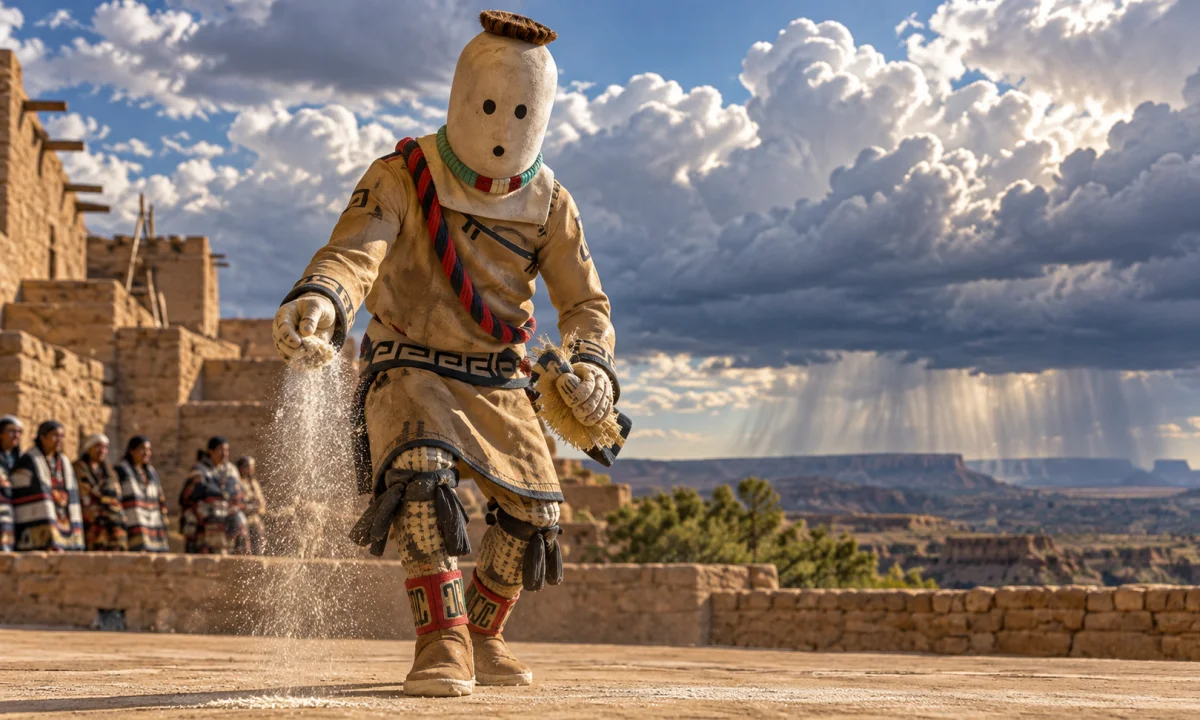
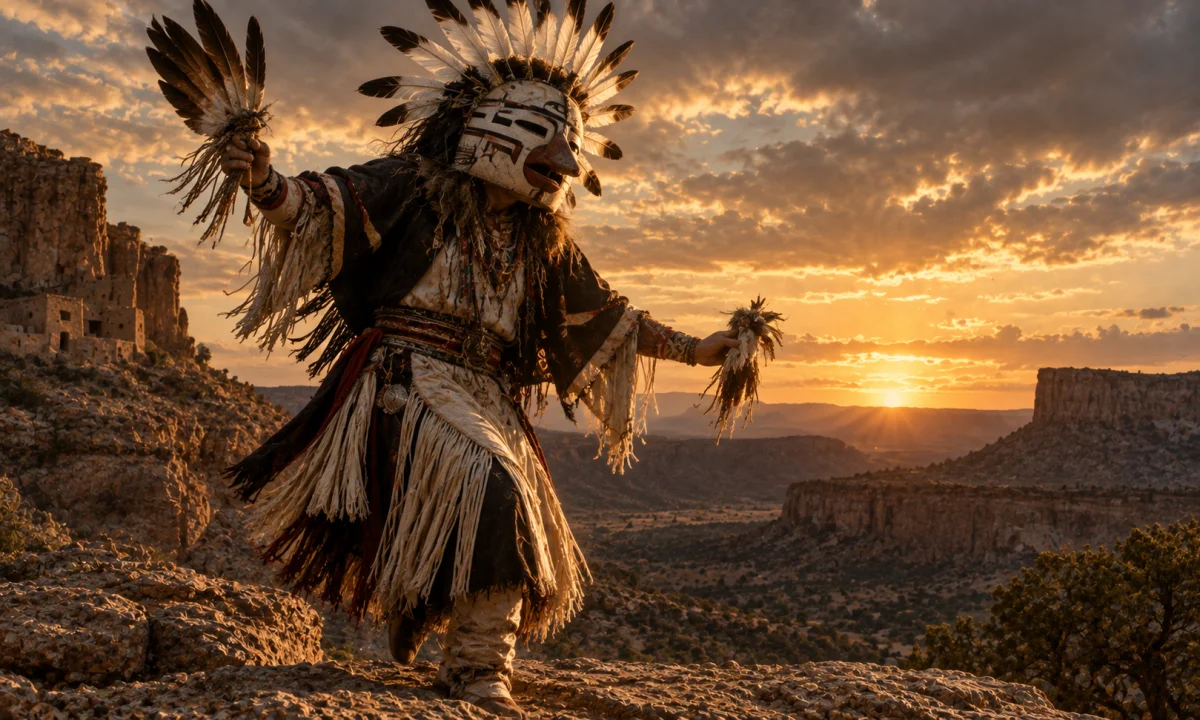
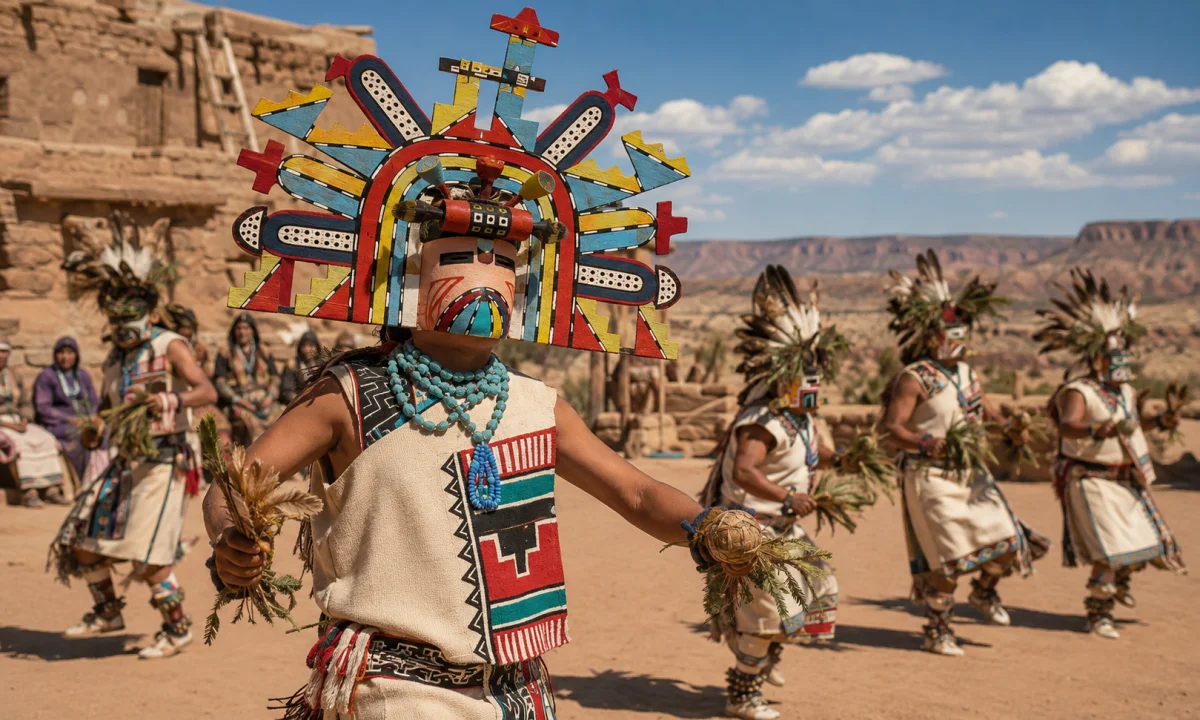
A useful context for understanding names such as Karwan is the Hopi concept of the katsina, often written kachina in English. The Hopi plural is commonly rendered as Katsinam. Katsinam are spiritual beings associated with the natural world, the ancestors, particular places, weather, animals, social responsibilities, and ceremonial relationships. They are not simply fictional characters or decorative figures. In ceremonial settings, initiated men may wear masks and regalia representing Katsinam, but the dancer is not merely acting out a theatrical role. The masked presence participates in a religious event through which the community renews its relationship with the spiritual world.
Because Hopi ceremonies have different levels of public and restricted knowledge, the absence of a detailed public description does not prove that a named being was unimportant. It may reflect the limited way in which religious information has been recorded or shared outside Hopi communities. Conversely, a name appearing in a modern list does not by itself establish that it was a major pan-Hopi deity or that all Hopi communities understood it in the same way.
The name and its uncertain classification
In general reference material, Karwan is sometimes labelled a Hopi god of war or a war spirit. That description should be treated cautiously. It is not clear from the surviving, widely accessible evidence whether Karwan was traditionally understood as a distinct deity, a Katsina, a ceremonial character, a local figure, or a name that has been simplified by non-Hopi writers.
Hopi words and names have been represented in English through several different spelling systems. Older writers often recorded Indigenous terms according to their own hearing and orthographic habits, while modern linguistic transcription may mark sounds that ordinary English spelling does not show. As a result, a name printed as Karwan may not always be identical to a name written differently elsewhere. Without a securely documented Hopi form and a clear cultural context, it is unsafe to infer a precise meaning from the English spelling alone.
The label “god” can also be misleading. European-language writers have often arranged Indigenous spiritual beings into categories such as gods, demons, heroes, nature spirits, and monsters. Hopi religious categories do not necessarily correspond to those divisions. A being associated with conflict might have a ceremonial, ancestral, protective, social, or cosmological significance that is lost when it is reduced to “the god of war.”
Possible association with warfare
The warlike description attached to Karwan probably reflects an attempt to identify the figure by a principal function. If the name does refer to a traditional Hopi spiritual being, the association may have involved protection, courage, martial skill, victory, or the dangers created by violence. It does not follow that Karwan was a universal war deity in the same sense as the gods of warfare found in some ancient Mediterranean or Near Eastern religions.
Hopi religious thought generally places communal balance, agricultural renewal, ceremonial obligation, and proper conduct at the centre of social life. Warfare would have been one concern among many rather than the defining subject of the entire religious system. A war-associated figure could therefore have been invoked or represented in a particular context without occupying a position comparable to a supreme creator or a central cosmic power.
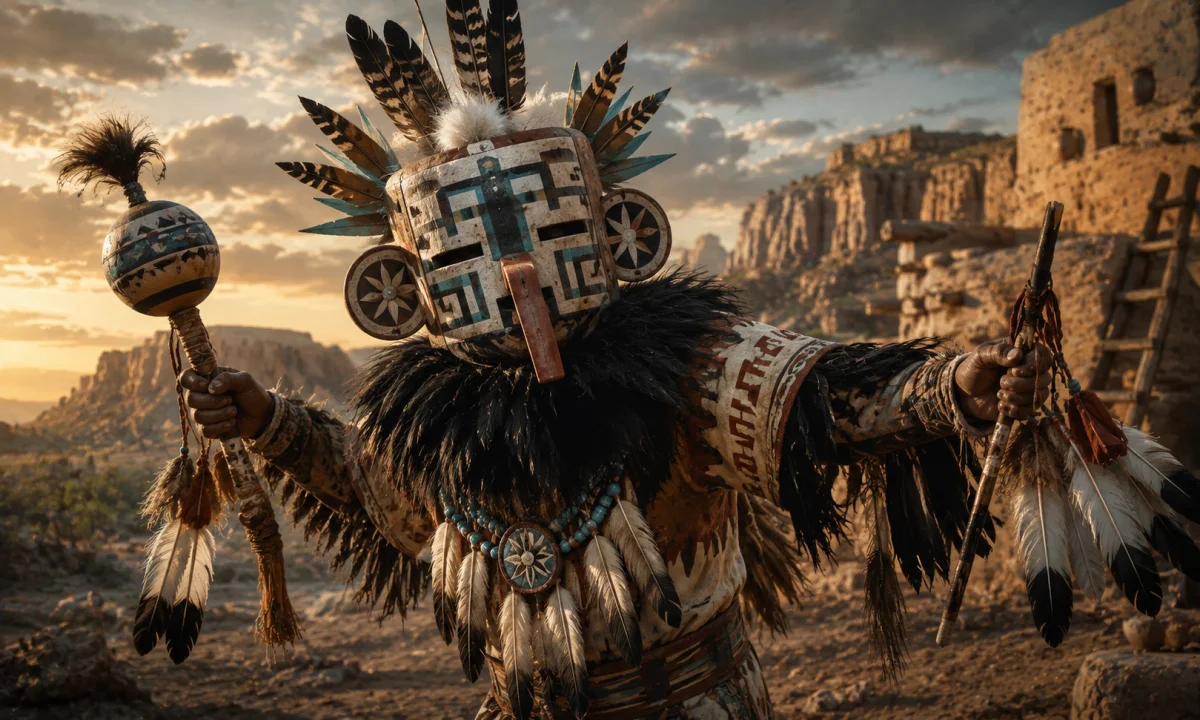
There is no reliable basis for assigning Karwan a fixed appearance, weapon, animal companion, genealogy, or set of exploits. Illustrations and online summaries sometimes give poorly documented figures elaborate costumes or powers, but those details should not automatically be regarded as traditional Hopi teachings. In the case of Karwan, claims about a specific mask, colour scheme, weapon, dwelling place, or ceremonial dance require evidence that is not consistently available in public descriptions.
Relation to the Katsinam
Many accounts of Hopi spiritual beings use “kachina” as a broad category, but the term covers a complex religious system. Katsinam may be associated with clouds, rain, crops, animals, ancestors, places, healing, social instruction, or ceremonial performance. Their visits during the public ceremonial cycle are especially important for children and for the community’s hopes of receiving rain and agricultural success.
If Karwan belongs within the Katsina tradition, its significance would need to be understood through that ceremonial setting rather than through a simple list of supernatural powers. A Katsina connected with conflict could represent disciplined strength, communal defence, the consequences of disorder, or a particular historical and ritual relationship. The exact interpretation might also differ between Hopi villages, clans, or ceremonial societies.
Katsina imagery also appears in carved wooden figures commonly called kachina dolls. Traditionally, these objects are teaching figures, often given to children so that they can learn to recognize ceremonial beings and understand aspects of Hopi religious life. They are not necessarily idols intended for worship. Contemporary carved figures may also be made for artistic sale, but commercial objects and their labels should not be assumed to preserve the complete meaning of a ceremonial being.
Stories and relationships
No single, widely attested myth cycle concerning Karwan can be identified with confidence. There is no secure public account establishing a birth, ancestry, marriage, rivalry, death, or series of adventures for the figure. Stories presented online as though they were a standard “myth of Karwan” may combine a brief catalogue description with invented narrative details or with material belonging to another Hopi being.
This lack of a clearly documented story is important. Many mythological encyclopedias encourage readers to expect every named figure to have a biography and a collection of dramatic episodes. Indigenous religious traditions do not always work in that way. A spiritual name may be known through ritual use, a song, a dance, a clan relationship, or a restricted body of teaching rather than through a public narrative. A short entry in a nineteenth- or twentieth-century compilation may therefore be only a fragment of a much larger context.
Karwan should not be casually identified with Masau’u, the powerful Hopi being associated in many accounts with death, the earth, the underworld, and the granting or confirmation of the Hopi people’s world. Nor should it be merged with Tawa, often described in English as a sun or creator power, or with Sotuknang, a major figure in accounts of world creation and destruction. These beings have their own traditions and functions. Similarities in broad labels such as “god,” “spirit,” or “protector” do not establish identity.
Interpretation and cultural significance
The most responsible interpretation of Karwan is a limited one: the name appears in some accounts of Hopi spiritual beings and is sometimes connected with war, but the available public documentation is insufficient to define a single, universally accepted character. The uncertainty concerns more than spelling. It includes the figure’s status, ceremonial role, geographical distribution, and relationship to the broader Katsina tradition.
This uncertainty also illustrates a wider problem in the study of Indigenous mythology. Early collectors frequently translated Native religious concepts into familiar European categories. A spirit might become a “god,” a ceremonial impersonator might be described as a “priest,” and a complex seasonal ceremony might be reduced to a story about a single supernatural character. Such descriptions can preserve valuable information, but they must be read as records made through particular historical and linguistic filters.
Hopi traditions should not be treated as a closed mythology belonging only to the distant past. Hopi communities remain living societies, and their religious practices continue to exist within contemporary cultural and political life. Some knowledge is shared publicly, while other knowledge is appropriately maintained within families, clans, societies, or ceremonial communities. Respect for that distinction is essential when discussing a comparatively obscure name such as Karwan.
Distinguishing reliable tradition from later description
- Traditional context: A claim is stronger when it is connected with a recorded Hopi term, a named village or ceremonial setting, and a documented account from a knowledgeable cultural source.
- Reference-book classification: Calling Karwan a “Hopi war god” may summarize a modern writer’s interpretation rather than reproduce a complete Hopi explanation.
- Unverified embellishment: Detailed claims about appearance, weapons, enemies, family relationships, or famous adventures should not be accepted without specific cultural documentation.
- Terminological caution: “Kachina,” “Katsina,” “spirit,” and “god” are not interchangeable labels. Each reflects a different level of translation and interpretation.
Karwan is therefore best presented as an uncertain and comparatively obscure name within accounts of Hopi mythology, with a possible association with warfare rather than a fully documented biography. Its inclusion in a catalogue of North American mythological beings reflects the history of recording and classifying Indigenous traditions as much as it reflects the figure’s place in Hopi religious life.