WORLD
WORLD
Jakuta
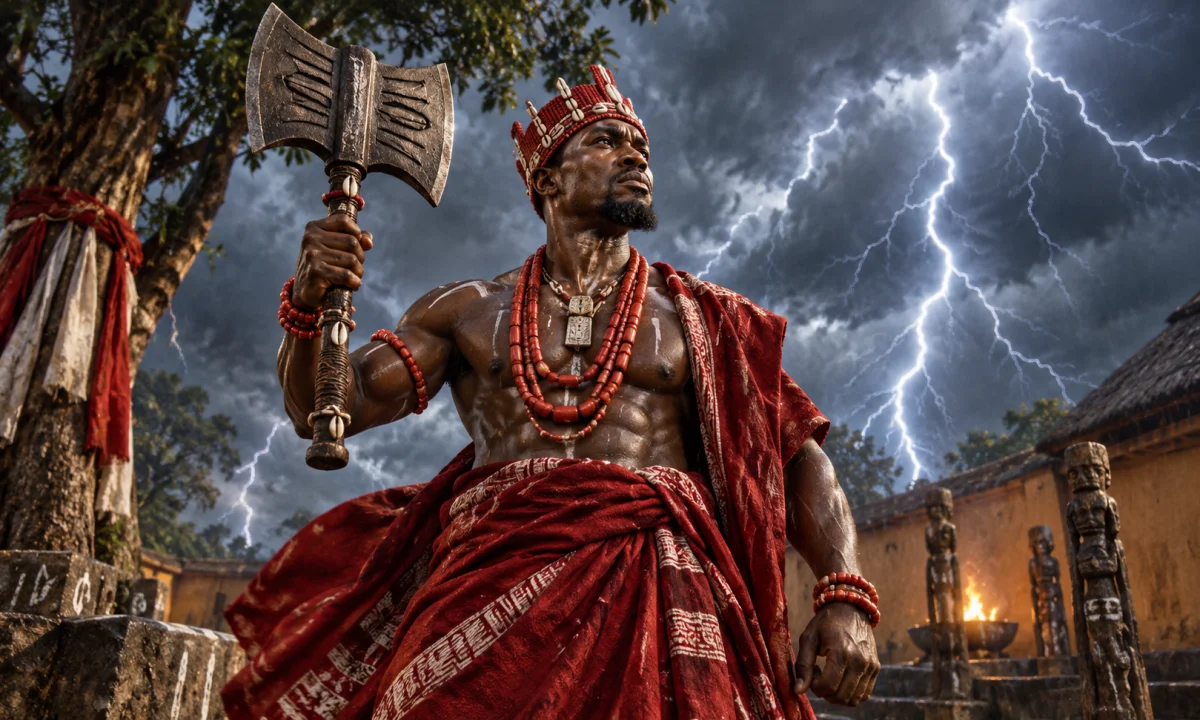
Jakuta is a Yoruba name associated with thunder, lightning and the dangerous power of the sky. In many accounts, Jakuta is an aspect, title or earlier form of Ṣàngó (often written Shango), the Yoruba orisha of thunder and lightning. In other traditions and interpretations, Jakuta is treated as a distinct thunder deity who was later closely identified with Ṣàngó. The relationship between the two names is therefore not entirely uniform, and local religious practice does not always follow the same classification.
Yoruba religious setting
Yoruba religious traditions developed among Yoruba-speaking peoples of West Africa, especially in present-day southwestern Nigeria and parts of Benin and Togo. They include devotion to òrìṣà, powerful divine beings who govern or embody aspects of the natural world, human society and sacred history. The òrìṣà are not simply equivalent to abstract “gods” in every context. They may be understood as divine powers, ancestral beings, sacred personalities or intermediaries within a larger order associated with Olódùmarè, the supreme source of creation.
Yoruba religion has no single canonical scripture that defines every òrìṣà in the same way. Religious knowledge has been preserved through oral histories, praise poetry, divination verses, ritual songs, priestly instruction, festivals and local custom. As a result, names and identities can overlap. A title used in one town as the name of an independent divine figure may be used elsewhere as an epithet of a better-known òrìṣà.
Jakuta belongs to this setting of layered religious language. The name is particularly connected with the violent force of thunderstorms: the flash of lightning, the crash of thunder, the destructive fall of objects from the sky and the sudden power that can protect, punish or transform human communities.
Name and identity
The name Jakuta is commonly explained through an association with stones or stone-throwing. It is often glossed as “one who fights with stones” or “one who throws stones.” Such translations are useful descriptions of the figure’s imagery, but the exact linguistic analysis and the historical development of the name are not always presented identically. Yoruba names carry tone and grammatical detail that are not fully represented by an unmarked English spelling, so forms such as Jakuta should not automatically be treated as a complete guide to pronunciation or meaning.
The stone imagery refers to the traditional belief that lightning leaves behind sacred stones. These stones, often called edùn àrá, are regarded in Yoruba religious contexts as objects connected with thunder and lightning. When such stones are found, they may be recognized as signs of the thunder power rather than ordinary pieces of rock. Their presence can establish a sacred site or provide a material focus for ritual attention.
There are three broad ways in which Jakuta is described:
- as an epithet or name of Ṣàngó, emphasizing his power to strike enemies and punish wrongdoing;
- as an older or more elemental thunder deity whose identity was later joined to Ṣàngó’s; or
- as a local manifestation of thunder power whose relationship with Ṣàngó depends on the community and its ritual tradition.
These descriptions should not be forced into one universal definition. Yoruba religious traditions have historically accommodated regional variation, the incorporation of local cults and the identification of related divine powers.
Jakuta and Ṣàngó
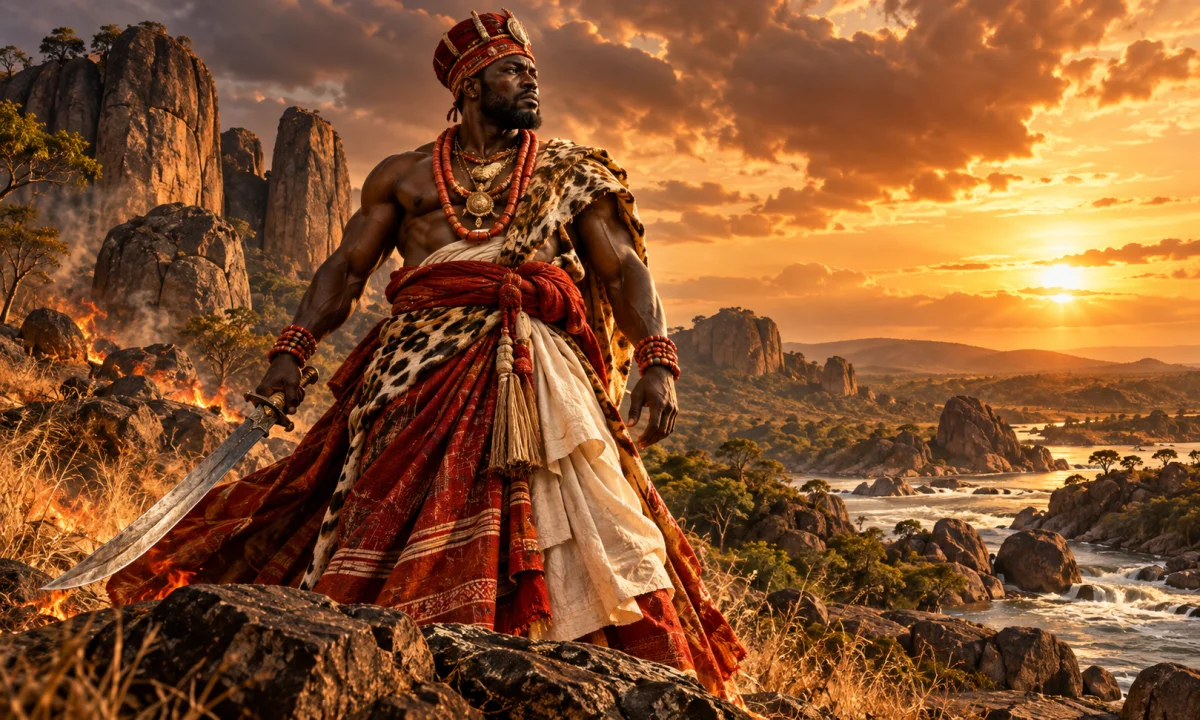
Ṣàngó is one of the best-known Yoruba òrìṣà. He is associated with thunder and lightning, royal authority, masculine power, warfare, drumming and the protection of social order. Yoruba historical tradition also remembers Ṣàngó as a former Aláàfin, or king, of Oyo. In religious narratives, the historical ruler and the divine thunder being are connected but are not always presented as exactly the same kind of figure. His posthumous transformation into an òrìṣà is part of a wider pattern in which important ancestors, rulers and culture heroes become objects of religious veneration.
Jakuta is frequently connected with the aspect of Ṣàngó that strikes from the heavens. The name highlights the weapon-like nature of thunderbolts and the belief that the thunder power can hurl stones against those who have violated moral or social obligations. In this interpretation, Jakuta is not a separate companion or subordinate of Ṣàngó. It is a title that reveals one of Ṣàngó’s powers.
Other interpretations give Jakuta greater independence. Some descriptions treat Jakuta as a primordial thunder being who existed before the historical king Ṣàngó was incorporated into the religious system. Ṣàngó’s rise may then be understood as an identification or merger between a royal ancestor and an already established force of thunder. This kind of merging is not unusual in the history of African religions: local divine powers can become associated with prominent rulers, political centres or expanding religious networks.
Because oral traditions are transmitted by communities rather than through one fixed written narrative, the boundary between “Jakuta” and “Ṣàngó” can remain fluid. A statement that Jakuta is “another name for Ṣàngó” may be accurate in one ritual context, while a statement that Jakuta is an older thunder power may reflect another layer of tradition.
Thunder, lightning and sacred stones
Thunderstorms are central to Jakuta’s symbolism. Lightning is sudden, brilliant and difficult to control; thunder is heard across great distances and can inspire both fear and reverence. The storm therefore expresses a power that is invisible in origin but unmistakable in its effects. Jakuta’s force can destroy buildings, trees and crops, yet it can also be understood as a manifestation of divine authority rather than meaningless violence.
The sacred thunderstones associated with lightning give this invisible power a physical presence. In Yoruba religious understanding, a stone connected with lightning may be treated as a sign that the thunder òrìṣà has acted in a particular place. Such stones can be kept at shrines or used in ritual settings connected with Ṣàngó and thunder worship. They are not simply “weapons” in a modern material sense. Their significance arises from the relationship between natural event, divine agency, ritual recognition and inherited religious knowledge.
Jakuta’s imagery also explains why thunder deities are associated with both protection and danger. A thunderbolt can punish a wrongdoer, defend the community or destroy an enemy. The same power that terrifies outsiders may be welcomed by devotees as a guardian force. This dual character is common in traditions concerning storm deities: their authority depends partly on their ability to act decisively against disorder.
Moral authority and social order
In interpretations that identify Jakuta with Ṣàngó, the thunder power is closely connected to justice and the enforcement of oaths. Thunder and lightning are not merely weather phenomena; they can be understood as signs that hidden wrongdoing has been exposed. Perjury, treachery and serious violations of social obligations may be placed under the judgment of the thunder òrìṣà.
This does not mean that every thunderstorm is automatically interpreted as a divine verdict. Yoruba religious explanations vary according to circumstance, ritual authority and local practice. Nevertheless, the possibility of supernatural punishment gives Jakuta a strong moral dimension. The figure represents a form of power that cannot easily be deceived and that can reach people who believe themselves beyond the reach of ordinary human law.
The association with kingship strengthens this symbolism. Ṣàngó’s historical connection with Oyo kingship links thunder to authority, public ceremony and the responsibilities of rule. Where Jakuta is understood as an earlier thunder power, the same connection may be expressed less through a specific historical king and more through the general idea of celestial sovereignty. In either case, thunder becomes a sign of forceful authority capable of defending a community and condemning abuse.
Ritual and religious associations
Worship connected with Ṣàngó and thunder includes shrines, sacred objects, praise names, drumming, dance and ritual specialists. Exact practices differ by community, and descriptions of one shrine or lineage should not be treated as a universal account of every Yoruba tradition. The use of thunderstones and the performance of praise poetry are among the features most strongly associated with the thunder cult.
Drums are especially important in Ṣàngó traditions. Rhythmic performance can communicate praise, summon attention and create a setting in which the presence of the òrìṣà is acknowledged. The sound of drums naturally recalls thunder, although the religious meaning of the music is cultural and ritual rather than a claim that ordinary thunder is literally produced by instruments.
Jakuta may also be discussed alongside other powers in the Ṣàngó complex, including Òya, who is strongly associated with winds, storms and transformation, and other figures linked to Ṣàngó in regional traditions. These relationships belong primarily to Ṣàngó narratives and should not automatically be transferred to every interpretation of Jakuta as an independent deity. When Jakuta is treated as a title of Ṣàngó, such relationships may be included; when Jakuta is distinguished as a separate or older power, the connection may be more limited.
Stories and regional variation
There is no single universally accepted cycle of stories devoted exclusively to Jakuta. Much of the narrative material connected with the name comes through accounts of thunder worship and through traditions concerning Ṣàngó. In those stories, Ṣàngó may appear as a powerful ruler whose authority is linked to thunder, or as a divine being who commands lightning and punishes those who defy sacred law.
One well-known group of Ṣàngó traditions describes his difficult reign and his eventual death or disappearance, followed by his transformation into a divine power. The details differ considerably. Some versions say that he hanged himself after a military or political disaster; others frame the event through disappearance, shame, supernatural power or the actions of his enemies. These stories should not be presented as a single fixed biography, and they belong specifically to the broader Ṣàngó tradition rather than to a uniform Jakuta mythology.
In some interpretations, the identification of Ṣàngó with Jakuta allows the thunder god’s divine nature to be read as present before, during and after the king’s human life. In others, Jakuta represents the older natural force that Ṣàngó came to embody. The distinction reflects different ways of understanding how human history and divine power meet: a ruler may become a god, a god may be represented through a ruler, or two traditions may gradually become inseparable.
Distinguishing Jakuta from related thunder beings
Jakuta should not be casually merged with every African or Afro-diasporic thunder deity. Neighboring West African peoples have their own storm and thunder powers, including the Fon and Ewe traditions associated with figures such as Hevioso or Ṣogbo. These traditions have influenced one another in regions where communities lived in close contact, but related symbolism does not prove that all such figures are identical.
Jakuta is also not simply another spelling of every form of Ṣàngó found in the African diaspora. In Cuba, Ṣàngó is widely known as Changó in Lucumí practice; in Brazil, he is associated with Xangô in Candomblé and related traditions. These names reflect historical transmission, linguistic change and the development of new religious communities in the Atlantic world. They preserve important connections with Yoruba religion, but each tradition has its own ritual history and should be studied on its own terms.
The same caution applies to the spelling Jakuta. A name appearing in a modern book, game, website or popular retelling may be used as though it referred to a fully separate character. Traditional evidence may instead indicate a title of Ṣàngó, a regional form of thunder worship or a scholarly reconstruction based on limited written records. The safest description depends on the particular source and community being discussed.
Cultural significance
Jakuta’s importance lies in the way the figure joins natural power, moral judgment and political authority. Thunder is both an event in the landscape and a religious language for speaking about consequences. Lightning makes hidden power visible for an instant; the thunder that follows extends its presence across the community. Through this imagery, Jakuta can represent a force that is immediate, uncompromising and impossible to ignore.
The figure also illustrates how Yoruba religious identities are formed through accumulation rather than rigid separation. A divine power may have an ancient natural aspect, a local name, a royal association and a place within a wider network of òrìṣà. The relationship between Jakuta and Ṣàngó is therefore significant not only because both are connected with storms, but because it shows how oral traditions preserve several historical and theological layers at once.
In contemporary discussions, Jakuta is best described with care: a Yoruba thunder name or figure, often identified with Ṣàngó and sometimes interpreted as an older or distinct thunder deity. Treating that variation as part of the tradition, rather than correcting it into one supposedly final definition, gives a more accurate picture of Yoruba religious thought.