WORLD
WORLD
Irdlirvirisissong
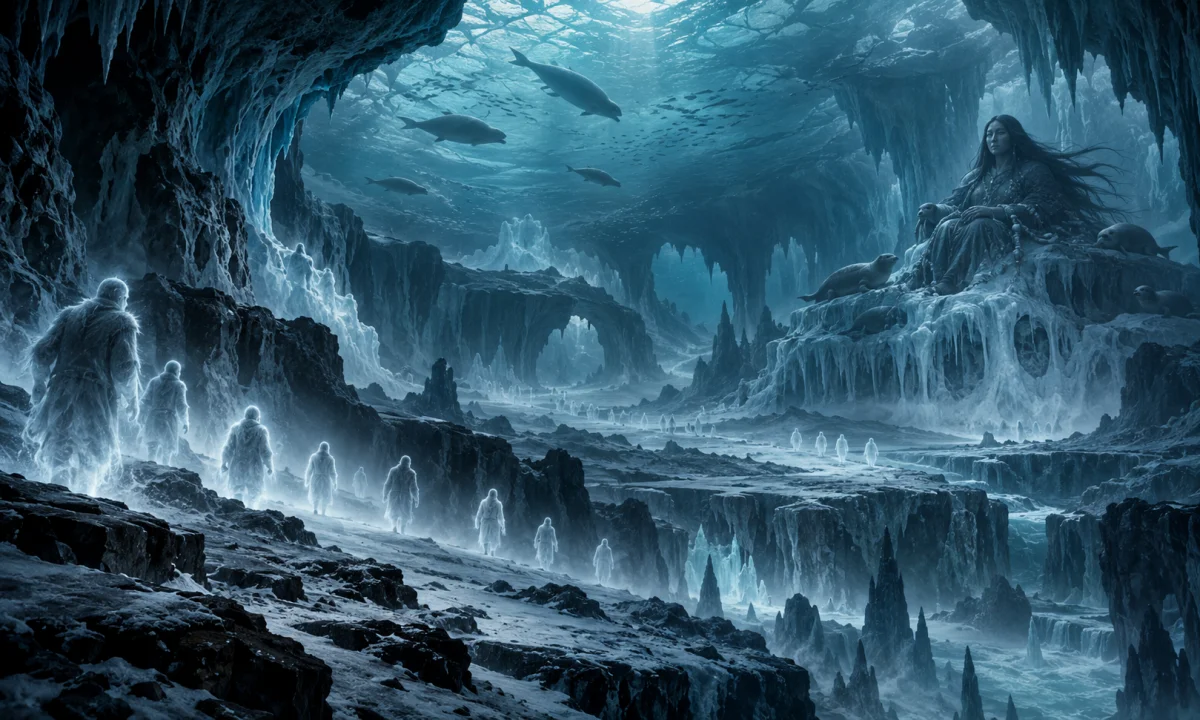
Irdlirvirisissong is a poorly documented name associated with Inuit mythology and with accounts of a dangerous marine being. Unlike better-known figures such as Sedna, the sea-mother, or the ijiraq, a mysterious wilderness spirit, Irdlirvirisissong does not belong to a widely recorded and stable body of traditional stories. The name appears mainly in English-language compilations of legendary creatures, where it is generally classified as an Inuit sea monster. Its spelling, description and place within Inuit storytelling are uncertain.
Origins and cultural setting
“Inuit mythology” is a broad modern label for the diverse traditional religious and narrative systems of Inuit peoples across the Arctic. Inuit communities have lived across Alaska, Canada and Greenland, and their languages, local environments and storytelling traditions are not identical. A being reported in one region should not automatically be treated as a belief shared by all Inuit peoples.
Traditional Inuit stories developed within societies whose lives depended heavily on knowledge of the sea, ice, animals and weather. The ocean was a source of food and travel, but it was also unpredictable and dangerous. Narratives about marine beings could therefore express several things at once: respect for the powers of the sea, warnings about unsafe conduct, explanations for accidents and disappearances, and reflections on the proper relationship between humans, animals and the wider spirit world.
Many Inuit traditions were transmitted orally. Early outside observers often recorded stories through translation, summary or interpretation rather than through the speakers’ own written forms. Names could be reshaped when they passed between Inuit languages, missionaries’ spelling systems, explorers’ notes and later English reference books. Such processes make it difficult to determine whether a rare name represents a local traditional being, a variant spelling, a mistranslation or a figure whose original context has been lost.
The name and its identification
The form Irdlirvirisissong is not a standardized spelling that can be confidently connected to one universally recognized Inuit term. Variants may occur in English-language references, and the pronunciation suggested by the spelling may not reflect the pronunciation of the original language. There is also no secure basis for treating the name as a transparent English translation.
For that reason, the name should be handled cautiously. It is often presented as though it referred to a clearly defined creature with a fixed appearance and a single established legend. The available evidence does not support that level of certainty. In particular, popular lists sometimes attach elaborate physical features, habits or powers to Irdlirvirisissong without identifying a specific community, storyteller or traditional narrative behind those claims.
The safest description is that Irdlirvirisissong is a rare and uncertain name for an Inuit-associated marine monster or dangerous sea being. The classification reflects the way the figure is commonly presented in modern reference material, not proof that it was a pan-Inuit religious figure.
Appearance and nature
Descriptions of Irdlirvirisissong are inconsistent. It is generally imagined as an enormous creature of the sea, but the surviving English presentations do not provide a dependable, canonical physical description. Accounts may emphasize its size, its threatening nature or its ability to endanger people travelling by boat. Other details should be treated as variant or unverified rather than as defining characteristics.
There is no securely established evidence that Irdlirvirisissong possessed one particular combination of animal features, such as the body of a whale, the head of a bird or the limbs of a land predator. Such composite descriptions are common in modern catalogues of monsters, which often combine fragments from different traditions or embellish brief entries. They should not be repeated as established Inuit tradition without a clear traditional context.
Nor is it certain that the being was understood as a god, demon or spirit in the strict sense of those categories. These terms come largely from European religious and folkloric classification. An Inuit narrative being may not fit neatly into the divisions between animal, spirit, monster and supernatural person. A dangerous marine being could be understood through relationships, behaviour and place rather than through a fixed theological category.
Possible role in traditional imagination
Even when the precise stories attached to a name are uncertain, the marine-monster classification points to an important setting in Inuit life: travel on the sea and among sea ice. Kayaking, hunting and fishing required close attention to currents, ice conditions, animal behaviour and weather. A story about a threatening being could reinforce caution without functioning merely as a children’s tale.
In Inuit storytelling, supernatural danger is often connected with human conduct. Disrespect toward animals, violations of social rules, broken taboos or careless behaviour may place people at risk. It would be too broad to claim that every story about Irdlirvirisissong carried one particular moral, but the general cultural setting makes it reasonable to interpret a sea-monster narrative as part of a wider system of environmental knowledge, social instruction and spiritual concern.
The sea itself was not necessarily imagined as an empty wilderness populated only by monsters. Inuit cosmologies commonly present animals, humans and other-than-human beings as participants in a living world governed by relationships and obligations. A frightening marine figure may therefore represent more than physical danger. It can mark the limits of human control and remind listeners that the ocean is not simply a resource available without consequence.
Stories and narrative variants
No single widely attested narrative about Irdlirvirisissong can be identified with confidence. The name is not associated, in the surviving popular record, with a stable cycle of stories comparable to the extensive traditions surrounding Sedna or the many regional accounts of helping spirits, animal transformations and encounters with the dead.
This absence is important. It does not prove that no Inuit storyteller ever used the name, nor does it make the figure unreal within the tradition in which it may have occurred. Oral traditions are often local, and many were recorded incompletely or not at all. It does mean that broad claims about the creature’s relationships, habitat, origin and exploits should not be presented as settled facts.
Some modern descriptions may also have confused Irdlirvirisissong with other Arctic beings. Once a rare name has been detached from its original language and context, compilers may place it beside better-known sea monsters and fill in missing details by analogy. The result can look like a complete mythology even when the underlying evidence consists of a short, uncertain entry.
Distinction from other Inuit and Arctic beings
Sedna
Irdlirvirisissong should not be identified with Sedna, although both may be associated with the sea. Sedna is a major figure in several Inuit traditions, especially as a powerful sea-mother or mistress connected with marine animals, hunting success and ritual relationships. Her name, stories and attributes also vary by region, but she has a much broader and better-documented place in Inuit religious and narrative traditions.
Qalupalik
The qalupalik is a frightening being in some Inuit traditions, often associated in modern descriptions with coastal waters and the danger of children approaching unsafe ice or shorelines. It is frequently portrayed as a child-stealing creature, though details differ between accounts. Qalupalik and Irdlirvirisissong should not be merged merely because both are linked with the sea.
Akhlut
Akhlut is usually described in modern references as a shape-changing being associated with an orca or wolf, particularly in traditions connected with Alaska. The exact documentation and regional context of accounts vary. It is not another name for Irdlirvirisissong.
Tizheruk
Tizheruk is another name often listed among Arctic sea monsters, especially in connection with Inuit-related folklore. Like Irdlirvirisissong, it is surrounded by inconsistent modern descriptions. Similar classification does not establish identity. Each name requires separate attention to its language, community and source tradition.
Religious and cultural significance
It is misleading to treat every supernatural creature in Inuit storytelling as a “monster” in the modern entertainment sense. The word suggests a creature designed chiefly to frighten an audience, whereas traditional beings may have religious, ethical, ecological and social significance. A dangerous figure can be part of a serious account of how people should behave toward animals, elders, strangers, the dead and the environment.
At the same time, the limited evidence for Irdlirvirisissong does not justify assigning it a specific ritual function or theological meaning. There is no reliable basis for claiming that Inuit communities universally worshipped it, feared it during a particular ceremony or regarded it as the ruler of a defined region of the ocean. Those kinds of details belong to specific traditions and should not be supplied simply because they appear in general accounts of mythology.
The figure’s uncertain status also illustrates a wider problem in the study of Indigenous traditions. A name can survive in a colonial-era note or a later encyclopaedia while the story, language and community context disappear. The resulting entry may preserve a memory of a traditional being, but it may also distort the original. Respectful interpretation therefore requires distinguishing what is documented from what is inferred.
Later reception
Irdlirvirisissong has had little established presence in mainstream literature, film, television or games. Its principal modern life appears to be in lists of mythological creatures, cryptozoological catalogues and online discussions of unusual legendary beings. In those settings, the name may be presented with a confident description that exceeds the evidence available for it.
When the figure is used in modern fiction, it is best understood as a creative adaptation rather than as a straightforward representation of Inuit belief. Authors and game designers may turn the name into a giant predator, an abyssal monster or a supernatural antagonist, but these inventions should be distinguished from traditional material. Using an Indigenous name without acknowledging its uncertain documentation can also create a false impression that a modern monster design faithfully represents Inuit culture.
Irdlirvirisissong is therefore most accurately treated as an obscure Inuit-associated name whose surviving presentation points to a dangerous marine being, while leaving its original identity and narrative context unresolved. The uncertainty is not a minor detail: it is the central fact necessary for discussing the figure responsibly.