WORLD
WORLD
Ilamatecuhtli
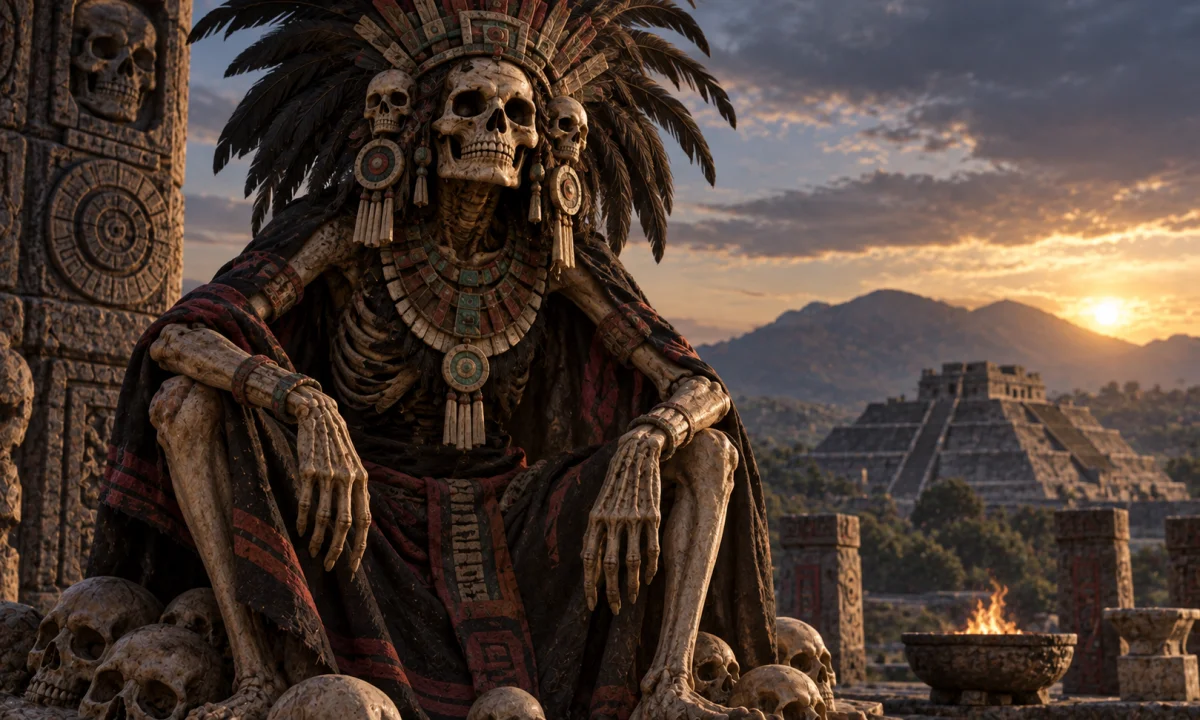
Ilamatecuhtli is an aged female deity in the religious traditions of central Mexico, especially those associated with the Mexica, often called the Aztecs. Her name is usually translated as “Old Woman” or “Old Lady,” although the Nahuatl compound is more difficult to render precisely. She is connected with old age, the earth, death, and the renewal of life, and she received an important festival during the Mexica calendar year.
Name and identity
Ilamatecuhtli is formed from Nahuatl elements commonly understood as ilama, “old woman,” and tecuhtli, a title meaning “lord,” “ruler,” or “noble.” Because tecuhtli is a title rather than a simple gendered noun, translations such as “Old Woman Lord” or “Old Lady” are possible. English-language works do not always agree on the best rendering.
The name should not be treated as a complete description of her nature. It emphasizes age and status, but the surviving evidence presents Ilamatecuhtli as more than a personification of old women. She belongs to a group of powerful female deities associated with the earth, fertility, death, childbirth, warfare, and the regeneration of life. Her aged form suggests the earth at the end of a cycle: worn, dormant, and close to death, but also capable of producing new life.
Her identity is not entirely uniform across surviving sources. Colonial-era accounts and Indigenous painted manuscripts do not provide a single systematic theology in which every deity has one fixed role. Different communities, temples, priests, and scribes could emphasize different aspects of a divine figure. For that reason, Ilamatecuhtli is best understood as a distinct deity with overlapping associations, rather than as a figure whose character can be reduced to one modern label.
Religious and historical setting
The Mexica religion formed part of the wider religious world of Nahua-speaking peoples in central Mexico. The word “Aztec” is useful as a broad modern term, but it can conceal important differences between Mexica practice and the traditions of other Nahua communities. Ilamatecuhtli is most securely known through sources connected with central Mexican ritual life in the centuries before and after the Spanish invasion.
No complete pre-conquest Mexica theological book survives in written form. Knowledge of Ilamatecuhtli comes from a combination of sources produced or recorded in the colonial period. These include the Florentine Codex, based on interviews with Indigenous informants; the Primeros Memoriales; and pictorial manuscripts such as the Codex Borbonicus. These works preserve valuable information about ceremonies, images, names, and ritual specialists, but they were created in a period shaped by Spanish colonial rule and Christian scrutiny.
The sources therefore require care. A description in a missionary manuscript may reflect an Indigenous account, a Spanish interpretation, or a mixture of both. Painted manuscripts may communicate through costume, gesture, calendrical placement, and symbolic objects rather than through written explanation. Differences between sources do not necessarily mean that one account is false; they may reflect different ritual contexts or local traditions.
The festival of Tititl
Ilamatecuhtli is especially associated with Tititl, the seventeenth twenty-day period, or veintena, in the Mexica solar calendar. The word Tititl has been translated in several ways, including “contraction,” though its exact meaning and ritual implications are debated. The period is often placed during the winter season in modern calendar correlations, but the precise correspondence between the Mexica calendar and the modern calendar remains uncertain.
Colonial descriptions identify Tititl as the time when Ilamatecuhtli received a major ceremony. A woman impersonating the goddess played a central role in the ritual. In Mexica religious practice, an individual who represented a deity was not merely acting in a theatrical performance. Through costume, ritual treatment, speech, movement, and ceremonial identification, the impersonator became the focus of worship as the deity’s living manifestation for the duration of the rite.
The ceremony associated with Ilamatecuhtli included singing, dancing, offerings, and sacrifice. The ritual death of the impersonator formed part of a larger pattern in which the death of a divine representative expressed transformation and renewal. The sources describe such rites in disturbing terms because human sacrifice was an important element of some state ceremonies in the Mexica capital. These practices should be interpreted within their religious framework, in which death could be understood as a transfer of sacred power and a condition of cosmic or agricultural regeneration.
Descriptions of Tititl also connect Ilamatecuhtli with the end of an agricultural and calendrical phase. Her age may represent exhausted vegetation, the aging year, or the earth’s apparent withdrawal before renewed growth. These interpretations are not a single explicit doctrine stated in every source. They arise from the relationship between her old-woman form, her seasonal festival, and broader Mesoamerican patterns of death and rebirth.
Appearance and symbolic attributes
Ilamatecuhtli is generally represented as an elderly female figure. Her age is important: she is not simply a youthful mother goddess or a generic earth spirit. The signs of age place her at the far end of human life and connect her with ancestry, decline, and the accumulated power of an ancient being.
Painted representations of Mexica deities commonly use distinctive clothing, headdresses, body paint, ornaments, and ritual objects to identify them. Ilamatecuhtli’s images are associated with the ceremonial context of Tititl and with an aged female form. The surviving depictions are not naturalistic portraits, and they should not be read as if every line represented a literal physical feature. A costume element may indicate a ritual office, a relationship to a particular ceremony, or a symbolic connection with another deity.
Her symbolism can be grouped around several related ideas:
- Old age and ancestral authority: Ilamatecuhtli’s age marks her as ancient and powerful rather than weak. In a religious setting, an old woman could embody experience, seniority, and the authority of the first generations.
- The earth: She is associated with the earth as a living and consuming power. The earth gives food and receives the dead, linking nourishment and burial within one sacred process.
- Death and transition: Her festival included the death of a deity impersonator, and her aged appearance evokes the closing of a cycle. Death here is not necessarily an ending in the modern secular sense; it may be a passage into another condition.
- Renewal: The death of the old form allows a new cycle to begin. This connection with renewal is particularly relevant in an agricultural society dependent on seasonal change, rainfall, soil, and the return of crops.
Some modern descriptions assign Ilamatecuhtli a wide range of additional powers, including control over particular celestial phenomena. Such claims are not equally well supported by the main colonial accounts and should not be presented as universally accepted. Her strongest and most consistent associations are with old age, the earth, death, and ritual renewal.
Relationships with other goddesses
Ilamatecuhtli is often discussed alongside several other major female deities of central Mexican religion. The comparison is useful, but the figures should not be merged.
Toci, whose name means “Our Grandmother,” is another elderly female deity connected with the earth and with the generative powers of older women. Toci is especially associated with the festival of Ochpaniztli and with themes involving sweeping, purification, childbirth, healing, and agricultural renewal. Because both goddesses can appear as ancient female powers, some interpretations treat them as related forms or aspects of a broader earth-mother complex. Nevertheless, Toci and Ilamatecuhtli have different names and distinct major festival contexts.
Coatlicue, “She of the Serpent Skirt,” is a powerful earth and mother goddess known especially from Mexica sculpture and from the stories surrounding Huitzilopochtli’s birth. She is associated with serpents, fertility, death, and the consuming as well as nourishing earth. These themes overlap with Ilamatecuhtli, but Coatlicue should not be described simply as another name for Ilamatecuhtli. The two figures belong to a network of related religious ideas without being identical in every source.
Cihuacoatl, whose name means “Snake Woman,” is associated with childbirth, warfare, death, and the earth. She was also connected with a prominent political and ritual office in the Mexica state. Cihuacoatl’s relationship to motherhood and the dead can resemble Ilamatecuhtli’s symbolism, but their names, narratives, and ceremonial roles remain distinct.
These comparisons show that Mexica deities did not necessarily function as isolated characters with sharply separated territories. Religious powers could overlap, appear in different forms, or be brought together in a ceremony. At the same time, overlap is not proof that every related goddess was merely a local version of one universal deity.
Stories and surviving traditions
Ilamatecuhtli does not possess a large cycle of surviving myths comparable to the better-known stories of Huitzilopochtli, Quetzalcoatl, or the creation of the Fifth Sun. Her importance is documented more clearly through ritual descriptions and calendrical records than through a long narrative biography.
The most important tradition is therefore the ceremony of Tititl. The goddess appears through the impersonator, whose ritual life and death express the passage from old age to renewal. This is a different kind of mythic evidence from a narrative about divine conflict or the founding of a city. It shows how a deity could be encountered through repeated ceremonial action rather than through a single canonical story.
Accounts of the ceremony also reveal the political character of Mexica religion. Major festivals brought together priests, rulers, warriors, dancers, musicians, tribute, and offerings. The state’s public rituals presented the health of the community and the continuation of the cosmos as matters requiring collective participation. Ilamatecuhtli’s festival placed an old female divine power within that larger system of agricultural, social, and cosmic obligations.
Cultural significance
Ilamatecuhtli offers an important reminder that Mesoamerican ideas of fertility were not limited to youth, sexual reproduction, or maternal abundance. The aged body could represent accumulated power and the completion of a necessary cycle. The old woman was connected to the beginning of renewed life precisely because she stood near death and transformation.
Her symbolism also brings together processes that modern categories often separate. The earth is a source of food, but it is also the place where the dead return. Agricultural growth depends on decay, and social continuity depends on honoring those who came before. In this framework, Ilamatecuhtli’s associations with the earth, death, and renewal are not unrelated attributes added to one another; they are parts of a connected view of existence.
The title-like element tecuhtli further suggests that age did not imply insignificance. Ilamatecuhtli is an “old woman” who is also marked by lordly or noble status. Her name can therefore be read as expressing both gender and authority: she is an ancient female power who commands ritual respect.
Later reception
Ilamatecuhtli is less prominent in modern popular culture than figures such as Quetzalcoatl, Tezcatlipoca, or Coatlicue. She appears mainly in discussions of Mexica religion, Mesoamerican art, mythology, and the ritual calendar. When she is adapted in modern fiction, games, or visual art, creators may portray her as an earth goddess, death goddess, elderly mother, or seasonal spirit. These portrayals can draw inspiration from traditional themes, but they are creative reinterpretations rather than evidence for ancient belief.
Modern summaries sometimes combine Ilamatecuhtli with Toci, Coatlicue, Cihuacoatl, or other earth-related goddesses in order to create a single “Aztec earth mother.” That approach makes the subject easier to categorize but obscures important distinctions. Ilamatecuhtli is best recognized as a particular aged female deity associated above all with the Tititl festival and with the interwoven powers of age, earth, death, and renewal.