WORLD
WORLD
Hare
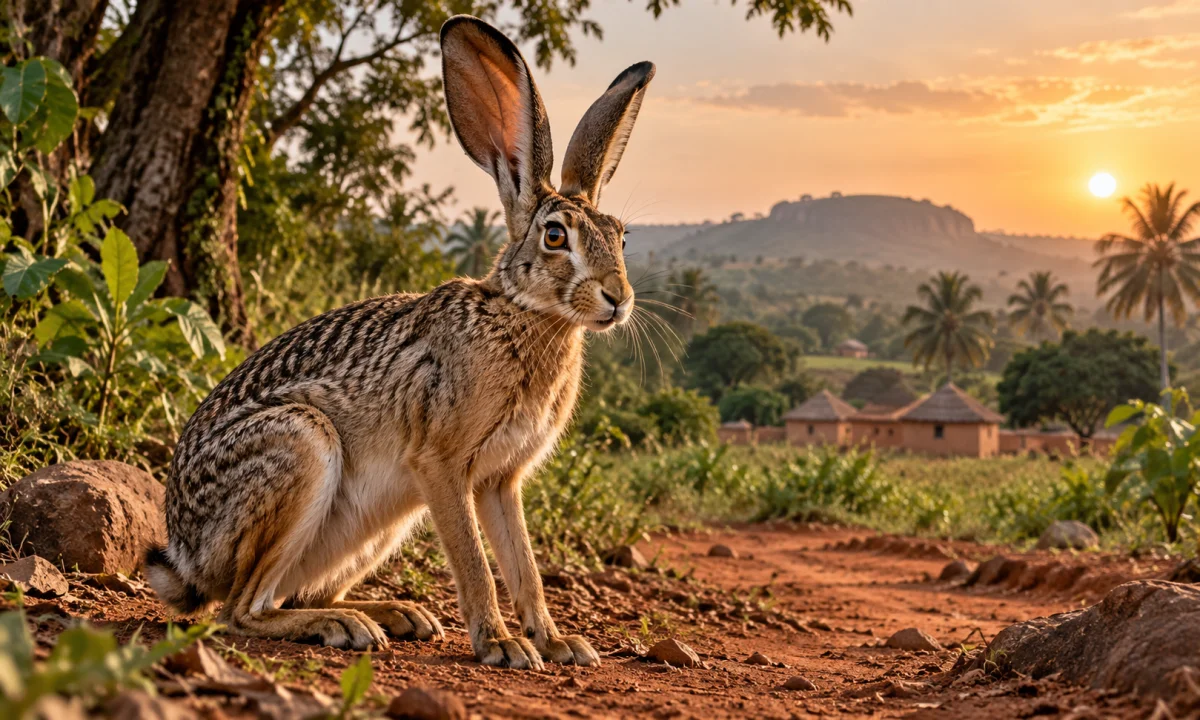
Hare occupies a modest but recognisable place in Yoruba animal folklore. In Yoruba, the animal is commonly called ehoro, although English translations may render the word as “hare,” “rabbit,” or sometimes simply “small wild rabbit,” depending on the dialect, context and translator. Hare is not generally regarded as a major Yoruba deity or orisha. Instead, it appears mainly as a character in oral narratives, moral tales and animal stories in which intelligence, speed, caution and opportunism are tested against strength and authority.
Because Yoruba storytelling is a living oral tradition rather than a single fixed mythology, the character does not have one universally accepted biography, genealogy or set of sacred attributes. A hare in one tale may be an ingenious survivor; in another, a boastful schemer whose cleverness creates trouble. The stories are best understood within the wider Yoruba tradition of animal narratives, where human social behaviour is explored through the actions of animals.
Yoruba cultural setting
Yoruba religious and cultural traditions developed among Yoruba-speaking peoples of southwestern Nigeria and neighbouring parts of Benin and Togo. Their religious world includes the supreme creator, often called Olódùmarè or Ọlọ́run, numerous orishas, ancestors, divination practices and a large body of oral literature. These elements should not be treated as identical. A creature can be prominent in folktales without being an object of worship, and a story character need not belong to the same category as a deity.
Yoruba oral literature includes myths about the origins of the world, accounts associated with the orishas, praise poetry, proverbs, riddles, historical traditions and entertaining animal tales. Animal stories are often called àlọ́ in Yoruba, although terminology and usage can vary. Such tales are usually performed, not merely read. A narrator may adapt the plot, change the dialogue, emphasise a moral lesson or introduce local details according to the audience.
Hare belongs primarily to this narrative sphere. The animal can express qualities that are difficult or dangerous to discuss directly in human society: cunning, impatience, greed, resistance to authority and the ability of a weaker individual to survive among stronger opponents. The story’s lesson may praise cleverness, warn against deception or show that intelligence without restraint eventually produces humiliation.
Name and identity
The Yoruba word ehoro is commonly translated as “hare” or “rabbit.” In English, hare and rabbit refer to related but distinct animals, yet many traditional translations do not preserve the difference consistently. A story described in one English version as involving a hare may appear elsewhere with a rabbit, especially when the original tale has been translated for a broad international readership.
This variation does not necessarily indicate two different mythological beings. It often reflects the difficulty of matching local animal names to zoological categories in another language. Regional vocabulary, translators’ choices and the setting of a story can all affect the English form. Where a particular Yoruba text uses ehoro, it is safer to preserve the Yoruba name or explain the translation than to assume that every English version describes the same species with scientific precision.
Hare also needs to be distinguished from several other animal figures in Yoruba storytelling. Most importantly, it should not automatically be identified with Ìjàpá, the tortoise. Ìjàpá is one of the best-known trickster figures in Yoruba and other West African traditions. Since both tortoise and hare may be clever, troublesome or morally ambiguous, retellings sometimes merge their characteristics. They are nevertheless different animals and different narrative characters.
Hare should likewise not be treated as a local form of the Anansi spider, the famous trickster of Akan-speaking traditions. West African storytelling cultures share motifs and stories, and characters can influence one another across linguistic and regional boundaries. Shared patterns, however, do not prove that Yoruba ehoro is Anansi under another name.
Hare as a folktale character
Hare’s most consistent narrative quality is quick intelligence. The animal is physically vulnerable when compared with large predators, powerful chiefs or supernatural beings, so survival depends on observation and rapid decision-making. Hare may listen while others speak, notice a weakness in an opponent’s plan or use an apparently harmless question to redirect a dangerous situation.
Speed is both a literal and symbolic attribute. A hare can flee from danger, arrive before a rival or escape punishment at the last moment. Yet Yoruba tales do not necessarily present speed as an uncomplicated virtue. An animal that constantly escapes responsibility may be admired for its ingenuity but distrusted for its lack of honesty. Hare’s success can therefore be temporary: the clever trick works, but the trickster is later exposed by greed, overconfidence or a failure to understand the consequences.
In many African animal-tale traditions, small creatures confront larger animals through contests, wagers, journeys or disputes over food. Yoruba versions may use these general narrative patterns, but there is no single canonical collection in which every hare story appears in one standard form. The identity of the opponent may change, as may the reason for the conflict. In one performance, the central issue may be hunger; in another, unfair power or a boastful challenge.
Hare can also function as a boundary figure. It is a wild animal associated with fields, grassland and the edges of human settlement, but it is clever enough to enter social situations governed by rules. This makes it useful in stories about negotiation. Hare may understand the language of power without possessing power itself, and may survive by manipulating the expectations of stronger characters.
Stories, motifs and regional variation
There is no universally authoritative Yoruba “Hare cycle” comparable to a fixed epic with a settled sequence of episodes. Hare stories are found within a broad field of oral narrative, and their details vary between communities, performers and collections. Some versions may be told primarily to children, while others use humour and animal behaviour to comment on adult relationships, status and public conduct.
Recurring motifs include contests of intelligence, attempts to obtain food, disputes over ownership, escapes from punishment and schemes directed against larger animals. These motifs should not be mistaken for a single inherited plot. They are narrative patterns that may be rearranged and adapted. A storyteller can make hare the hero of a particular episode while allowing another animal to win in a later tale.
Animal stories often work through reversal. The physically strongest character assumes victory, only to be defeated by a smaller one. Conversely, the clever character may believe that every problem can be solved by deception and then suffer because a victim remembers the trick or because two rivals compare their experiences. This reversal gives the audience room to enjoy the performance while also considering its moral implications.
In some tales, Hare’s intelligence resembles practical wisdom: the animal recognises danger and avoids an unnecessary fight. In others, it is closer to cunning: Hare lies, disguises its intentions or persuades someone else to accept an unfair arrangement. The distinction matters. Yoruba moral thought does not require every successful trickster to be morally good. A story may celebrate mental agility as a survival skill while condemning selfishness or betrayal.
Relationship to Yoruba religious thought
Hare is not normally listed among the principal orishas. The orishas are sacred powers with religious identities, cults, praise names, ritual relationships and, in many cases, extensive traditions concerning their origins and activities. Hare lacks this status in mainstream accounts of Yoruba religion. It is therefore misleading to describe ehoro as a god, spirit or divine ruler merely because it appears in stories with supernatural or moral dimensions.
At the same time, the boundary between folklore and religious culture is not always rigid. Yoruba oral traditions frequently connect everyday life, morality, the natural world and the unseen realm. Animal behaviour may be used to express ideas about destiny, wisdom, social order or the consequences of misconduct. A folktale can therefore carry cultural and ethical significance without being a ritual myth or a statement of formal theology.
Yoruba divination literature also contains many narratives involving humans, animals, ancestors and supernatural powers. These stories are associated with the interpretation of verses and the work of diviners, but the presence of an animal in a divination narrative does not automatically make that animal a sacred being. The role of Hare must be established from the particular tradition or text rather than inferred from the mere appearance of the animal.
Symbolism and interpretation
Hare’s small size makes it a natural emblem of the weak confronting the powerful. The animal’s ability to escape can represent the value of alertness in a world where social rank, physical strength or wealth determine who is normally heard. In this reading, Hare’s cleverness is not simple dishonesty; it is a means of resisting domination.
Another interpretation focuses on social intelligence. Hare succeeds because it understands motives, predicts reactions and uses language effectively. This resembles the importance given in Yoruba culture to speech, reputation, verbal skill and the ability to interpret situations correctly. A quick tongue alone is not enough, however. The successful character must also know when to remain silent, when to retreat and when not to overreach.
The animal can also symbolise the dangers of cleverness detached from character. A hare that repeatedly deceives others may begin to believe that it is invulnerable. Folktales often punish precisely this confidence. The trickster becomes trapped by the habits that once protected it: greed causes it to take an unnecessary risk, pride encourages it to accept a challenge, or dishonesty makes others unwilling to help.
These competing meanings explain why Hare cannot be assigned one permanent moral label. It is neither simply a heroic champion of the oppressed nor merely a wicked liar. Its character depends on the story, the narrator and the audience. Yoruba animal tales commonly invite listeners to judge conduct in context rather than rely on a simple division between good animals and bad animals.
Hare and the tortoise: an important distinction
Confusion between Hare and the Yoruba tortoise is especially common in modern summaries of African mythology. The tortoise, usually called Ìjàpá, has a much more prominent trickster role in Yoruba folktales. Ìjàpá is often associated with elaborate schemes, appetite, pride and the ability to exploit social rules. Hare may display similar behaviour, but similarity of function does not make the figures identical.
Some stories from different African traditions assign a familiar trickster plot to different animals. A tale about a tortoise in one community may have a hare, rabbit, spider or another small animal in another. This process reflects the mobility of oral narratives. It is not evidence that all these characters originated as one figure. When discussing Yoruba tradition, names and animal identities should be retained rather than blended for convenience.
Nor should the presence of a hare in a story be treated as proof that the tale belongs to another culture. West African traditions have long exchanged stories through migration, trade, intermarriage, slavery, religious contact and modern publishing. Similar plots can arise independently because clever small animals are widely effective storytelling figures. Establishing a story’s specific cultural setting requires attention to its language, performance context and recorded tradition.
Transmission and modern representation
Much of the material concerning Yoruba hare stories has been transmitted orally. Oral transmission preserves a narrative while allowing variation, and the version collected by an outsider or printed in a schoolbook may represent only one performance among many. Translations can also simplify names, remove repeated praise or explanatory dialogue and replace local references with more familiar English terms.
Modern children’s books, classroom retellings and websites sometimes present “Hare” as though it were a single, fully defined Yoruba mythological personality with a fixed appearance and a complete list of powers. That presentation is convenient but misleading. The traditional evidence supports a more flexible picture: ehoro is an animal character whose significance changes according to the tale in which it appears.
Contemporary artists and writers may adapt Hare as a symbol of resilience, wit or resistance to authority. Such creative work can be valuable, especially when it acknowledges its setting and distinguishes adaptation from inherited tradition. A modern character inspired by Yoruba hare folklore should not automatically be described as an ancient deity or as a direct equivalent of Ìjàpá, Anansi or another famous trickster.
For Yoruba animal folklore, the most accurate description is therefore also the most nuanced. Hare is a recurring but variable figure associated with the word ehoro, with cleverness, speed and survival, and with the moral ambiguities of trickster storytelling. Its place is chiefly in oral narrative and cultural imagination, not in the pantheon of Yoruba orishas.