WORLD
WORLD
Hannya
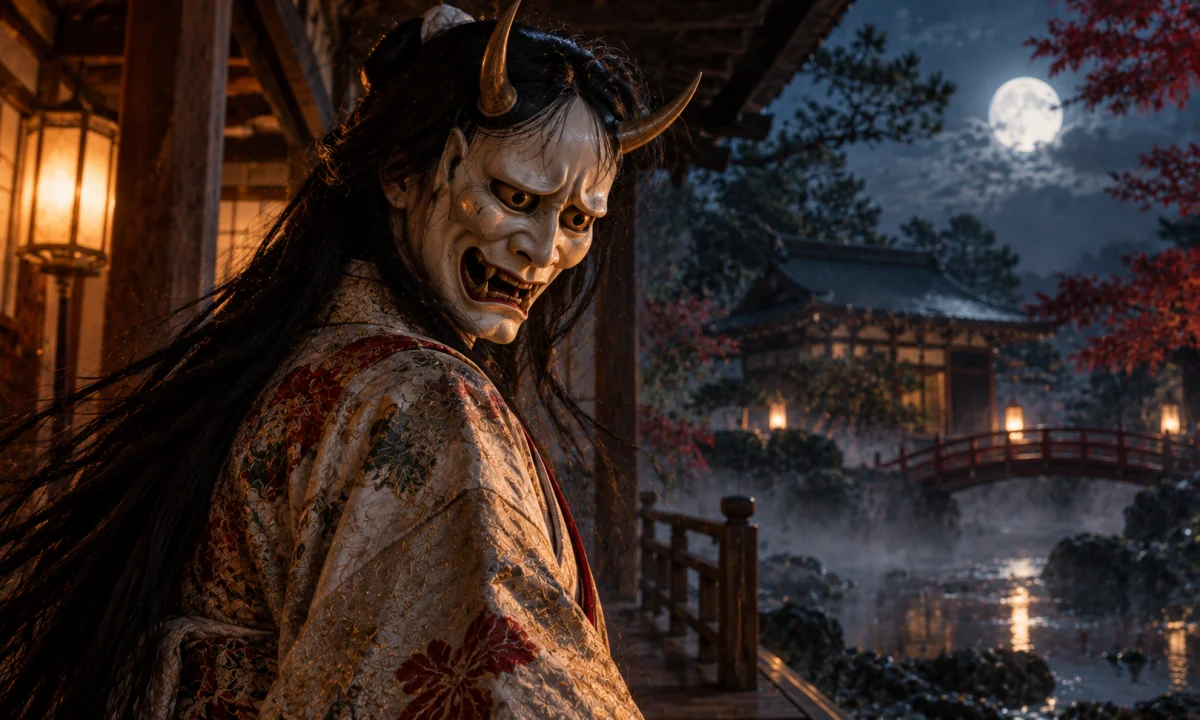
Hannya is one of the most recognizable figures in Japanese theatrical tradition: a female demon with sharp horns, metallic eyes, pointed teeth and an expression that can appear furious, grief-stricken or sorrowful depending on how the mask is held. The image is especially associated with Noh drama, where it represents a woman transformed by intense jealousy, hatred and emotional suffering. Hannya is often described as a creature of Japanese mythology, but it is more precise to call it a theatrical demon figure whose form developed through Japanese religious ideas, folklore and Noh performance.
There is no single ancient myth about a being named Hannya comparable to Amaterasu, Susanoo or the yōkai of a particular folktale. Instead, “hannya” usually refers to a type of Noh mask and to the demonized female characters who wear it. These characters are commonly women whose powerful emotions have changed them into supernatural beings. Their stories often concern betrayal, abandoned love, sexual jealousy, resentment or the destructive consequences of attachment.
Meaning of the name
The Japanese word hannya is also the Japanese reading of the Buddhist term prajñā, commonly translated as “wisdom” or “transcendent wisdom.” The word entered Japanese through Buddhist scripture and related Chinese Buddhist vocabulary. It appears in such expressions as Hannya Shingyō, the Japanese name for the Heart Sūtra.
The relationship between this religious term and the Noh demon is an important but sometimes oversimplified subject. The name of the mask is generally connected with Buddhist vocabulary, and some traditional explanations associate the mask’s frightening appearance with profound or penetrating insight. However, Hannya in Noh is not simply a Buddhist goddess of wisdom, nor is the demon a direct personification of the Heart Sūtra. The mask belongs to a theatrical tradition in which Buddhist ideas, older supernatural beliefs and dramatic representations of human passion overlap.
Some accounts also connect the term with a mask carver or artisan named Hannya-bō, who is said in tradition to have contributed to the mask’s development. The historical details of this attribution are not certain, and it should not be treated as a securely documented origin story. The word’s Buddhist meaning and the mask’s theatrical identity are related in cultural history, but they are not interchangeable.
Origins in Japanese religious and theatrical culture
Japanese ideas about spirits and demons developed through the interaction of indigenous beliefs, Buddhist teachings and Chinese cultural influence. A dead person might become a vengeful spirit, while a living person overwhelmed by hatred or jealousy could be represented as moving toward an inhuman state. Buddhist narratives frequently portray attachment, anger and desire as forces that bind beings to suffering. Japanese theatre gave these ideas visible and emotionally powerful form.
Noh emerged as a major performance tradition during the medieval period, especially in the fourteenth and fifteenth centuries. Its plays combine chanting, instrumental music, dance, stylized movement, poetic language and masks. Rather than presenting supernatural transformation through realistic special effects, Noh often reveals it through changes in costume, dance, voice and mask. A character may first appear as an ordinary woman and later return in demonic form, showing that the emotional truth of the story has become visible.
The Hannya mask is therefore not merely a monster mask. It is a carefully controlled theatrical instrument. Its fixed features are designed to change according to the performer’s angle and movement. When the actor tilts the mask upward, light can catch the metallic eyes and teeth, making the face seem fierce. When the mask is lowered, the brow casts a shadow over the eyes, creating an impression of sorrow and despair. The same face can suggest rage, anguish, humiliation or grief without changing its carved features.
Appearance of the Hannya mask
The traditional Hannya mask usually has two horns rising from the forehead, gold or metallic-looking eyes, sharp teeth and an unnaturally wide mouth. The face is often painted a pale color, while the horns, teeth and eyes create a striking contrast. The long hair surrounding the mask may contribute to its frightening and unstable appearance.
Its expression is deliberately ambiguous. The raised eyebrows and exposed teeth suggest anger, while the downward lines and shadowed eyes can suggest a woman overwhelmed by pain. This duality is central to the mask’s meaning. Hannya is frightening, but the figure is not presented as evil in a simple or emotionless sense. The demon’s violence is usually connected to a recognizable human history of love, rejection, betrayal or resentment.
Different masks and performances may vary in color and detail. Noh tradition includes distinctions among masks associated with different degrees of demonic transformation, social status or emotional intensity, although descriptions are not always uniform across all schools and commentators. White, red and darker Hannya masks may be interpreted differently in particular theatrical contexts. Broad claims that every color has one fixed meaning should therefore be treated cautiously.
The mask is worn by a male performer in traditional Noh, as women’s roles have historically been performed by men. The actor’s body, gestures and controlled dance are essential to the mask’s meaning. The object does not function independently as a portrait of a demon; its expression comes alive through performance.
Hannya as a transformed woman
In the stories associated with Hannya masks, the demon is often understood as a kijo, a term that can mean a demonized or monstrous woman. The word does not describe exactly the same thing as Hannya, however. Kijo is a broader category, while Hannya is particularly associated with the horned Noh-mask form and the emotional transformation it represents.
The woman may be dead, living, or existing in an ambiguous state between human and supernatural. Her transformation is usually not an arbitrary curse. It expresses the consequences of overwhelming passion. Jealousy in these stories is not merely a brief feeling; it becomes a force capable of reshaping identity, turning a person into the very kind of demon feared by others.
This does not mean that traditional Japanese culture treated all jealous women as literal demons. Noh drama is stylized and symbolic, and its supernatural figures often embody moral, psychological and religious tensions at the same time. The demon’s anger can be condemned, pitied and understood simultaneously.
Important Noh stories and roles
Aoi no Ue
Aoi no Ue, or Lady Aoi, is one of the best-known works associated with the Hannya mask. The play draws on the world of The Tale of Genji, the classical Japanese court romance traditionally attributed to Murasaki Shikibu. In the original literary story, Lady Aoi is the wife of Prince Genji, while the older Lady Rokujō is a former lover whose wounded pride and jealousy create a powerful supernatural presence.
In the Noh play, Lady Rokujō’s living spirit appears in connection with Lady Aoi’s illness. She initially presents herself in a more human form, but her suppressed resentment becomes visible as she changes into a fierce female demon. The Hannya mask allows the performance to show both the dignity of the noblewoman and the destructive force of her jealousy.
The play does not reduce Rokujō to a simple villain. Her suffering is linked to abandonment, social isolation and the humiliation of emotions that cannot be openly expressed within the courtly world. Ritual and Buddhist intervention may calm or expel the spirit, but the drama retains the intensity of the pain that produced the apparition.
Dōjōji
Dōjōji tells a story connected with the temple of Dōjōji in Kii Province, now in Wakayama Prefecture. A woman is said to have fallen in love with a travelling Buddhist monk named Anchin. When he rejected or evaded her, her passion turned into fury. She pursued him to the temple, where he hid inside the great temple bell. The woman transformed into a serpent or dragon-like creature, coiled around the bell and killed him within it.
The Noh play focuses on a dancer who arrives at the temple during a ceremony for a newly cast bell. She performs an elaborate dance, gradually revealing the supernatural history concealed beneath her human appearance. In the climactic section, she appears in a demonic form often represented by a Hannya mask and is associated with the serpent transformation.
Dōjōji is one of the most technically demanding pieces in the Noh repertory. Its famous bell, controlled choreography and gradual revelation make the transformation a major theatrical event. The female demon in this story is sometimes loosely called Hannya, but the narrative also specifically presents her as a serpent or dragon-like being. Hannya and the serpent are related through the play’s imagery, not identical as categories.
Kurozuka
Kurozuka, also known as The Black Mound, concerns a mysterious old woman living alone in the wilderness. She offers shelter to travelling priests but warns them not to look into a particular room. When curiosity leads them to disobey, they discover evidence of her horrifying nature. She returns in demonic form and confronts them.
The story is linked with the legend of the demon of Adachigahara, a tale that circulated in several forms. In Noh performance, the old woman’s transformation may be represented through a Hannya mask or another demonic mask, depending on the production and tradition. Her character is not simply the jealous lover found in Aoi no Ue; she belongs to a broader tradition of dangerous female supernatural beings associated with isolation, violence and concealed identity.
Momijigari and other appearances
In Momijigari, or Viewing the Autumn Leaves, a woman encountered during an autumn excursion is revealed to be a demon. The play includes themes of enchantment, altered appearance and danger concealed beneath beauty. A Hannya mask may be used in the demon’s revelation, although mask choice and staging can vary.
These plays demonstrate that Hannya is not one fixed character with one biography. The mask can represent several different women or female demons. Their stories may involve jealousy, seduction, revenge, spiritual danger or monstrous transformation. What unites them is the theatrical language of a woman whose emotional or supernatural identity has crossed the boundary of ordinary humanity.
Symbolism and interpretation
Hannya is frequently interpreted as a representation of jealousy, but jealousy alone does not explain the full image. The figure also expresses grief, frustrated desire, anger at social powerlessness and the fear of losing control over one’s own emotions. The mask’s divided appearance—terrible yet sorrowful—makes it especially effective for showing the coexistence of love and hatred.
From a Buddhist perspective, the stories can be read as dramas of attachment. Desire becomes suffering when it is treated as something that must possess or control another person. Anger then perpetuates the suffering of both the victim and the angry spirit. In some plays, ritual prayer or Buddhist practice offers a means of calming the supernatural presence. Yet the theatre does not always provide a simple moral resolution. The audience is invited to witness the demon’s pain as well as its violence.
Hannya can also be understood through the social conditions represented in the stories. Women in courtly or patriarchal settings may have limited ways to express resentment openly. The supernatural transformation gives form to emotions that polite society suppresses. This does not make the traditional narratives modern feminist works in any straightforward sense, but it helps explain why the figure can evoke both fear and sympathy.
Distinction from related figures
- Oni: An oni is a broad Japanese category of demon or ogre. Oni are commonly shown with horns, fangs and powerful bodies, but not every oni is a Hannya, and Hannya is not simply the female equivalent of all oni.
- Kijo: A kijo is a broader term for a woman who has become demonic or monstrous. Hannya is a specific theatrical form closely associated with Noh masks and female jealousy or anguish.
- Yūrei: A yūrei is a ghost or spirit of the dead, often represented in later visual traditions with white clothing and long black hair. A yūrei may be vengeful, but it is not automatically a Hannya. A spirit can transform into or be portrayed as a demon without the two categories becoming identical.
- Rokujō: Lady Rokujō is a particular literary and theatrical character from the world of The Tale of Genji. She is associated with the Hannya mask in Aoi no Ue, but Hannya is not her personal name.
- Jorōgumo and serpent women: The jorōgumo is a spider-like yōkai that can assume the form of a beautiful woman. Serpent women in legends such as Dōjōji belong to a different set of traditions, even when a Noh performance uses a Hannya mask to represent their transformation.
Later reception and popular culture
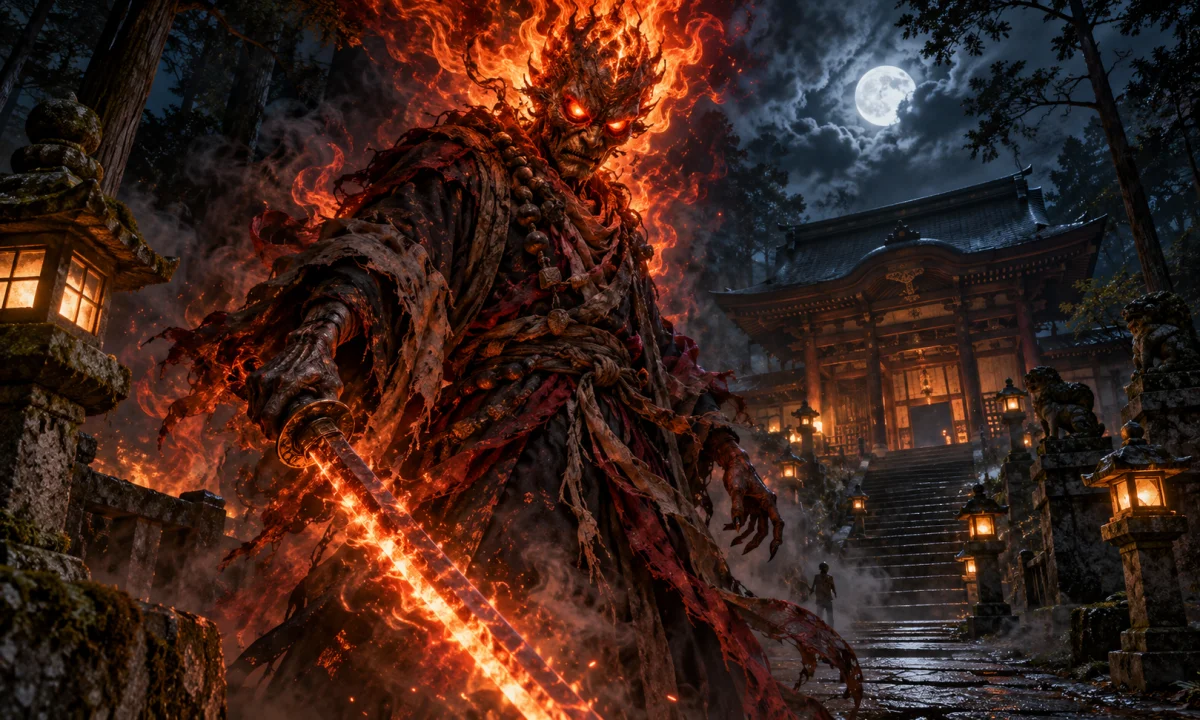
Outside Noh, Hannya has become a widely recognized image in Japanese visual culture. Masks and Hannya faces appear in festival displays, decorative arts, tattoo designs, posters, clothing and commercial imagery. The mask is especially popular in tattooing, where it may represent jealousy, protection from evil, the coexistence of love and anger, or the wearer’s identification with a painful transformation.
Modern novels, manga, anime, films and video games often use Hannya as a shorthand for a dangerous woman, a demon of jealousy or a frightening supernatural warrior. These adaptations may preserve the horns, fangs and metallic eyes while changing the figure’s powers, gender dynamics and narrative role. Such versions belong to modern popular culture rather than to a single continuous ancient legend.
In contemporary Japanese speech, the word may also be used figuratively or humorously for a frightening expression, especially when someone’s face is described as resembling a Hannya mask. This everyday use depends on the familiarity of the theatrical image. The traditional figure remains strongest, however, in Noh, where the mask’s controlled movement preserves its most distinctive meaning: a human face made terrifying by emotion, yet still marked by sorrow.