WORLD
WORLD
Gendenwitha
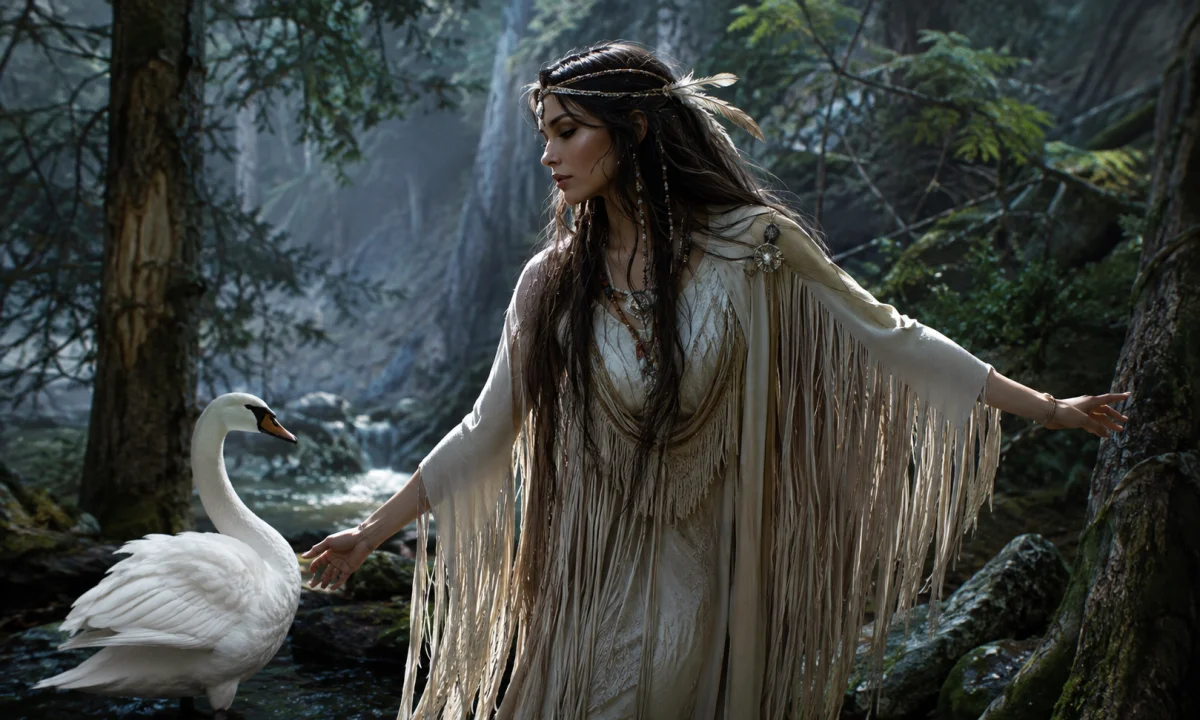
Gendenwitha is a figure associated in some Haudenosaunee, or Iroquois, traditions with the dawn and the Morning Star. Her name appears in several spellings, including Gendewitha and Gendenwitha, and accounts of her identity and story are not completely uniform. In the versions most often circulated in English, she is a woman who becomes, or is transformed into, a celestial being connected with the star seen before sunrise.
Cultural setting
The Haudenosaunee are the Indigenous peoples traditionally united in the Haudenosaunee Confederacy, known in much English-language writing as the Iroquois Confederacy. The Confederacy originally included the Mohawk, Oneida, Onondaga, Cayuga and Seneca nations; the Tuscarora later joined it. “Iroquois mythology” is therefore a broad and sometimes imprecise label. Haudenosaunee nations have distinct languages, histories and storytelling traditions, even though they share important cultural and political connections.
Stories about stars, the sun, the moon and the changing sky belong to a wider religious and ceremonial understanding of the world. Celestial bodies are not merely distant objects in the sky. They can be persons, powers or participants in relationships that explain the order of nature. Such narratives may connect the sky with human conduct, seasonal change, death, renewal and the boundaries between different parts of existence.
Many Haudenosaunee stories were preserved through oral transmission and later recorded by missionaries, ethnographers, collectors and Indigenous storytellers writing in English or in European forms of spelling. A written version is not necessarily a complete or definitive form of the tradition. The same name may be transcribed differently by different recorders, and a story collected from one nation or community should not automatically be treated as a belief shared identically by all Haudenosaunee peoples.
Name and identity
The name Gendenwitha is often translated or explained in English as “she who brings the dawn,” “she who bears the day” or with a similar reference to daylight. These translations should be treated cautiously. Haudenosaunee languages contain grammatical and cultural meanings that cannot always be reproduced precisely in a short English gloss, and the spelling Gendenwitha reflects an English-language transcription rather than a universally fixed original form.
Gendenwitha is generally classified as a female celestial figure, rather than as a goddess in the classical European sense. The word “goddess” is sometimes used for convenience in modern reference works, but it can suggest a system of individual deities that does not accurately describe every Haudenosaunee understanding of spiritual beings. Depending on the account, Gendenwitha may be understood as a woman who enters the sky, a star-person, or a personification of the Morning Star.
Her identity is also sometimes stated more confidently than the surviving evidence allows. Some summaries present her simply as the Morning Star, while others describe a narrative in which a human woman is changed into that star. These may represent different retellings, different stages of interpretation, or attempts by later writers to condense a more complex oral tradition.
Gendenwitha and the Morning Star
The most familiar account places Gendenwitha in a story involving Hahgwehdiyu, one of the powerful twins in Haudenosaunee creation traditions. Hahgwehdiyu is commonly identified in English-language accounts as the beneficent or good twin, in contrast with his dangerous opposing twin. The precise spelling, pronunciation and details of the twins’ characters vary between sources and nations.
In the versions usually associated with Gendenwitha, Hahgwehdiyu desires or pursues her. Gendenwitha resists him and attempts to escape. The pursuit carries the story into the sky, where she becomes the Morning Star or is placed among the stars. In some retellings, her daily appearance before sunrise is treated as part of an ongoing celestial pursuit: she appears in the eastern sky, while the power associated with the sun follows or overtakes her as daylight arrives.
This outline is widespread in modern summaries, but individual details should not be treated as certain features of every traditional version. Some accounts emphasize transformation; others emphasize the relationship between the Morning Star and the sun. The surviving English-language record is not extensive enough to establish one canonical narrative with a fixed sequence of events, and it is difficult to separate traditional variation from the reshaping that can occur when an oral story is translated, shortened or retold for a general audience.
The connection with dawn gives Gendenwitha a natural association with transition. The Morning Star appears at the threshold between night and day, making it a fitting figure for movement between states: darkness and light, earth and sky, human life and celestial existence. The story’s imagery also links desire, pursuit and freedom with the regular movements of the heavens.
Appearance and celestial character
Gendenwitha is usually imagined as a woman or female star, but traditional accounts do not provide a single standard physical description comparable to the illustrated portraits found in modern mythology books. Her most important “appearance” is her presence in the eastern sky before sunrise. The star’s visibility is brief and dependent on the time of year, weather and the position of the sun, which reinforces the themes of approach, escape and changing boundaries.
Modern readers commonly identify the Morning Star with Venus, because Venus is the brightest planet and can appear prominently before sunrise. This identification is astronomically plausible, but it should not automatically be presented as an exact statement of traditional Haudenosaunee astronomy. “Morning Star” can be a cultural and poetic designation as well as a technical reference to a particular planet. Different communities and sources may use celestial terms in ways that do not correspond neatly to modern scientific categories.
The star’s brightness also makes Gendenwitha a figure of emergence. She is associated with the first light that announces the coming day, rather than with the full power of the sun. That distinction matters symbolically: the dawn is a sign of change and expectation, while the completed daylight belongs to another phase of the cosmic order.
Relationship to Hahgwehdiyu
The relationship between Gendenwitha and Hahgwehdiyu is often described as one of pursuit. In many retellings, the story is framed as an episode in the wider conflict or activity of the cosmic twins. Yet the role of Gendenwitha should not be reduced to a passive object of a male character’s desire. The most memorable feature of her story is her movement away from him and her appearance as an independent celestial presence.
Interpretations of the pursuit vary. One reading treats it as an explanation of the relationship between the Morning Star and the sun: the star appears ahead of sunrise and then vanishes as the sun rises. Another sees it as a story about the boundary between human and supernatural worlds, in which a woman’s attempt to escape an unwanted claim results in a permanent place in the heavens. A third approach emphasizes the cyclical structure of the sky rather than a moral lesson about the characters.
These interpretations are scholarly or literary readings, not interchangeable statements of Haudenosaunee doctrine. It is important not to assume that a narrative about a celestial pursuit was intended as a single allegory. Oral traditions can carry several meanings at once, and the significance of a story may depend on the language, community, occasion and storyteller.
Place within Haudenosaunee cosmology
Gendenwitha should be distinguished from the central figures of Haudenosaunee creation traditions. She is not another name for Sky Woman, the ancestral woman whose fall from the upper world is a foundational episode in many Haudenosaunee narratives. Nor is she one of the two cosmic twins themselves. Sky Woman, the twins and Gendenwitha belong to different narrative roles, even when later retellings place their stories within a single broad mythology.
She also should not be confused with every Indigenous tradition concerning a “Morning Star.” Many peoples of North America have stories about the planet Venus or a dawn star, but the presence of a similar celestial image does not prove that the traditions share a common origin. “Morning Star” is a recurring description because the bright object is conspicuous and culturally significant, not because all stories about it describe the same being.
The limited and variable record makes it unwise to assign Gendenwitha a large system of powers or a formal cult that is not documented. She is best understood through the narrative and celestial role associated with her: a female figure linked with dawn, the eastern sky and a movement from the human world into the heavens. Claims that she governs a broad list of natural forces or serves as a universal goddess of love, beauty or fertility generally reflect modern expansion rather than securely established traditional evidence.
Sources, transmission and uncertainty
Knowledge of Gendenwitha comes through the same difficult process that affects much recorded Indigenous mythology. Haudenosaunee stories were traditionally transmitted in community settings, through speech, memory, performance and language. When collectors wrote them down, they selected particular versions and rendered Indigenous names through inconsistent spelling systems. Translation could also alter relationships, tone and religious vocabulary.
For that reason, the name may appear in reference works with different forms, and the story may be attributed broadly to the “Iroquois” without identifying the nation or community from which a version came. Such a label can conceal meaningful differences. A careful account should distinguish a specific recorded version from a general statement about all Haudenosaunee peoples.
There is also a difference between traditional presence and modern visibility. Gendenwitha is less widely known than figures such as Sky Woman, Hiawatha or the twins, and many popular descriptions repeat one another without providing enough information to show whether they derive from an early record, a later retelling or a modern mythology website. Repetition does not by itself establish historical or cultural authority.
Modern representations
In contemporary writing, Gendenwitha is sometimes presented as a star goddess, a moon-associated woman, a symbol of feminine independence or a character in generalized collections of Native American mythology. These descriptions may be creative interpretations, but they should not be confused with documented Haudenosaunee tradition. In particular, assigning her attributes taken from Greek, Roman or modern fantasy mythology can remove the figure from the cultural setting in which her story has meaning.
Modern readers may still find the image of Gendenwitha powerful: a woman who becomes a star at the edge of day, whose brief appearance marks the meeting of night and light. That image can support poetry, fiction and visual art, provided that creative adaptation is clearly distinguished from traditional belief. The most responsible approach is to preserve the uncertainty around the name and the surviving versions while recognizing her significance as a Haudenosaunee-associated figure of the dawn.